Showing 34 results

Archival description
34 results with digital objects Show results with digital objects
LSH/1/1/2/1/113 · Part · 1933-07-18
Part of The Ludlow & Sherriff Collection

SUMMARY:
Travel from Zangthang included cold, wind, and intermittent sun, with a lama accompanying for part of the route to collect seeds of meconopsis, thalictrum, and primulas. Gentians were found near Tulung La, and on the following day a fine white gentian was collected at the summit of Dza La, while Sherriff walked the whole way in improved weather.

CONTENT:
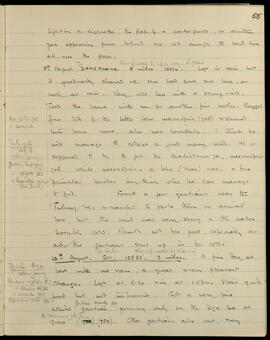
lighting a cigarette, the flap of a waterproof, or another yak appearing from behind are all enough to send him all over the place.

To Sherriff walked the whole way - L. Yakid
9th August. ZANGTHANG. 8 miles. 15,374'. Left in rain, but it gradually cleared up, and we had some sun here, as well as rain. Very cold here with a strong wind.

Took the lama with me for another five miles. Bagged four lots of the little blue meconopsis (708) and showed him some more, also wee horridula. I think he will manage to collect a good many seeds. He is supposed to try to get the thalictrum 710, meconopsis 708, white meconopsis, a blue (shao) mec. + two primulas, besides anything else he can manage to find. Found a few gentians near the Tulung La, and wanted to photo them on arrival here, but the wind was very strong and the water horribly cold. Results not too good, especially as all the gentians shut up in the cold.

10th August. GVI. 15,853'. 9 miles. Sherriff walked the whole way. A fine day at last with no rain, a great and very pleasant change. Left at 6.30 in at 1.0 pm. View quite good but not impressive. Got a very fine white gentian, growing only on the Dza La at the summit of the pass 17,000' (789). Other gentians also out, very
LSH/1/1/1/1/35 · Part · 1933-05-17 - 1933-05-18
Part of The Ludlow & Sherriff Collection

SUMMARY:
Rain in Yatung limited collecting to a few rhododendrons and a viburnum, and ponies were arranged for travel to Gangtok amid staffing issues due to Williamson’s wedding. The next day the journey from Yatung to Tsomgo crossed the Natu La in mist and soft snow, with a small avalanche observed and a pony falling.

CONTENT:
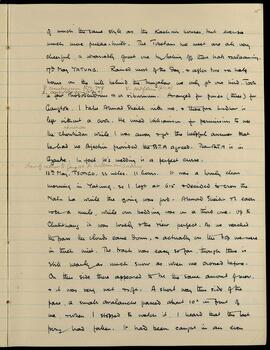
of much the same style as the Kashmir houses, but ever so much more pukka-built. The Tibetans we meet are all very cheerful, & invariably greet one by taking off their hats & salaaming.

17th May YATUNG. Rained most of the day, & after two & a half hours on the hill behind the bungalow we only got one bird. Took R. cinnabarinum (L&S. 748), R. cephalanthum (L&S. 9), a few rhododendrons & a viburnum V. cordifolium (L&S. 10). Arranged for ponies (three) for Gangtok. I take Ahmad Sheikh with me, & therefore Ludlow is left without a cook. He wired Williamson for permission to use the chowkidar while I was away & got the helpful answer that he had no objection provided the B.T.A agreed. The B.T.A is in Gyantse. In fact W's wedding is a perfect curse.

Sherriff returns to Gangtok for Williamson's wedding.

18th May. TSOMGO. 22 miles. 11 hours. It was a lovely clear morning in Yatung, so I left at 6.15 & decided to cross the Natu La while the going was good. Ahmad Sheikh & I each rode a mule, while our bedding was on a third one. Up to Chushithang it was lovely & the view perfect. As we reached the pass the clouds came down, & actually on the top we were in thick mist. The track was easy so far, though there is still nearly as much snow as when we crossed before. On this side there appeared to be the same amount of snow, & it was very wet & soft. A short way this side of the pass, a small avalanche passed about 10 yds in front of me, & when I stopped to watch it, I heard that the last pony had fallen. It had been caught in an even

LSH/1/1/3/3/85 · Part · 1933-04-09
Part of The Ludlow & Sherriff Collection

SUMMARY:
At Trimo, excursions towards the Po La yielded Primula obliqua and several rhododendrons; delays with kit led to a decision to wait until the 12th before moving on. Lumsden shot a serow at close range and later attempted to bag a barking deer, while otherwise little of interest was found.

CONTENT:
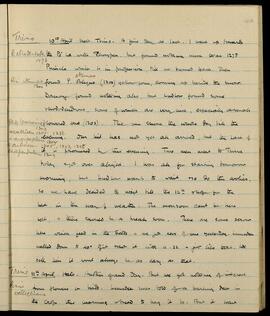
Trimo, 10th April Halt. Trimo. A fine day at last. I went up towards
the Po La with Sherriff, but found nothing more than 1278
[P. atrodentata] Primula which is in profusion, till we turned back. Then
[Prin. strumosa 1300] found P. obliqua (1300) yellow form, coming up beside the snow.

Dansey found nothing also, but Ludlow found some
rhododendrons, some of which are very nice, especially a small
[Rho. tsariense 1303] orange-flowered one (1303). The sun shone the whole day till the
[R. wallichii 1302, 1306; R. argipeplum 1304; R. arboreum 1305, 1307, 1308; R. pendulum 1309] evening. Our kit has not yet all arrived, but the last of
it is promised by this evening. Two men went to Tsoma
today over a ridge. I was all for starting tomorrow
morning, but Ludlow wants to wait, so do the coolies,
so we have decided to wait till the 12th & hope for the
best in the way of weather. The monsoon can't be here
yet, & there should be a break soon. There are some serow
here which feed in the fields, & we got news of one yesterday. Lumsden
walked down to 40 yds of it & shot it with a .22 - just like that. We
tell him it won't always be as easy as that.

Trimo 11th April Halt. Another grand day. But we got nothing of interest
[Prim. wallichiana] from flowers or birds. Lumsden was told of a barking deer in
the crops this morning & tried to bag it too. But it went

LSH/1/1/2/1/22 · Part · 1924-06-23
Part of The Ludlow & Sherriff Collection

SUMMARY:
The party reached Trashigong on 29 June and proceeded east up the Gamri Chu valley to Sakteng, arriving in four stages by July 3rd. Most members, except Sherriff, the interpreter, the cook, and the diarist, fell ill with malaria; after taking quinine for about ten days they recovered enough to continue.

CONTENT:
His. 14. We reached Trashigong on 29 June & found ourselves in a dry part of the Manas Valley very much like that of the Mo Chu at Wangdi Phodrang. From Trashigong we branched off eastwards up the unexplored Gamri Chu valley to Sakteng, which we reached in 4 stages (July 3rd). Here a calamity befell us which appeared at one time as if it would wreck our plans. This was malaria. With the exception of Sherriff, our interpreter, the cook, and myself, the remainder of the party collapsed with malaria. We flew to the quinine bottle, and after about 10 days were sufficiently recovered to continue our journey.

LSH/1/1/3/3/217 · Part · 1996-06-18
Part of The Ludlow & Sherriff Collection

SUMMARY:
Ascent to Takar La in heavy rain followed by a descent into a dry zone with lingering snow and old avalanches made travel difficult for ponies. The writer notes abundant primulas on the east side, observes and releases a Lerwa chick, and records P. bellidifolia, K.W.'s new sikkimensis, and P. tibetica near camp.

CONTENT:
Sherriff
Takar La 28. Potentilla glabra var. rhodocalyx 2231, Gentianella 2233, Androsace zayuanensis 2234, Anemone strigillosa v. canescens 2235, Anemone demissa var. grandiflora 2236, Corydalis 2237, 2238, Pedic. oldenii 2239.
Sherriff

28th June. Camp Zimsakhi 14000' 8 miles. Rained hard all morning as we climbed to the Takar La (16700') at about 11.5. The rain continued to half way down here, then we were in the dry zone, & could see there had been no rain down here. Both sides of the pass have much snow, old avalanches which will stay all year I suppose. There were masses of primulas on the E side, far more than on this side. All kinds of sikkimensis, yellow & white (2211 & 2212), the red one (odontica) 2158 in masses & the little white (vernicosa) 1615. But nothing new could we see. At about 15500 saw four Lerwa with young. Caught one chick & released it. Snow made it difficult for the ponies on the way down, often had a job, unloading, walking over their saddle cloths & then on again. All bare shale slopes both sides near the top. On this side the descent is steep most of the way every step down the last bit to camp. P. bellidifolia is pretty common on the open hillside & among scrub. K.W.'s new sikkimensis is not common. It is a queer flower, the claws folded right back on the tube & calyx - not altogether pretty, but with a most beautiful scent. P. tibetica is still in bloom & growing.

LSH/1/1/3/3/189 · Part · 1936-06-13
Part of The Ludlow & Sherriff Collection

SUMMARY:
Notes skepticism about a report of Kingdon Ward shooting near the gompa and mention that he went up the diarist’s nala likely finding primulas. Records two halts at Sumbatse with weather details, Tsongpen’s excursion with little of interest, searches for blood pheasant, a visit to Yarap with vegetables growing well, and abundant primulas above a small loch, with plant species listed.

CONTENT:
anywhere on the pilgrimage, or they would be ill after too much rain here. When Kingdon Ward was here last year, he said he was not shooting, but did so even close to the gompa. I do not believe this story, as K.W. hardly ever shoots. I was sorry to hear that K.W. went up 'my' nala, so he probably found all these primulas. The red one is a little apt to lose colour on top, and has rather a short season, but he is a beauty for all that.

Sumbatse - Kyimdong Chu Sherriff
14th June. Halt. Fine for most of the day, after a good deal of rain at night. Tsongpen went up the same valley, but kept to the south. He did not find much of interest. I went again to look for the blood pheasant, but saw nor heard any sign of him.
(Androsace graminifolia 1815, brahma-putrae 1816, strigillosa 1814, Iris decora 1817)

Sumbatse Sherriff
15th June. Halt. Rain on and off all day. The official date for the monsoon, and it looks rather like it. Went to Yarap and saw the vegetables coming on well. Then up the valley south of Yarap, but found little till the head, above a little loch, where all the primulas seen the other day were in masses, added to which was
(L. tibetica 1819, Primula trichosanthes 1832, Primula officinalis 1823)

LSH/1/1/3/3/214 · Part · 1996-06-18
Part of The Ludlow & Sherriff Collection

SUMMARY:
At Sinjo Sank near Malo, the diarist notes many Leptopoecile in dwarf juniper and rhododendron around 14,500 ft, suspecting a nearby nest based on behavior. Rhododendron specimens noted include Rhod. tepidulum (1870) and Rhod. cerasinum (1873).

CONTENT:
Sinjo Sank.
Ludlow & Sherriff
near Malo
Rhod. Tepidulum 1870.
Rhod. Cerasinum 1873.

Saw a good many Leptopoecile in dwarf juniper & rhododendron at about 14500'. I think they had a nest, judging by the noise & the way they came right up to me. But there were two ♂♂ & one ♀.

LSH/1/1/3/3/35 · Part · 1937-02-27
Part of The Ludlow & Sherriff Collection

SUMMARY:
A short 2-mile ascent from Rungzyung to Shungphu (approx. 5650 ft) is described, with barometer and temperature readings, route direction, and vegetation noted (Pinus longifolia, oak, and cultivation). The diarist is offered a house by the local owner and his wife, mentions the Dzongpen stays there, and plans to proceed toward the Chöling La (also called Mondé La). Rivers and valleys referenced include the Gamri Chu and Karti Chu.

CONTENT:
Sherriff - Ludlow - Bound for Mera
6000-6500 ft

Shungphu 8th March. Shung phu 2 miles. B.P. 201.9 Temp. 52° = approx 5650'. A very short march. Path leaves Rungzyung & ascends directly up the spur on the East side of the valley coming in to the Gamri Chu at Rungzyung. Direction approx 143° M. The valley to the W. of Rungzyung is called the Karti Chu. Path is steep & direct, and this place is reached in about 1 1/4 hours. The hillside is covered to a considerable extent with Pinus longifolia & a certain amount of oak. But there is also a good deal of cultivation on either side of the ridge. A house has been put at my disposal here, & I hate the idea of living in it. Although comparatively clean looking, I'm sure it will harbour bugs of all kinds - certainly fleas. When I arrived here the owner & his wife, quite a comely woman, came out to meet me. The Dzongpen always stays here if he comes up this way. Water good. Tomorrow's march leads up to what seems to be generally called the Chöling La, which is sometimes known as the Mondé La. These places are not marked on our map. Although each day is perfectly clear of cloud in the

[Left margin notes:]
Gamri Chu
Salix caprea 1

LSH/1/1/4/1/56 · Part · 1933-07-23
Part of The Ludlow & Sherriff Collection

SUMMARY:
The diarist travels over the Cha La to Sanga Chöling and finds Sherriff already there. They note that splitting their collecting efforts during peak flowering was very successful, especially with Primulas, yielding about 50 species between them. The last six weeks were strenuous, and a week’s rest at Sanga Chöling was beneficial.

CONTENT:
July 30. to Sanga Chöling - L. 164.
Over the Cha La - I found Sherriff already there.

L. 165 "The splitting up of forces during the height of the flowering season has been a great success. S. has a number of flowers I did not meet with: & vice versa. S. has done extremely well with Primulas. We prob. have 50 different sp. between us."

L. July 31. Sanga Chöling 165.
"The last 6 weeks have been strenuous"

Aug. 1-5. Sanga Chöling
L. p. 165 "This week's rest has done us all a lot of good"

NB
Sherriff records
remains of last
6 weeks

LSH/1/1/4/1/60 · Part · 1933-07-23
Part of The Ludlow & Sherriff Collection

SUMMARY:
The party left Sanga Chöling, crossed the Traessen La, traversed high dry country to the Tsari valley, visited Tsobermang, and descended the Tsari Chu to Migyitun, unsuccessfully seeking Sclater's Monal. With flowering largely over by late September, they separated for seed collecting, sending two collectors to Pachakshiri, while returning via Kyimpu where Himalayan Crossbills were abundant. Sherriff collected seed on the main range above Lung, and later L. and the narrator went via Tsana and Tawang to Sakden, where Shanth rejoined at Dewangiri.

CONTENT:
Route

L. Iris H. We left Sanga Chöling again on Aug. 6 and ascended the Char Chu to Shing. We then crossed the Traessen La (16,900) and worked eastwards through unexplored country to the head of the Tsari valley. The country traversed on this part of our journey was very elevated, and lay entirely within the dry zone. The birds met with were mainly those of the plateau, and of no particular interest.

We paid another visit to Tsobermang and then descended the Tsari Chu to Migyitun where we made another effort to obtain specimens of Sclater's Monal, but without success.

It was now the end of Sept., and except for Gentians and a few other plants, the flowering season was over, so we decided to separate again for the seed harvest.

Having sent 2 of our collectors to Pachakshiri, we returned to Sanga Chöling to pick up the remainder of our baggage, and descended the Cha Chu to Kyimpu. Kyimpu lies at the foot of the Le La at an altitude of 13,500 ft. Here in the conifer woods I encountered a bird I have sought in vain for many years. This was the Himalayan Crossbill (Loxia curvirostra himalayensis), another rarity according to the textbooks. Here at Kyimpu however it was very common, feeding in large flocks in larch trees. (Nos 348)

From Kyimpu Sherriff returned to the passes on the main range above Lung and spent a month collecting seed.

L. and I. returned to Tsana and from thence to Sakden via Tawang. From Sakden to Dewangiri where Shanth rejoined them on Nov. 24.