Showing 29 results

Archival description
29 results with digital objects Show results with digital objects
LSH/1/1/1/1/97 · Part · 1933-07-21
Part of The Ludlow & Sherriff Collection

SUMMARY:
Notes describe UNGAR on the UNGAR CHU and the route over the bridge to the left bank, passing DRUMA, WANGYI, and KHINAY LHAKANG, with ample water and fuel and Shukhang free of leeches. A tiring day is recounted with mules running off, a late start to allow Ramzana to skin birds, hot sticky weather, and observations of birds, butterflies, and the first Delphinium, with plant records listed (Delphinium carola 298; Polygonatum nervulosum 300; Chirita bifolia 301).

CONTENT:
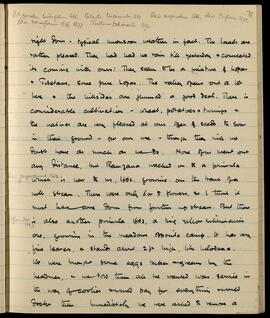
46

(UNJAR)
UNGAR lies on the right bank of this river, close to the bridge, not as marked on the map (78 M Towang 1920). The bridge is crossed here to the left bank of the UNGAR CHU, the route ascends gradually at first, steeper later, passing the villages of DRUMA, WANGYI & KHINAY LHAKANG, passing several side nalas, all of which are easily crossed, without bridges.

Delphinium carola 298
Polygonatum nervulosum 300
Chirita bifolia 301

Water & fuel ample. Shukhang appears to be free of leeches. No conifers on route. // A most tiring day, but otherwise a good one. We had had rather a disturbed night thinking of leeches, & waking up to see whether any were on us. But we had soaked the legs of our beds in salt water, & that kept them pretty well off. The mules ran off in the night, so we had to walk the whole way. 10 miles does not sound much, but this must have been equal to at least 20 on the flat. We left camp late at 8.0 to give Ramzana time to skin some birds, so that I could photograph some flowers. Mist soon came up again later, but as we got down to the low valley, the sun came out, & it was frightfully hot & sticky. Birds were interesting, as were butterflies, & I got our first Delphinium -
LSH/1/1/2/1/117 · Part · 1933-07-18
Part of The Ludlow & Sherriff Collection

SUMMARY:
The diarist halts at Tsona, collects and packs Paraquilegia and catches Parnassius butterflies, while dealing with staff illness and asking the Dzongpen to arrange further collection and forwarding to Sahden amid rainy, snowy weather. Delays occur when yaks fail to arrive under the Tibetan 'Tao' system, with details of payments and origins from the Mago direction. The party then camps west of Gorpa La, noting barometric readings for nearby passes and Dongkar, and a route skirting Tsona hill.

CONTENT:
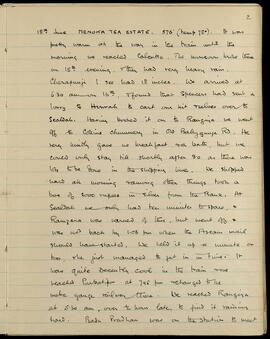
57

13th August - Halt Tsona. B.P. 186.7 Temp. 58°. Spent the morning taking bits of Paraquilegia, & catching parnassius, a number of P. imperator were seen & caught, but of the others only P. epaphus. Packed the Paraquilegia in two boxes, below stones, then charcoal, then earth. Ramzana down with fever. Ahmad Sheikh now better. Always one of them seems to have it. Bagged six lots of Paraquilegia flowers, & asked the Dzongpen to arrange to collect & send on to Sahden. He promises to, but I am a little doubtful. A good deal of rain, & some fresh snow on the hills round about.

[Marginal notes: Cyananthus incanus 794, Meconopsis horridula, Clematis orientalis 797, Butterflies, Paraquilegia]

14th August. Halt at Tsona. Yaks did not turn up, so we had to wait. The system of 'Tao' in Tibet is a curse. Our yaks had to come from 2-3 days journey away in the Mago direction to take us in the opposite direction. We pay them 2 tankas a day per yak, besides which they get 3 tankas per day from the Tsona people.

[Marginal note: Gentiana aglaia 798]

15th August. Camp West of GORPA LA. 14 miles. (B.P. of Gorpa La 181.1" Temp 50°. B.P. of SANG LA. 181.9" Temp 50°. B.P. of Dongkar 188.5 Temp 58°.). If camped at Tsona village, route leaves towards the West, & skirts the Tsona hill, turning to the North, over a

LSH/1/1/2/1/5 · Part · 1934-06-13 - 1934-06-14
Part of The Ludlow & Sherriff Collection

SUMMARY:
The diarist travels by lorry from Srinagar to Kud, notes heat and crowded lodging, and lists team members Ramzana, Ahmad Sheikh, and Gulla. The journey continues to Lahore in extreme heat, with a near fuel shortage, before boarding the Calcutta mail and using ice to keep Lumiere films cool.

CONTENT:
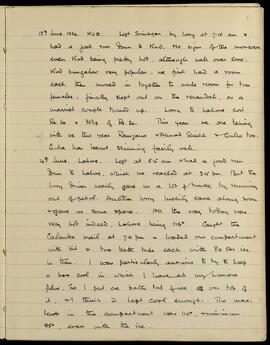
13th June, 1934. KUD. Left Srinagar by lorry at 7.15 am & had a good run down to Kud. No signs of the monsoon even Kud being pretty hot, although well over 5000'. Kud bungalow very popular: we first had a room each, then moved in together to make room for two females: finally slept out on the verandah, as a married couple turned up. Lorry to Lahore cost Rs. 60 + tolls of Rs. 30. This year we are taking with us this year Ramzana & Ahmad Sheikh & Gulla too. Gulla has learnt skinning fairly well.

14th June. Lahore. Left at 5.15 am & had a good run down to Lahore, which we reached at 2.15 pm. But the lorry driver nearly gave us a lot of trouble by running out of petrol. Another lorry luckily came along soon & gave us some spare. All the way today was very hot indeed, Lahore being 116°. Caught the Calcutta mail at 7.0 pm & loaded our compartment with kit & two bath tubs each with 80 lbs ice in them. I was particularly anxious to try to keep a box cool in which I have all my Lumiere films. So I put one bath tub full of ice on top of it, & I think it kept cool enough. The max. temp in the compartment was 110°, minimum 85°, even with the ice.

LSH/1/1/2/1/165 · Part · 1933-08-30
Part of The Ludlow & Sherriff Collection

SUMMARY:
Camped at Tobrang with persistent rain, the party continued collecting, including several 'badal rats', and birding near a marsh on the Pang La route. Notes mention primulas by the marsh, illness of Kurtip, Ramzana and companions remaining well, and a misdirected mail reportedly sent to Sahden after a message from Pinto. Leeches and dense jungle hindered hunting despite a spell of fine weather.

CONTENT:
81

about 100 lbs, a good test on a path like the Me La - Cho La one.

Tobrang
31st August Halt Tobrang. Bad day: rain from morning till night. Very wet work collecting.

1st September Halt Tobrang. Rain mist all day, but we did surprisingly well, getting three or four "badal rats". Saw a star in the evening which promises well for tomorrow!

2nd September Tobrang. Quite a good day. Rode up the Pang La route to a marshy flat, where there were any number of good birds about. Got nothing new, but several wanted birds. There are some primulas growing on the edge of the marsh, but they have no flowers or stalks—probably the common yellow one. Kurtip again down with fever, fairly badly. Ramzana & Co. all quite fit though.

3rd September Tobrang. Fine all day. It almost makes one hope the monsoon may be over. In spite of the good day though, we got a poor bag, losing several, & not managing to get a shot at others through the denseness of the jungle, or because of armies of leeches. A note came by devious ways from Pinto today. Some BF has sent our mail up to Sahden again. It

LSH/1/1/2/1/37 · Part · 1915-05-29
Part of The Ludlow & Sherriff Collection

SUMMARY:
At Sakden on 27 July, many of the Kashmiris were down with fever, with Ramzana particularly ill, which delayed progress but enabled exploration of two high areas. The writer ascended to Nyuksang La on the route to Mera, describing shepherding, buckwheat cultivation, and the route via the Gamri Chu with changing vegetation from broadleaf and fir to rhododendron.

CONTENT:
17

wrestling in Bhutanese style. All the people here are shepherds. They grow their crops on the steep hillside - as far as I can see only buckwheat.

27th July. SAKDEN. All our Kashmiris have been down
Buddleia colvilei 614
Lil. nanum 615
Rhod. campanulatum 616, 619, 622, 624,
Mec. horridula 623
with fever. Ramzana has been bad. This prevented us from getting on, but on the other hand it has helped, as we have been able to explore two small areas at a good height. I have been up to the Nyuksang La (estimated 12500-13000') on the route to Mera. Mera is where most of the yaks & sheep are kept. They return to Sakden in the winter. From Sakden the road leads across the Gamri Chu, up a small saddle & steeply down 800 ft - to the South. A branch of the Gamri Chu is met there & followed up for 1 1/2 miles, then crossed & a steep ascent made S.W. to the Nyuksang La. When this ascent begins, the jungle is mostly broad leaf trees, with some fir & quite a number of larch. Then fir predominates, & after passing a "basti" rhododendron takes the place of fir, till the top is reached when there is

LSH/1/1/2/1/41 · Part · 1933-07-08
Part of The Ludlow & Sherriff Collection

SUMMARY:
Notes on Primula observations, heavy rain, and challenging flower photography with exposure details. On 10th July at Sahden, the diarist went with Danang to the Orka La on the Dirang Dzong road, took compass bearings, and described fine morning conditions.

CONTENT:
19

Primula found on the Me La last year, and seen at Narim Thang at 15,000'. Left at 6:00 am and hurrying, reached the pass at 9:30. Rain came on at 9:00 and it rained on and off all the time. Home again at 3:00 pm in heavy rain which continued all evening. Took 2 photos, 632 (P. stolonifera) and 634 (Ph. elegantula), at 4:00 pm in very heavy rain, clouds low down. Exposures were f/16 and 4 1/2 minutes, a little underexposed: f/11 and 2' 40" slightly under. Colour photography of flowers under such circumstances is no easy job. A large paulin is hung over me while I arrange focus. Then exposure made with an umbrella over the camera, held high. Servants all better, but Ramzana very weak and unable to leave on 10th.

10th July. Sahden. Started at 4:30 am and went up with Danang to the Orka La on the Dirang Dzong road. Reached the pass at 8:30 and stayed there till 10. Walked down very quickly in two hours. I took a bearing from Sahden to the ridge along which the path runs, and found it 88° Mag. Another bearing up the first river on the left bank of the Gamri Chu, gave 115°. A back bearing to Sahden from the Orka La gave approx 290°. Sahden itself was not visible. This was a lovely morning, and it

LSH/1/1/2/1/91 · Part · 1933-07-18
Part of The Ludlow & Sherriff Collection

SUMMARY:
The diarist records compass bearings from Chera La to several snow peaks and notes that two western peaks with glaciers are uncharted. Due to locals stating there is no yak route to Chera and limited manpower, the party decides to split: the diarist with A. Sheikh, Gulla, and Kurtip to Chera, and Ludlow with Pintso, Ramzana, and Danong to Luguthang.

CONTENT:
Chera La as follows: from Chirachun to a snow peak in direction of Tawang 284° Mag. From Chera La up the Dongma Chu to a snow peak at the head of the river 36° Mag. From Chera La to a snow peak west of the Tulung La 332° Mag. The two western of these peaks are not shown on the map at all. Both look over 20,000 ft. and have glaciers on them. In camp here, we find considerable trouble. The locals now say we cannot get by yaks to the mountains to the west at all. This makes things very difficult indeed. We may manage things by dividing camp, I going where they say they can't take yaks, and Ludlow going to Luguthang or some such place. But wherever we go, it is a gamble. We must choose some valley to settle in for a week or two and work thoroughly. If it's good, we win, if it's bad we lose, as the time for flowers will be over.

NB
To split up:—
S to Chera
L to Luguthang

Later. The decision is now made: there is definitely no yak route to Chera — the place I intend going to. As there are only 15 available men, only one of us can go there. So I, with A. Sheikh, Gulla and Kurtip go there; while Ludlow goes to Luguthang with Pintso, Ramzana and Danong. They say that laden yaks will find it difficult to go to Luguthang ("the sheep plain"). Our boxes are so unlike

LSH/1/1/10/1/5 · Part · 1949-09-14
Part of The Ludlow & Sherriff Collection

SUMMARY:
Halted at Pangotang due to persistent rain while Pasang and Mundon went to Kantanang for Primula reticulata seed; H.H. sent a Bhutanese blanket, causing concern about excess baggage. The camp was crowded with Drogpas and Tibetans returning from the Mela via the Monlakarchung La; Danang is unfit and may join later instead of going to Ludlow, and lack of yak prevented a planned trip to Tolegang.

CONTENT:
14th September. Halt at Pangotang. Wet all day. Pasang & Mundon went off for 3 days to Kantanang. The only thing I know I want from there is seed of a primula called reticulata, which was very pretty. But it will likely not be ready yet. We can wait longer though for Kantanang. It is not important, & the other places must take preference. H.H. is making me very embarrassed. He has now sent a very fine Bhutanese blanket. I don't know what to do with it & had told him I did not need any bedding at all. I fear Hicks & I may have to carry a good many unwanted things away with us - unwanted by me anyway. Pangotang is a regular Piccadilly Circus today, with all the Drogpas coming back from the Mela. Tibetans too are camped beside me on their way back over the Monlakarchung La. H.H. said it was a success, they had good weather. He tells me Danang is still not fit, which presumably means that he cannot go to Ludlow now, but will have to join me when he is alright. It will be a sad blow to Ludlow, although I believe Ramzana has seen almost all that Danang saw on their way East.

15th Sept. Halt. No yak turned up today, so I did not go out to Tolegang as intended. Very heavy rain again last night, & a good deal today too. Sat in camp all day practically, & did nothing but write a

LSH/1/1/3/3/161 · Part · 1983-05-05
Part of The Ludlow & Sherriff Collection

SUMMARY:
Monsoon rains begin, pleasing local Lopas and Tibetans, and the party notes cultivation of wheat, potatoes, and turnips while offering seeds for sowing. Ramzana finds a new primula (1662, Primula yargongensis) by a hill stream and another primula (1663, P. florindae) in meadows; headmen bring provisions as the party arranges for paid services and medical help.

CONTENT:
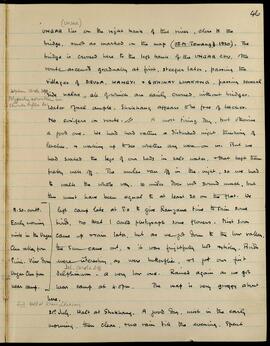
Polygonatum cirrhifolium 1668. Calanthe tricarinata 1669. Rhod. megeratum 1666, Rhod. triflorum 1675.
Rhod. neriiflorum 1676, 1677. Trillium tschonoskii 1670.

right down - typical monsoon weather in fact. The locals are rather pleased. They had had no rain till yesterday and connected its coming with ours. They seem to be a mixture of Lopas and Tibetans, some pure Lopas. The valley opens out a lot here and the hillsides are 'jhummed' a good deal. There is considerable cultivation - wheat, potatoes and turnips and the natives are very pleased at our offer of seeds to sow in their ground - for our use - though they will no doubt have as much as we do. None of us went out any distance, but Ramzana walked on to a primula which is new to us, 1662 (Prim. yargongensis), growing on the bank of a hill stream. There were only 6 or 8 flowers, so I think it must have come down from further up stream. But there is also another primula 1663 (P. florindae), a big yellow sikkimensis one, growing in the meadows opposite camp. It has very fine leaves, and stands about 2 ft high, like helodoxa. We were brought some eggs, butter and greens by the headmen, and we told them all we wanted was service in the way of coolies and would pay for everything and would doctor them. Immediately we were asked to remove a

LSH/1/1/2/1/7 · Part · 1934-06-14
Part of The Ludlow & Sherriff Collection

SUMMARY:
Entry headed 18th June from Menoka Tea Estate notes heavy monsoon rain in Calcutta, arrival there on the 16th, breakfast at Collins’ chummery, intensive shopping including withdrawing silver rupees, and a hurried departure on the Assam Mail. The party changed trains at Parbatipur and reached Rangiya in rain, where Babu Pradhan met them.

CONTENT:
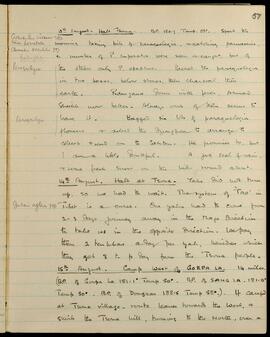
18th June MENOKA TEA ESTATE. 576' (temp 78°). It was pretty warm all the way in the train until the morning we reached Calcutta. The monsoon broke there on 15th evening, and they had very heavy rain. Cherrapunji I see had 18 inches. We arrived at 6.30 am on 16th, and found that Spencers had sent a lorry to Howrah to cart our kit and selves over to Sealdah. Having booked it on to Rangiya we went off to Collins chummery in Old Ballygunge Rd. He very kindly gave us breakfast and a bath, but we could only stay till shortly after 9.0 as there was lots to be done in the shopping line. We shopped hard all morning and among other things took a box of 2000 rupees in silver from the Bank. At Sealdah we only had ten minutes to spare, and Ramzana was warned of this, but went off and was not back by 1.00 pm when the Assam mail should have started. We held it up a minute or two, and he just managed to get in in time. It was quite decently cool in the train and we reached Parbatipur at 7.45 pm and changed to the metre gauge railway there. We reached Rangiya at 5.30 am, over ½ hour late, to find it raining hard. Babu Pradhan was on the station to meet