Mostrando 8 resultados

Descripción archivística
8 resultados con objetos digitales Muestra los resultados con objetos digitales
LSH/1/1/5/1/121 · Part · 1933-06-19 - 1933-06-21
Parte de The Ludlow & Sherriff Collection

SUMMARY:
Diary entries from Dungshinggang record rest days with fine mornings and heavy afternoon hail and rain, photo developing difficulties, and limited plant finds including Primula species. A message arrives from Phobshikha that Purbo had been ill for a day but is now much better.

CONTENT:
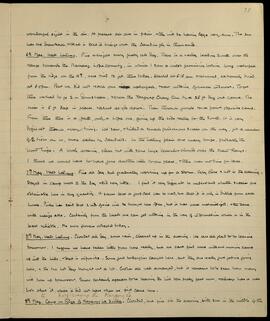
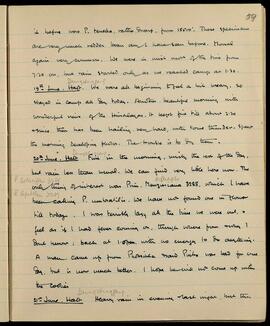
it before was P. tenella, rather dwarf, from 15,500'. These specimens are very much redder than any I have seen before. Monal again very common. We were in mist most of the time from 7.30 on, but rain started only as we reached camp at 1.30.

[Dungshinggang]
19th June. Halt. We were all beginning to feel a bit weary, so stayed in camp all day today. Another beautiful morning with wonderful views of the Himalayas. It kept fine till about 2.30 & since then has been hailing very hard, with some thunder. Spent the morning developing photos. The trouble is to dry them.

[Dungshinggang]
20th June. Halt. Fine in the morning, misty the rest of the day, but rain less than usual. We can find very little here now. The [P. bellidifolia 3288] only thing of interest was Prim. Menziesiana 3288, which I have [P. capitata 3289] been calling P. umbratilis. We have not found one in flower till today. I was terribly lazy all the time we were out, & feel as if I had fever coming on, though where from anyway I don't know: back at 1.0 pm. with no energy to do anything. A man came up from Phobshikha said Purbo was bad for one day, but is now much better. I hope he will not come up with the coolies.

[Dungshinggang]
21st June. Halt. Heavy rain in evening & last night, but this
LSH/1/1/5/1/141 · Part · 1933-06-06 - 1933-07-04
Parte de The Ludlow & Sherriff Collection

SUMMARY:
Notes a plan for Tsongpen Tenduk to visit the Pelada camp to collect items including primula seed, mentions a north-trending valley with seasonal yak herders’ huts, and describes rainy halts at Marulhang on the Rinchen Chu with exploratory walks over passes. Observations include Primula alpicola (luna), Meconopsis bella, and other alpine species, though little new was found.

CONTENT:
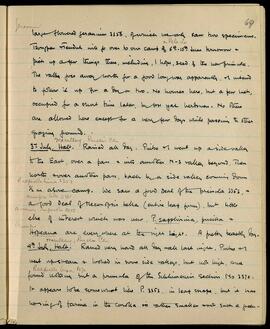
Geranium
large flowered geranium 3356, of which we only saw two specimens.
Tsongpen Tenduk will go over to our camp on Pelada of 6th-10th June tomorrow & pick up a few things there, including, I hope, seed of the new primula.
The valley goes away north for a good long way apparently, & I intend to follow it up for a day or two. No houses here, but a few huts, occupied for a short time later, by the yak herdsmen. No others are allowed here except for a very few days while passing to other grazing ground.

3rd July. Halt. Marulhang, Rinchen Chu. Rained all day. Purbo & I went up a side valley to the East, over a pass & into another N-S valley beyond. Then north & over another pass, back by a side valley coming down 1/2 m above camp. We saw a good deal of the primula 3353 (P. alpicola luna), & a good deal of Meconopsis bella 3361 (entire leaf form), but little else of interest which was new. Anemone rupicola 3358, P. sapphirina, pusilla & Hopeana are everywhere at the right height. A pretty beastly day.

4th July. Halt. Marulhang, Rinchen Chu. Rained very hard all day & all last night. Purbo & I went upstream & worked in some side valleys, but not high, and found nothing but a primula of the Sikkimensis section No 3370 (P. alpicola luna). It appears to be somewhat like P. 3353, in leaf shape, but it has nothing of farina; the corolla is rather smaller and not such a green-

LSH/1/1/6/1/51 · Part · 1933-05-05
Parte de The Ludlow & Sherriff Collection

SUMMARY:
Entries describe halts at Lalung with an attempted approach to a long waterfall via a crossing of the Yargyap Chu, noting flies, a small poisonous snake, ticks, and wood snipe. The writer discusses unreliable local supplies, some butterfly collecting, and preparations with coolies before moving camp toward the Kargong La.

CONTENT:
wonderful sight in the air. At present all are in pairs, often will be having eggs very soon. The sun has one drawback, that is that it brings out the damdim fly in thousands.

6th May. Halt Lalung. Fine alright very pretty all day. There is a valley leading South over the range towards the Marrang Lopa country, in which I saw a most promising looking long waterfall from the ridge on the 4th, we tried to get there today. Started at 5.15 am and returned, extremely tired at 6.0 pm. But we did not reach our waterfall, saw nothing of much interest. To get there we had to go 2 m downstream, across the Yargyap Chu in a 25 ft dug out canoe. The river is 5 ft deep in places, and about 40 yds across. Then through jungle to a point opposite camp. From there there is a path, only a Lopa one, going up the side valley to the South. It is very difficult though, and very tiring. We saw, and killed a small poisonous snake on the way, got a number of ticks on us, and were eaten by damdims. In the Lalung plain are many snipe, probably the Wood Snipe. A lovely evening, clear but with some huge cumulus clouds over the Main Range. I think we would have to have gone another mile to our place, and there was no time for that.

7th May. Halt Lalung. Fine all day, but gradually working up for a storm. Very close and hot in the evening. Stayed in camp most of the day and did very little. I find it very difficult to understand whether supplies are obtainable here in any quantity. It seems that a good deal can be had, but that it is only in driblets from each house. Purbo has said that 2 mds of rice will be brought here often, but it has never materialized: the same with maize atta. Certainly from the locals one can get nothing in the way of information which is in the least reliable. No more flowers collected today.

8th May. Halt Lalung. Clouded all day, some rain, cleared up in the evening. We are all glad to be leaving tomorrow. I suppose we have taken little from here really, but we can't find more without moving camp up into the hills, and that is impossible. Some good butterflies caught here, but they are really just getting going now, and the two hot days brought out a lot. Coolies all well arranged, but it remains to be seen how many will turn up tomorrow. Snow certainly appears to be leaving the hill tops pretty fast now, and always has a wet look above it, which it did not have when we first came here.

9th May. Camp on Ridge to half way up the Kargong La 3 miles. Clouded, but fine till the evening, with sun in the middle of the

LSH/1/1/6/1/133 · Part · 1933-09-07
Parte de The Ludlow & Sherriff Collection

SUMMARY:
Arrangements are made for a message from Tsela Dzong to reach Pana, and Kusho rejoins to assist with the Lamdo to Sanga Choling leg. Between 18–20 Sept., the party travels from Tse to Lamdo and on to Kongshong in heavy rain, checks stores, crosses the Tsangpo with loads, and collects limited seeds; Purbo reports on routes and local groups near Molo, Dzeus, Tanjong, Lo ba, and Tsari Soma. A hard ascent via Go nyi re with a Lopa guide leads to cold, windy conditions that hinder seed collecting.

CONTENT:
Tsela Dzong by Dzong-Dzong runner. So I think it should be here in 5 days or so, that with any luck I will get it at Pana. I am asking the Dzongpen to send it on there at once. I am glad to have Kusho back again to help with what will be a pretty hectic trip from Lamdo to Sanga Choling.

18th Sept. To TSE. Rain at night and nearly all today. The monsoon seems to be very busy still. In Tse all the things we left appear to be in good condition and have not suffered, as the bacon did. Nearly a whole side of it was eaten, and half a cheese too, by some kind of bug, while Ludlow and Taylor were away during June and July. We crossed the Tsangpo in six kowas, with all kit, about 24 loads the three of us.

19th Sept. To Lamdo. Rain most of yesterday, and very heavy rain all night. Collected a few seeds of Phlomis 5798 and a very few of Plectranthus. I find I can get more or less direct from here to Go nyi re, without going up to Kongshong first. That will make things much easier, though tomorrow will be a hard day's trek. I hope we have a reasonably fine day to do it in. Purbo came in this afternoon. He reached Molo from Dzeus in three days, which is extraordinary good going, but got some fever on the way back and was held up. He stays the night with us, which I hope will give some more hints to Kusho and Dzongpen about how to manage the Molo and Tanjong people. He does not anticipate any trouble with the Molo people going to the Lo ba, but it seems the Lopas have given a lot of trouble somewhere near Tsari Soma and have carried off 5 men. However I don't think they would dare do anything to a body of 12 or 15 coolies that I would have with me, especially as they would know I had a gun.

20th Sept. To Kongshong. Rain all night and all this morning, finer in afternoon. Coolies rather late, and did not get off till 6.15, with the same Lopa who lost me last time, as guide. To save a day I decided to go up direct from Lamdo to Go nyi re, and then drop down to Kongshong. It is an awful pull up, very steep for about 5000 ft, then along a rocky knife edge ridge, up and down and very tiring. The wind at the top was very cold and almost a gale, driving mist and fine rain. It was really too cold for seed collecting and I had no feeling in my fingers at all. We did not really do well either, but got lots of Meconopsis integrifolia, a good deal of Mec. florindae, which is not yet

LSH/1/1/2/1/235 · Part · 1969-04-29
Parte de The Ludlow & Sherriff Collection

SUMMARY:
Clear views were obtained toward the Dongkar range and passes including Gorpo La, Pun Sum La, and Warha La, with a local belief noted about the 'Thief' near Orka La at Sakden. Danang returned from Bum La beyond Tawang with seed collections, though some desired plants were missing or eaten, and further collecting and short stays are planned.

CONTENT:
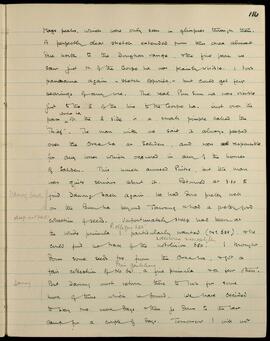
Mago peaks, which were only seen in glimpses through them.
A perfectly clear stretch extended from this area almost
due north to the Dongkar range, and the fine peak we
saw just N. of the Gorpo La was plainly visible. I took
panorama again - sketch opposite - but could get few
bearings of any use. The real Pun Sum La was visible
just to the E of the line to the Gorpo La. Just over the
pass (Warha La) on the E side is a small pimple called the
"Thief". The man with us said it always peeped
over the Orka La at Sakden, and was responsible
for any losses which occurred in any of the houses
of Sakden. This much amused Purbo, but the man
was quite serious about it. Returned at 3.30 to

find Danang back again. He had done pretty well
on the Bum La beyond Tawang and had a pretty good
collection of seeds. Unfortunately sheep had been at
the white primula I particularly wanted (No: 655, P. obliqua), and he
could find no trace of the Notholirion macrophyllum (650). I brought
down some seeds too from the Orka La, and got a
fair collection of No 641 (Prim. gambeliana), a fine primula and a few others.

But Danang must return there to look for some
more of these which he found. We have decided
to stay two more days and then go down to the last
camp for a couple of days. Tomorrow I will not

LSH/1/1/3/3/121 · Part · 1933-04-09
Parte de The Ludlow & Sherriff Collection

SUMMARY:
The party halted while Purbo and Danong were sent to explore beyond the previous day’s route; Lopa traders carrying madder en route to Tirim visited the camp, were photographed, and their attire was described. Weather held until evening rain, and a decision was made to return to Charme rather than go up the Char River. The following day they marched to Natrampa but saw nothing of note.

CONTENT:
30th April. Halt. I did not go out today, but sent Purbo and Danong up beyond where I reached yesterday. In the morning some Lopas arrived here with loads of madder, going up to Tirim. They were at first frightened, but soon became quite happy, and eventually allowed us to photograph them. They are Abors of some kind. Some had most wonderful headdresses on, made of fibre stained black, and falling down over the back. Others had the little neatly woven bamboo hat with a small spout at the back. It is used either as a hat or as a drinking cup - very neat. Others wore very little indeed. Some were much bigger and stronger looking than others. The smaller ones cannot have been more than four feet high.

The route I was on yesterday leads to the Chupung La. Danong returned in the evening, but with no flowers at all - a great disappointment. I was sure something good would come from up there, but he could see nothing, except a primula or two which was just coming up. Today was fine again till the evening, when it rained a little, but nothing to worry about. Decided to return to Charme, not go up the Char River to Charme.

1st May. Natrampa. 7 m. Overcast, but no rain. Saw nothing.

LSH/1/1/2/1/125 · Part · 1933-07-18
Parte de The Ludlow & Sherriff Collection

SUMMARY:
After descending about 1000 ft and collecting butterflies, the party reached Dongkar where a load fell off a bridge; Purbo later recovered the tent two miles downstream after nearly drowning. They enjoyed fine views and a garden-like camp, noted abundant Delphinium grandiflora and borage, observed Ramzana’s meagre condition after fever at Tsuna, and outlined transport changes from Bhutan via Mago toward the Cho La and Shingbe.

CONTENT:
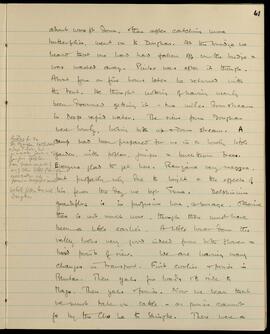
about 1000 ft down, then after catching more butterflies, went on to Dongkar. At the bridge we heard that one load had fallen off on the bridge and was washed away. Purbo was after it though. About four or five hours later he returned with the tent. He thought nothing of having nearly been drowned getting it - two miles downstream in deep rapid water. The views from Dongkar were lovely, looking both up and down stream. A camp had been prepared for us in a lovely little "garden", with poplar, juniper and buckthorn trees. Everyone glad to get here. Ramzana very meagre, but probably only due to height and the effects of his fever the day we left Tsuna. Delphinium grandiflora is in profusion here, and borage. Otherwise there is not much now, though there must have been a little earlier. A little lower down the valley looks very good indeed from both flower and bird points of view. We are having many changes in transport. First coolies and ponies in Bhutan. Then yaks for loads and to ride to Mago. Then yaks and ponies. Now we hear that we must take on cattle - as ponies cannot go by the Cho La to Shingbe. There were a

[Marginal notes:]
Ludlow p. 92
D. grandiflorum has produced a large and blue flower in a water garden in a garden from Bhutan.
From grass carpets with blue Delphinium flowers, wild aster etc. form a delightful sward.
We both fell in love with Dongkar.

LSH/1/1/2/1/219 · Part · 1934-10-14
Parte de The Ludlow & Sherriff Collection

SUMMARY:
The author reports that missing mail appears irretrievable after a visit from the cheerful Dzongpon, and notes differing beliefs among companions about a mantra causing a Tibetan companion’s illness. On 15 October they travel to Rungzyung in persistent rain, carrying the ailing Tibetan by stretcher, while also listing several collected plants.

CONTENT:
lost mail is not to be found. I'm afraid it must be regarded as a complete loss, not to be traced anywhere. The Dzongpon was very cheerful and kind, though he took up a lot of our time, when we wanted to read our mail soon. But he's a good soul. The poor Tibetan is in a bad way again. He has quite recovered from the original abscess in the shoulder, but now has an even worse one near the artery in the thigh. We will carry him by stretcher with us and hope the thing will come to a head soon. Poor man he has had a rotten time. He says, as usual, that someone has put a mantra on him and is rather fatalistic. Purbo & Co rather favour that idea. They all believe in it, even Pinto, educated though he is.

Trashigang
Strobilanthes glutinosus 1061
Leptodermis 1062
" steppiana 1063
Oxyspora paniculata 1064
Daphne Shillong 1065

15th October. To RUNGZYUNG. 8 m. 4050'. Rained all day. The foul weather has again come just as we start up to a collecting area, as usual. Carried the Tibetan on a stretcher, much to the locals' astonishment. His new abscess will I think come to a head tomorrow evening. It's pretty bad now. The air is simply soaking wet here - all day, in or out