Showing 4 results

Archival description
4 results with digital objects Show results with digital objects
LSH/1/1/6/1/160 · Part · 1936-11-07
Part of The Ludlow & Sherriff Collection

SUMMARY:
The diarist describes violent winds near Tre that wrecked tents, forcing a camp beside a house, and a difficult march with wildlife sightings before nearing Tsona. On 9 November they reached Tsona amid snow, found Pinbo ill with malaria, settled arrangements for ponies, paid off Kusho and Kesang, and noted correspondence from Ludlow at Shakti.

CONTENT:
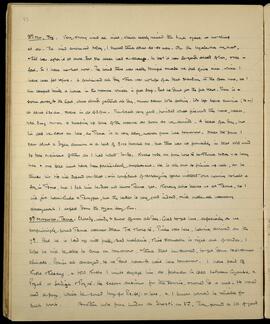
8th Nov, Tre. Very strong wind all night, which nearly ruined the tents and gave us no sleep at all. The wind continued today, I should think about 40-50 mph. On the Nyalaha Malwat, Jill was after it at once. But she never had a chance. In 100s it was 50 yards ahead of her, 1000 in fact. So I have no hat now. The wind there was really terrific and made me feel quite sick, which I have never felt before. It continued all day and there was no hope of a tent standing in the open here, so I am camped beside a house in the manure which is feet deep. But we drive for the full blast. There is a storm away to the East, where clouds gathered all day; snow seems to be falling. We left before sunrise (to us) at about 6:30 am, were in at 4:30 pm. The locals very good, provided what firewood they have, water, yak dung and soon were sweeping up some of the manure as soon as we arrived. A beast of a day, but I'm glad we came on here, as Tsona is a very easy march from here tomorrow. Near the pass I saw about a dozen ammon and a herd of 8-10 burhel too, but there was no possibility in that cold wind to take a cinema of them as I had hoped to do. Kusho rode on from here to Tsona today - a long trek and one that must have been particularly unpleasant. He is all out to finish up well, as he thinks his tip will depend on that: is confident of arranging yaks without our having to halt a day in Tsona, but I tell him he does not know Tsona yet. Kesang also leaves us at Tsona, so I will just have Lhakpa and Tsongpen, but the latter is very good indeed, will make all necessary arrangements I expect down the Nyam Jang Chu.

9th November. Tsona. Cloudy, windy and snow off and on all day. Glad to get here, especially as we surprisingly found Tsona warmer than Tre or Shoto. Pinbo was here, having arrived on the 7th. But he is laid up with pretty bad malaria; his stomach is right out of order. I hope he will be able to come on tomorrow; I think that he should, to get down to a warmer climate. Ponies all arranged, so we don't have to wait here tomorrow. I have paid off Kusho and Kesang, and told Kusho I might engage him as postman in 1940 between Gyantse and Poyal or Sadiya and Poyal. He seems anxious for the service, and would do it well. He would need a pony, which he could buy for Rs. 40/- or less, and I know would be reliable for such work. Another note from Ludlow at Shakti on 3rd. They found a lot of food.
LSH/1/1/5/1/95 · Part · 1928-05-31 - 1928-06-02
Part of The Ludlow & Sherriff Collection

SUMMARY:
Entries describe travel from Phobsikha toward Lao La with mostly fine weather, strong valley winds, and plant collecting, including Primula boothii in seed and other alpine flora. Plans are made to head toward wet Ridang, and route notes describe the path toward Gangte Gompa across a swampy valley with measurements taken at Lao La.

CONTENT:
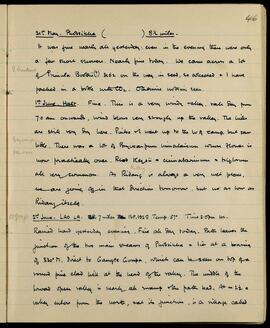
31st May. Phobsikha ( ) 8½ miles.

It was fine nearly all yesterday; even in the evening there were only a few short showers. Nearly fine today. We came across a lot of Primula Boothii(?) 3162 on the way, in seed, so collected & I have packed in a bottle with CO2. Otherwise nothing seen.

1st June. Halt. Fine. This is a very windy valley, all day from 7.0 am onwards, wind blows very strongly up the valley. The hills are still very dry here. Pinbo & I went up to the W of camp, but saw little. There was a lot of Bryocarpum himalaicum whose flower is now practically over. Rhod Keysii & cinnabarinum & triflorum all very common. As Ridang is always a very wet place, we are going off in that direction tomorrow, but not as low as Ridang itself.

2nd June. LAO LA. 7 miles BP. 1928 Temp. 57° Time 2.0 pm Ht.

Rained hard yesterday evening. Fine all day today. Path leaves the junction of the two main streams of Phobsikha & lies at a bearing of 330° M. direct to Gangte Gompa, which can be seen on top of a round pine clad hill at the head of the valley. The middle of the broad open valley is nearly all swamp & the path bad. At m 2½ a valley enters from the north, & at its junction, is a village called

LSH/1/1/6/1/137 · Part · 1938-09-24 - 1938-09-28
Part of The Ludlow & Sherriff Collection

SUMMARY:
Travel from Paka toward Lilung over several days in rainy weather, with washed-out bridges requiring boat crossings. The diarist meets Ludlow and Taylor at Tse, notes delays to the mail, and reports grim European news of war. Local interactions include the Tsongpen, Pinbo bearing news, a long dinner with a Paka man, and arrangements via a lady at Miling for money to be taken to Sanga Choling.

CONTENT:
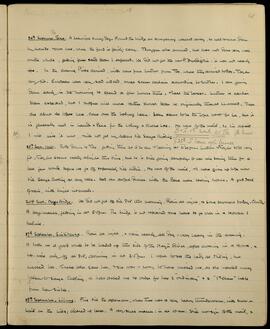
24th September Paka. A beautiful sunny day. Found the bridge at Kongshing washed away, so had to come down by hamdo from here, where the ford is fairly easy. Tsongpen also arrived, but has not done very well on the whole, getting fewer seeds than I expected. We did not get the new P. dryadifolia: it was not nearly ripe. In the evening Pinbo arrived, with news from Ludlow from Tse, where they arrived today. Taylor very fit. European news very bad indeed, war seems certain according to Ludlow. I am going down early in the morning to spend a few hours there, and hear the latest. Ludlow is earlier than expected, but I suppose will move rather slower than he originally thought he would. There are about 40 lopas here, come over the Lokung leka. Leka seems to be the lopa word for la, but is generally used in hamdo and Paka for the Lokung and Kucha las. No news of the mail, so I'm afraid I will miss it now, and will not get my letters till Sanga Choling.
S.T.H. and T while at Tse for lunch.
25th. S. leaves after lunch.

25th Sept. Halt. Rode down to Tse, getting there at 6:30 am and leaving at 2:30 pm. Ludlow and Taylor both very fit: Taylor seems really alright this time, but he is still going carefully. It was nice seeing them for a last few words before we go off separately till India. No news of the mail, and have given up hope now till Sanga Choling at any rate. Had an awful dinner with the Paka man lasting hours. A good deal of rain, with bright intervals.

26th Sept. Nagu Bridge. We did not get off till 8:15 this morning. Rain at night, and some showers today. Cloudy. A long march, getting in at 5:00 pm. The bridge is not repaired and we have to go over in a kowa I believe.

27th September. Sunbitenka. Rain at night, and rain nearly all day - very heavy in the evening. It took us a good while to be loaded up this side of the Nyü River, after crossing in a kowa, and we were only off at 8:15, arriving in at 3:00 pm. I went to see the lady at Miling, but missed her. Kucha later saw her, as she was very sorry to have missed me, as she wanted money taken to Sanga Choling, and has asked me to order for her 2 "ordinary" and 2 "1st class" hats from her sister.

28th September - Lilung. Fine till the afternoon, when there was a very heavy thunderstorm, with snow or hail on the hills; cleared up later. A very short march: in at 10:00 am. Still no sign of the mail, and

LSH/1/1/2/1/221 · Part · 1934-10-14
Part of The Ludlow & Sherriff Collection

SUMMARY:
The diarist reports a night disturbed by insects, rainy weather clearing after an east wind, and ongoing concern for a Tibetan companion with an abscess. They note mixed attitudes from locals, observations on extensive rice cultivation compared to Rungzyung and the Trashiyangsi valley, and remarks on rhododendron flowering and regional snow/frost levels. They remain in the same camp as before.

CONTENT:
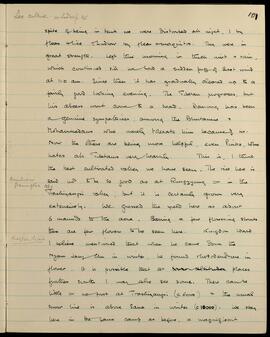
In spite of being in tents we were disturbed all night, I by fleas and lice, Sherriff by fleas and mosquitoes. They were in great strength. Left this morning in thick mist and rain, which continued till we had a sudden puff of East wind at 11:00 am. Since then it has gradually cleared up to a fairly good looking evening. The Tibetan progresses, but his abscess won't come to a head. Dorong has been a genuine sympathiser, among the Bhutanese and Mohammedans who merely tolerate him because of us. Now the others are being more helpful, even Pinbo, who hates all Tibetans very heartily. This is, I think, the best cultivated valley we have seen. The rice here is said not to be so good as at Rungzyung or in the Trashiyangsi valley, but it is certainly grown very extensively. We guessed the yield here as about 6 maunds to the acre. Barring a few flowering shrubs there are few flowers to be seen here. Kingdon Ward, I believe, mentioned that when he came down the Nyam Jang Chu in winter, he found rhododendrons in flower. It is possible that at lower altitude places further south I may also see some. There is little or no frost at Trashiyangsi (c. 6,000') and the usual snow line is above Sana in winter (c. 10,000'). We stay here in the same camp as before, a magnificent