Mostrando 13 resultados

Descripción archivística
13 resultados con objetos digitales Muestra los resultados con objetos digitales
LSH/1/1/5/1/23 · Part · 1935-11-27
Parte de The Ludlow & Sherriff Collection

SUMMARY:
At Nabzi (4600 ft) on April 30th, after fine weather turning to rain by noon, Pimbo fetched the local Kazi, who agreed to arrange a trip to a pass towards the Black Mountain. A brief search along the Trongsa path yielded few plants, while notes describe how the Jirgang Chu joins the Mangde Chu near Byiti Sam and outline routes via Nabzi Kortha and the Trashi La.

CONTENT:
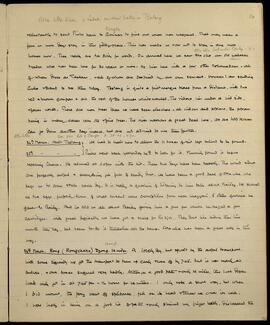
Jirgang Chu Valley R. Arboreum 2800. 11

April 30th Nabzi 4600ft. Fine all yesterday and last night, but rain by 12 noon today. The local Kazi did not come up yesterday, so Pimbo went down for him today and brought him back.

I went out along the Trongsa path, but although the country looks wonderful - or would be 1500' higher - we found little but some ferns. A man said there were primulas along the bunds of the fields, but not yet out - red, yellow and white. But we can see no sign. When I asked the colour of some irises at the same place, he said they were red, white, yellow and blue, all from the same plant, so I can't put much weight in what he says.

The Kazi has just been down, and he says he will arrange for us to go up to a pass, towards the Black Mountain. Beyond that he knows nothing of the country. This is good, and I hope we will get into some good country.

The Jirgang Chu flows to the Mangde Chu, joining it about 3 miles above BYITI SAM (Bitana Sang). Shamgong Dzong is about 3 miles above BYITI SAM. The road to Byiti Sam goes via Nabzi Kortha over the Trashi La, 3 m beyond and then down a valley to the Mangde Chu. The Trongsa road goes along
LSH/1/1/5/1/101 · Part · 1928-06-02
Parte de The Ludlow & Sherriff Collection

SUMMARY:
The diarist travels down from the Lao La to Ritang and on to Trashidinka in the Tang Chu valley, noting dense forest, steep side valleys, masses of Lilium giganteum, rain, leeches, and a painful leg. At Ritang there is a mail mix-up involving a box of tankhas exchanged by the Maharaja, and later the party camps on the Pele La Range east of the Tang Chu; the Tang Chu area is noted as rich in Primulas.

CONTENT:
NB. Tang Chu area rich in Primulas (nos 5-10).

5th June. Camp in Tang Chu valley at Trashidinka, 9 miles. Ht. approx 9000'. (Trashidinka).

Fine till 3.0pm, then rain. Path drops pretty steeply on north side of the Lao La, and continues through dense forest. At m 3 it reaches the main E to W route 1/2 m to the E of Ritang. This is followed down to Ritang at m 3 1/2. Thence path keeps up the L bank of the Tang Chu, winding about a good deal and climbing up and down. Two side valleys are crossed, the second a very steep sided one, and the path keeps gradually up to the village of Trashidinka. Just opposite this, a big valley enters the R. bank of the Tang Chu. // We had a long wait at Ritang, and while there a mail arrived, having taken 18 days I believe. There we heard another mail had gone on "for the Gangtok sahibs". Pimbo thought it was not right, so called the man back, and it turned out to be a box with tankhas which the Maharaja had exchanged for my rupees. It was addressed clearly enough to the "flower collecting sahib wherever he may be", but no one could read the writing. Beyond Ritang we saw masses of Lilium giganteum. Rain came on here, so did leeches, flies and dimdams. It's a pretty foul place, but ahead looks excellent. My left leg has been very painful for three days now, but I don't know any reason for it, so can do nothing. Very glad to get news of Ludlow again.

6th June. Camp on Pele La Range E of Tang Chu. B.P. 190.5 T. 54°. 5.0pm. (up to 15,000 ft)

LSH/1/1/5/1/115 · Part · 1933-06-14 - 1933-06-16
Parte de The Ludlow & Sherriff Collection

SUMMARY:
Heavy rain flooded the camp at Phobsikha, mail was sent via Adao and Chirang, and plans were made to proceed to Dungshinggang. Pimbo fell ill and was left behind with quinine and aspirin to rejoin later. On 16 June they reached Camp Tsophup near Dungshinggang amid hail and rain, noting Primula pusilla near camp.

CONTENT:
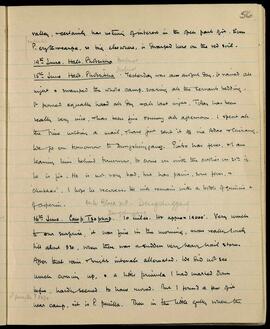
valley, certainly has nothing of interest in the open part of it. Even
P. erythrocarpa, so big elsewhere, is dwarfed here on the red soil.

14th June. Halt. Phobsikha District

15th June Halt. Phobsikha District. Yesterday was an awful day. It rained all
night & swamped the whole camp, soaking all the servants' bedding.
It poured equally hard all day & all last night. Today has been
really very nice, & has been fine & sunny all afternoon. I spent all
the time writing a mail, & have just sent it off via Adao & Chirang.
We go on tomorrow to Dungshinggang. Pimbo has fever, & I am
leaving him behind tomorrow, to come on with the coolies on 21st if
he is fit. He is not very bad, but has pains, some fever, &
'chukkas'. I hope he recovers. He will remain with a bottle of quinine &
of aspirin. onto Black Mt - Dungshinggang

16th June. Camp Tsophup. Dungshinggang 10 miles. Ht. approx. 14,000'. Very much
to our surprise, it was fine in the morning, & was really lovely
till about 9:30, when there was a sudden very heavy hailstorm.
After that rain & bright intervals alternated. We did not see
much coming up, & a little primula I had marked down
before, hardly seemed to have moved. But I found a few of it
near camp, it is P. pusilla. Then in the little gully where the

LSH/1/1/6/1/21 · Part · 1938-03-21
Parte de The Ludlow & Sherriff Collection

SUMMARY:
While halted at Tsetang, the party sent Pimbo back to Gonkar to recover 11 boxes of kit, which he found near Chora. They met the Ladakhi trader Ata Ulla, who spoke about Bailey, showed bird eggs from near Lhagyari, and helped procure a sheep. On 26 March they marched to Rong (Rongchaka) Dzong with poor bullock transport, and the writer suffered a minor fall from a pony.

CONTENT:
Atta Ulla Khan, a Ladakhi merchant trading in Tsetang

Kongka reluctantly to send Pimbo back to Gonkar to find out what has happened. That may mean a four or more days stay in this filthy place. This has made us vow not to stay in any more houses now. They really are too dirty for words. On arrival here we saw Ata Ulla, an old Ladakhi trader who has been here for 30 years or more. He lives here with a few other Mohammedans—all of whom dress as Tibetans, and all of whom are despised by our own servants. However I am sending Culla and Daud to see them today. Tsetang is quite a picturesque place from a distance, with two red and brown gompas and all the rest of the houses whitewashed. The village lies under a hillside, faces north. There are more trees than we have seen elsewhere—all willows and poplars, the poplars being in many cases very old and fine trees. The river narrows a great deal here. We are told kowas can go down another day's march, but are not advised to use them further.

24th March. Halt Tsetang. We had to halt here to allow the 11 boxes of kit left behind to be found.

25th March. Halt Tsetang. Pimbo went back yesterday 24th to look for it, and luckily found it before reaching Chora. He returned at 6:00 pm with the kit. These two days have been beastly. The wind and dust are perfectly awful and everything gets full of sandy dust. We have seen a good deal of Ata Ulla who begs us to come and talk each day. It is really a question of listening to him talk about Bailey. He showed us two eggs, properly blown, of what he said were crossoptilon from near Lhagyari, 5 others of which he gave to Bailey. And he told us all about Bailey giving him a gun for which he had a few cartridges. With great difficulty we have got a sheep for Rs 2/12. They don't like killing them this month they say, but seem to do it themselves all the same. Ata Ulla has been a great help in this way.

26th March. Rong (Rongchaka) Dzong. 14 miles. A lovely day, but spoilt by the awful transport. With some difficulty we got the transport to turn up early and were off by 7:45. But it was nearly all bullocks, and our boxes suffered very badly. Although a good path and only 14 miles, the last dozen loads only got in at 7:45 pm—12 hours for 14 miles. I only rode a short way, but when I did mount, the pony went off splitarse, fell on its head and threw me over its neck. I was lucky in being on a good bit of path and only skinned my finger badly, and dislocated the...

LSH/1/1/1/1/165 · Part · 1933-09-24
Parte de The Ludlow & Sherriff Collection

SUMMARY:
Notes damp weather, farewell to Pimbo, Kuntip, and Danong while taking on Tenduk, with praise for the Bhutanese workers; Tenduk will help with Kusho until the party returns to Sikkim. Describes dry, treeless country, the Kuru Chu gorge near Lhakang and its several local names, steady progress by coolies including many women wearing the Lhassa head dress, and few notable flowers or birds. A margin note mentions reunion at Yatung on Oct 3.

CONTENT:
81

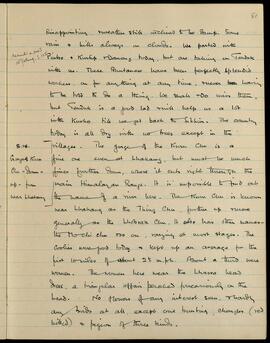
Disappointing, weather still inclined to be damp. Some rain & hills always in clouds. We parted with Pimbo & Kuntip & Danong today, but are taking on Tenduk with us. These Bhutanese have been perfectly splendid workers, on for anything at any time, never having to be told to do a thing. We shall miss them, but Tenduk is a good lad will help us a lot with Kusho till we get back to Sikkim. The country today is all dry with no trees except in the villages. The gorge of the Kuru Chu is a fine one even at Lhakang, but must be much finer further down, where it cuts right through the main Himalayan Range. It is impossible to find out the name of a river here. The Kuru Chu is known near Lhakang as the Thing Chu, further up more generally as the Lhobrak Chu. It also has other names - the Mo chi chu & so on, varying at most stages. The coolies were good today & kept up an average for the first 10 miles of about 2 1/2 m.p.h. About a third were women. The women here wear the Lhassa head dress, a triangular affair perched precariously on the head. No flowers of any interest seen, & hardly any birds at all, except one bunting, choughs (red billed) & pigeon of three kinds.

reunited on Oct 3 at Yatung. S. 105
B. 26. Gorge of Kuru Chu - down

LSH/1/1/3/3/115 · Part · 1933-04-09
Parte de The Ludlow & Sherriff Collection

SUMMARY:
Notes from Lung describe a rough track above the right bank, forested slopes, and village/camp spots, with few flowering Primula and nearly finished Rhododendron, comparing the area unfavourably to Natrampa. The next day at Lung, the party halts and splits up, sending Pimbo and Danong to inspect the route up the Char Chu.

CONTENT:
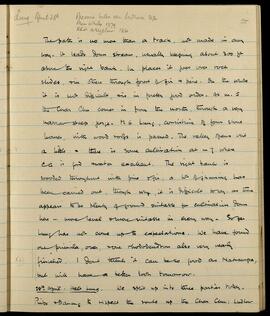
Lung April 28th
Paeonia lutea var. ludlowii 1376
Prim. whitei 1379
Rhod. arizelum 1380

The path is no more than a track, not made in any way. It leads down stream, usually keeping about 300 ft above the right bank. In places it goes over rock slides, in others through forest of fir & pine. On the whole it is not difficult, & is in pretty good order. At m. 5 the Char Chu comes in from the north, through a very narrow steep gorge. M 6 Lung, consisting of four stone houses, with wood roofs is passed. The valley opens out a little & there is some cultivation at m 7 where camping is good & water excellent. The right bank is wooded throughout with pine & fir; a lot of burning has been carried out, though why it is difficult to say, as there appears to be plenty of ground suitable for cultivation down here - more level & more suitable in every way. So far Lung has not come up to expectations. We have found one primula, over, some rhododendron also very nearly finished. I don't think it can be so good as Natrampa, but will have a better look tomorrow.

29th April. Halt Lung. We split up into three parties today. Pimbo & Danong to inspect the route up the Char Chu: Ludlow

LSH/1/1/3/3/123 · Part · 1933-04-09
Parte de The Ludlow & Sherriff Collection

SUMMARY:
Notes on flowering rhododendrons, a yellow peony, tsuga, and firs; Danong and Tenduk scout south towards the Karhongla, sending back rhododendron and Primula roylei specimens. The diarist struggles with photography, and Pimbo injures his leg and needs a stitch.

CONTENT:
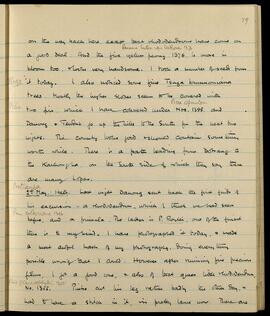
on the way back here, except that rhododendrons have come on a good deal. And the fine yellow peony (Paeonia lutea var. ludlowii) 1376, is more in bloom too, shows very handsome. I took a number of seeds from it today. I also noticed some fine Tsuga brunoniana trees. Mostly the higher slopes seem to be covered with two firs (Picea spinulosa), which I have collected under Nos. 1395 and

Danong & Tenduk go up the hills to the South for the next two nights. The country looks good & should contain something worth while. There is a path leading from Dotrang to the Karhongla, on the South side of which they say there are many Lopas.

Natrampa. 2nd May. Halt. Last night Danong sent back the first fruits of his excursion - a rhododendron, which I think we had seen before, and a primula (Primula calderiana 1396). The latter is P. Roylei, one of the finest there is to my mind. I have photographed it today, & made a most awful hash of my photographs, doing everything possible wrong that I could. However after ruining five precious films, I got a good one, & also of that queer little rhododendron, No. 1355 (Rhododendron glaucophyllum). Pimbo cut his leg rather badly the other day, & had to have a stitch in it, is pretty lame now. There are

LSH/1/1/2/1/63 · Part · 1933-07-08
Parte de The Ludlow & Sherriff Collection

SUMMARY:
At Tsona the party photographed locals and shared biscuits and ginger. Ludlow collected 30 Colias butterflies while the writer obtained a horned lark and noted abundant Paraquilegia; they also exchanged rupees to tankas and arranged cheap transport. Gifts including gloves, a papier-mâché bowl, Kashmir tweed, Bhutanese cloth, and saffron were gratefully received.

CONTENT:
30

have their photos taken, and would cheerfully have sat
Cine No 2 for hours for them. We gave them some of our
finished at luxuries - chocolate biscuits, ginger etc. They
Tsona - seemed thoroughly happy. Then Ludlow went out
with a butterfly net and walking stick gun for three
hours. He shot nothing as the gun seems pretty
useless over 10 yards. But he caught 30 colias
butterflies, which will certainly be very good.
Cinema I went out at 1.30 and returned at four. Got a
No 3 c. good horned lark and one flower. There are very
All at few flowers here, but Paraquilegia is finer than
Tsona I've seen anywhere. On the rocks north of camp
Flower box are dozens of clumps, some nearly 2 ft across.
On servant At Tawang we were unable to get our rupees
changed to tankas. But here we have changed
Rs 200 @ 10 tankas. The rate given is not
Contax No 3 too good. But transport here is very cheap.
finished at Pimbo arranged to hire at 2/3 tanka per load.
Tsona Yesterday we gave our presents: 1 pr gloves,
a silver lined papier-mâché bowl, a length of
Kashmir tweed, a piece of Bhutanese cloth and
some saffron. The saffron caused great
excitement, as it is very good and quite unobtainable
here. They were quite thrilled with everything.

LSH/1/1/2/1/107 · Part · 1933-07-18
Parte de The Ludlow & Sherriff Collection

SUMMARY:
After bathing at the hot springs, the party received gifts from the Maharaja via eight men from Bumthang, including rice, butter, cloth, a dagger, silver lime boxes, and potatoes, with plans to return the cloth to Trashigang. Flower collecting has been modest, and they expect to write multiple letters of thanks. Pimbo probed why locals discouraged their movements, learning it may be due to fears of them digging for valuables and disturbing earth spirits.

CONTENT:
a bath at the hot springs. There are several places banked up to make it possible to sit in water 2 ft deep, just as hot, or hotter, than one likes. I felt much better after a good bath. When we came back we found that a party of 8 men had arrived with presents from the Maharaja & Co in Bumthang. They brought 2 maunds of rice, 2 maunds of butter(!), about 3 maunds of cloth of various kinds, a dagger, silver lime boxes and a maund of potatoes. We kept all but will return the cloth to Trashigang by the same people. We have not done much in the way of flower collecting between us. I think we have perhaps 6 or 8 good things collected in these six days. However we have found out a good deal about the country and something of the people. The worst about the presents is that they mean that tomorrow we must write to Bumthang no less than seven letters of thanks each! Pimbo has been trying to get to the bottom of why these people have been doing their utmost to put us off wandering about the countryside. The only likely true answer he can get, is that they were afraid we would try to dig up 'pearls' or gold or other valuable stones, and so, of course disturb the earth spirits. Beyond that I think

LSH/1/1/2/1/159 · Part · 1933-07-18
Parte de The Ludlow & Sherriff Collection

SUMMARY:
The author discusses hopes that the monsoon is ending, tests a walking stick gun for use in dense jungle, and worries about overdue mail and poor arrangements by the Trashigang Dzongpen. On 28th August they march 9 miles to Lao, experiencing fine weather until late morning followed by heavy rain and returning to the leech zone.

CONTENT:
78

eggs & beans & potatoes, all very welcome, as we had none left. I now tell Ludlow that this is the end of the monsoon. As a rule it is he who is so optimistic about the weather. After such a heavy monsoon to start with, it might quite likely finish off early, though I hardly believe it myself. Ludlow tried the walking stick gun yesterday & found it distinctly dangerous. But after peeling all the outer covering away, I found it very good this morning. Perhaps after all it will come in useful. Something of the sort is needed in the very thick low jungle in which many of the most interesting birds live. It is time Pimbo came back; he must have found the road in worse condition than he expected. There are several bridges down we know. The non-arrival of any mail is very worrying. We should have had two since reaching here, but have had none, nor any news of them. The Trashigang Dzongpen was so optimistic about everything, but his arrangements seem to have been pretty bad.

28th August. LAO. 9 miles. 9203' (B.P. 195.6° Temp 60°).

Fine till 11.0 am then heavy rain most of the day. Back into the leech zone with a vengeance. As soon as we