Showing 30 results

Archival description
30 results with digital objects Show results with digital objects
LSH/1/1/9/1/102 · Part · 1949-07-12
Part of The Ludlow & Sherriff Collection

SUMMARY:
The writer treats a yakherd's child who broke his arm after falling from a sheep, applying a splint and dressing blisters. On 15 July they halt in thick mist and rain; Pasang and Gyundon also stay, men arrive from Pangstang with mules, there is no letter from Betty, and Ngudup cannot obtain information on the route. On 16 July they march to Namdating in persistent mist and rain via the Kyikyi Tsom La, descending between lakes at the head of the Chachuka valley towards the Tsangpo valley.

CONTENT:
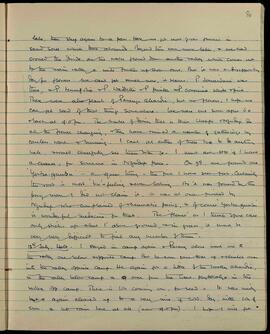
to the Drolma Shöki La. It is much colder now than a month ago, and they will be pretty chilly when they come in. A woman came down from the yakherds upstream, with her child aged about 6. The poor kid had been riding a sheep (!) and had fallen off and broken his arm - about 3 days ago. It had been tied up with some moss, very tightly, which made things worse by strangling the arm and causing large blisters. I don't know what they had put on. I doubt if I did much good, but I put a splint on and dressed the blisters.

15th July. Halt. Thick mist and rain. Stayed in camp again, so did Pasang and Gyundon. We are all tired of this place, and will be glad to move tomorrow morning over the pass leading to the Tsangpo valley. Several men have come up from Pangstang, with I think the Druk Locha's mules, to graze above here. I hoped anyone coming up now might have brought a letter from Betty, but there is none. All coolies have turned up this evening. I still can't get any information about where we are going to. Someone must know, but Ngudup either won't or can't extract any useful information - the same difficulty as one always has on first going to a place.

16th July. Namdating. From 5:45 to 1:30 pm. Mist all day, rain on top. This was a queer march, and I'm not quite sure yet where we are. First we went up the valley opposite camp; over the side to the south to the next valley, down into that and steep up again to the Kyikyi Tsom La. The first pass would be about 15,000' and the Kyikyi Tsom La about 15,500. Then down rock scree and grass hillside to between two fine lakes at the head of what I had previously seen was the Chachuka valley. This is the one I went up on 1st July; the lower lake was the one I just
LSH/1/1/9/1/33 · Part · 1949-05-06
Part of The Ludlow & Sherriff Collection

SUMMARY:
A local messenger is sent over the Sebri La to Charkakora to arrange a meeting at Pangkar. After heavy rain, the Kuomo Chu bridge is washed away; two Tibetans visit from Tsari Chikchar, Pasang departs for Julu to collect mice, and Ngudup recounts a recent landslip that killed 11 people. The following day brings more rain, little of botanical interest, and hopes for a letter from Betty.

CONTENT:
by sending a local over the Sebri La to Charkakora. I said then back in four days, so as to meet me at Pangkar. A man agreed at the great cost of Rs 7/- + the chance of a tip! So off he goes early tomorrow.

28th April. Halt. We had an absolute deluge of rain last night till a late hour, & that finished the rain for a little, as today has been perfect. But the bridge over the Kuomo Chu was washed away early this morning. It is as well we did our tour on the other side yesterday. The bridge even then was very shaky, & I knew it would soon go. Got nothing of interest today. Two Tibetans came into camp, & one recognized me. They had come from Tsari Chikchar, & one had been a coolie with me round the "Kingkor". They remembered our last visit quite well. Pasang goes off tomorrow to Julu, for the mice there, & back on 30th. We tried up a very steep side valley to the west today. I thought Ngudup was nervous all the time, & he told me this afternoon that that valley had come down in a landslip only 5 or 6 years ago, smashed all the houses & killed 11 people. After last night's rain he expected a repetition it seems.

29th April. Halt. A fine morning, suddenly clouding over, & raining by 1.0 pm. Pasang went off at 6.0 & I went up more than half way with him. There was hardly anything to be seen, certainly other than we had already collected. Rhod. Lindleyi very common everywhere, as is Magnolia Campbellii. I fear Pasang will get very little. Betty should by now have got my letter, & I hope will send one back tomorrow. It will be interesting to hear how they got on. While

LSH/1/1/9/1/67 · Part · 1949-06-15
Part of The Ludlow & Sherriff Collection

SUMMARY:
The diarist halted due to weather, sent a man to reconnoitre a pass for snow conditions, searched unsuccessfully for blood pheasant young, and noted finding but not collecting P. yargonensis. They record local clothing said to come from near Tsetang on the Tsangpo and report heavy monsoon rain, with the scout later advising the pass is feasible but risky due to falling rocks; plans hinge on the Drogpas’ return from taking the Drok Locha to Shasjetang.

CONTENT:
6th June Halt. Very wet night, but fine most of the day. Sent a man up to the pass we want to cross, to see if there is too much snow. I say that 'we' want to cross, but I am probably the only one who wants it. The other way would be simpler & easier for the locals. I looked for blood pheasant young today with no success, though I saw many pairs. We found but did not collect P. yargonensis. Otherwise the day was blank. The locals mostly wear very gay chubas here, & I wanted to see them wearing them. But Ngudup tells me they all come from near Tsetang on the Tsangpo. That is the big bazaar we passed in '46 on the R bank, where the huge chorten is. The cloth is coloured & woven there it seems. But no Tibetan would ever wear clothes made of that pattern. Surely these used to be made in Bhutan? Of course the Drogpas here wear woollen clothes, not cotton which are general in Bhutan.

7th June Halt. A real monsoon day, rain almost all day, but never very heavy & no fine periods for long. One can almost see the snow drifts melting, & one can certainly hear the result of the rain & melting snow in the rocks falling down the hillside. The man we sent off yesterday morning got back by evening, & reported only about 30 yards of deep snow at the top. He, in fact, said we could go alright, as long as I did not mind boxes being bumped against rocks, & was prepared for a bad bit of 200 yds where rocks keep falling down. I don't like the last thing. It is always beastly, but I think we should try when the Drogpas come back from taking the Drok Locha down to Shasjetang. In the meantime, as there is so little up

LSH/1/1/9/1/99 · Part · 1933-07-11
Part of The Ludlow & Sherriff Collection

SUMMARY:
The party crossed a pass and lakes into another valley but found few flowers, noting several Primula species and plants of “Pasang's Abardia” without bloom. The writer criticizes Lhakpa and Ngudup for damaging collections and considers asking Holt to replace Ngudup; on the 9th a fresh Yertsa-gumbu was found by the pony man and taken by Ngudup for rheumatic pains.

CONTENT:
lake, then steep again to a pass. Here we got more prim flowers in sand scree which there abound. Beyond this were more lakes, and we had crossed the divide, as the water flowed down another valley which comes out to the main valley a mile further up than ours. But it was a disappointing day for flowers. We can't get much now, it seems. P. jonarduni was there, and P. tenuifolia and P. waddellii and P. pusilla and P. concinna white and pink. There were also plants of Pasang's Abardia, but no flowers. I hope we can get seed of that thing somewhere. We were out soon after 6:00 and back at 4:00 pm. The trouble of doing that is that Lhakpa and Ngudup do all the flower changing, and they have ruined a number of gatherings by careless work and burning. I can't get either of those two to do anything well, and would cheerfully see them both go. I must ask Holt if I have a chance for someone in Ngudup's place. On 9th, we found one 'Yertsa-gumbu' - a queer thing - the first I have seen fresh. Certainly the root is most 'bug'-feeling and even looking. As it was found by the pony man I did not claim it. It was at once pinched by Ngudup who complained of rheumatic pains, and of course 'Yertsa-gumbu' is wonderful medicine for that. The 'flower' or

LSH/1/1/9/1/151 · Part · 1949-04-09 - 1949-09-05
Part of The Ludlow & Sherriff Collection

SUMMARY:
Page records advances made to families of workers and details ration allowances. It also notes staff joining dates and payment arrangements in 1949, including amounts advanced and recipients such as spouses, brothers, and friends.

CONTENT:
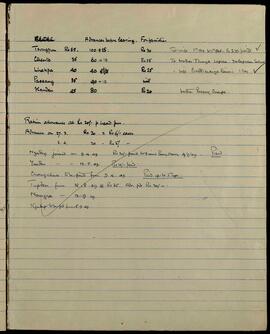
Advances before leaving. For families
Tsongpon Rs 55. 100 + 15. Rs 30 To wife 1st Apr to 1st Oct - Rs 210 paid
Chento 35 60 + 10 Rs 15 To brother Thage Lepcha. Dalapchen School
Lhakpa 40 40 Rs 25 - wife Buddhimaiya Raini 1 May
Passang 35 40 + 10 nil
Kanden 45 80 Rs 20 brother Pasang Sherpa.

Ration allowance at Rs 20/- per head per month.
Advance on 27.3. Rs 30 = Rs 6/- each
5.4. 20 = Rs 4/-
Ngudup joined on 9.4.49. Rs 30/- paid to friend Pasang 4/7/49. Paid.
Yunden joined on 12.5.49. Rs 10/- paid.
Changchun to be paid from 9.4.49. Paid up to 5 Sept.
Tupden from 15.8.49 @ Rs 35. Advance paid Rs 30/-.
Namgye from 13.9.49.
Ngudup to be paid from 5.9.49.

LSH/1/1/9/1/44 · Part · 1933-05-07
Part of The Ludlow & Sherriff Collection

SUMMARY:
The diarist finds the Tomtom valley too narrow and snowbound for camping and decides to return to Dunkhar, weighing options between Singhi Dzong and Waitsang via Bumthang. On the morning of the 10th May, they decide to go to Waitang/Waitsang on the Bumthang Chu, noting advice from Ngudup and the prospect of Betty joining in July.

CONTENT:
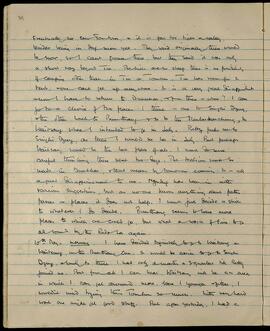
Eventually we saw Tomtom, & it is far too tight a valley, besides being in deep snow yet. They said originally there would be snow, so I can't grouse there, but they said it was only a short way beyond Tin. The hills are so steep there is no possibility of camping other than in Tin or Tomtom. Tin has room for 2 tents, none can get up anywhere. It is a very real disappointment now I have to return to Dunkhar, & from there - when? I can go to a choice of two places I think - one to Singhi Dzong, the other back to Bumthang & so to the Menlarkarchung, to Waitsang where I intended to go in July. Betty pulls me to Singhi Dzong, as there I would see her in July. But perhaps Waitsang would be the best place of all. I must do some careful thinking these next two days. The decision must be made in Dunkhar, & that means by tomorrow evening. It is all a real disappointment to me. Ngudup has been in with various suggestions, but as no one knows anything about paths, passes or places, it does not help. I must just decide & stick to whatever I do decide. Bumthang seems to have more places to which one could go, but what a waste of time to go all round by the Rudola again.

10th May - morning. I have decided definitely to go to Waitang or Waitsang on the Bumthang Chu. It would be easier to go to Singhi Dzong, & lovely to think I had only a month & 3 quarters till Betty joined me. But from all I can hear, Waitsang will be an area in which I can get around more. Were I younger & fitter, I wouldn't mind trying this Tomtom so much. With very hard work, one might get good stuff. But after yesterday, I had a

LSH/1/1/9/1/47 · Part · 1933-05-07
Part of The Ludlow & Sherriff Collection

SUMMARY:
Notes a new rucksack carrier named Taphirk and heavy local demand for worm medicine and remedies for stomach and 'heart' complaints. On 12 May at Shamshering, after rain and mist, two messengers arrived (one from Wanguco and one from Lhumbe Dzongpen) while the writer awaited letters from Betty via Holt's man; strawberries and possibly raspberries were sought for dinner. On 13 May at Timyung Dzong, very short marches are described and Ngudup is blamed for misjudging distances.

CONTENT:
Taphirk, a rucksack carrier. He is a nice looking lad, and I think he will be useful. Here there is great demand for 'worm' medicine. Everyone has them, tape or round, usually the latter. Everyone also complains of 'heart' situated remarkably near the stomach, cured usually with stomach powder. A few have come for gonorrhoea, but not so many as one would have expected. How grand it will be eventually to get to a place we can expect food, flowers, and above all air. Here we have been shut in, in low, hot valleys. But there are only 5 more days of that now.

12th May. Shamshering. Last night rain, mist all today. Our fine weather is over for the winter, but it was lovely while it lasted, and made everything look very pretty. Back again in this place. The march only takes 4 1/2 hours, which means one is in by 9:30, and there are no flowers to collect or look for here. Two messengers have arrived - one from Wanguco, and another from Lhumbe Dzongpen. I hope for a third, the only one I want, which would be with letters from Betty, sent back by Holt's man who took her the box of stores. He should be back by now. As a change of diet, I am having strawberries for dinner, with raspberries if they can be found. The latter are really good, but we haven't seen any bushes near camp yet.

13th May. Timyung Dzong. 4 miles. Ngudup slipped up about these two marches. He told me that from Dumahan to Lhumbe was for Bhutanese more than 2 days march. So I thought 3 for us would be just right. Yesterday we were in at 9:30, today at 7:15! And tomorrow we should be in by 7:15 too I think, as we can see the Dzong. What a waste of good time in the foulest of

LSH/1/1/9/1/77 · Part · 1933-06-16 - 1933-06-17
Part of The Ludlow & Sherriff Collection

SUMMARY:
The diarist worked high above the Sokpon's huts near Haeth on 16 June, collecting several Primula species and observing many Grandala. On 17 June at Waitang, after a mishap with a shying pony that broke the diarist's glasses, Lundrup found a white variety of Primula caveana near the junction of two rivers.

CONTENT:
happen honestly. Whether it is Ngudup or Lhakpa who is doing it, I don't know. Either is capable, but Ngudup would think it quite usual.

16th June. Haeth. Half wet half fine, mostly misty up the hills. We went up the valley above the Sokpon's huts, and on the whole had a good day. Got Primula capitata (one only), P. tenuifolia, P. walshii (very few) and saw the finest lot of P. caveana I have ever seen. It is common as dirt here. Lots of P. bellidifolia beside the caveana in places. There were many Grandala flying about, but I saw no nests. All this was of course high up, and I'm very tired tonight, although I rode to 14,000' most of the way. The walking beyond was steep and there was a longish walk back. A good day. Obviously we are into things now all of a sudden really.

17th June Waitang. Height 13,400'. Fine at times, mostly misty, raining and cold. The day was notable for two things - the miserable pony I had, who shied at everything and a new white variety of P. caveana. After several shies, the pony in some way loosened the girth and the saddle slipped round, and me with it. Luckily we were on no dangerous part above the river, and I only fell among smooth boulders which did no damage to me at all, but smashed my reading glasses. Luckily I have another pair. We are camped almost at the junction of the two rivers, but it is not very convenient because to cross the main river we must go down 2 miles or up 3, and the best side is the other side. I wandered about a little, but saw nothing of interest. The lads went out separately, and came back very depressed, but Lundrup had found a white variety of P. caveana, or that is what I take it to be. It cannot be anything else, but I have never heard of such

LSH/1/1/9/1/98 · Part · 1933-07-10 - 1933-07-11
Part of The Ludlow & Sherriff Collection

SUMMARY:
Notes snow leopard tracks and sparse flowers, including masses of P. concinna and an Allardia found by Pasang, after a strenuous day. On 10 July the party stayed in camp, sent mail to several correspondents, discussed travel plans with H.H., and chose to take the pass opposite Drolmo Sishi La on the 16th; on 11 July bad weather arrived in the afternoon, Yundun could not go out, and the diarist and Pasang went up a nearby valley.

CONTENT:
93
Saxifraga contraria op no. 19390

pugs of a big snow leopard at 15000', but otherwise no wild life. Flowers were very few. P. concinna 19392 was in masses at the first lake, and nearly all white which I've never seen before. Then a little higher, certainly 15500', Pasang found a pretty Allardia, with mauve flowers and covered densely in white felt like hairs, all over. Got back dead beat - even Ngudup - to find the mail had arrived and a basket of vegetables for H.H. Nothing very much in it, but it was nice to have. No mail from Betty. She's been very lucky in weather I must say. Again a fine day.

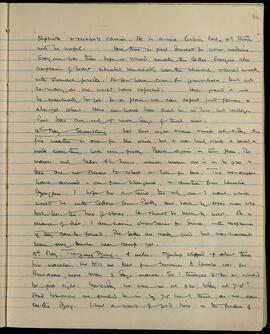
10th July. Haah. Again a good day, with a few fine showers amid sunshine, and Kanghar visible quite a lot of the day. Stayed in camp and got a mail off to Kyong, H.H., Betty and Wangmoo. Tobsgye is asking for our dates of sailing, so that he can get M.K.'s passage booked too. So I have written H.H. today to ask what his plans are, telling him we proposed to fly, and would prefer to do this, but that we will go by sea if possible should he particularly wish it. No flowers today. We have now planned not to go by the Drolmo Sishi La, but by the one opposite here, on 16th. That decision made, is very nice. Now we have 5 days here, and we know how our time will be fitted in till we go to Bumthang.

11th July. Haah. Another beautiful morning, followed by heavy hail and rain about 2.0pm and clearing up after. Yundun's feet are too bad for him to go out, so Pasang and I went ourselves. We went up stream to the first yak herds on the R bank (1 1/2 m?) then turned up that valley. The climb was very steep at first, past a small

LSH/1/1/9/1/39 · Part · 1949-05-06
Part of The Ludlow & Sherriff Collection

SUMMARY:
The party marches through dense forest near Rongang, noting many Primula mollis (first not in flower, then found flowering) but few other plants of interest, with capsules of a lily and some rhododendrons observed. Route discussions mention Nashina as not promising, Serdong La lacking nearby water, and Tiu as the best first halt, while Ngudup grows increasingly depressed about their plans.

CONTENT:
we were in. Then at about mile 5 the path levels off till just before reaching here it drops suddenly again. In the dense forest, both close to Rongang and in the very steep bit, there was any amount of the new primula 18806 (P. mollis), but again not in flower. Apart from that the march was very uninteresting. Poor Ngudup gets more and more depressed as he hears of where we are going and how long we will stay there. We still don't get very good information though. It seems Nashina would be much good, though the Serdong La might be good, but there is no water within miles of the pass. Tiu seems our best bet for the first halt.

4th May. Shambling. 6 miles. Very heavy rain all last night until just as we started. Fine but mist and cloud today. We found our primula in flower today (P. mollis 18816), very close to Rongang, and also just beside camp here. Otherwise nothing of interest seen - in fact these last two days have really been remarkable for the absence of flowers. There were, near the pass yesterday, capsules of a lily - either Lilium nepalense or L. nepalense var. concolor, and there were many Rhododendron virgatum and Rhododendron griffithianum. But today we really saw nothing at all. We can however, see the snows, not the main range, but a subsidiary running South. Today's road climbs for the first mile round a spur and