Showing 281 results

Archival description
281 results with digital objects Show results with digital objects
LSH/1/1/1/1/35 · Part · 1933-05-17 - 1933-05-18
Part of The Ludlow & Sherriff Collection

SUMMARY:
Rain in Yatung limited collecting to a few rhododendrons and a viburnum, and ponies were arranged for travel to Gangtok amid staffing issues due to Williamson’s wedding. The next day the journey from Yatung to Tsomgo crossed the Natu La in mist and soft snow, with a small avalanche observed and a pony falling.

CONTENT:
of much the same style as the Kashmir houses, but ever so much more pukka-built. The Tibetans we meet are all very cheerful, & invariably greet one by taking off their hats & salaaming.

17th May YATUNG. Rained most of the day, & after two & a half hours on the hill behind the bungalow we only got one bird. Took R. cinnabarinum (L&S. 748), R. cephalanthum (L&S. 9), a few rhododendrons & a viburnum V. cordifolium (L&S. 10). Arranged for ponies (three) for Gangtok. I take Ahmad Sheikh with me, & therefore Ludlow is left without a cook. He wired Williamson for permission to use the chowkidar while I was away & got the helpful answer that he had no objection provided the B.T.A agreed. The B.T.A is in Gyantse. In fact W's wedding is a perfect curse.

Sherriff returns to Gangtok for Williamson's wedding.

18th May. TSOMGO. 22 miles. 11 hours. It was a lovely clear morning in Yatung, so I left at 6.15 & decided to cross the Natu La while the going was good. Ahmad Sheikh & I each rode a mule, while our bedding was on a third one. Up to Chushithang it was lovely & the view perfect. As we reached the pass the clouds came down, & actually on the top we were in thick mist. The track was easy so far, though there is still nearly as much snow as when we crossed before. On this side there appeared to be the same amount of snow, & it was very wet & soft. A short way this side of the pass, a small avalanche passed about 10 yds in front of me, & when I stopped to watch it, I heard that the last pony had fallen. It had been caught in an even
LSH/1/1/1/1/31 · Part · 1933-05-15
Part of The Ludlow & Sherriff Collection

SUMMARY:
An easy downhill march to Yatung through fir, larch, and rhododendron is described, with few flowers seen and notes on birds and scenes such as Kargiu monastery. The party visits the Depen of Pipithang with Pema translating, rides along the Amo Chu, meets telegraph clerk Rosemeier, and decides to skip Lingmathang due to late flowers, with plans for Ludlow to go to Sharithang while the writer returns.

CONTENT:
13

snow was very fine. The Tibetans have some most expressive words. Their word for dawn means either "The lifting of the skies", or "Sunlight on the peaks."

to
14th May. YATUNG. 9950'. 12 miles. Fine most of the day at low

B. S. contd
Scenes on the way down from Chusitang.
Kargiu monastery -
Piptanthus nepalensis (no. 3)

altitudes, snow on the hills after midday. An easy march down hill to the Chumbi valley, through fir rather than pine & larch & rhododendron jungle. We let the kit go on ahead & wandered down very slowly, looking for birds. Surprised how few flowers are out. There is hardly anything to be collected here now, & there will be less in Lingmathang. Still no news about Tibet from Williamson. Called on the Depen of Pipithang, an agreeable Tibetan trade agent. There the head clerk of the B.T.A. - Pema - met us & translated. Rode in from Pipithang up the Amo Chu, a river which looks ideal for trout, were it not in Tibet. Met here by Rosemeier, the telegraph clerk, who long outstayed his welcome.

15th May. YATUNG. All flowers are so far behind that we have decided not to go to Lingmathang to seek flowers. We will see the place tomorrow & when Ludlow is ready he will go direct to Sharithang. I must return

LSH/1/1/1/1/199 · Part · 1933-09-15
Part of The Ludlow & Sherriff Collection

SUMMARY:
Notes describe difficulties using yaks for transport, observations of the green Tibetan plateau with abundant sheep and yaks, and that Bailey had found the area interesting for flowers though the party seems too late. On 16th September they marched 12 miles to GOBSHI (14,000'), after snow and cold, reaching what is described as their last camp before the route with dak bungalows to Kalimpong.

CONTENT:
Transport is rather difficult from here: there seem to be no animals but yaks. Yaks are excellent beasts, but they move in herds, and so are continually crashing one's boxes. With two of Ludlow's full of birds, and two of mine full of plates, that is a serious business. The people here are as dirty as I have seen anywhere, but also as cheerful as one could wish. There are again thousands of sheep in this valley and also thousands of yaks a little higher up. I never imagined the Tibetan plateau would be so green. There is quite a fair amount of grass on these hills. The higher the grass, the more nutriment it seems to have, and that, I suppose is the reason why the sheep in Tibet do so well. Bailey reported this place as being quite interesting for flowers, but we must be too late.

16th September. GOBSHI. 12 miles. 14,000'. It snowed most of last night and was beastly cold and wet this morning. We did not get off till 7:30 and transport was all yaks. They got in at 3:30 pm. It cleared up soon after we left, and except for one very heavy shower, was a good day. Everyone seems pretty glad to be at our last camp. Beyond Gyantse there are dak bungalows the whole way to Kalimpong, so our camping is at an end tonight. There is much more cultivation down here,

LSH/1/1/3/3/167 · Part · 1983-05-05
Part of The Ludlow & Sherriff Collection

SUMMARY:
The party set up the wireless and clearly heard England for the first time since Puntsogong, likely aided by monsoon conditions, with generally fine weather though cloudy on the hills. On 27 May they halted in camp due to rain, and on 28 May they went about seven miles down the valley along a difficult river path; Ludlow crossed the river, and they noted abundant Rhododendron lindleyi, a magnolia about to flower, and mixed jungle of bamboo, rhododendron, birch, larch, Tsuga dumosa and deciduous trees.

CONTENT:
Schisandra grandiflora 1704
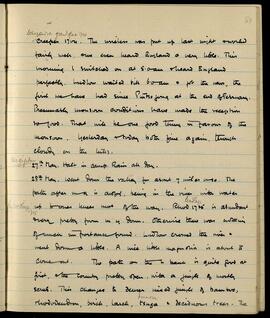
Creeper 1704. The wireless was put up last night and worked fairly well; we even heard England a very little. This morning I switched on at 5:00 am and heard England perfectly. Ludlow waited till 6:00 am and got the news, the first we have had since Puntsogong at the end of February. Presumably monsoon conditions have made the reception so good. That will be one good thing in favour of the monsoon. Yesterday and today both fine again, though cloudy on the hills.

Meigiptan 1714
27th May. Halt in camp. Rain all day.

28th May. Went down the valley for about 7 miles or so. The path after mile 4 is awful, being in the river with water up to one's knees most of the way. Rhododendron lindleyi 1715 is abundant and very pretty from mile 4 down. Otherwise there was nothing of much importance found. Ludlow crossed the river and went down a little. A nice little magnolia is about to come out. The path on the left bank is quite good at first, the country pretty open, with a jungle of mostly scrub. This changes to denser mixed jungle of bamboo, rhododendron, birch, larch, Tsuga dumosa and deciduous trees.

LSH/1/1/1/1/38 · Part · 1933-05-23
Part of The Ludlow & Sherriff Collection

SUMMARY:
Diary note records Ludlow traveling to Sharithang via a valley leading to the Cam La Thada in western Bhutan. The valley is forested with firs (Abies webbiana) and has luxuriant undergrowth of Ilex, willows, and Viburnum.

CONTENT:
W. Bhutan
20th May Ludlow goes to Sharithang via
a valley leading to the Cam La Thada
Both sides of the valley were forested
firs (Abies webbiana) with a luxuriant
undergrowth of Ilex, willows, Viburnum, etc.

LSH/1/1/1/1/56 · Part · 1933-06-08
Part of The Ludlow & Sherriff Collection

SUMMARY:
The valley between Damthang and Ha is described as very pretty, with cultivation starting a mile below Damthang and continuing all the way to Ha. Principal crops are wheat, barley, and buckwheat; villages are small but houses are built on massive lines.

CONTENT:
Ludlow June 8. The valley between Damthang
& Ha is very pretty. Cultivation begins a
mile below Damthang & continues the
whole way to Ha. Principal crops are
wheat, barley, buckwheat - good crops with
lots of straw. Villages are small but
houses are built on massive lines.

LSH/1/1/4/1/171 · Part · 1933-11-08 - 1933-11-09
Part of The Ludlow & Sherriff Collection

SUMMARY:
At Tsona on 8 November, after a very cold night, the diarist arrived early; Pintso prepared for departure toward the Kechen La, while Ludlow, delayed at Tawang and Sakden, had reached Trashigang on 28 October with seeds and flowers. The diarist dealt with a Dzongpen, noted missing post, and had mail from Chayul forwarded; on 9 November the party left Tsona joyfully for a camp north of Kechen La amid evening clouds over the Nyam Jang Chu, though yaks were delayed.

CONTENT:
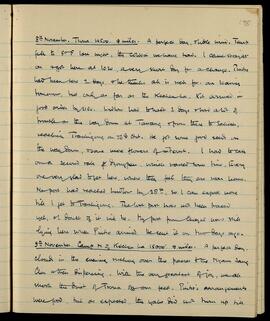
8th November. Tsona. 14500. 9 miles. A perfect day, and little wind. Temp fell to 5°F last night, the coldest we have had. I came straight on and got here at 10:30, a very short day for a change. Pintso had been here 2 days, and he thinks all is well for our leaving tomorrow, but only as far as the Kechen La. Kit arrived in good order by 11:30. Ludlow had to halt 2 days and had a lot of trouble on the way down at Tawang and from there to Sakden, reaching Trashigang on 28th Oct. He got some good seeds on the way down, and some more flowers of interest. I had to call on a second rate of Dzongpen, which wasted some time. Everyone very glad to get here, where they feel they are near home. No post had reached Ludlow by 28th, so I can expect none till I get to Trashigang. The lost post has not been traced yet, and I doubt if it will be. My post from Chayul was still lying here when Pintso arrived. He sent it on two days ago.

9th November. Camp N of Kechen La 15000' 9 miles. A perfect day. Clouds in the evening rushing over the passes of the Nyam Jang Chu and then dispersing. With the very greatest of joy, we all shook the dust of Tsona off our feet. Pintso's arrangements were good, but as expected, the yaks did not turn up till

LSH/1/1/2/1/65 · Part · 1933-07-18
Part of The Ludlow & Sherriff Collection

SUMMARY:
At Tsona, the party hiked above camp, photographed Paraquilegia grandiflora, collected butterflies, and shot a few birds, then spent the afternoon developing and packing, leaving a dump of 11 boxes. Mail arrived after a month; Kurtip recovered, and it is noted that permission to reach the area was hard-won in Lhasa, while Pintso had exaggerated the cost of gifts given earlier.

CONTENT:
31

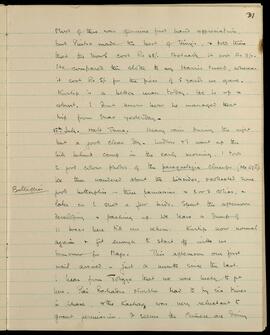
Most of this was genuine first-hand appreciation, but Pintso made the best of things, and told them that the bowl cost Rs 45/-. Actually it cost Rs 8/-. He compared the cloth to my Harris tweed, whereas it cost Rs 5/- for the piece of 5 yards we gave. Kurtip is a better man today. He is up and about. I don't know how he managed that trip from Shao yesterday.

18th July. Halt Tsona. Heavy rain during the night, but a good clear day. Ludlow and I went up the hill behind camp in the early morning. I took 2 good colour photos of the Paraquilegia grandiflora (No 678). We then wandered about the hillsides, and collected some good butterflies - three Parnassius and 2 or 3 Colias, - later on I shot a few birds. Spent the afternoon developing and packing up. We leave a dump of 11 boxes here till our return. Kurtip now normal again and fit enough to start off with us tomorrow for Mago. This afternoon our first mail arrived - just a month since the last. I hear from Tsona that we were lucky to get here. Rai Bahadur Norbhu had to try six times in Lhasa, the Kashag was very reluctant to grant permission. It seems the Chinese are doing

LSH/1/1/2/1/63 · Part · 1933-07-08
Part of The Ludlow & Sherriff Collection

SUMMARY:
At Tsona the party photographed locals and shared biscuits and ginger. Ludlow collected 30 Colias butterflies while the writer obtained a horned lark and noted abundant Paraquilegia; they also exchanged rupees to tankas and arranged cheap transport. Gifts including gloves, a papier-mâché bowl, Kashmir tweed, Bhutanese cloth, and saffron were gratefully received.

CONTENT:
30

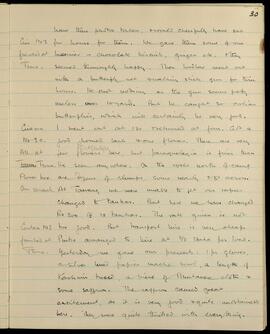
have their photos taken, and would cheerfully have sat
Cine No 2 for hours for them. We gave them some of our
finished at luxuries - chocolate biscuits, ginger etc. They
Tsona - seemed thoroughly happy. Then Ludlow went out
with a butterfly net and walking stick gun for three
hours. He shot nothing as the gun seems pretty
useless over 10 yards. But he caught 30 colias
butterflies, which will certainly be very good.
Cinema I went out at 1.30 and returned at four. Got a
No 3 c. good horned lark and one flower. There are very
All at few flowers here, but Paraquilegia is finer than
Tsona I've seen anywhere. On the rocks north of camp
Flower box are dozens of clumps, some nearly 2 ft across.
On servant At Tawang we were unable to get our rupees
changed to tankas. But here we have changed
Rs 200 @ 10 tankas. The rate given is not
Contax No 3 too good. But transport here is very cheap.
finished at Pimbo arranged to hire at 2/3 tanka per load.
Tsona Yesterday we gave our presents: 1 pr gloves,
a silver lined papier-mâché bowl, a length of
Kashmir tweed, a piece of Bhutanese cloth and
some saffron. The saffron caused great
excitement, as it is very good and quite unobtainable
here. They were quite thrilled with everything.

LSH/1/1/1/1/19 · Part · 1933-05-08
Part of The Ludlow & Sherriff Collection

SUMMARY:
Heavy snow has closed the pass near Tsomgo, with temperatures around freezing and ongoing snowfall; film and exposure notes are recorded. On 8th May, Danong scouted towards the Natu La and reported over five feet of snow and lost mule loads, leading to plans to send mules back to Gangtok for rations. Karponang bungalow is reportedly occupied by two lamas, emissaries of the Tashi Lama, preventing use of that stop.

CONTENT:
7

feet of snow on the pass. Normally the pass is open all
year, the rhododendrons should be coming into flower here,
instead of being under 2 ft of snow as they now are. There
seems little or no hope of our crossing for some days yet.
My bad luck on passes seems to continue. Min. temp in
verandah today was 33°: maximum in verandah 45°, but
maximum outside 50°. Snow is thawing hard, but
fresh light snow continually falling. Light given by
Electrophot in open, between f 16 & 22.

Cine Film B3.
Close up of caravan man. f 8 & x.

8th May. TSOMGO. A lovely morning from sunrise till 9.0, when
mist came down and it snowed. Two men (Danong and a muleteer,
Lepcha Coleen) sent up the pass with mules to see whether we can get on tomorrow.
Ludlow and I walked down towards Lagyap La for birds - the
only collecting we can do. Found one dazed moth in the snow
on the path. 3.0 pm. Danong came back, having gone five
miles towards the Natu La. He reports that even there, the
snow is over five feet deep, and that several mules and their
loads have been lost. He thinks there is no hope of crossing
for five days anyway, and says that even with 50 coolies we
should have no hope. Karponang bungalow is occupied
we believe by two lamas, emissaries of the Tashi Lama
who is thought to be intending to return to Tibet. So we
could not go there even if we wanted to. Our idea is to
let the mules return to Gangtok for rations: send Danong

B. 3.
Tsomgo lake evening and early morning