Showing 23 results

Archival description
23 results with digital objects Show results with digital objects
LSH/1/1/6/1/159 · Part · 1936-11-05 - 1936-11-07
Part of The Ludlow & Sherriff Collection

SUMMARY:
Diary entries describe travel from Yar Shika to Loro Tö, including a visit with the Dzongpen (gifted silk and saffron) and discussion of missing photographs from Sanga Chöling, scenic views, and lost/damaged film rolls previously entrusted to Bhutanese couriers. Subsequent days note severe transport disruptions with drunk porters fighting, the Dzongpen demanding a passport, Kusho struggling to arrange transport, strong valley winds, and observations of hares and the absence of partridges.

CONTENT:
this morning, & quite a number still in flower. Clouded at night & early morning, fine & bright all day.

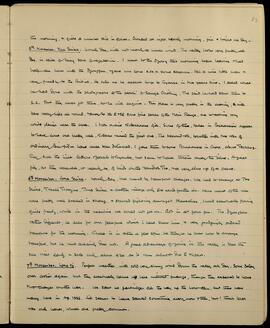
5th November. Yar Shika. Lovely day, with not nearly so much wind. The valley looks very pretty all day, in spite of being bare of vegetation. I went to the Dzong this morning before leaving & had half an hour with the Dzongpen, & gave him some silk & some saffron. He's a nice little man & very friendly to the British. He tells me he expects to go to Gyantse in two years time. I asked what he had done with the photographs of the 'peach' of Sanga Chöling. He said he had sent them to S.C. But they never got there, so he will enquire. This place is very pretty in the evening, with bare rocky hills all round, & away to the ESE some fine peaks of the Main Range, & a retreating very white glacier near the crest. I took a few Kodachrome of it. Some of these, taken in Pachakshiri appear to have come out pretty well. Kodak ruined the first one. The second roll, together with two rolls of ordinary Pan film have never been delivered. I gave them to some Bhutanese in Chura, above Tsetang. They took the line letters & parcels to Gyantse, but seem to have thrown away the films. A great pity, as they were all, or nearly so, of birds on the Yamdrok Tso, & a very close up of a crane.

6th November. Jora Shika. Lovely day, but ruined by transport changes. We had to change at Tro Shika, Trashi Trongme, Timp Shika & another village only 500 yards further on. Here most of the men were pretty well soaked in chang, & started fighting amongst themselves, blood eventually flowing quite freely, while in the meantime we cursed our fate. Got in at four p.m. The Dzongpen rather difficult; he asks for our passport which I can't show him, & very grudgingly ordered transport for the morning. Kusho is in rather a flat spin. He thought he knew how to arrange transport, but he most certainly does not. A great advantage of going in this valley is that the sun rises early & sets only about 4.30, as it runs almost due E & West.

7th November. Loro Tö. Perfect weather, with cold very strong wind down the valley all day. Some delay over coolies again, but they eventually came up here without change, though they expected to have two changes on the way. We saw no partridges all the way up the Loro chu, but there were many here in Ap. 1936. Jill seems to have scented something every now & then, but I think that was only hares, which are pretty common.
LSH/1/1/6/1/95 · Part · 1933-07-09 - 1933-07-05
Part of The Ludlow & Sherriff Collection

SUMMARY:
Heavy rain at Tum La hampers collecting; most Primula are over, though a yellow-flowered Meconopsis is noted. On 9–10 July the party faces flooding on the Nagü Chu, Kusho warns the coolies, threats are reported from local Lopas about going to Nagü, and the plan shifts to bypass Shoka La and proceed to Lando.

CONTENT:
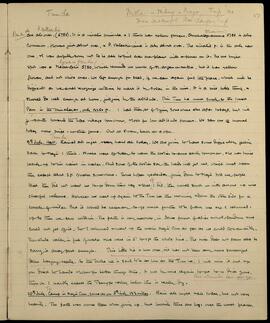
Tum La
Mola - Milung - Nagu Trip no more successful than Langong Trip

Primula etc. P. calliantha are all over. (5785). It is a nivalis primula & I think has yellow flowers. Omphalogramma elwesiana? 5786 is also common, flowers just about over, & P. valentiniana is also about over. The nivalis p. is the only new one, & I was awfully sorry not to be able to find even one plant with a flower on it. The one bright spot was a Meconopsis lyrata or horridula? 5790, which reminds me much of M. argemonantha, but it has yellow flowers, and not white ones. We left enough for seed, if we can again find the place, which will be difficult as we could recognize nothing to mark it by today, in the mist. It is a nice little thing, & should do well enough at home, judging by the altitude. This Tum La must surely be the lowest Pass in the Himalayas, only 12250 ft. I had thought of trying somewhere else after today, but will go south towards the Lopa village tomorrow, & look for low altitude flowers. We saw one of monal today & some snipe - no other game. Out at 5.00 am, back at 4.00 pm.

9th July. Halt. Tum La. Rained all night, & very hard all today. We are going to have some difficulty getting back to Nagü I think. Kusho went off today to warn the coolies to come early tomorrow, & he was twice nearly up to his waist in water. And some of the coolies say the loads will get wet, which must mean they expect about 3 ft of water somewhere. Some Lopas yesterday, going down to Nagü told my people that they did not want me to go down there & that if I did, they would shoot us with arrows - a nice cheerful welcome. However we went up again to the Tum La this morning & down the other side for a couple of miles. But it would be necessary to go much further to be of any use so I returned. Up to then we saw nothing. The path is very narrow, in dense forest of abies & rhododendron & we could not get off it. So I returned & went up the main Nagü Chu as far as we could conveniently. The whole valley is full of water & we were in 6" to 1 ft the whole time. The river does not seem able to carry it away fast enough. This little trip is now over, & it has not been any more successful than Langong really. As the Shoka La is said to be as low as the Tum La, I will miss it out & go on direct to Lando & hope for better things there. It will be nice again to get to a drier zone, though I hardly expect the Tsangpo valley below this is really dry. Primula alpicola 5801 - often blue.

10th July. To Camp in Nagü Chu, same as on 5th July. 12 1/2 miles. Rain all night & all today, but not very heavily. The path was worse than when going up, but luckily there are logs over the worst places,

LSH/1/1/6/1/105 · Part · 1933-07-19 - 1933-07-21
Part of The Ludlow & Sherriff Collection

SUMMARY:
Amid continuous rain and cold, the party at Tsanang Gompa finds their bridge washed away, fords the river via a natural crossing, and gathers mixed reports about the steepness of Kucha La. Reaching Kongshong, they pay off reluctant coolies, send Kusho to recruit more with nine days’ rations, and prepare for the pass. On a halt day, despite illness and heavy morning rain, the diarist makes a strenuous 4,000 ft climb as the weather clears at the top.

CONTENT:
Tsanang La 19 July. P. florindae 5877 G. phyllocalyx 5878
20 July. R. xanthocodon 5883.

19th July. Tsanang Gompa. 6 miles. Very heavy rain all night and today. We did not get off till 8.30, as the coolies had to come up from 2 miles down the valley. A filthy morning even, cold. New snow lying pretty thick on the hills above 14,000'. Our bridge, made on the 17th, had been washed away, but we found another natural one further up over half the river, the other half being fordable. Rain pours down steadily without a stop, and I am surprised how cold it has become. News about the Kucha La is still difficult to get. It is said to be as steep as the Tsanang La, but I can hardly credit that, as Lopas do use it, and it would be very difficult to cross the Tsanang La loaded as Lopas always are. The only way to find out is to go and see. The gompa here is said to be very old, about 350 years or so. There is a newer one too about 100 years old, now much smaller than it used to be. The old monastery contains some very fine old tankas. It is said to be under the Lhalu family; the only lama here complains that nowadays they get no allowance, no rations or anything, all of which they used to have. News from local people about the Kucha La is rather more hopeful. They say three days are enough to reach it from Kongshong. I hope so.

20th July. Kongshong. 6 miles. Rain all day. The coolies, going homewards, found no difficulty in getting here in two days, and would have gone on to Pana with the greatest ease. One of them did tell Tsungpen that they were unwilling to go to the Tsanang La; that is why they kept back the whole time. Phutso would have got them on alright though. The river is much lower than when we went up, but why I don't know. Paid off coolies and sent Kusho in to get another lot, with nine days' rations, to allow for three up, three at the Pass, and three down. In the meantime we must spend two very dull days here, waiting for coolies to collect rations.

21st July. Halt. This was really a red-letter day. All last night it poured and all today up till 12.0 noon it poured. I had decided to go up a hill to the North of the valley—a climb of 4000 ft fully. This morning though, I was not feeling fit, very weak and with a bit of fever. The rain was almost too much for me, and for a while we hesitated. However, I felt I must go and left at 5.30 am in pouring rain to start the climb, which proved much further and much steeper than I had expected. I could only go slowly, and we did not reach the top till nearly midday, but we got there alright. Then the weather suddenly cleared up, and we had a

Trip to Chiniung La
LSH/1/1/6/1/81 · Part · 1938-06-20
Part of The Ludlow & Sherriff Collection

SUMMARY:
During a halt at Langong, two local men reconnoitred the Chiniung La, encountering deep snow, a half-frozen lake to the south, remains of Lopas on the pass, and few flowers, while the diarist records plant notes and a long circuit over the main range. That evening the gyimpon described local customs regarding Lopas and claimed that “Highburn Pk” near Tso Kar is the real Takpa Shiri; the writer wished to hear the account through Pintso but struggled to understand Kusho, who had been drinking chang. The party then moved to a camp south of the Tse La in heavy rain.

CONTENT:
Chiniung La
Trip to Chiniung La

20th June. Halt Langong. Rain nearly all day, finer in the evening. Trompen or rather two locals went up the valley to the South of Langong to try the South of the main range. It took 3 hours to reach the pass, going without a halt. The pass is called the CHINIUNG LA, (BP. 185.0, Temp 51°. 9.0 am, Ht. approx 15318.) There is a good deal of deep snow on this side still, but sufficient has melted to show the remains of some Lopas who died on the pass last year. Five died there, but we only saw one. They don't just leave their dead where they lie, but put a few stones round them, cover them with their hats & their fibre rain coat affair, then leave them little bundles of tsampa or food, & stick their bow up at one end. The arrows however, seem to have been taken away. Two Lopas crossed this pass last week & returned. On the South side, about 500 ft. down is a large lake, still half frozen, which shows how late things are here. There were hardly any flowers out as far as we went - P. Valentiniana near others of P. tsariensis. We got nothing on the South side. Then we did a big circle round to the left, over the main range again, but there was little new. P. chamaethamna was really more beautiful in masses, occasionally mixed with P. tsariensis. P. Hobsonii common & also P. macrophylla 5608. P. rotundifolia 5606 was common near the Chiniung La. Out at 5.30, back at 3.30 pm. pretty tired. The gyimpon this evening said they had not much trouble with the Lopas. When they come, a yak is killed on a stone & both the Lopas & the Langong people drink the blood. After this there is no trouble between the men, but he said that perhaps a woman or two or a child might get hit up, he did not know much about them. Tomorrow they have some kind of tamasha. As far as I can make out, they all go out with guns & let them off in Pachakshiri direction. It seems some idea of frightening the Lopas, who however know nothing about it all. I should like to have heard the whole story through Pintso. Kushos Urdu or Hindi is about as good as my Tibetan, & he is almost impossible to understand, especially as he had been drinking chang this evening. The gyimpon insists that the "Highburn Pk" - near Tso Kar - is the real Takpa Shiri, & that it is universally so called. I wonder if he can be right?

21st June. Camp S. of the Tse La. 6 miles. BP. 186.4° Temp. 50° Time 3.30 pm. Ap. ht. 14457'. Heavy rain

LSH/1/1/6/1/160 · Part · 1936-11-07
Part of The Ludlow & Sherriff Collection

SUMMARY:
The diarist describes violent winds near Tre that wrecked tents, forcing a camp beside a house, and a difficult march with wildlife sightings before nearing Tsona. On 9 November they reached Tsona amid snow, found Pinbo ill with malaria, settled arrangements for ponies, paid off Kusho and Kesang, and noted correspondence from Ludlow at Shakti.

CONTENT:
8th Nov, Tre. Very strong wind all night, which nearly ruined the tents and gave us no sleep at all. The wind continued today, I should think about 40-50 mph. On the Nyalaha Malwat, Jill was after it at once. But she never had a chance. In 100s it was 50 yards ahead of her, 1000 in fact. So I have no hat now. The wind there was really terrific and made me feel quite sick, which I have never felt before. It continued all day and there was no hope of a tent standing in the open here, so I am camped beside a house in the manure which is feet deep. But we drive for the full blast. There is a storm away to the East, where clouds gathered all day; snow seems to be falling. We left before sunrise (to us) at about 6:30 am, were in at 4:30 pm. The locals very good, provided what firewood they have, water, yak dung and soon were sweeping up some of the manure as soon as we arrived. A beast of a day, but I'm glad we came on here, as Tsona is a very easy march from here tomorrow. Near the pass I saw about a dozen ammon and a herd of 8-10 burhel too, but there was no possibility in that cold wind to take a cinema of them as I had hoped to do. Kusho rode on from here to Tsona today - a long trek and one that must have been particularly unpleasant. He is all out to finish up well, as he thinks his tip will depend on that: is confident of arranging yaks without our having to halt a day in Tsona, but I tell him he does not know Tsona yet. Kesang also leaves us at Tsona, so I will just have Lhakpa and Tsongpen, but the latter is very good indeed, will make all necessary arrangements I expect down the Nyam Jang Chu.

9th November. Tsona. Cloudy, windy and snow off and on all day. Glad to get here, especially as we surprisingly found Tsona warmer than Tre or Shoto. Pinbo was here, having arrived on the 7th. But he is laid up with pretty bad malaria; his stomach is right out of order. I hope he will be able to come on tomorrow; I think that he should, to get down to a warmer climate. Ponies all arranged, so we don't have to wait here tomorrow. I have paid off Kusho and Kesang, and told Kusho I might engage him as postman in 1940 between Gyantse and Poyal or Sadiya and Poyal. He seems anxious for the service, and would do it well. He would need a pony, which he could buy for Rs. 40/- or less, and I know would be reliable for such work. Another note from Ludlow at Shakti on 3rd. They found a lot of food.

LSH/1/1/1/1/6 · Part
Part of The Ludlow & Sherriff Collection

SUMMARY:
Itemized expenses and payments for travel, wages, tips, and supplies, including lorry to Srinagar, bungalow charges, road expenses, parcels, and tickets. Mentions payments to Damang, Pintso, A. Sheikh, and a watch for R.S. Lama, with routes involving Yatung, Kalimpong, and Calcutta.

CONTENT:
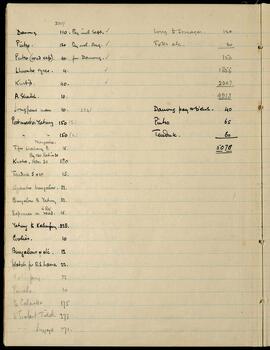
2907
Damang 110. Pay incl Sept. ✓ Lorry to Srinagar. 120.
Pintso. 120 Pay incl. Aug. ✓ Tolls etc. 30
Pintso (road exp). 40. for Damang. ✓ 150
Lhuentse syces. 4. ✓ 1856
Kurtip. 40. ✓ 2907
A. Sheikh. 10. 4913

Jongpens men 10. 3241 Damang pay & b'shish. 40
Postmaster Yatung 150 (S.) Pintso 65

    • 150 (L.) Tenduk. 60
      Nangarbe. 5078
      Tips Lhakang to 15.
      Pay 130. Ration 20
      Kusho. Adv. 30 180
      Tenduk 5 + 10 15.
      Gyantse bungalow. 32.
      Bungalow to Yatung 32.
      Rs/
      Expenses on road. 15.
      Yatung to Kalimpong. 228.
      Coolies. 10
      Bungalows & etc. 12
      Watch for R.S. Lama 22.
      Kalimpong. 32
      Parcels. 10
      To Calcutta 175
      To Sealkote Tickets. 273
      Luggage 171.
LSH/1/1/6/1/131 · Part · 1933-09-07
Part of The Ludlow & Sherriff Collection

SUMMARY:
The party splits, with S. going up the Lando Chu towards Molo and Tsari while Ludlow and Taylor head to Lusha; the diarist travels via Tsela Dzong with Gulla and the Tsongpen, aiming to meet Kusho. Taylor is improving but will avoid the passes, with Tendrup assigned most passes and Ludlow to do Lusha La; notes mention continuing rain, river levels on the Tsangpo and Nyang Chu, and timelines to Dewangiri. Mail news: Kusho has returned from Lhasa, and Norbhu redirected the mail via Gyantse.

CONTENT:
Sept 16 Party splits - S. up the Lando Chu then on to Molo, the Do La, Langong Valley & Tsari
L. & T. to Lusha - then up the Pan La across to Tsari. Tamnyen La - Po-Doshong La

14th Sept. } Halt Temo. Rained a good deal, hardly any sun to dry our seeds. All plans made for
15th " } future. Ludlow & Taylor go off to Lusha tomorrow, while I start off too, via Tsela Dzong - Taylor very much better & able to do quite a lot. Gulla & Tsongpen only accompany me, but we hope to pick up Kusho in Tsela Dzong.

16th September. Ligding. 8 miles. Fine, but still very cloudy, with rain apparently constant on the Main Range. We have now parted again, Ludlow & Taylor going over to Lusha to start collecting in that area, while I go West. Taylor will not do the Passes, but Tendrup will work them all but the Lusha La, which Ludlow will do. They will thus be very quick, & should leave Tse before the end of the month. Taylor wants to return as quickly as possible, seeing he cannot work the passes, & he should & must be in Dewangiri by the 16th November. I work out my moves to get me down there by the 1st Dec. if I travel fast, & so I hardly think that Ludlow will wait for me so long. It looks as if we should not meet again this trip till we are in Kashmir, or won't see Taylor certainly. He is much better, & were his tongue only reasonably clean, I would say he was safely out of the wood. He is a difficult person to feed, being very particular about what he eats, & that is not easy to cope with on a trip like this. Although the rain continues, - we have had no sun at all these last three days - the monsoon must be over except for odd rain on the Main Range, which we always notice goes on till the 18th Oct or so. The Tsangpo went down two or three feet during the week we were at Temo, and it is a good 12 ft or more lower than it was when at its highest. The Nyang Chu does not show such a big drop nearly.

17th Sept. Tsela Dzong. Rain at night & showery today. It took us a good long time to get ponies etc to be transported over here. There are 5 branches of the river to cross. The Nyang Chu has only dropped a foot since we were here on 10th August. Kusho is here, having returned from Lhasa in 8 days. The mail had not reached Lhasa when he caught it up on, I think, the 31st Aug. Norbhu stayed the mail runner & sent him back here, while he sent on our mail to Gyantse by the Tibetan post. He expected it back in 8 days & was then to send it to

LSH/1/1/1/1/203 · Part · 1933-09-25
Part of The Ludlow & Sherriff Collection

SUMMARY:
The diarist recounts a shooting outing near Gyantse with Henlin and Worth, marked by mishaps and a listed bag. At SAKANG, they describe comfortable staged travel, leaving Kusho behind and continuing with two servants and Tenduk, with clear weather, views of Gyantse, and harvest scenes en route to O. Sowgon.

CONTENT:
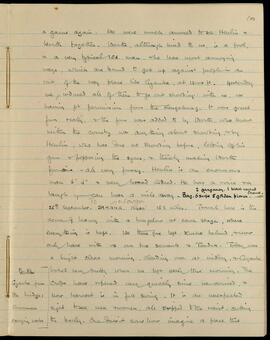
a game again. We were much amused to see Henlin & Worth together. Worth, although kind to us, is a fool, & a very typical I.C.S. man. He has most annoying ways, which are bound to get up against people in an out of the way place like Gyantse, at 13000 ft. Yesterday we induced all of them to go out shooting with us, we having got permission from the Kengchung. It was great fun really, & the fun was added to by Worth, who knew neither the country nor anything about shooting, & by Henlin, who has done no shooting before, letting off his gun & peppering the syces, & thereby making Worth furious - all very funny. Henlin is an enormous man 6' 4" & very broad indeed. He has a voice & a laugh you can hear a mile away. - Bag. 6 snipe 5 golden plover. 2 garganey, 1 black necked crane.

25th September. SAKANG. 13400' 15 1/2 miles. To O. Sowgon. Travel here is the acme of luxury with a bungalow at each stage, where everything is kept. We therefore left Kusho behind, & now only have with us our two servants & Tenduk. Today was a bright clear morning, clouding over at midday, & Gyantse looked very pretty when we left early this morning. The crops have ripened very quickly since we arrived, & now harvest is in full swing. It is an unexpected sight to see men & women, all strapped to the waist, cutting the barley. One doesn't somehow imagine a place this

B. 32. Gyantse from the bridge: A woman carrying water

LSH/1/1/1/1/159 · Part · 1933-09-24
Part of The Ludlow & Sherriff Collection

SUMMARY:
Notes on catching butterflies, shooting Blood pheasants at Homo, and finding a bright blue delphinium. The Dzongpen of Lhakang was informed of the party’s arrival via Kusho. Detailed route description from camp to Lhakang Dzong, crossing the river and passing through scrub and conifer forest to open shrubland.

CONTENT:
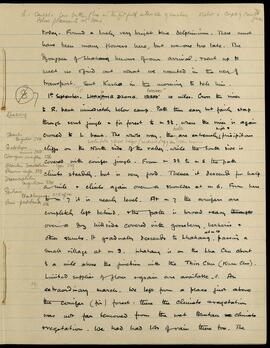
L. caught a few butterflies in the fitful intervals of sunshine. I shot a couple of Blood pheasants at Homo. 78 male

today. Found a lovely very bright blue delphinium. There must have been many flowers here, but we are too late. The Dzongpen of Lhakang knows of our arrival, & sent up to meet us & find out what we wanted in the way of transport. Sent Kusho in the morning to tell him.

1st September. To H 10000 LHAKANG DZONG. 12200' 10 miles. Cross the river to R. bank immediately below camp. Path then easy but fairly steep through scrub jungle & fir forest to m 3 1/2, where the river is again crossed to L bank. The whole way, Waterfalls of great height (vertical drop 500') also occur. there are extremely precipitous cliffs on the North side of the valley, while the South side is covered with conifer jungle. From m 3 1/2 to m 5 the path climbs steadily, but is very good. Thence it descends for half a mile & climbs again over a shoulder at m 6. From here to m 7 it is nearly level. At m 7 the conifers are completely left behind, & the path is broad & easy over a dry hillside covered with gooseberry, berberis & other shrubs. It gradually descends to at m 10 Lhakang, passing a small village at m 9. Lhakang

LSH/1/1/6/1/69 · Part · 1937-06-05
Part of The Ludlow & Sherriff Collection

SUMMARY:
The diarist records extensive Primula and Omphalogramma observations around a steep pass, notes multiple slips on a difficult grass slope, and experiences photographic mishaps in wind, mist, and rain. They glissade down avalanche snow, then travel to Langong in heavy rain, buy a young yak, develop photographs, and plan to go to the Lo La on the 10th.

CONTENT:
Omph brachysiphon

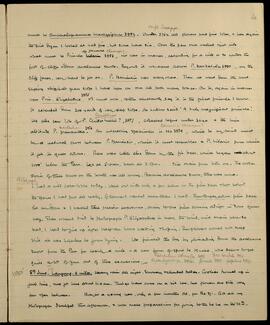
must be Omphalogramma brachysiphon 3982. Under 3762 all flowers had five lobes, & here again the first dozen I looked at had five, but some have six. Over the pass we walked right into what must be Primula aff strumosa chionantha 3983, it was in masses, extending for a mile or so under the foot of cliffs & down avalanche shoots. Beyond it we came across P. barbatula 3990, on the cliff faces, very hard to get at. P. tsariensis was everywhere. Then we went down the most slippery & difficult grass slope I have been on and all took many tosses. On it, again in masses was Prim. Elizabethae 3985 or must now, rather reluctantly, say it is the finest primula I know. It extended down 200 yards of very steep slope. As Ludlow said "A truly magnificent primula". We also saw lots of P. Geraldinae 3987, collected before under 3640 + the high altitude P. mosheoidea 3986. An interesting specimen is No 3984, which to my mind must be a natural cross between P. tsariensis (tsariensis x chionantha?), which it most resembles & P. hilaris from which it gets its queer colour. There was little else down to the fir trees, which began about 1000' below the Pass. Left at 5.0 am, back at 3.0 pm. Mist & rain from then on. The coolies' stories of thick snow on the south was all wrong. Barring avalanche snow, there was none.

Photograph
I had a wild catastrophe today. Went out with only a few films in the film pack case behind the spares I had put all ready. Of course I wanted more than I had. The Dufaycolor film pack let me down & I wasted three precious exposures, owing to one film coming adrift in some queer way. Then when I tried to photograph P. Elizabethae in mass, the wind, mist & rain were so bad, I had to give up after half an hour's walking & hoping. The flowers would not keep still & it was hopeless to form trying. We finished the day by glissading down the avalanche snow from the Pass for nearly a mile - a new form of sport to Kusho, who seems to get quite a bit of fun out of these excursions. R. campylocarpum 3994, vernicatum 3991, forrestii 3995, populare 3997, etc. louloula 3992.

11900' 8th June. To Langong. 6 miles. Heavy rain all night. Scenery occluded today. Coolies turned up in good time, and for here about 11.0 am. Things have come on a bit here, but flowers are still very few & far between. Bought a young yak, only a few months old, for Rs. 3/-. Got all my photographs developed this afternoon, & will make preparations for going to the Lo La on the 10th.