Mostrando 7 resultados

Descripción archivística
7 resultados con objetos digitales Muestra los resultados con objetos digitales
LSH/1/1/6/1/99 · Part · 1933-07-05
Parte de The Ludlow & Sherriff Collection

SUMMARY:
The diarist reports hiring a new Khampa servant named Kesang, a difficult crossing of the broken bridge at Shona where Jill fell, and short, largely uneventful marches. In Paka they met an exiled Tibetan from Lhasa who assisted with transport arrangements, and later heavy rains delayed travel toward Samo; a coolie from Lando reportedly drowned while fording the river.

CONTENT:
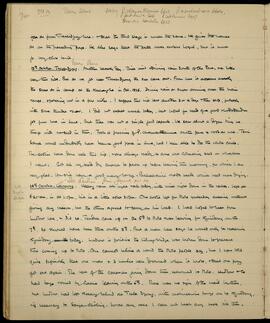
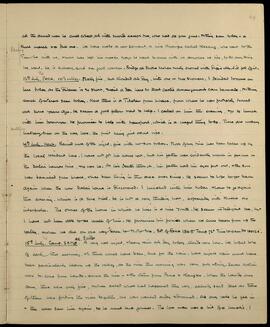
all the armed men he could collect, all with swords except two, who had old flint guns. Nothing seen today - a short march and a dull one. We have made a new servant, a nice Khampa called Kesang, who went to the Tumba with us, and has left his master says he wants to come with us anywhere we like, to do anything we want. He is a cheery soul and a good worker. Bridge at Shona broken and only crossed with difficulty. Jill fell off it.

13th July. PAKA. 10 1/2 miles. Mostly fine, but clouded all day, with one or two showers. I decided to come on here today as the distance is so short, and wait a day here so that coolie arrangements can be made. Nothing much of interest seen today. Here there is a Tibetan from Lhasa, from where he was probably turned out some years ago. He seems a good fellow and out to help. I called on him this evening, and go to lunch with him tomorrow. He promises to help with transport, which is a useful thing to do. There are many mulberry trees on the way here, the fruit being just about ripe.

14th July. Halt. Rained most of the night, fine with no sun today. Most of my time has been taken up by the local resident here. I have not got his name yet, but his father was evidently much in favour in the Dalai Lama's time, and so was he. At his death though, his father had his eyes put out, and the son was banished from Lhasa, and has been living in this area ever since. He seems to hope to get back again when the new Dalai Lama is discovered. I lunched with him today, and have to go again this evening, which is a sore trial. He is not a very thrilling host, especially with Kusho as interpreter. The owner of the house in which he lives is a nice youth. He seems intelligent too, but I have not been able to see much of him. He promises his ponies when we come back from up the valley, and when we are on our way back to Molo too. BP. of Paka 194.8' Temp 72° Time 10.0 am. Ht 10012.4'.

15th July. Camp. SAMO. To AR. 8 miles. A very wet night, and heavy rain all day today, clouds very low. We hoped to be off early this morning, or think would have been, but for the rain. Last night's rain must have been particularly heavy up the valley, as the river this morning was very full and dirty. Seven coolies were to come from Lando - across the river - and the others from Paka and Kangka. When the Lando ones came, there were only five, and when asked what had happened they very calmly said that as three of them were fording the river together, one was washed away and drowned. At any rate he fell in and they never saw him again, so he must be a goner. The lost man was a bit of a lunatic. I
LSH/1/1/6/1/103 · Part · 1933-07-05
Parte de The Ludlow & Sherriff Collection

SUMMARY:
At W. Tsanangho, the diarist reports heavy rain and poor visibility, explores the Tsanangha valley, and notes scarce primulas overall but finds two primulas new to them (No. 5865 of the Dryadifolia section and No. 5872, a nivalid close to P. sino-purpurea). Logistics are disrupted due to Kushu’s arrangements, reducing planned time on the Kuchaha; Kesang and a local accompany the outing, with observations of musk deer and local attire from Kongbo.

CONTENT:
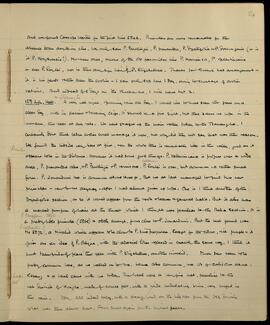
And we found Cassiope wardii for the first time 5846. Primulas are more remarkable for their absence than anything else. We only saw P. Paulingii, P. prenantha, P. Dryadifolia & P. doshongensis (or is it P. Kongboensis?). No new ones, none of the old favorites like P. baileyensis, P. valentiniana or even P. Rockii, nor is there any sign here of P. Elizabethae. Thanks to Kushu's bad arrangements—it is his fault rather than the coolies—I can only stop here 1 day, owing to shortage of coolies' rations. And instead of 6 days on the Kuchaha, I will have but 2.

W. Tsanangho
18th July. Halt. A very wet night, & pouring rain all day. I would like to have seen this place on a clear day, with its glaciers & towering cliffs. It should be a fine sight, but there seems no hope in the monsoon, this year at any rate. We went straight up the main valley today to the Tsanangha. I certainly don't think laden coolies could manage it now, but why did they not say that was their reason.

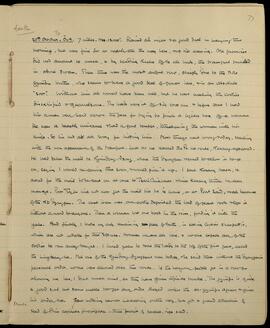
We found the hillside very bare at first, on the whole there is remarkably little in this valley, good as it appears to be in the distance. However it had some good things. P. Valentiniana is profuse over a wide area, P. prenantha also, & P. Paulingii & P. vernicosa. P. Rockii is over, but common—a rather small form. P. Jonarduni too is common above 14000 ft. But we at last managed to find two new primulas—new to us anyway—after I had almost given up hope. One is I think another of the Dryadifolia section, or so it would appear from the roots & leaves & general habit. But it also has a marked pompom of hairs at the throat, which I thought was peculiar to the Bella section. It is a pretty little primula (5865) & oddly enough, grows close to P. Jonarduni. But the best found was No 5872, a Nivalid which appears to be close to P. sino-purpurea. Except for the colour, rich purple—it gives one an idea of P. obliqua, with the adaxial lobes reflexed in exactly the same way. I think it must take pride of place this year with P. Elizabethae, another nivalid. Musk deer seem to be pretty common here, as we walked on to two. Lerwa also common, & a lot of Coelicolor above.

Kesang & a local came with me today. The local wore a vampire hat, peculiar to the wet districts of Kongbo, made of coarse felt, with a wide undulating brim, very useful in this rain. Very cold indeed today, with a strong wind on the hilltops from the SW, driving what was then almost sleet. Fresh snow again on the highest peaks.

LSH/1/1/6/1/127 · Part · 1933-09-01 - 1933-09-07
Parte de The Ludlow & Sherriff Collection

SUMMARY:
Diary notes record halts and short marches from Kyabden via Cha-Chomo Dzong, Te, Pang/Pona, Ligang, and into Dzeng, with generally fine weather and some rain. Plant records include Gentiana waltonii and Rhododendron bulu. Taylor falls ill and, with Kesang (whose poisoned foot is lanced), goes down the Tsangpo by kowa boats; the writer later meets Ludlow near Temo La.

CONTENT:
not meet Krush on the way back.

Kyabden
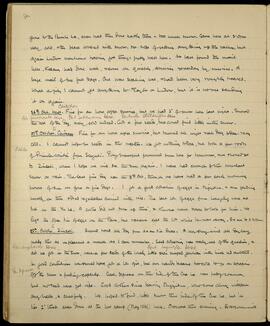
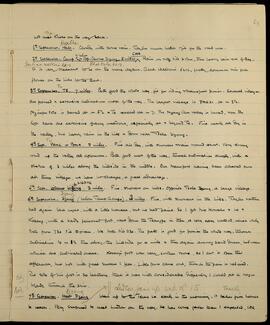
1st September. Halt. Cloudy with some rain. Taylor much better fit for the road now.

2nd September. Camp below CHA-Chomo Dzong. Smiles. Rain on and off till 2.0 pm, then heavy rain rest of day.
Gentiana waltonii 6212. Rhododendron bulu 6213.
It is very pleasant to be on the move again. Gentiana waltonii 6212, pretty common in full flower on the hills to the East.

To 3rd September. TE. 7 miles. Path good the whole way, fit for riding transport ponies. Several villages are passed and extensive cultivation most of the way. The largest village is PAGZI, at mile 2 1/2. Nyönpa tolo is passed at mile 5 1/2 and Te reached at mile 7. The Nyang Chu valley is broad, on the left bank are extensive grassy meadows, especially at and beyond Te. Fine nearly all day in the valley, but heavy rain in the hills and down near Tsela Dzong.

To 4th Sept. PANG or PONA. 8 miles. Fine all day, with showers of rain round about. Very strong wind up the valley all afternoon. Path good most of the way, through cultivation chiefly, with a stretch of 3 miles along the hillside in the middle. Our transport having been collected from all these villages, we have no changes, a great advantage.

LIGDING
5th Sept. Ligang. 3 miles. Fine, showers on hills. Opposite Tsela Dzong, a large village.

Dzeng
6th September. Dzeng (below Temo Gompa). 8 miles. Fine, with showers in the hills. Taylor rather bad again last night, with a little nausea, but no bad pains. So I got two kowas and he and Kesang, with a badly poisoned foot, went down the Tsangpo in them, a very easy method, which only took from 7.30 till 10.0 am. We took till 11.30. The path is good for ponies the whole way, through cultivation to mile 1 1/2 then along the hillside for a mile and then again among sand dunes, between which are cultivated areas. Kesang's foot was very swollen and sore, so I cut it open this afternoon, but not with great success I fear. Little pus came out, though the pain is relieved. The sole of his foot is so leathery, that it was with considerable difficulty I could get a razor blade through the skin.

Ludlow joins up with L. & S. Temola

Dzeng
7th September. Halt Dzeng. Went up to the Temo La early in the morning. It takes five hours to reach. Very surprised to meet Ludlow on the way. He has come faster than I expected. We

LSH/1/1/6/1/146 · Part · 1936-10-02
Parte de The Ludlow & Sherriff Collection

SUMMARY:
Entries for 13 and 14 October describe wet, misty conditions around Trashidzung and Langong, limited success collecting rhododendron seed, and a pressing of P. chamaethauma, with coolies assisting and seeds dried for packing. News from Ludlow reports delays and rerouting due to the Lilung bridge collapse, with casualties and mail issues, and mentions movements via Lhacha, Tsela Dzong, and toward Kyindong/Sangachöling.

CONTENT:
74a
Oct. 13 Tsari Sama
seeds of P. chamaethauma 6603, P. morsheadiana 6604,
P. sikkimensis 6606, P. vernicosa 6607,
Swertia kantelu 6605.

far as from Trashidzung here: & that the third stage is much the same. He gives two names as on the preceding page. He also says that the path never enters Loque, but it must go very close to it.

Tsari Sama
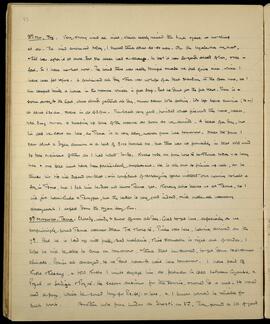
13th October. Trashidzung. Another beastly day. Thick mist & driving rain south of the Pass, & little on this side. But as we got near Trashidzung the sun came out. From here it appears exactly the same as in camp at the Kashong La in Oct. 1936. Driving rain or snow coming over the main range, petering out in a few miles. I suppose this will last another 3 or 4 days then stop, probably with some thunder snow. I did not expect much today, but hoped for seed of a good rhododendron got from here in June. But there was not a single good capsule. We saw about a dozen tiny wee things with no seed in them. Took a pressing of P. chamaethauma on the pass & root as well. Tsari Sama would undoubtedly have been a good place in June, had I been able to do the whole circle. The coolies have done well this trip, & are always ready to come out collecting seed or whatever I want. Got all my seeds dry enough to pack up before leaving this morning, for which I am very glad. We still have a good many Lo-La - Pachakshiri rhodo seeds which need more drying.
See Ludlow's diary - Kew Journal XII 14.

14th October. Langong. Heavy rain all night & all today, with mist right down in the valley. Left at 8.30 am, in at 1.0 pm, kit in a little after 3.0 pm. One coolie left for Molo yesterday evening without giving any reason, but the others agreed to carry on his load. I had hoped to hear from Ludlow here, & did so. Tendup came up on the 5th to Molo & was leaving for Kyindong on the 7th, so should have been there on the 9th. But a man here says he would only be reaching Kyindong today. Ludlow is positive the Lilung bridge was broken down to prevent their coming up to Molo. One cannot believe a word the Molo people say, but I was told quite definitely that one man & 3 mules were drowned when it broke, & that one pony got out again. The rest of the caravan going down then, returned to Molo. Ludlow & Co had to go round by Lhacha leaving on the 5th. There was no sign of the mail between, but Ludlow had left Kesang behind at Tsela Dzong, with instructions to go on to Kyindong, if necessary to Sangachöling. So at any rate I can not hear any more till then.

LSH/1/1/6/1/151 · Part · 1938-10-22
Parte de The Ludlow & Sherriff Collection

SUMMARY:
Rained overnight but the party traveled about 7 miles to Öla, facing major disputes with transport coolies allegedly stirred up by the Noro Gyumpu's brother; the diarist struck a man who threatened a woman with a knife. Kesang, having taken mail to Kyindong Dzong where the Dzongpen refused to forward it, was sent back to have it sent on to Tsari Chunchar, leaving Taylor unlikely to receive it until his return.

CONTENT:
troubles
77

20th October. ÖLA. 7 miles. App. 13000'. Rained all night & a good deal early this morning, but was fine for us nearly all the way here, up till evening. All promises did not amount to much, & by sending Kucho off to all huts, the transport started in about 8:00 am. Then there was the most awful row, chiefly due to the Noro Gyumpu's brother, who seems to have a good deal of power here, & is an absolute "soor." Without him all would have been well, but he was making the coolies dissatisfied & quarrelsome. The loads were not off till 10:00 am & before that I had hit a man very hard across the face for trying to pinch a lighter box off a woman. He was a beastly nuisance & had a foul temper, threatening the woman with his knife, so I'm not at all sorry for hitting him. Most things went wrong today, starting with the non-appearance of the transport. Just as we reached the Pa La route, Kesang appeared. He had taken the mail to Kyindong Dzong, where the Dzongpen refused to allow it to go on, saying I would be coming there soon, & would pick it up. I sent Kesang back, & asked for the mail to be sent on at once to Tsari Chunchar, which Kesang thinks he can manage. Poor Taylor will not now get the mail till he is home, or

LSH/1/1/6/1/156 · Part · 1938-10-22
Parte de The Ludlow & Sherriff Collection

SUMMARY:
Snow blocks progress near Bimbi La and limits collecting; the party arrives to deep cold and finds a large, roughly handled mail, with Kesang bringing it in by sunrise. Despite brief clear spells at Chikchar and Chosam, persistent snowfall yields only a few seeds and some Primula winteri roots from Senjuti, and pony transport is arranged toward Zimsati. The writer notes inability to send anything to Taylor or Ludlow.

CONTENT:
80a

gone to the Bimbi La, even had they done badly there — too much snow. Came here at 3:00 pm
very cold, the place covered with snow. No hope of getting anything up the valley, but
again Ludlow mentions having got things pretty well here. At last found the mail
here. Kesang had done well, came on quickly, arriving yesterday by sunrise. A
huge mail of two full bags. One was soaking wet, and had been very roughly treated.
What a pity I cannot get anything to Taylor or Ludlow, but it is no use sending
it on again.

Chikchar
26th Oct. Halt. Fine for an hour after sunrise, but we had 3 inches of snow here last night. Snowed
Gen. sino-ornata 6640. Gent. sikkimensis 6641. Gentianella stellarifolia 6642.
the rest of the day, very cold indeed. Got a few seeds, but could find little in the snow.

27th October. Chosam. Fine for an hour after sunrise, but snowed all night and day today. Very
cold. I cannot hope for seeds in this weather. We got nothing today, but took a few roots
P. sibirica
of Primula winteri from Senjuti. Pony transport promised from here for tomorrow, and should get
to Zimsati, where I hope we will see the sun again. I have had enough of this constant
snow

LSH/1/1/6/1/160 · Part · 1936-11-07
Parte de The Ludlow & Sherriff Collection

SUMMARY:
The diarist describes violent winds near Tre that wrecked tents, forcing a camp beside a house, and a difficult march with wildlife sightings before nearing Tsona. On 9 November they reached Tsona amid snow, found Pinbo ill with malaria, settled arrangements for ponies, paid off Kusho and Kesang, and noted correspondence from Ludlow at Shakti.

CONTENT:
8th Nov, Tre. Very strong wind all night, which nearly ruined the tents and gave us no sleep at all. The wind continued today, I should think about 40-50 mph. On the Nyalaha Malwat, Jill was after it at once. But she never had a chance. In 100s it was 50 yards ahead of her, 1000 in fact. So I have no hat now. The wind there was really terrific and made me feel quite sick, which I have never felt before. It continued all day and there was no hope of a tent standing in the open here, so I am camped beside a house in the manure which is feet deep. But we drive for the full blast. There is a storm away to the East, where clouds gathered all day; snow seems to be falling. We left before sunrise (to us) at about 6:30 am, were in at 4:30 pm. The locals very good, provided what firewood they have, water, yak dung and soon were sweeping up some of the manure as soon as we arrived. A beast of a day, but I'm glad we came on here, as Tsona is a very easy march from here tomorrow. Near the pass I saw about a dozen ammon and a herd of 8-10 burhel too, but there was no possibility in that cold wind to take a cinema of them as I had hoped to do. Kusho rode on from here to Tsona today - a long trek and one that must have been particularly unpleasant. He is all out to finish up well, as he thinks his tip will depend on that: is confident of arranging yaks without our having to halt a day in Tsona, but I tell him he does not know Tsona yet. Kesang also leaves us at Tsona, so I will just have Lhakpa and Tsongpen, but the latter is very good indeed, will make all necessary arrangements I expect down the Nyam Jang Chu.

9th November. Tsona. Cloudy, windy and snow off and on all day. Glad to get here, especially as we surprisingly found Tsona warmer than Tre or Shoto. Pinbo was here, having arrived on the 7th. But he is laid up with pretty bad malaria; his stomach is right out of order. I hope he will be able to come on tomorrow; I think that he should, to get down to a warmer climate. Ponies all arranged, so we don't have to wait here tomorrow. I have paid off Kusho and Kesang, and told Kusho I might engage him as postman in 1940 between Gyantse and Poyal or Sadiya and Poyal. He seems anxious for the service, and would do it well. He would need a pony, which he could buy for Rs. 40/- or less, and I know would be reliable for such work. Another note from Ludlow at Shakti on 3rd. They found a lot of food.