
Affichage de 5 résultats

Description archivistique
5 résultats avec objets numériques Afficher les résultats avec des objets numériques
LSH/1/1/6/1/99 · Part · 1933-07-05
Fait partie de The Ludlow & Sherriff Collection

SUMMARY:
The diarist reports hiring a new Khampa servant named Kesang, a difficult crossing of the broken bridge at Shona where Jill fell, and short, largely uneventful marches. In Paka they met an exiled Tibetan from Lhasa who assisted with transport arrangements, and later heavy rains delayed travel toward Samo; a coolie from Lando reportedly drowned while fording the river.

CONTENT:
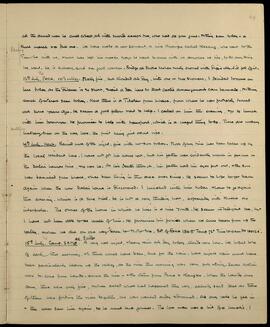
all the armed men he could collect, all with swords except two, who had old flint guns. Nothing seen today - a short march and a dull one. We have made a new servant, a nice Khampa called Kesang, who went to the Tumba with us, and has left his master says he wants to come with us anywhere we like, to do anything we want. He is a cheery soul and a good worker. Bridge at Shona broken and only crossed with difficulty. Jill fell off it.

13th July. PAKA. 10 1/2 miles. Mostly fine, but clouded all day, with one or two showers. I decided to come on here today as the distance is so short, and wait a day here so that coolie arrangements can be made. Nothing much of interest seen today. Here there is a Tibetan from Lhasa, from where he was probably turned out some years ago. He seems a good fellow and out to help. I called on him this evening, and go to lunch with him tomorrow. He promises to help with transport, which is a useful thing to do. There are many mulberry trees on the way here, the fruit being just about ripe.

14th July. Halt. Rained most of the night, fine with no sun today. Most of my time has been taken up by the local resident here. I have not got his name yet, but his father was evidently much in favour in the Dalai Lama's time, and so was he. At his death though, his father had his eyes put out, and the son was banished from Lhasa, and has been living in this area ever since. He seems to hope to get back again when the new Dalai Lama is discovered. I lunched with him today, and have to go again this evening, which is a sore trial. He is not a very thrilling host, especially with Kusho as interpreter. The owner of the house in which he lives is a nice youth. He seems intelligent too, but I have not been able to see much of him. He promises his ponies when we come back from up the valley, and when we are on our way back to Molo too. BP. of Paka 194.8' Temp 72° Time 10.0 am. Ht 10012.4'.

15th July. Camp. SAMO. To AR. 8 miles. A very wet night, and heavy rain all day today, clouds very low. We hoped to be off early this morning, or think would have been, but for the rain. Last night's rain must have been particularly heavy up the valley, as the river this morning was very full and dirty. Seven coolies were to come from Lando - across the river - and the others from Paka and Kangka. When the Lando ones came, there were only five, and when asked what had happened they very calmly said that as three of them were fording the river together, one was washed away and drowned. At any rate he fell in and they never saw him again, so he must be a goner. The lost man was a bit of a lunatic. I
LSH/1/1/6/1/141 · Part · 1936-10-02
Fait partie de The Ludlow & Sherriff Collection

SUMMARY:
At Lo La, the diarist collected Primula and Rhododendron specimens around a small lake amid frost, snow, and sun, noting Jill’s reluctance to collect seeds and the coolies’ hardiness. On October 8 a halt was made; a circuit to the southwest of the lakes yielded a few bulbs, and Tsongpen arrived reporting difficulties obtaining ripe seed, fears of Lhopas on the route, and a theft problem with a dismissed man.

CONTENT:
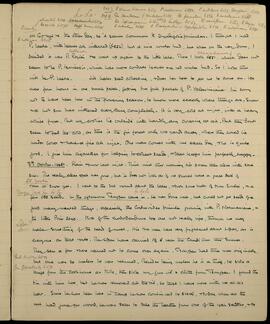
Lo La. Oct 7. P. chamaethauma 6551, P. calderiana 6552, P. subularia 6553, tsangpoensis 6554.
Oct 8. Gent. hamberxii f. caulibaccans 6555, Rh. pumilum 6556, R. concatenans 6560.
Rh. lopsangianum 6561, 6567 R. lindleyi 6562, R. xeriflorum 6563, R. haysii 6565.
R. elatum 6568, R. brachyanthum v. hypolepidotum 6576, R. sulphureum 6580.
abrivale 6558, normaniana 6574.
laccata 6575, Omph. minor 6585.

On Gonyi-re the other day, so it seems common to Omphalifolia primulas. I thought I had P. laeta, with leaves all withered (6552), but a nice winter bud, but when on the way down, I decided it was P. calderiana so went up again to the little lake. There I took 6551, which does not seem to be P. tsariensis, which has more cordate leaves & a red winter bud. So I hope this will be P. laeta. Jill hates seed collecting, & does her best to get me to come on. We were four hours in one small patch, getting two full packets of P. valentiniana. I'm sorry not to have been here in the flowering season, to know more exactly where things are. Snow & a hot sun has withered everything completely. It is very cold at night, with a heavy white frost. But my coolies lie outside with hardly any covering at all. But they don't seem to feel the cold, as there is the fir forest only 100 yards away, where they could lie under cover & have a fire all night. One man comes into me each day, this is quite good. I give him cigarettes for helping to collect seeds, & that keeps him perfectly happy.

8th October. Halt. Rain & snow last night. Thick mist this morning till 9.00 am then clear with some sun. The really clear spell has gone, but it does not look as if we should have a great deal of rain or snow yet. I went to the SW round about the lakes, & took some bulbs of Nom. souliei, & a few odd seeds. In the afternoon Tsongpen came in. He has done well, but could not get seeds of a good many wanted things, especially the Cortusoides primula growing with P. normaniana, & the little Prim 3640. Most of the rhododendrons too are not really ripe, though we may make something of the seeds of most. His two men were very frightened about Lhopas, as is everyone on that route. The Lhopas have carried off 5 near the Chudi-Cun this summer. They saw a few & were warned not to come over again. Tsongpen had three men originally, but one was so useless he was returned. Besides being useless he is a thief. He stole a knife from the cookhouse at Molo, then stole my gun oil & cloth from Tsongpen. I found the tin with him here, but he has removed all the oil, so that I have none with me at all now. Since he has been here in camp he has continued to steal, & today when all the rest had gone for wood, he was seen to take the leather from one of the yak saddles, & to...

LSH/1/1/6/1/165 · Part · 1938-11-24
Fait partie de The Ludlow & Sherriff Collection

SUMMARY:
The writer decides not to move a man expected to die soon, blaming lamas, and notes clear views over the Assam plains toward the Brahmaputra. On 25 November at Diwangiri, Ludlow is fit and busy with birds as the party, including Jill and the servants, prepares to pack for Kashmir.

CONTENT:
88

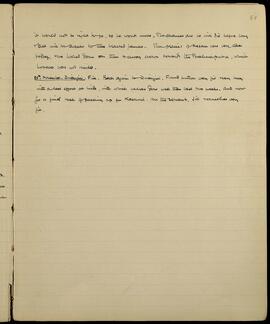
It would not be right to go, so he won't move. The chances are he will die before long and that will be thanks to these blasted lamas. The plains of Assam were very clear today, we looked down on them and away across toward the Brahmaputra, which however was not visible.

25th November. Diwangiri. Fine. Back again to Diwangiri. Found Ludlow very fit and very busy with a last effort at birds, with which he has done well these last two weeks. And now for a final rush of packing up for Kashmir. All the servants, Jill and ourselves very fit.

LSH/1/1/8/1/21 · Part · 1946-12-11
Fait partie de The Ludlow & Sherriff Collection

SUMMARY:
The diarist describes sparse official presence across Tibetan towns, then records halts and short marches with bullocks en route toward Tsela Dzong. A pony carrying Ludlow and Elliot’s bedding goes missing and is later recovered; Sandup returns to Kyindong, and difficult road conditions near Risho require manhandling loads, with mention of skin ferries.

CONTENT:
There can be no other country which runs itself like Tibet. Since we left Gangtok we have not come across many officials in their place of business. The T.T.A. Yatung is hardly ever anywhere but in Kalimpong. There was a dzongpon in Phari. There was one in Gyantse. But there were none in Nangkarbe, Pede or Gongkar. The Nethong Dzongpon was in residence, and we have seen none since then.

3rd Dec. Halt. Very windy last evening, but clear and cold at night, with not a very low temp. No one appeared this morning early, but by 11.0 some 30 bullocks had come. The men are a pleasant friendly - several having been with us before both in 1933 and 1938 in Langong or beyond Kyindong Dzong. They remember us, apparently quite happily, and they even remember Jill. They are going to Tsela Dzong with us, and we should have no trouble when once away from here. The only troublesome people are the representatives of the Dzong. The village here is very poor, but they seem friendly enough.

4th Dec. Kamchang. Bullocks got off in good time, last party leaving at 8.0. We were in at 11.30 - it is a short march. But bullocks take a very long time. One pony with Ludlow and Elliot's bedding never arrived in. Kamchang is the lower of two villages, each only with a few houses. Pollarded walnut trees are much in evidence.

5th Dec. Halt. Again had to halt, this time owing to the lost pony. It strayed up a side valley 2 miles from here. Sandup has gone back to Kyindong. Pony came in late at night - or rather the bedding was brought in - the pony had fallen and hurt itself.

6th Dec. Camp 2 m. beyond Chongrong on S. bank, left at 7.30: in with bullocks at 4.30pm. Road very bad for bullocks in 3 places, the worst being 1 1/2 m beyond Risho, where all loads had to be manhandled for 100 yds over a cliff. There are 'skin' ferries at 1 1/2 m above Risho, -

LSH/1/1/8/1/107 · Part · 1947-05-06
Fait partie de The Ludlow & Sherriff Collection

SUMMARY:
Arrangements for transport were secured via clerks in the absence of a Dzongpon or Drunyer, and Pedong Dorje plans to accompany the party to Trigu. On 14 May they marched 13 miles to Chong gye Dzong in intense heat, noted extreme dryness in the valley, passed a large wall of chortens, and recorded that the old Dzong is the birthplace of the Great Fifth Dalai Lama; plans were made to reach Trigu in two days.

CONTENT:
on, eventually a kind of dayig was given me, and transport was promised. All was done by 3 clerks, as there is no Dzongpon and even the Drunyer has gone, so no seal could be put on the paper, but all seems well. Pedong Dorje insists on coming with us to Trigu.

14th May. Chong gye Dzong 13 miles. A good day, but very hot indeed and difficult for Jill. Transport was late, but we got off at 7:30 and were in by 2:15 pm. The valley is very dry indeed. There is no water in the river at all, none in any irrigation channels and only a little in wells. The whole valley is broad and full of cultivation. I have never seen so much in Tibet before - even near Gyantse. About mile 7 we passed a small village with a huge wall of chortens all joined together, each about 6 ft square and perhaps 10-12 ft tall. There were supposed to be 108 chortens. I counted more than that. Here the old Dzong is perched on a ridge and consists of several buildings joined together by bridges. This is the birthplace of the Great Fifth Dalai Lama. All seems set for tomorrow's march, which could be done in one to Trigu. But I intend to go in two days. As usual, there is no Dzongpon. Every Dzongpon has been called to Lhasa, and only tsapos or clerks are left. But I don'