Showing 14 results

Archival description
14 results with digital objects Show results with digital objects
LSH/1/1/8/1/15 · Part · 1946-11-14
Part of The Ludlow & Sherriff Collection

SUMMARY:
The diary records a march from Rapdang to Tromda, followed by several halt days due to missing transport and delays, during which repairs were made and a cold bath taken in the Tsangpo. Samduprup was sent to Guru Namgyel Dz. and returned with orders to wait three days, and the Dzongpon’s envoy asked for the lamyig. A report is noted about an earlier plane crash near Langong (Langong Phu Chu), including details of four deceased men and insignia on the aircraft.

CONTENT:
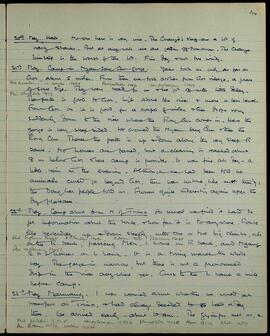
22nd Nov. Rapdang. Left at 0800: in at 2.0. Kit in at 2.30 till 6.0pm: some did not come in at all this evening. We paid for transport before leaving, which we have not had to do since Rong. The other method is much nicer.

23rd Nov. Tromda. A very short march of 7 miles only. We were in at 10.0 to find no 'dayig' had come. It was produced to us by a Tibetan who said he had found it on the road. So we know we will have a delay here. Some coolies still have not caught up since yesterday. We sent Samduprup to Guru Namgyel Dz. He returned late in the evening with the news that we must wait 3 whole days here for transport!

24th Nov. Halt. Tromda. Spent the day in clearing up, repairing boxes & generally getting things in order again. Also bathed in a very cold Tsangpo.

25th Nov. Halt. Again spent in repairs. The Dzongpon sent a man down to see us. He asked for the lamyig, but we managed to put him off. He was one of two who had to investigate a plane which crashed near Langong - in the 'Langong Phu Chu'. Kyindong & Guru Namgyel were ordered to look into this. The story he told us was that he went there in the 9th Tib month last year & that the plane must have crashed two years before. There were 4 men, one thought to be an officer with some rank badge on his R shoulder only. The plane had a star in blue & red on the wings. Two men were found some hundreds of yards away from the crash, two inside - one strapped to his seat. Their clothes were all rotten, so were the notes they carried, one man having a big wad of notes. The only thing...

LSH/1/1/8/1/109 · Part · 1947-05-06
Part of The Ludlow & Sherriff Collection

SUMMARY:
Describes a route from Cuny up a forked valley with irises, roses, and berberis, passing villages toward the Samu La, noting carved dorings and that the area is the 5th D.L.'s birthplace. On 16th May at Triju Dzong, details the ascent over a ridge with views of Triju Tso (apparently drying), descent past Drokpa tents to Teachee, and lodging in the butter tax collector’s house, noting local officials and yak herders.

CONTENT:
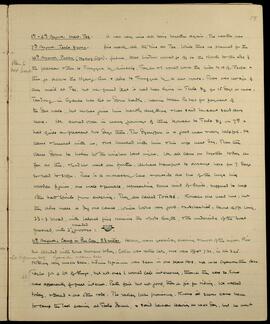
a picturesque place, more so when the whole fort, plastered onto a hillside beside the Dzong, is seen. Here also are monasteries, all because the place is the 5th D.L.'s birthplace. On the plain are two "dorings", about 15 ft high and carved. They appear very old. There is no writing on them. We crossed the main valley at Cuny and to the right bank, and went up a valley which is a fork of the main one. This valley is a nicer one, with a small stream in it, some [Iris laeter 12448] shrubs - roses and berberis - among irises, with lingkas at most of the small villages or gompas. About mile 7 1/2 this valley is left for one which comes in from the left or SE. is followed up to this village, the last on the way up to the Samu La. There is cultivation up to here, and a group of 5-6 homes together. Turdus merula maxima is common here; there are a good many snowcocks high up. T. henrici is common as far as this.

16th May Triju Dzong. A cold dismal morning, clearing up by 10.0, with occasional hail showers round about, and some heavy storms too. Left at 6.15 in at 1.30 pm. Kit in at 4.30 pm. The road is good nearly throughout, but from what I hear, this is an area where storms are common and there is a heavy snow and rainfall. Path ascends the same valley easily till the valley peters out at mile 5. There is a pass leading down here to the Yaktsang Chu, but our path keeps right-handed (west) and continues to climb to about mile 7 when a ridge is crossed. From here the Triju Tso is visible but not Triju Dzong. Now the lake consists of deepish water of about 1/2 mile at the N. end, 1/2 mile wide and then marshy shallow looking water further south. There is I believe much more water in summer; but the lake appears to be drying up. The descent is easy, with one or two ups and downs. A few Drokpa tents are passed but no pukka buildings till the stony ones here in Teachee. There must be 50 houses here, and I suppose they contain people who mostly look after yaks. We stayed in a house kept for the butter tax collector - quite good and convenient. There are 4 headmen. The Dzongpon.

LSH/1/1/3/3/59 · Part · 1936-03-10
Part of The Ludlow & Sherriff Collection

SUMMARY:
Botanical notes describe conifers, prunus, primulas, and rhododendrons, followed by short march entries between Rungzyung toro, Trashigong, and GHUNKARA. Lumsden treated many patients; the party met the Dzongpon at Trashigong, packed specimens and mail, and calculated food supplies before crossing the river.

CONTENT:
27

almost entirely conifer - either Pinus nepalense or P. longifolia. A most beautiful prunus tree was seen in several places. It reaches a height of about 60 ft. and its flowers are really beautiful. (Rhododendron arboreum 1185). I took another primula from the waterfall. There seem to be two there, both pink. One has flowers which are deeply cut, and the one I took today has almost entire petals.

Prunus cerasoides var. magnifica 1192
Primula gracilipes 1188
" filipes 1189
Rhododendron irroratum 1193

17th March. Rungzyung toro. A short and uninteresting march, but not very hot. Thunder is coming up and I fear we will soon have a bad storm. Lumsden has more and more patients each day and must have seen 25 today.

Elaeagnus umbellata 1196
Caesalpinia sepiaria 1197
Hypericum griffithii 1198

18th March Trashigong. An uninteresting march, with nothing much to be seen. The bauhinias on the river banks are fine. The Dzongpon met us, and we spent most of the day in packing up birds, flowers and getting off a big mail in two bags. We had awful calculations about the amount of butter, atta and rice to take with us, and now have I think 13 bags of rice and 3 of atta.

19th March GHUNKARA. Cross the river up up the R bank,

LSH/1/1/8/1/115 · Part · 1933-05-19
Part of The Ludlow & Sherriff Collection

SUMMARY:
The party halts amid difficulties with the Chanjö and then travels from Gor through the Nyam Sang Chu gorge, crossing the Nyam Sang Chu and Rong Chu, and passing small settlements like Men and Ngang en route toward Trimo. They camp near Trimo and reach Marmang, noting weather, logistics, and several plant collections, and are met by the Dzongpon at Trimo.

CONTENT:
104

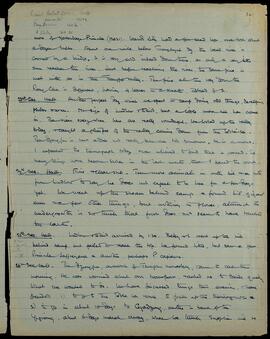
20th May. Halt. No one here is very nice. The Chanjö's staff are a lot of nasty sharks. But at any rate we are getting off tomorrow. The Chanjö himself is the worst of the lot. Fine day but too windy.

21st May. Camp in Nyam Sang Chu gorge. Yaks took us only as far as Gor, about 5 miles. From there we took coolies from Gor village, a place of some size. They were ready for us and we got off with little delay. (Rhod. cinnabarinum in flower 12469. Rhod. wallichii 12470. Campylocarpum 12484. Prim. atrodentata 12473.)
The path is good to Gor, high above the river and more or less level. From Gor on it is good for a couple of miles, then drops very suddenly down to the river where the Rong Chu comes in. Here the gorge is very steep sided. We crossed the Nyam Sang Chu then the Rong Chu. Thence the path is up and down along the very steep R bank. No houses are passed, but a clearing is reached about 8 m below Gor where camp is possible. It was fine all day - a little rain in the evening. Although we had been told no animals could go beyond Gor, this was untrue, like most things the Dongkar people told us. Flowers quite interesting again after the dry plateaus.

22nd May. Camp about 6 m N of Trimo. As usual we find it hard to get information about the route, how far it is to anywhere. Route like yesterday, up and down steeply, with one or two big climbs, all on the R. bank, passing Men, 1 house on R bank, and Ngang, 2 or 3 houses on L bank. (Rhod. hylaeum 12485. R. baileyi 12490. arboreum 12491. tsariense 12498. Prim. calderiana 12493.) It is a tiring march the whole way. The gorge is narrow, but there is not a pronounced drop in the river anywhere yet. Cross to the L bank a mile before camp.

23rd May. Marmang. I was worried about whether we would get transport at Trimo, and had almost decided to halt a day there. We arrived early - about 10 am. The Dzongpon met us, a (Rhod. pendulum 12525. campylocarpum 12526, glaucophyllum 12535, keysii 12536, ciliatum 12537. Prim. dickieana 12538, waltonii 12540.)

LSH/1/1/6/1/117 · Part · 1933-07-27
Part of The Ludlow & Sherriff Collection

SUMMARY:
The party halted at Tse, planned routes with Ludlow going north toward the plateau and then to Trongsa, while Taylor and the diarist would work NW of Tsela and cross the Nyang Chu to reach Trongsa by a new route. They found delayed mail at Tsela Dz, traveled by coracle to Tsela Dzong, and then on to Puchu (Nyang Chu); there was a dispute with Tendong in Gyantse over dak payments, cordial visits with the Dzongpon and his wife, and Sherriff visited to hear the wireless, after which Ludlow went on ahead while transport was arranged.

CONTENT:
58

1st - 6th August. Halt. Tse.
It was very nice all being together again. The weather was fine nearly all the time at Tse. While there we planned for the future, that Ludlow would go off to the North to the edge of the plateau then to Trongsa by himself. Taylor and I would work the hills NW of Tsela and then go across the Nyang Chu and also to Trongsa by a new route. There was no sign of any mail at Tse, but we found that it had been lying in Tsela Dz for 15 days or more.

7th August. Tsela Dzong.

10th August. Puchu (Nyang Chu).
Plans for next month.
Tendong in Gyantse has let us down badly, having taken Rs 240 for payment of the dak wala, but he has given him hardly anything and has said he cannot send any more. We came over in many journeys of three coracles to Tsela Dz on 7th and had quite a pleasant two days there. The Dzongpon is a good man and very helpful. He came and lunched with us, and we lunched with him and his wife next day. Then Sherriff came down to listen to the wireless last night. We all came on together today as far as this, then Ludlow went on further. We have transport to arrange here for 7 days so had to stop. There is a monastery here and outside are two of the huge big wooden figures, one male and female, representing

LSH/1/1/8/1/91 · Part · 1938-04-09
Part of The Ludlow & Sherriff Collection

SUMMARY:
The diarist reports failed transport arrangements at Haet Tse, a visit to the Dzong, and a river crossing by kowa, noting river levels and unsettled weather. On moving to Shoka in heavy rain, there were still shortages of pack animals and help; conditions improved as more servants and a helper from the Dzongpon arrived, though Samdup and much of the kit were still missing.

CONTENT:
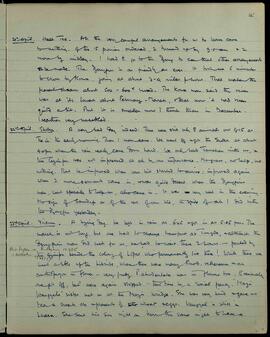
21st April. Haet Tse. All the very careful arrangements for us to leave came to nothing. Of the 15 ponies ordered, 2 turned up by 9.0 am and 2 more by midday. I had to go to the Dzong to see that other arrangements be made. The Dzongpon is as friendly as ever. It took me 6 minutes to cross by Kowa, going at about 3-4 miles per hour. That makes the present stream about 500 - 600 yards broad. The Kowa man said the river was at its lowest about February - March, and that now it had risen quite a bit. But it is smaller now I think than in December. Weather very unsettled.

22nd April. Shoka. A very bad day indeed. There were still only 8 animals out of 15 at Tse in the early morning. Then 1 more came. We went off for the Shoka at about 4.0 pm when the rain really came down hard. We only had Tamchen with us, and the Gyimpu was not impressed at all by our importance. No grass, no help, no nothing. But he improved when our kit started to arrive; improved again when 2 more servants came in, and was quite decent when the Dzongpon's man, sent specially to help us, also came in. It was very wet in the evening. No sign of Samdup or of the rest of our kit, in spite of all I did with the Dzongpon yesterday.

23

LSH/1/1/8/1/35 · Part · 1933-12-23 - 1933-12-24
Part of The Ludlow & Sherriff Collection

SUMMARY:
Notes on pine species near the river and collection of Ward's lily bulbs; very cold by the bridge below Trongchu Dz. Halt days are spent in camp developing photos and unpacking a working thermograph, with views toward the Sobhe la; awaiting Ludlow and Elliot while the Dzongpon, a monk, is present, and more animals and kit arrive with a note from Ludlow.

CONTENT:
Pinus tabuliformis 12028
Armandii 12029
Tsuga dumosa 12030
P. whitei 12021

More of yesterday's Primula (12021). Ward's lily had a few seeds left and we took about a dozen bulbs. About one mile below Trongchu Dz, the local river is crossed by a bridge. It is very cold indeed down there, as only a very little sun reaches the river. Just before reaching the river, the same pine is met with as in the Tsangpo valley. The pine all the way down the Rong Chu is different, having 4 leaves in a sheath, instead of 2.

23rd Dec. Halt. Another perfect day, which we spent in camp doing odd things, developing photos and so on. No sign of Ludlow and Elliot, but a little more help has come in. The views everywhere here are really wonderful. We looked up the valley today, and caught a glimpse of the valley coming down from the Sobhe la. The Dzongpon is here and does not really take over till tomorrow. He is a monk. I unpacked the thermograph today, and was relieved to find that it worked. So many things have become broken in the last months, that I feared the worst.

24th Dec. Halt. Fine and clear still. Ten more animals in with kit and a note from Ludlow to say he does not expect to be here for a few days yet. We went up the

LSH/1/1/8/1/37 · Part · 1933-12-24
Part of The Ludlow & Sherriff Collection

SUMMARY:
Notes on extreme temperatures and plant survival are followed by a halt during which the diarist and Ludlow visit the Dzongpon with gifts to secure cooperation for travel plans. They plan routes to the Sobhe La and Gyadzong, attempt to train a local to use a thermograph, test photographic equipment, and repack supplies.

CONTENT:
fairly easy. Supplies are not easy here, there is no doubt of that. The thermograph showed fine interesting results. But the whole question of temperatures to which plants are subjected is one of great interest. On the main range there is snow now; there has been snow above 13,000 or less for about a month or two. So the plants there are protected. But north of the Himalayan range for instance, there is no snow on the Tamu La for instance. Yet we had, at 11,500, a temp of -4°F. On the Tamu La, at 13,900', the temp must be 15-20° below zero. Yet the plants survive that. A contrast was the place Lil. Wardii was growing. The temps were down to -4° there, yet I could dig out the bulbs with my hand. Where we took P. sonchifolia(?), we broke the blade of the kukri cutting the frozen soil.

27th Dec. Halt. Fine again, but with thin cirrus cloud collecting. Ludlow and I called on the Dzongpon in the morning and gave him 1 pair of binoculars, 1 bottle of saffron, 1 Stanley flask, 1 than of cotton cloth, 1 picture frame and 1 photo of the Dalai Lama. That is a bribe. He seemed more pleased and easy than yesterday, and made no objections to our plans to go towards the Sobhe La on the 30th and to Gyadzong, with 50 coolies, on about the 6th or 8th of Jan. I have tried today to teach a local about the thermograph which Ludlow and I hope to put up above Laha on the Sobhe La route. He cannot read or write, but I think I will get him to do something. He seems quite intelligent and a decent youth. Took a few photos today to test the roll film adaptor which I fitted for use with either camera. As a test, I used the readings given by a GE meter.

28th - 29th Dec. Halt. Checked and repacked all kit, and took out a 2 months' supply for our visit to Gyadzong and a small supply for Ludlow and myself to take to the Sobhe La.

LSH/1/1/10/1/37 · Part · 1933-10-10
Part of The Ludlow & Sherriff Collection

SUMMARY:
Expected malaria patients from Punakha did not appear, despite H.H.’s orders, leading to frustration and letters to H.H. and Tobsgye. On 20 Oct the party marched to Taluku, found the hut gone, noted a better camp at Nahila, and collected 47 bulbs of Lil. Wallichianum; on 21 Oct they reached Balimape, where the Zimpon was away in Ha.

CONTENT:
shrubs all the way down, but otherwise the place looks dry. We were to have had 40 malaria cases here waiting for us, from Punakha, whose blood Hicks was to make slides of to see what kind of malaria they all suffer from. H.H. ordered these men to be produced. But there was nothing here, all the Dzongpon said was "There is no fever in Punakha". If this is really so, which I very much doubt, then all our gift of 5000 Paludrine is being just thrown away now. I personally think there is a lot of fever, but that the Dzongpon is a fool who has not the energy to call in the sick people. I've written a stinker to H.H. & told Tobsgye all about it. We are both rather sick at this. It seems v. difficult to get anything done for these people. They say they want something done, but then won't do anything, when one tells them what to do.

20th Oct. Taluku. A lovely day, with clouds in the morning, but clearing to the real cold weather dryness. This is an absurdly short march which I only arranged as there was a nice hut here, which would save trouble for the locals in making arrangements. But we got here to find the hut gone. That doesn't really matter as we have tents, but a much better camp would have been at Nahila, 4 miles on. We got 47 very fine bulbs of Lil. Wallichianum on the hillside across the valley here. Some are bigger than I have ever seen, but none has had more than 2 flowers on it, whereas in Kalimpong gardens they can have up to 5 flowers.

21st Oct. Balimape. Again fine though mostly clouded. We got in by 2.0 but kit not till 4.0 - 5.0 pm. The Zimpon is away in Ha, so we are spared any trouble here in the way of conversation & entertainment. He is a pleasant man, but it makes things easier if he is not here.

LSH/1/1/2/1/69 · Part · 1933-07-18
Part of The Ludlow & Sherriff Collection

SUMMARY:
After a late start from Tsuna, the party visited the Dzongpon to fix prices, then traveled via the Drong toward Lablung, ascended to the Nyongchung La, and descended into the Thang Chu valley where fuel and grazing were noted. Few flowers were seen, but a delphinium and a Corydalis were recorded; Himalayan blackbirds were numerous at Thang and gazelle were observed in the valley.

CONTENT:
33

= 14869 x 1.05 = 15612'. Ht of Thang = B.P. 186.4°, Temp. 52°.
Mean with Pass 56° = 13903' x 1.015 = 14120'.

Leave camp at Tsuna village & proceed to the Drong, reached at m 1. Thence across the plain to the north, towards the village of LABLUNG. At m 2 — ½ m short of the village turn right handed up a valley to the NYONGCHUNG LA at m 4. Ascent easy over open hillside. Bearing from La to Tsuna = 235° Mag. Rather steeper descent at 60° Mag to the Thang Chu valley. Follow up this valley across by a bridge at m 6. Good C.G. fuel available but limited: grazing, food.

A very late start, not moving off till nearly 10 am. Then a call on the Dzongpon till 11 while prices were fixed. Few flowers seen. A nice delphinium on the way up the valley to the pass, & a beautiful little Corydalis at the very top. Himalayan blackbird at Thang fairly numerous. Saw gazelle in the valley.

[Marginal notes:]
Delphinium pylzowii 657
Corydalis 658
Arenaria glanduligera 659
And