Showing 8 results

Archival description
8 results with digital objects Show results with digital objects
LSH/1/1/5/1/130 · Part · 1933-06-21
Part of The Ludlow & Sherriff Collection

SUMMARY:
Notes question the identification of Prim. No. 3301 as P. umbratilis, contrasting Cooper’s description with observed deep coloration and a high-elevation cliff habitat between 14–15,000 feet in the rhododendron zone. The plant is noted on very steep cliffs and is said to extend to the extreme top of the abies zone, with a cross-reference to 2576.

CONTENT:
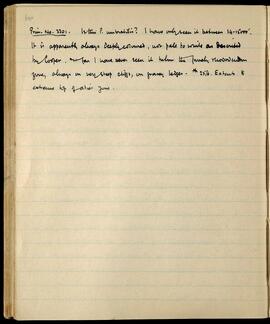
Prim. No. 3301. Is this P. umbratilis? I have only seen it between 14-15000'.
It is apparently always deeply coloured, not pale to white as described
by Cooper, so far I have never seen it below the purely rhododendron
zone, always on very steep cliffs, on grassy ledges. * 2576. Extends to
extreme top of abies zone.
LSH/1/1/5/1/106 · Part · 1937-06-07
Part of The Ludlow & Sherriff Collection

SUMMARY:
Notes compare Primula specimens: No. 2305, likely a variety of P. griffithii from 14,000–15,000 ft, resembling No. 21621 from Chikchar, Tsari (May 1936), with early, low, non-whorled flowering on open grassy slopes. No. 3227 is identified as P. hopeana, noted as unusually early; Cooper collected it on 20th June and 1st July, with later flowering previously observed in Tsari and in Tibet.

CONTENT:
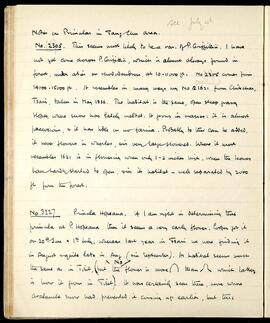
Notes on Primulas in Tang Chu area.

No. 2305. This seems most likely to be a var. of P. Griffithii. I have not yet come across P. Griffithii, which is almost always found in forest, under Abies or Rhododendron, at 10-11,000 ft. No. 2305 comes from 14,000-15,000 ft. It resembles in many ways my No. 21621 from Chikchar, Tsari, taken in May 1936. The habitat is the same, open steep grassy slopes, where snow has lately melted. It grows in masses: it is almost precocious, and it has little or no farina. Probably to this can be added, it never flowers in whorls, or very large flowered. Where it most resembles 1621 is in flowering when only 1-2 inches high, when the leaves have hardly started to open, and in its habitat - well separated by 2,000 ft from the forest.

No. 3227 Primula Hopeana. If I am right in determining this primula as P. Hopeana, then it seems a very early flower. Cooper got it on 20th June and 1st July, whereas last year in Tsari we were finding it in August and quite late in Aug (or September). Its habitat seems much the same as in Tibet, (but the flower is more [narrowly bell-shaped] than [widely bell-shaped] which latter is how it grows in Tibet). It was certainly seen there, here where avalanche snow had prevented it coming up earlier, but this

LSH/1/1/1/1/145 · Part · 1933-08-28
Part of The Ludlow & Sherriff Collection

SUMMARY:
Notes from Kangla and Narim Thang describe heavy rain, few birds, and generally poor collecting, though masses of Primula eburnea were found under rocks near a lake on the way to a pass. The party leaves the Zimpon, observes hanging glaciers, a flock of grandalas, and common snow partridges, and records several plant specimens.

CONTENT:
18 Aug. Kangla. Cremanthodium cf. linearis 471, Aconitum spicatum 473, Delphin. caeruleum 474, Cremanthodium palmatum var. Benthamii 475, Prim. eburnea 476, Mecon. aculeata 477, Prim. involucrata 479, Prim. glomerata 480, Polygonum forrestii 481.
71

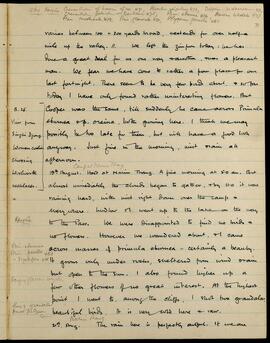
varies between 100 & 300 yards broad, extends for over half a mile up the valley. 11. We left the Zimpon today: he has done a great deal for us one way & another, was a pleasant man. We fear we have come to rather a poor place for our last fortnight. There seem to be very few birds about, & so far today I have only found rather uninteresting flowers. But Cooper was the same, till suddenly he came across Primula eburnea & P. oreina, both growing here. I think we may possibly be too late for them, but will have a good look anyway. Just fine in the morning, mist & rain all afternoon.

B. 26.
View from Singhi Dzong.
Women coolies choosing Woolworth necklaces.

Camp at Narim Thang
19th August. Halt at Narim Thang. A fine morning at 5.0 am. But almost immediately the clouds began to gather, & by 11.0 it was raining hard, with mist right down over the camp & everywhere. Ludlow & I went up to the lake on the way to the Pass. We were disappointed to find no birds & no flowers. However we wandered about, & came across masses of Primula eburnea - certainly a beauty. It grows only under rocks, sheltered from wind & rain but open to the sun. I also found higher up a few other flowers of no great interest. At the highest point I went to, among the cliffs, I shot two grandalas, beautiful birds. It is very cold here & raw.

Kangla
Prim. eburnea
Prim. pusilla 483
" dryadifolia 485
Hanging glaciers everywhere
flock of grandalas
Snow partridges common

Narim Thang
21st Aug. The rain here is perfectly awful. If we are

LSH/1/1/5/1/97 · Part · 1928-06-02
Part of The Ludlow & Sherriff Collection

SUMMARY:
The diarist ascends from Gonghe Gompa to the Lao La, crosses the pass, and collects a new Primula (P. geraniifolia, No. 3173) and notes Androsace geraniifolia (3175) in abies mixed forest. On 3rd June they halt at Lao La amid rain and mist, visit a cliff-top monastery, proceed to Jigche La, descend to Longtegang, join the main east–west road to the Pele La, and continue along a rough contouring path.

CONTENT:
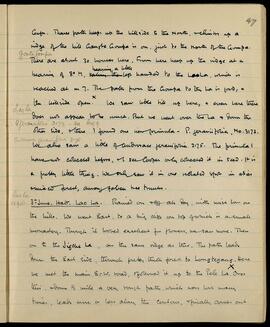
Gompa. Thence path keeps up the hillside to the North, climbs up a ridge of the hill Gonghe Gompa is on, just to the north of the Gompa.

There are about 30 houses here. From here keep up the ridge at a bearing of 8° M, bearing a little to the Lao La, which is reached at m 7. The path from the Gompa to the La is good, and the hillside open. We saw little till up here, and even here there does not appear to be much. But we went over the La and down the other side, where I found one new Primula - P. geraniifolia, No. 3173.

We also saw a little of Androsace geraniifolia 3175. The primula I have not collected before, and I see Cooper only collected it in seed. It is a pretty little thing. We only saw it in one isolated spot in abies mixed forest, among fallen tree trunks.

3rd June. Halt. Lao La. Rained on and off all day, with mist low on the hills. We went East, to a big cliff on top of which is a small monastery. Though it looked excellent for flowers, we saw none. Then on to the Jigche La, on the same ridge as this. The path leads down the East side, through pretty thick forest to Longtegang. Here we met the main E.-W. road, and followed it up to the Pele La. Over this, and down 1/2 mile a very rough path, which was lost many times, leads more or less along the contours, and finally comes out.

LSH/1/1/5/1/37 · Part · 1937-05-03
Part of The Ludlow & Sherriff Collection

SUMMARY:
The diarist notes a primula identified as P. bracteosa, previously found by Cooper in May 1915, and mentions it is their birthday. Heavy rain, hail, and deep fresh snow halt progress on the S. Ridge of Jirgang Chu, prompting plans to return to Naszi and possibly go via Chandesi; coolies reach camp by 2 pm and Dungshigon is again clouded.

CONTENT:
18

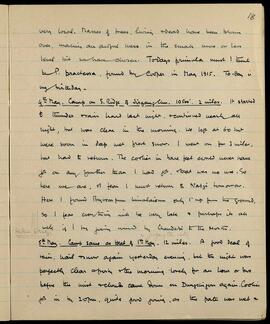
very local. Masses of trees, living and dead, have been blown over, making an awful mess in the small more or less level bit we have chosen. Today's primula must, I think, be P. bracteosa, found by Cooper in May 1915. Today is my birthday.

4th May. Camp on S. Ridge of Jirgang Chu. 10,500'. 2 miles. It started to thunder and rain hard last night, and continued nearly all night, but was clear in the morning. We left at 6:00 but were soon in deep wet fresh snow. I went on for 3 miles, but had to return. The coolies in bare feet could never have got on any further than I had got, that was no use. So here we are, and I fear I must return to Naszi tomorrow. Here I found Bryocarpum himalaicum only 1" up from the ground, so I fear everything will be very late and perhaps it is as well if I try going round by Chandesi to the North.

5th May. Camp same as that of 1st May. 12 miles. A good deal of rain, hail and snow again yesterday evening, but the night was perfectly clear and frosty and the morning lovely for an hour or two before the mist and clouds came down on Dungshigon again. Coolies got in by 2:00 pm, quite good going, as the path was wet and

LSH/1/1/3/3/29 · Part · 1937-02-27
Part of The Ludlow & Sherriff Collection

SUMMARY:
During a three-day halt, the party planned to head toward Sakden, while noting a Primula from Yonpu La as P. Boothii, previously found by Cooper and K. Ward in the Nyamjang chu. Lumsden treated many patients, the Dzongpen provided supplies and huts for the route up the Gamri Chu, and Ahmad Sheikh made excuses when tasked with making mince pies.

CONTENT:
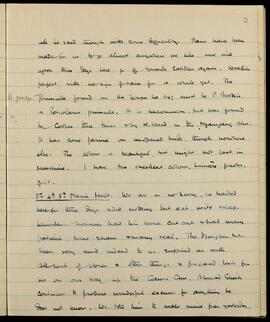
all he said, though with some difficulty. Plans have been made for us to go almost anywhere we like, and we will, after three days here, go off towards Sakden again. Weather perfect, with no sign of rain for a while yet. The Primula found on the Yonpu La 1147 must be P. Boothii, a Petiolaris primula. It is uncommon, but was found by Cooper three times and by K. Ward in the Nyamjang chu. It has some farina on unopened buds, though nowhere else. The colour is beautiful, but might not last in sunshine. I have two excellent colour Lumière photos of it.

3rd, 4th, 5th March Halt. We are in no hurry, so halted here for three days and did nothing but eat, write, and sleep. Lumsden, however, had his work cut out and had many patients, some sham and many real. The Dzongpen has been very kind indeed to us, supplied us with all sorts of stores and other things, and prepared huts for us on our way up the Gamri Chu. Ahmad Sheikh continues to produce wonderful excuses for anything he does not know. We told him to make mince pies yesterday,

LSH/1/1/3/3/53 · Part · 1934-03-10
Part of The Ludlow & Sherriff Collection

SUMMARY:
The diarist reads Cooper's article and concludes specimen 1166 is a Primula petiolaris, collects three young buds to send via air mail from Trashigong, and notes widespread smoke from jhumming across Bhutan. On 13 March they travel from Sanden to the Nyakhsung La, encountering snow, taking bearings, and searching for seeds, with primulas flowering at around 14,000 ft.

CONTENT:
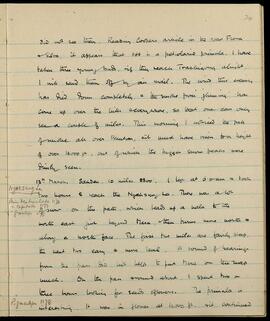
did not see them. Reading Cooper's article in the New Flora and Silva, it appears that 1166 is a petiolaris primula. I have taken three young buds, if they reach Trashigong alright, I will send them off by air mail. The wind this evening has died down completely, and the smoke from 'jhumming' has come up over the hills everywhere, so that one can only see a couple of miles. This morning I noticed the pall of smoke all over Bhutan, it must have risen to a height of over 16,000 ft, out of which the bigger snow peaks were dimly seen.

13th March. Sanden. 10 miles. 9,800'. I left at 6:00 am and took two hours to reach the Nyakhsung La. There was a lot of snow on the path, which leads up a nala to the north east just beyond Mera, then turns more north and along a north face. The first two miles are fairly steep, the next two easy and more level. A round of bearings from the pass did not help to put Mera on the map much. On the pass around about, I spent two or three hours, looking for seeds of flowers. The primula is interesting. It was in flower at 14,000 ft., and it continued

[Marginal notes: Nyakhsung La; Primula denticulata 1176; Primula capitata 1177; Primula gracilipes 1178]