Showing 4 results

Archivistische beschrijving
4 results with digital objects Show results with digital objects
LSH/1/1/6/1/70 · Part · 1938-06-09
Part of The Ludlow & Sherriff Collection

SUMMARY:
Records a clutch of seven Crossoptilon harmani eggs near Langong at about 12,000', with the nest described as in moss and fir leaves. Notes abundant blackbirds and T. albocinctus near Langong, limited range of T. m. merula, and that Bill flushed a Monal on the south side of Chubumbu La; specimen 5522 Primula alpicola is noted.

CONTENT:
350

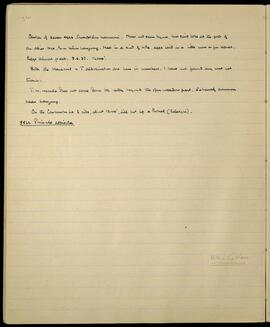
Clutch of seven eggs, Crossoptilon harmani. Nest not seen by me, but said to be at the foot of an abies tree, 1/2 m below Langong. Nest in a kind of hole, eggs laid in a little moss & fir leaves. Eggs almost fresh, 9.6.38. 12000'.

Both the blackbird & T. albocinctus are here in numbers. I have not found any nest yet though.

T. m. merula does not come down the valley beyond the open meadow part. Extremely common near Langong.

On the Chubumbu La S side, about 13000', Bill put up a Monal (Sclateri).

5522 Primula alpicola

Hitchin S's plans

LSH/1/1/8/1/51 · Part · 1947-01-13
Part of The Ludlow & Sherriff Collection

SUMMARY:
The diarist notes failed banana trees in Dongkar, widespread illness, and persistent bad weather during a series of halts while collecting birds. They visit Denchan Gompa, hunt game birds with local shikaris, and criticize Elliot’s contribution. Bill visits Yigong Tso and learns from the Be Gyimpon of a summer route to Tongkyuk over the TRESUR LA; Ludlow departs for Suowa with companions.

CONTENT:
to collect bush birds. Yesterday I was very surprised indeed to see banana trees growing beside a house above camp, in Dongkar. There were about ten, but the owner said they gave no fruit here. Tseringpon, when he saw them, immediately said they were dead, because the leaves had all withered - a state he had not seen at home. Temperatures up there must drop to 10°F as a minimum. We have had 14°F here. Goitre is very prevalent here, syphilis very bad indeed - "very much worse than Bhutan" Elliot says. The whole place seems to be in decay generally.

20th Jan Halt. Again saw more banana trees, locally called 'tali loma'. Went to Denchan Gompa then into big side valley. Saw some crossbills & heard Crossoptilon.

21st Jan - 24th Jan. Halt. Weather very unpleasant indeed & every day the same. The tops of the hills are covered in clouds all day & night, & a very light snow falls, down to about 9000' or sometimes to 8000', all day long. We get glimpses of sun but never much. We have all tried to get game birds, & between us have seen or got monal, tragopan, blood pheasant & wood partridge. Tseringpon & Laku are the chief shikaris & most bloodthirsty. Elliot is a great disappointment. He won't turn his hand to anything; won't even carry a gun & have a crack at anything. His medical work is poor. He takes no interest in the illnesses of the locals, & just dishes out 2 pills to everyone. Our own people have little use for him. I don't know how he has the face to do as little as he does, after agreeing to come on this trip & turn his hand to anything.

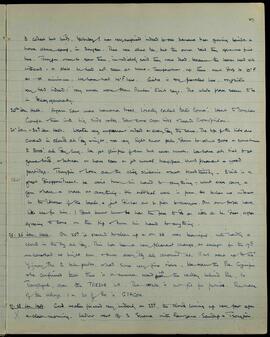
25-26 Jan. Halt. On 25th it started to clear up & on 26 was beautiful, with hardly a cloud in the sky all day. This has been a very pleasant change, as except for the 19th we have had no bright sun, & snow every day all around us. Bill went up to the Yigong Tso to take photos, & had some very fine views. He saw the Be Gyimpon who confirmed that there is a summer road up from the valley behind Be, to Tongkyuk, over the TRESUR LA. The route is not fit for ponies. The name of the village 1 m W of Be is GYAGON.

27-28 Jan. Halt. Good weather finished very suddenly on 28th, the clouds coming up very fast after a clear morning. Ludlow went off to Suowa with Ramzana, Sandup & Tseringpon.

LSH/1/1/8/1/75 · Part · 1936-03-02 - 1936-03-03
Part of The Ludlow & Sherriff Collection

SUMMARY:
Arrived at Trulung and rejoined Bill; a swarm of cliff-dwelling bees overran camp, stinging many and briefly incapacitating Joker before recovery. Hypsometer readings put the camp at 4917', contrasting with other sources, and plans were laid for Ludlow and Elliot to go to Tsela and Pemakochung while Bill visits Sobhe La and Namdu La before returning to Showa, with later work on the Gyala Range.

CONTENT:
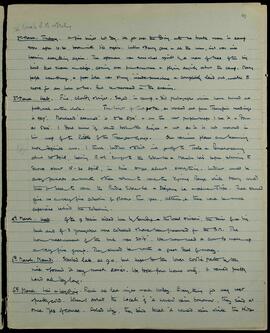
2nd March. Trulung. A fine bright hot day. We got over the driving with no trouble & were in camp soon after 10.30, back with Bill again. Ludlow & Henry gave us all the news, & it was nice hearing everything again. The afternoon was somewhat spoilt by a mass of bees of the big kind that swarm on cliffs, coming over from somewhere & flying angrily about the camp. Many people were stung, & poor Joker was stung inside somewhere & completely laid out, unable to move for an hour or two. But he recovered in the evening.

3rd March. Halt. Fine, cloudy & bright. Stayed in camp & did photographs which have turned out pretty well on the whole. The height of camp site, as worked out from hypsometer readings is 4917'. Morehead 'assumed' it to be 5700' & on the new purple maps I see it is down as 5300'. I don't know if Ward took the height or not, as it is not marked in his map of the Riddle of the Tsangpo Gorges. Our various plans are becoming more definite now. I think Ludlow & Elliot will go to Tsela & Pemakochung about 20 April, leaving Bill to go to the Sobhe La & Namdu La before returning to Showa about 15-20 April, in time to get almost everything. Ludlow would be away perhaps a month & then return to work the Gyala Range while Henry would then go

LSH/1/1/8/1/83 · Part · 1947-03-20
Part of The Ludlow & Sherriff Collection

SUMMARY:
The party halts for several days in a valley on the right bank of the river, noting delayed flowering compared to Tongkyuk and recalling the 1933 flood from a lake on the Munkhu Phu Chu. They describe routes toward Munkhu La and Yigong, observe various birds, and report activities including Akong collecting specimens, Tsongpen traveling to Sobhe La to repair a thermograph, and Bill ascending above camp but finding little in flower.

CONTENT:
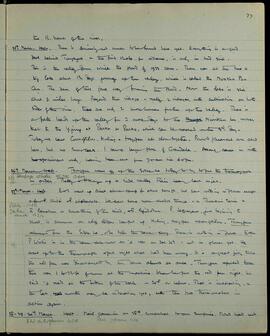
the R. bank of the river.

25th March. Halt. There is obviously not much to be found here yet. Everything is a good deal behind Tongkyuk — the pink rhodo, for instance, is only in bud still. This is the valley down which the flood of 1933 came. There was at the time a big lake about 1 1/2 days journey up this valley, which is called the Munkhu Phu Chu. The dam of this gave way forming the flood. Now the lake is still about 3 miles long. Beyond this village — really 2 villages, with cultivation on both sides of the river, there are only 2 more houses further up the valley. There is a path leads up the valley for 3 more days to the Munkhu la, over that to the Yigong at Parka or Parke, which can be reached on the 4th day. Today we saw Crossoptilon, kuling & tragopan all close together. Blood pheasant are also here, but no snowcock. I saw a large flock of Grandala. Akong came in with two specimens only, having been out from 7.0 am till 6.0 pm.

26th March Halt. Tsongpen went off up the Sobhe la today to try to put the thermograph in order. Betty & Akong up a side valley. Rain heavy last night.

27th March. Halt. Bill went up direct above camp for about 2000 ft, but saw nothing in flower except a few P. Winteri & rh. rhodentata. We saw some more rhodos though — a Thomsonii series & R. lanatum or something of the kind, rh. lepidotum. P. Jaffreyana, just beginning to shoot, is common on cliff ledges. We put up kuling, tragopan, crossoptilon. Tsongpen returned from the Sobhe la, she tells the same story. There is nothing in flower. Even P. Winteri is in the same state now as it was on Dec 31st — not in flower yet. He went up to the thermograph & put right what had been wrong. It is a great pity that the red pen was disarranged by the lama almost at once. Tsongpen reported that there was 1 to 1 1/2 ft of snow at the machine. When he put the red pen right, he said it read at the bottom of the scale — 20°F or below. That is interesting, & the last month may be interesting yet, with the two thermometers in action again.

28-29-30th March. Halt. Mail came in on 28th, somewhat to our surprise. Rhodo had not