Showing 59 results

Archival description
59 results with digital objects Show results with digital objects
LSH/1/1/8/1/62 · Part · 1947-02-20
Part of The Ludlow & Sherriff Collection

SUMMARY:
Daily weather notes for 19–23 Feb are followed by a detailed route from Tangdong to Lubong via Domuong, Pemadem, and Chashing Dingka, with altitude and terrain described. Photographic and field notes mention a headman of lower Tangdong, a Poba girl talking to Betty, panoramas from Karma La toward Namcha Barwa and Gyala Peri, and bird observations at Lubong.

CONTENT:
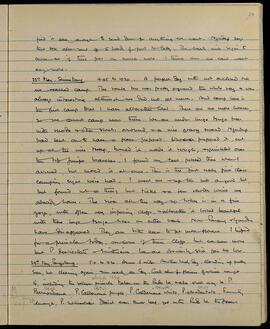
50

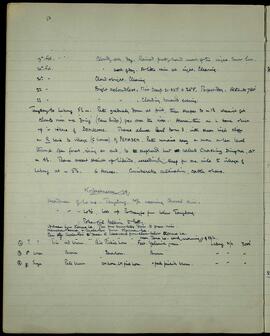
19th Feb. Cloudy all day. Rained pretty hard most of the night. Snow low.
20th Feb. Most of day. A little rain at night. Clearing.
21st - Cloud at night. Clearing.
22nd - Bright and cloudless. Min temp 21-22° = 26°F. Perfect day. Altitude 7500'
23rd - " " . Clouding towards evening.

Tangdong to Lubong 5 1/2 m. Path gradually down at first, then steeper to m 1 1/2 where it gets close to river and a 'zhing' (cane bridge) goes over the river. Above this on L bank high up is village of DOMUONG. Thence almost level to m 3, with sheer high cliffs on R bank to village (5 houses) of PEMADEM. Path remains easy and more or less level through open forest, rising at end, to a shepherd's hut called Chashing Dingka, at m 4 1/2. Thence ascent straight up hillside, exceedingly steep for one mile to village of Lubong at m 5 1/2. 6 Houses. Considerable cultivation, cattle there.

Kodachrome 14.
Headman of lower Tangdong. 20/2 wearing Goral skin.
-- Loto, look up Tsangpo from below Tangdong.
-- Poba girl talking to Betty.
Upstream from Karma La. Pan from snow hills down to green river.
Namcha Barwa & Gyala Peri from Karma La.
Pan from Gyala Peri & peaks to westward from close below Karma La.
near Tana La. early morning // of 23/2.

(2) ? ? Iris red brown. Bill pinkish horn. Feet yellowish green. Lubong 21/2 7000'
(3) ♂ Wren Brown Dark horn. Brown - - -
(4) ♀ Sunya Pale brown UM horn. LM pink horn. v pale pinkish brown. - - -
LSH/1/1/8/1/27 · Part · 1946-12-11
Part of The Ludlow & Sherriff Collection

SUMMARY:
The diarist negotiates transport with the Dzongpon, notes low rates, and plans to cross by ferry near Chamna and go over the Temu La, with observations on weather and local birds. On 18 Dec at Dzeng, Betty and the diarist travel with a small party, crossing the river by ferry opposite Chamna, where the headman recalls their 1938 visit.

CONTENT:
cloth, while he returned with a skin covered box - atta. We bought from the Dzongpon at 11 sangs a lump, chari at 15. Rice with container (30 sangs) at 105 - atta & tsampa, with container at 63. When the Dzongpon came here, he asked to see the lamyig, but he ignored the 12 sang rate quoted in it & said we had 'tse te' transport, the rate of which was 4 shokangs per riding & 2 shokangs per donkey etc. This is lower than we ever expected to have to pay, right back to our 1938 level. He has ordered our transport - ponies - they should be off tomorrow. The plan is to go by tru from near Chamna, then over the Temu La. Wind has been bad here till yesterday. The day we arrived, the weather began to change, & clouds came at night. The result was a high wind - always downstream, from 2.30 pm, followed by clouds in the evening & cloudy nights with very high temperature at night. Yesterday it cleared completely & the temp went right down, while there was no wind. We have been out for birds & got good ones of great interest. All are now interesting as showing what are residents here. Lophobasileus elegans is the best. 'Chang-tsai' are here & we shot 3 yesterday. Parrots & crossbills seen, but not yet shot. What we really want now is a sparkling day on the Temu La, so as to be able to see Namcha & Gyala Peri - the latter of which should be a more striking view. From Tsela Dzong one can only see a little of the Namcha group, over the Temu La Range.

18th Dec. Dzeng. Left at 9.0: in at 3.0 pm. We suddenly decided yesterday evening that Betty & I should go on with the goro ponies which had arrived. So we packed up the minimum stuff & came on today. Our party is Tsongpon, Kancha, Akong & ourselves. We have a total now of 4 coolies & 11 ponies. The ferry (tru) is almost opposite Chamna, 5 m. E. of Tse & the river at the ferry is about 200 yds wide. Crossing takes about 1/2 hour per trip there & back. The headman here remembers us from 1938, & seems

LSH/1/1/8/1/60 · Part · 1947-02-15 - 1947-02-20
Part of The Ludlow & Sherriff Collection

SUMMARY:
Captions note Tying Tso from Re (15 Feb), Tying Chu on the march from Sangyü to Chahzam (17 Feb), and Betty on the cane bridge at Trulung (20 Feb). Detailed route description from Trulung to Tangdong via the Po Tsangpo–Tonghyuk Chu junction, with notes on terrain, cultivation, and livestock, and a bird (Horornis) recorded at Tangdong, 7000 ft, on 20 Feb 1947.

CONTENT:
58

Kodachrome 13.
Tying Tso from Re. 15/2
Orchid No 12191
Tying Chu on march Sangyü to Chahzam 17/2
Orchid No. 12191
Betty on Dring at Trulung. 20/2. 10 ft short.

Trulung to Tangdong. Downstream from Trulung for ½ mile to the dring or cane bridge. (In summer this is a few hundred yards lower down, on a high rock.) Path on left bank then narrow & stony. The junction of the Po Tsangpo with the Tonghyuk Chu is at m 1. Thence path climbs steeply over a pass, 1000 ft, at m 2 & drops easily to a side valley called Lungpo at m 2½, coming down from a snow peak to the North locally called Tsela Lungpo. From here ascent easy to cultivation at Tangdong m 3½. Where there are 5 houses. Barley & millet are grown, & turnips. Path is not fit for ponies, loaded or unloaded. There are fowls & cattle here. Milk available.

Bird .1. Horornis ♂ Brown Iris: Bill dark horn: Legs Brown. Tangdong 7000'. 20.2.47.

LSH/1/1/9/1/125 · Part · 1933-08-26
Part of The Ludlow & Sherriff Collection

SUMMARY:
The diarist reports fleas from bamboo mats, notes Lilium nepalense and collects fine Podocarpum seed while traveling from Kotakha across Suele La and Tsele La into the Phobsikha valley, then planning and taking the Chele La toward Rukusi and Chendesi amid disputes with coolies and route advice from locals. News arrives that Ludlow has sent Dawong back to Bumthang with a bad leg.

CONTENT:
Too many fleas in it, from the bamboo mats supplied by locals. Nothing of interest seen on the way, except we noticed that there are some Lilium nepalense, though not many. Kotakha is about 2½ miles beyond the Muele La, on the left bank of the wide valley. This valley here is called the Pausa Chu, and the headman says that lower down it is called the Biameshu Chu, which is marked on the map.

27th August. Issa in Phobsikha valley. Very heavy rain last night, but it was to a clear sky at last that we woke up, and set off at 5.0 am. It remained fine except for some showers till the evening. This is the first sun we have seen since I left Betty at 10.30 on the Hala-Kyu La. The ascent to the Suele La was easy in climbs, but the wind was really awful and very difficult to deal with. The pass is about 10500-11000' and about 5 miles from Kotakha. Descent easy into another broad open valley. Path skirts the top of this, keeping up pretty well. It then climbs easily again to the Tsele La at about mile 10. It is again about 11000'. Descent into the Phobsikha valley not very steep, and path comes down half way between Phobsikha and Gonte Gompa. I could not find where we were supposed to go. We had been told Gonte, but coolies insisted in coming here. The locals want us to go over the pass north of Gonte, which would mean we could not reach Chendesi tomorrow. I have refused to go that way, and we will go over another pass, the Chele La to Rukusi. Got very fine seed of Podocarpum today. No flowers at all.

28th August Chendesi - I got in at 1.0, but Tupden had to stay for one miserable coolie who did not turn up and is very late. He had to change twice, once only 3 miles away, and again at Rukusi. The pass, the Chele La, about 12000', was not bad at all, but the path this side is very poor. No news from Ludlow, but it seems he has had to send Dawong back to Bumthang with a very bad leg. He is

LSH/1/1/10/1/41 · Part · 1933-10-10
Part of The Ludlow & Sherriff Collection

SUMMARY:
The diary records paying for pony transport and arranging routes via the Jelep La and Nathu La, with generous provisions from Rani Chuni and many loads of plants and seeds despite Betty having broken her arm. On 30 Oct at Damthang, coolies and transport are disorganized and late; on 31 Oct at Sharithang, rain and sleet continue with snow above 11,000 ft.

CONTENT:
four collectors. They will have to change transport at Rinchenpong. We have paid them at Rs 9/- per pony. Ludlow had 5 1/2 loads and Hicks at 10 1/2. I also paid Tsangpon at the rate of Rs 10/- per pony to Kalimpong - Rs 105/- - that being about half what we expect the cost to be. They will all go the Jelep La route, while we will go by the Nathu La. As usual we have been very well looked after here. Rani Chuni has been pouring things over to us, butter, cider, eggs, meat, even whisky. We can't stop her, and we'll be lucky to get off with just the number of transport ordered. With us we have 8 pony loads and 3 coolies with live plants. That can't all fit into a jeep and trailer, and we will certainly have to use some other form of transport to get the rest through. And so we end what has been a very successful trip for us all, with the one exception of Betty breaking her arm. Ludlow certainly has the best collection, but we all have lots of good stuff, and seeds should prove interesting, and also the rooted plants, of which we have brought more than ever before. We have 3 big baskets - each a man's load - each having 3 tiers of plants in them.

30th Oct. Damthang. Raining in the morning, off soon in the day. Coolies and transport very sad indeed. They do just as they like, and even by 4.0 pm several are not in after an 8 mile march. What is worse, is that we saw some of the boxes which were yesterday passing the bungalow this evening. In fact they never went yesterday at all. These people are very difficult now. There is no authority, no discipline.

31st Oct. Sharithang. Rain and sleet fell all evening and night, there was quite a bit of snow on the road today from about 11000 ft up to the top.

LSH/1/1/9/1/127 · Part · 1933-08-26
Part of The Ludlow & Sherriff Collection

SUMMARY:
Mail arrived with letters up to 6 August and a note from Betty at Changu; Danang departed with Pompoli and Tundru. At Tashiling the path to Chendesi was badly damaged, a pony fell through a weakened bridge and could not be rescued, and after storms the huts were preferred except for filthy Tsalimape; on hearing H.H. had gone back to Bumthang they planned to go straight through. Reaching Tongsa, the heaviest rains continued and people in Trongsa Dz. reported considerable recent damage.

CONTENT:
Described as being carried in a dhooley by 4 men. That is very sad, & Ludlow will miss him very much indeed. A small mail came in last night, with letters of up to 6 August from home - very quick - & a note from Betty from Changu. I heard later that with Danang went Pompoli & Tundru.

29th August. Tashiling. Yesterday the path to Chendesi showed signs of wear. There were 6-7 baddish breaks, but today there were 15-20 & some were big affairs. Some have only come down 2-3 days ago. Just before we reached a bridge whose sides have been scoured out a bit, a man crossed with 3 ponies. 2 got across, & the 3rd broke one of the long tree planks & fell through into a chasm below. How the pony squeezed through the breadth of only one plank, I don't know. We helped for over an hour, but could do nothing, & had to leave. I fear the pony will be dead before help we sent for here reaches it. I would have ridden over that bridge five minutes later, & it certainly would have given way with me on. So I consider myself lucky today. It has just kept fine once more today. I expected a sparkling day because about 1.0 last night there was a thunderstorm & very heavy rain, which came in through the roof & soaked us all. If there were decent places for tents, I wouldn't dream of occupying these huts. Chendesi & Tashiling huts are, at any rate, clean & bugless. Tsalimape is the filthy place. Heard last night that H.H. has gone back to Bumthang, so we will go straight through too.

30th August. Tongsa. A dreadful day of the heaviest rain yet seen. Again the path was washed away in many places. In Trongsa Dz. they said considerable damage had been done by the rain in the last 7-9 days. That was when H.H.

LSH/1/1/8/1/61 · Part · 1947-02-20
Part of The Ludlow & Sherriff Collection

SUMMARY:
At Shingcha Woma hot springs the party noted strong sulphur fumes and found a single tree of the so-called 'Carmine Cherry' just coming into bloom. On 19 Feb a halt day, Ludlow asked locals about the Tongkyuk Chu flood that dammed the Po Tsangpo for three days, with no local damage. On 20 Feb the diarist and Betty set out with Tsompen, Kancha, and Akong toward a Gompa at the confluence of the Po Tsangpo and Kongbo Tsangpo, after overnight rain and snow down to Trulung, starting about 8 and needing to cross the Dring.

CONTENT:
small holes, boiling hard. This place the locals call 'Shingcha Woma' - the lower Shingcha. There is another small stream nearby of tepid water. The smell is very sulphurous. The only find of interest in the flower line was Ward's 'Carmine Cherry' (Prunus cerasoides var. rubra), No. 12222, of which we found only one tree, just coming into bloom, a very pretty thing & a lovely colour.

19th Feb. Halt. Cloudy day. Rained all night off & on. Ludlow asked about the effect of the Tongkyuk Chu flood on the Po Tsangpo. The locals said they heard a noise like thunder, then the flood came down & blocked the Po Tsangpo for three days. The river rose about 40'-45', dammed up to the hot springs. No damage was done locally. There is a local shikari here, who knows all about the bird they call 'tse'. It is, in the south, Sclater's Monal.

20th Feb. Tangdong. Betty & I started off today with Tsompen, Kancha & Akong to go to a Gompa where the Po Tsangpo & Kongbo Tsangpo meet. It rained pretty hard all last night & snow was down to about 8000' at Trulung. Cleared in the morning, & we were off about 8.0. But the Dring had to be crossed by our 15

LSH/1/1/9/1/55 · Part · 1933-05-22
Part of The Ludlow & Sherriff Collection

SUMMARY:
Notes on supplies being sent to Betty, followed by travel from Shimitang to Pangotang with excellent weather and a favorable campsite under Tsuga trees. The party observed a river gorge and collected several Primula species on the Pudo La.

CONTENT:
find it easy enough to send down for anything we want. Ngudup says
that H.H. also sent off 5 loads of food to Betty. The bears will begin to
curse us if this goes on much more. I think now we can't want
any more.

23rd May. Shimitang. 4.45 to 10.30. A perfect day with not a cloud till
we reached camp. The route too was pretty grand the whole way & was
always interesting, although we did not see much. And camp here is
the first camp that I have altogether liked. There are no more houses,
so we cannot camp near them. We are under huge Tsuga trees,
with rhodo & other shrubs around & a nice grassy sward. Ngudup
had sent on to have a place prepared. Whoever prepared it, cut
up all the nice turf, turned it, made it rough, & sprinkled over
the top juniper branches. I found my tent pitched there when I
arrived, but moved it at once. This is the first really first class
camping site we've had. I went out up the hill a good bit,
but found not a thing but ticks & a few rhodos which we
already have. The river all the way up today is in a fine
gorge, with often very imposing cliffs, & altogether it looked beautiful
with these huge Tsuga trees on either bank. Now Pasang & Nyundru
have disappeared. They are both keen to see more flowers. I hoped
for a primula today, on some of these cliffs, but we saw none
but P. denticulata & Smithiana. We are obviously still far too low.

24th May. Pangotang. 5.0 to 9.30. About 6 miles. Another lovely day, clouding up pretty
soon, but clearing again, sun nearly all day. Good also for flowers of which we got
16, including the yellow primula elongata (18946) taken on the Pudo La, & also what may be P.
Barnardiana (18946). P. Calderiana purple (18947), P. Calderiana white (18954), P. atrodentata (18957). Funny
enough, P. sikkimensis doesn't even show leaf yet on the Pudo La the flowers

NB
Concerning
seeds

LSH/1/1/9/1/37 · Part · 1949-05-06
Part of The Ludlow & Sherriff Collection

SUMMARY:
The writer instructs Chengala of Dengchung to show a plant to Betty and collect seeds of several trees, including one used locally for yellow dye, with earlier material taken at Panghar. After a strenuous day crossing the Rip La, the diarist visits the half sisters of H.H., two of whom come to the tent, and later receives a letter from Betty while expressing concern about Hicks.

CONTENT:
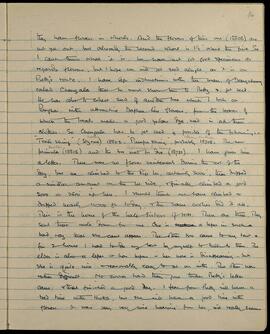
they have flowers in whorls. And the flowers of this one (18806) are not yet out, but already the second whorl is 1 1/2" above the first. So I can't think what it is. We have not got good specimens as regards flowers, but I hope we will get seed alright as it is on Betty's route. I have left instructions with the man of Dengchung called Chengala that he must show this to Betty & get seed. He has also to collect seed of another tree which I took at Panghar, with attractive Daphne like flowers, from the leaves of which the locals make a good yellow dye, used in all their clothes. So Chengala has to get seed if possible of the following:- "Trali shing" (Styrax hookeri) 18802. "Pumpa shing", probably Viburnum erubescens 18706. The new mother primula (18806) and the tree used for dye (Daphniphyllum himalayense) (18733). I have given him a letter.

There were no flower excitements during the rest of the day, but we climbed to the Rip La, certainly 3000', then dropped a similar amount on the W. side, & finally climbed a good 2000 or 2500' up here. I should think we have climbed or dropped nearly 11000 ft. today, & the same coolies did it all. This is the home of the half sisters of H.H. There are three. They sent their mule down for me. One is a leper in such a bad way that she can't appear. The other two came to my tent & for 2 hours I had to do my best by myself to talk to them. The elder is also a leper or has lupus - her nose is disappearing - but she is quite nice & reasonably easy to get on with. The other was rather difficult. No sooner had they gone than Betty's letter came & that finished a good day. I fear poor Betty will have a bad time with Hicks, but she will have a good time with flowers. It was very very nice hearing from her, it really seems

LSH/1/1/9/1/113 · Part · 1949-08-21
Part of The Ludlow & Sherriff Collection

SUMMARY:
The party marches in persistent rain from Samtegang to Wangdipotrang and over Hinglai La to Tsalimape, with a halt day due to wet weather. They encounter an unprepared Ritang headman, receive a protracted visit from a local Dzongpon, and have slow coolies over the pass. Few flowers are seen, but seeds of Streptopus simplex, Vaccinium, and a Cotoneaster are collected; Lilium nepalense is noted as common.

CONTENT:
We hear Raja Dorji lost 160 cattle there lately.

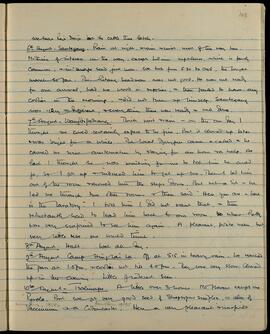
6th August - Samtegang. Rain at night, rain and mist most of the way here. Nothing of interest on the way, except Lilium nepalense, which is fairly common, and in unripe seed just now. We took from 5:30 to 12:45, the longest march so far. The Ritang headman was no good. He was not ready for our arrival, had no wood or supplies, and then failed to have any coolies in the morning, and did not turn up himself. Samtegang was very different, everything there was ready and well done.

7th August - Wangdipotrang. Thick mist and rain - on the one day I thought we could certainly expect to be fine. But it cleared up later and was bright for a while. The local Dzongpon came and called and he caused us some consternation by staying for an hour and a half. At last I thought he was waiting for me to tell him he could go, so I got up and induced him to get up too. Then I led him out of the room and showed him the steps down. But not a bit - he led me through two other rooms and then said "Here you are - here is the lavatory." I told him I did not want that, and then reluctantly had to lead him back to our room, where Betty was very surprised to see him again. A pleasant, polite man, but very little use, one would think.

8th August - Halt. Wet all day.

9th August - Camp Hinglai La. Off at 5:15 in heavy rain. We reached the pass at 1:00 pm, and coolies not till 4:00 pm. They were very slow. Cleared up in the evening. Little of interest seen.

10th August - Tsalimape. A little over 3 hours. No flowers except one Pyrola. But we got very good seed of Streptopus simplex, and also of Vaccinium and a Cotoneaster. Here a very pleasant camp-fire.