India

Área de elementos

Taxonomía

Código

Nota(s) sobre el alcance

    Nota(s) sobre el origen

      Mostrar nota(s)

        Términos jerárquicos

        India

          Términos equivalentes

          India

            Términos asociados

            India

              176 Descripción archivística resultados para India

              176 resultados directamente relacionados Excluir términos relacionados
              LSH/1/1/1/1/176 · Part · 1933-09-05
              Parte de The Ludlow & Sherriff Collection

              SUMMARY:
              A local guide led the party to their campsite at Lachen and reported that the last European to camp there was 27 years earlier, when White, the P.O., camped shortly after the Tibetan War.

              CONTENT:
              Lachen. - The man who conducted
              us to our camping site informed
              us that the last time a European
              had camped here was 27 years ago,
              when White the P.O. had camped
              here shortly after the Tibetan War.

              LSH/1/1/1/1/181 · Part · 1933-09-05
              Parte de The Ludlow & Sherriff Collection

              SUMMARY:
              The writers received provisions and friendly letters sent by H.H., note Dorji’s recovery and Tobgye’s imminent departure for Kalimpong, and an invitation to return to collect seeds. They describe a short, easy march up the Kuru Chu via Lalung to Munda, with bridges, ample water but scarce fuel, observed crops, and fine valley views.

              CONTENT:
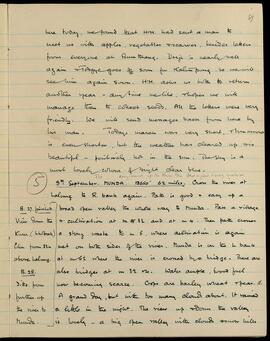
              here today, we found that H.H. had sent a man to meet us with apples, vegetables & scarves, besides letters from everyone at Bumthang. Dorji is nearly well again & Tobgye goes off soon for Kalimpong, so we won't see him again soon. H.H. asks us both to return another year - anytime we like, & hopes we will manage then to collect seeds. All the letters were very friendly. We will send messages back from here by his man. Today's march was very short, & tomorrow is even shorter, but the weather has cleared up & is beautiful - positively hot in the sun. The sky is a most lovely colour of bright clear blue.

              9th September. MUNDA. 13650' 6 1/2 miles. To easy march up the Kuru Chu past a good deal of cultivation. Cross the river at Lalung to R. bank again. Path is good & easy up a broad open valley the whole way to Munda. Pass a village & cultivation at m 3 1/2 and at m 4. Then path crosses a stony waste to m 5, where cultivation is again met on both sides of the river. Munda is on the L bank at m 6 1/2 where the river is crossed by a bridge. There are also bridges at m 3 1/2 & 4. Water ample, wood fuel now becoming scarce. Crops are barley wheat & peas.

              A grand day, but with too many clouds about. It rained a little in the night. The view up & down the valley is lovely - a big open valley with clouds & snow hills.

              B. 27. finished. View down the Kuru (Khobrak) Chu from 3 1/2 m above Lalung.
              B. 28. Ditto from further up the river to Munda.

              Yamdrok Tso to Nangartse via Ta La Pass
              LSH/1/1/1/1/193 · Part · 1933-09-24
              Parte de The Ludlow & Sherriff Collection

              SUMMARY:
              Notes describe passing Yamdrok Tso at Talung with views from Cho Dzong, an easy ascent and descent over the Ta La pass to the plain and Nangartse, and fording the Karo Chu, with fine weather and filming tame ravens. From camp at Nangartse they mention the monastery of Dorji Phamo, report failed telephone contact with Williamson in Lhasa and that they will not meet at Gyantse; the item was sent from Gyantse to Calcutta on 24/09/1933.

              CONTENT:
              95

              B. 30.
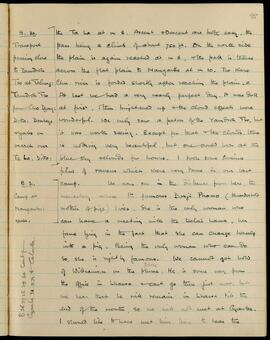
              Transport passing close to Yamdrok Tso at Talung:
              Yamdrok Tso from Cho Dzong:
              Ditto: Donkeys & yaks on march over Ta La. Ditto:

              the Ta La at m 5. Ascent & descent are both easy, the pass being a climb of about 750 ft. On the north side the plain is again reached at m 6, & the path is thence across the flat plain to Nangartse at m 10. The Karo Chu river is forded shortly after reaching the plain.

              At last we had a very nearly perfect day. It was dull at first, then brightened up & the cloud effects were wonderful. We only saw a patch of the Yamdrok Tso, but it was worth seeing. Except for that & the clouds, there is nothing very beautiful, but one could look at the blue sky & clouds for hours. I took some Cinema films of ravens which were very tame in our last camp.

              B. 31.
              Camp at Nangartse:
              raven.

              We can see in the distance from here, the monastery where the famous Dorji Phamo (thunderbolt mother of pigs) lives. She is the only woman who can have a meeting with the Dalai Lama, her fame lying in the fact that she can change herself into a pig. Being the only woman who can do so, she is rightly famous. We cannot get hold of Williamson on the phone. He is some way from the office in Lhasa & can't go there just now, but we hear that he will remain in Lhasa till the end of the month, so we will not meet at Gyantse. I should like to have met him there to hear the

              B 26 27 28 29 30 Sent from Gyantse 24.9.33 to Calcutta.

              Yak transport and march to GOBSHI
              LSH/1/1/1/1/199 · Part · 1933-09-15
              Parte de The Ludlow & Sherriff Collection

              SUMMARY:
              Notes describe difficulties using yaks for transport, observations of the green Tibetan plateau with abundant sheep and yaks, and that Bailey had found the area interesting for flowers though the party seems too late. On 16th September they marched 12 miles to GOBSHI (14,000'), after snow and cold, reaching what is described as their last camp before the route with dak bungalows to Kalimpong.

              CONTENT:
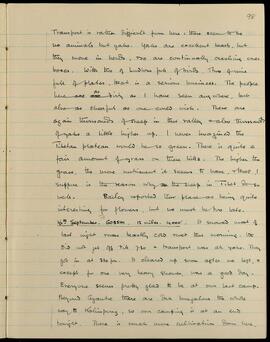
              Transport is rather difficult from here: there seem to be no animals but yaks. Yaks are excellent beasts, but they move in herds, and so are continually crashing one's boxes. With two of Ludlow's full of birds, and two of mine full of plates, that is a serious business. The people here are as dirty as I have seen anywhere, but also as cheerful as one could wish. There are again thousands of sheep in this valley and also thousands of yaks a little higher up. I never imagined the Tibetan plateau would be so green. There is quite a fair amount of grass on these hills. The higher the grass, the more nutriment it seems to have, and that, I suppose is the reason why the sheep in Tibet do so well. Bailey reported this place as being quite interesting for flowers, but we must be too late.

              16th September. GOBSHI. 12 miles. 14,000'. It snowed most of last night and was beastly cold and wet this morning. We did not get off till 7:30 and transport was all yaks. They got in at 3:30 pm. It cleared up soon after we left, and except for one very heavy shower, was a good day. Everyone seems pretty glad to be at our last camp. Beyond Gyantse there are dak bungalows the whole way to Kalimpong, so our camping is at an end tonight. There is much more cultivation down here,

              LSH/1/1/1/1/201 · Part · 1937-09-17 - 1937-09-24
              Parte de The Ludlow & Sherriff Collection

              SUMMARY:
              Diary notes describe arrival at Gyantse after storms, a visit to Tering Raja, meeting Worth and Rajput officers, and mail issues, with B.31 sent to Calcutta on 21 September 1937. Subsequent days in Gyantse included social calls on the Kengchung, a good lunch, and tennis with Worth, Henlin, and Capel, with observations of local crops and a parnassius butterfly.

              CONTENT:
              99
              barley & mustard crops - & peas
              the barley being again nearly ripe. There are also peas. Saw nothing very interesting in the way of birds, but saw one parnassius. It was too lively & we failed to catch it.

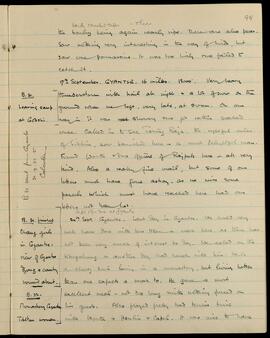
              17th September. GYANTSE. 16 miles. 13000'. Very heavy
              B. 31. thunderstorm with hail all night & a lot of snow on the
              Leaving camp ground when we left, very late, at 9.0 am. On our
              at Gobshi. way in it was showery & we got rather soaked
              once. Called in to see Tering Raja, the rightful ruler
              of Sikkim, now banished here - a most delightful man.
              Found Worth & two officers of Rajputs here - all very
              kind. Also a really fine mail, but some of our
              letters must have gone astray, as we miss some
              parcels which must have reached here had our
              letters not been lost.

              B 31 sent from Gyantse 21.9.37 to Calcutta

              Sept 19 - we at Gyantse
              B. 31. finished 24th Sept. Gyantse. Last day in Gyantse. We could very
              Chang girls well have done with less than a week here, as there has
              in Gyantse: not been very much of interest to do. We called on the
              view of Gyantse Kengchung & another day had lunch with him. He is
              Dzong & country a cheery soul living in a monastery, but living better
              round about. than one expects a monk to. He gave a most
              B. 32. excellent meal - not too long with nothing forced on
              Monastery Gyantse. his guests. Also played pretty bad tennis twice
              Tibetan women. with Worth & Henlin & Capel. It was nice to have

              To Kalimpong; later journey to Srinagar
              LSH/1/1/1/1/215 · Part · 1933-10-06
              Parte de The Ludlow & Sherriff Collection

              SUMMARY:
              Notes describe a hot, steamy descent and climb with collecting of butterflies and birds, a wire to Tobgye, and arrival at Kalimpong where ponies met the party below Pedong and lunch was taken with Chuni. Later entries mention three days in Kalimpong before traveling via Calcutta, Sialkot, Wazirabad, and Kud to reach Srinagar, while Tobgye went to Darjeeling.

              CONTENT:
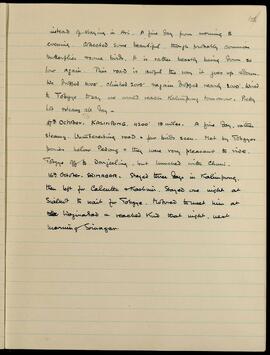
              instead of staying in Ari. A fine day from morning to evening. Collected some beautiful, though probably common butterflies and some birds. It is rather beastly being down so low again. This road is awful the way it goes up and down. We dropped 4000', climbed 2000' and again dropped nearly 2000'. Wired to Tobgye today we would reach Kalimpong tomorrow. Pretty hot and steamy all day -

              17th October. TO KALIMPONG. 4200' 19 miles. A fine day, rather steamy. Uninteresting road and few birds seen. Met by Tobgye's ponies below Pedong and they were very pleasant to ride. Tobgye off to Darjeeling, but lunched with Chuni.

              16th October. SRINAGAR. Stayed three days in Kalimpong, then left for Calcutta and Kashmir. Stayed one night at Sialkot to wait for Tobgye. Motored to meet him at Wazirabad and reached Kud that night, next morning Srinagar.

              LSH/1/1/2/1/5 · Part · 1934-06-13 - 1934-06-14
              Parte de The Ludlow & Sherriff Collection

              SUMMARY:
              The diarist travels by lorry from Srinagar to Kud, notes heat and crowded lodging, and lists team members Ramzana, Ahmad Sheikh, and Gulla. The journey continues to Lahore in extreme heat, with a near fuel shortage, before boarding the Calcutta mail and using ice to keep Lumiere films cool.

              CONTENT:
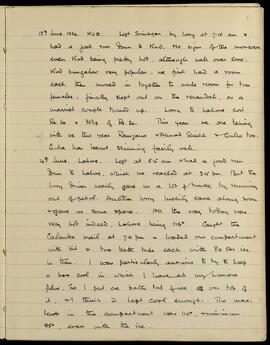
              13th June, 1934. KUD. Left Srinagar by lorry at 7.15 am & had a good run down to Kud. No signs of the monsoon even Kud being pretty hot, although well over 5000'. Kud bungalow very popular: we first had a room each, then moved in together to make room for two females: finally slept out on the verandah, as a married couple turned up. Lorry to Lahore cost Rs. 60 + tolls of Rs. 30. This year we are taking with us this year Ramzana & Ahmad Sheikh & Gulla too. Gulla has learnt skinning fairly well.

              14th June. Lahore. Left at 5.15 am & had a good run down to Lahore, which we reached at 2.15 pm. But the lorry driver nearly gave us a lot of trouble by running out of petrol. Another lorry luckily came along soon & gave us some spare. All the way today was very hot indeed, Lahore being 116°. Caught the Calcutta mail at 7.0 pm & loaded our compartment with kit & two bath tubs each with 80 lbs ice in them. I was particularly anxious to try to keep a box cool in which I have all my Lumiere films. So I put one bath tub full of ice on top of it, & I think it kept cool enough. The max. temp in the compartment was 110°, minimum 85°, even with the ice.

              LSH/1/1/2/1/7 · Part · 1934-06-14
              Parte de The Ludlow & Sherriff Collection

              SUMMARY:
              Entry headed 18th June from Menoka Tea Estate notes heavy monsoon rain in Calcutta, arrival there on the 16th, breakfast at Collins’ chummery, intensive shopping including withdrawing silver rupees, and a hurried departure on the Assam Mail. The party changed trains at Parbatipur and reached Rangiya in rain, where Babu Pradhan met them.

              CONTENT:
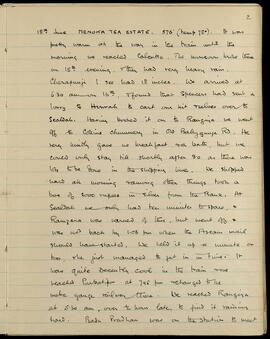
              18th June MENOKA TEA ESTATE. 576' (temp 78°). It was pretty warm all the way in the train until the morning we reached Calcutta. The monsoon broke there on 15th evening, and they had very heavy rain. Cherrapunji I see had 18 inches. We arrived at 6.30 am on 16th, and found that Spencers had sent a lorry to Howrah to cart our kit and selves over to Sealdah. Having booked it on to Rangiya we went off to Collins chummery in Old Ballygunge Rd. He very kindly gave us breakfast and a bath, but we could only stay till shortly after 9.0 as there was lots to be done in the shopping line. We shopped hard all morning and among other things took a box of 2000 rupees in silver from the Bank. At Sealdah we only had ten minutes to spare, and Ramzana was warned of this, but went off and was not back by 1.00 pm when the Assam mail should have started. We held it up a minute or two, and he just managed to get in in time. It was quite decently cool in the train and we reached Parbatipur at 7.45 pm and changed to the metre gauge railway there. We reached Rangiya at 5.30 am, over ½ hour late, to find it raining hard. Babu Pradhan was on the station to meet

              LSH/1/1/2/1/23 · Part · 1924-06-23
              Parte de The Ludlow & Sherriff Collection

              SUMMARY:
              The party stays in the Dzongpen’s guest quarters, sends presents to Bumthang, and arranges future mail to India via Neoli instead of Dewangiri to avoid the wet march to Darrang Mela; the Dzongpen is very hospitable and even takes up shooting sparrows. On 29 June they make a short, mostly downhill march to Trashigong with the Jongpen, passing cultivated hills near Pinhogong (Rongtung) and noting the Dangme Chu (Trashiyangsi Chu) below.

              CONTENT:
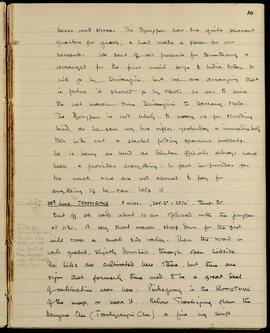
              boxes and stores. The Dzongpen has two quite pleasant quarters for guests, and had made a place for our servants. We sent off all presents for Bumthang and arranged for the first mail to go to India today. It will go by Dewangiri, but we are arranging that in future it should go by Neoli, so as to miss the wet march from Dewangiri to Darrang Mela. The Dzongpen is not likely to worry us for shooting birds, as he saw my two rifles yesterday and immediately took both out and started potting sparrows himself. He is being as kind as Bhutan officials always have been, and provides everything. In fact he provides far too much, and we are not allowed to pay for anything if he can help it.

              29th June TO TRASHIGONG 5 miles. (205.2° = 3574'. Temp. 81°.

              Sent off all loads about 10 am and followed with the Jongpen at 11.30. A very short march, steep down for the first mile over a small side valley. Then the road is well graded, slightly downhill, through open hillside. The hills are cultivated here and there, but there are signs that formerly there used to be a great deal of cultivation near here. Pinhogong is the RONGTUNG of the map, or near it. Below Trashigong flows the Dangme Chu (Trashiyangsi Chu) a fine big swift

              LSH/1/1/2/1/33 · Part · 1915-05-29
              Parte de The Ludlow & Sherriff Collection

              SUMMARY:
              Mentions a flowering specimen at Punakha on 29 May 1915 and doubts about obtaining seed. Provides a detailed route description from Phungui across side valleys and bridges along the Gauri Chu to the Munde La, noting waterfalls, villages, and Takpa inhabitants.

              CONTENT:
              certainly Cooper's 3937, found at Punakha at 5000'
              in flower on 29th May '15. It is a fine flower, but
              I doubt if we could get the seeds. I saw it growing
              on rocky ground about ½ mile above the bridge over
              the main Gauri Chu, on the R. bank - 30 yards off
              the road to the right, and again close to the road a little
              further on. // Leaving Phungui the road drops and
              crosses a side valley which leads up to the Sikkim
              La. Then up, and again down to a side valley, the
              Murbe Chu at m 3. Both are crossed by bridges, and the
              latter is a fair sized river. Again the ascent is steep,
              over a ridge and down to the L bank of the Gauri Chu at m 5.
              This is followed to m 6½ where the Gauri Chu is
              crossed by a bridge to the R bank. Path gradually
              climbs and crosses a side valley at 7½. Thence ascent
              very steep, over a ridge and past a fine waterfall at m 8.
              Then past a village at m 9, it turns slightly left and
              an exceedingly steep ascent begins, after crossing a side
              valley at m 10. The path is stepped for a great part
              of the steep climb to the Munde La (about 9600') at m
              12½. Most of this is through jungle. At the Munde La,
              the country opens out and slopes of wonderful grazing are
              around. There are several villages near here and the
              inhabitants are Takpas, more nearly allied to Tibetans.