India

Zone des éléments

Référentiel

Code

Note(s) sur la portée et contenu

    Note(s) sur la source

      Note(s) d'affichage

        Termes hiérarchiques

        India

          Termes équivalents

          India

            Termes associés

            India

              176 Description archivistique résultats pour India

              176 résultats directement liés Exclure les termes spécifiques
              LSH/1/1/1/1/65 · Part · 1933-06-21
              Fait partie de The Ludlow & Sherriff Collection

              SUMMARY:
              Revisited Cheli La and collected flowers including Primula sikkimensis, Kashmir corydalis, and Bergenia ligulata; left Ha with Ludlow, ascended through rhododendron scrub to the pass with views of Chomolhari. Transport was by ponies, mules, and porters; spent the night at Chang na na amid a heavy thunderstorm and troublesome flies.

              CONTENT:
              30

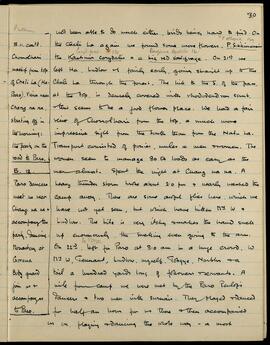
              B. 11. contd. not been able to do much either, birds being hard to find. On
              Chomolhari the Cheli La again we found some more flowers, P. sikkimensis
              massif from top (? P. obliqua 129), the Kashmir corydalis (Coryd. cash. 131) &
              of Cheli La (Ha- a big red saxifrage (Bergenia ligulata 130). On 21st we
              Paro). Views near left Ha, Ludlow & I fairly early, going straight up to the
              Chang na na, Cheli La through the forest. The hill to the S. of the pass,
              starting off in at the top, is densely covered with rhododendron scrub.
              the morning: This seems to be a good flower place. We had a fair
              the party on the view of Chomolhari from the top, a much more
              road to Paro. impressive sight from the South than from the Natu La.
              Transport consisted of ponies, mules & men & women. The
              women seem to manage 80 lb loads as easily as the
              men almost. Spent the night at Chang na na. A
              B. 12. heavy thunder storm broke about 2.0 pm & nearly washed the
              Paro dancers camp away. There are some awful flies here, which we
              meet us near
              LSH/1/1/1/1/75 · Part · 1933-06-30
              Fait partie de The Ludlow & Sherriff Collection

              SUMMARY:
              Notes on the death of the Thimbu penlop and Tobgye’s sending of English medicine, causing concern with the Maharaja. On 30th June Ludlow and the author travelled to Lomi-Tsa-wa via Do Kyong La in clearing weather, collecting flowers including Magnolia globosa and observing that vegetation in the Trashi-cho-dzong valley and at the pass resembled Sikkim.

              CONTENT:
              35

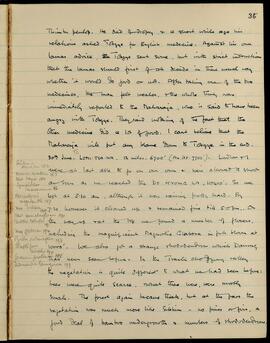
              Thimbu penlop. He died of dropsy & a short while ago his
              relations asked Tobgye for English medicine. Against his own
              lamas advice, Tobgye sent some, but with strict instructions
              that the lamas should first of all decide in their usual way
              whether it would do good or not. After taking one of the two
              medicines, the man felt weaker, & the whole thing was
              immediately reported to the Maharaja, who is said to have been
              angry with Tobgye. They said nothing of the fact that the
              other medicine did a lot of good. I can't believe that the
              Maharaja will put any blame down to Tobgye in the end.

              30th June. TO LOMI-TSA-WA. 12 miles - 6700' (An. Ht. 7700'). Ludlow & I
              Embelia oleracea 182
              Anemone rivularis 183 were at last able to go on our own & were allowed to shoot
              Rhod. Keysii 184
              Symplocos ramosissima 186 as soon as we reached the DO KYONG LA, 10410'. So we
              Pedicularis megalantha 187
              left at 5.30 am, although it was raining pretty hard. By
              Meconopsis villosa 189
              Rhod. camelliaeflorum 190 7.30 however it cleared up & remained fine till 5.0 pm. On
              Berberis celestina 191
              the way up & at the top we found a number of flowers,
              Mag. globosa 192
              Pyrola rotundifolia 193 including the magnificent Magnolia Globosa in full bloom at
              Streptopus simplex 194
              10000'. We also got a strange rhododendron which Dawang
              Geranium pratense 198
              Didissandra lanuginosa 199 has never seen before. In the Trashi-cho-dzong valley
              the vegetation is quite different to what we had seen before:
              trees were quite scarce, & what there were, were mostly
              small. The forest again became thick, but at the pass the
              vegetation was much more like Sikkim - no pines or firs, a
              good deal of bamboo undergrowth & numbers of rhododendrons.

              LSH/1/1/1/1/77 · Part · 1933-07-01
              Fait partie de The Ludlow & Sherriff Collection

              SUMMARY:
              The party splits as W and Mrs W go to Punakha while the diarist and Ludlow, on Tobgye's advice, take a dense leech-infested jungle path from below Lomitsawa towards Wangdupotrang. They avoid shooting due to sensitivities in the late Shabdrung’s area near Thimbu, collect some birds, butterflies, and plants, and after a tiring nine-hour trek reach the Punakha Chu/Mo Chu; camp conditions are filthy with flies, mud, and fleas.

              CONTENT:
              36

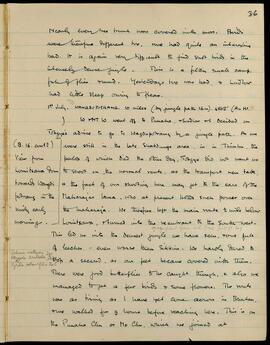
              Nearly every tree trunk was covered with moss. Birds were therefore different too, and we had quite an interesting bag. It is again very difficult to find shot birds in the intensely dense jungle. This is a filthy small camp, full of flies and mud. Yesterday too was bad, and Ludlow had little sleep owing to fleas.

              70
              1st July. TO WANGDUPOTRANG. 10 miles (by jungle path 16 miles). 4508' (An Ht. ). W and Mrs W went off to Punakha, and Ludlow and I decided on Tobgye's advice to go to Wangdupotrang by a jungle path. As we

              (B. 16. contd) View from Lomitsawa down towards Wangdi Potrang in the misty early morning.

              were still in the late Shabdrung's area, in Thimbu, the Penlop of which died the other day, Tobgye did not want us to shoot on the normal route, as the transport men talk, and the fact of our shooting here may get to the ears of the Maharaja's lama, who at present holds such power over the Maharaja. We therefore left the main route ½ mile below Lomitsawa, and turned into the re-entrant to the South West.

              magnificent fern with fronds 3-5 ft long
              This led us into the densest jungle we have seen, and full of leeches - even worse than Sikkim. We hardly dared to stop a second, as our feet became covered with them.

              Schima wallichii 201
              Polygala arillata 202
              Pyrola rotundifolia 203

              There were good butterflies to be caught though, and also we managed to get a few birds and some flowers. The route was as tiring as I have yet come across in Bhutan, and we walked for 9 hours before reaching here. This is on the Punakha Chu or Mo Chu, which we joined at

              LSH/1/1/1/1/91 · Part · 1933-11-02
              Fait partie de The Ludlow & Sherriff Collection
              • SUMMARY:
                The diarist records a warm farewell from friends in Bumthang, including H.H. and the ladies (notably Ashe Paldon), with gifts and a light‑hearted evening dressing in various outfits. Route notes describe an easy ascent along the left bank to THANG NARU, a river difficult to ford in summer, muddy sections, a 150-foot cliff with houses and a monastery, and scattered houses along the Tang Chu valley.

              CONTENT:
              43

              Tobgye & Ludlow

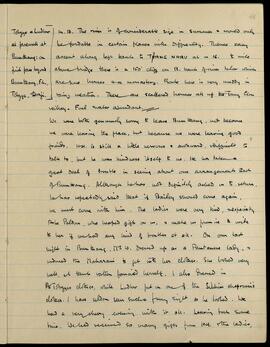
              • m. 13. The river is of considerable size in summer & would only
                at farewell at

              • be fordable in certain places with difficulty. Thence easy
                Bumthang: on

              • ascent along left bank to THANG NARU at m 15. 1/2 mile
                first pass beyond

              • above bridge there is a 150' cliff on R. bank of river below which
                Bumthang. F.L.,

              • are some houses & a monastery. Route here is very muddy in
                Tobgye, Dorji.

              • rainy weather. There are scattered houses all up the Tang Chu

              • valley. Fuel water abundant.

              We were both genuinely sorry to leave Bumthang, not because we were leaving the place, but because we were leaving good friends. H.H. is still a little nervous & awkward, & difficult to talk to, but he was kindness itself to us. He has taken a great deal of trouble in seeing about our arrangements East of Bumthang. Although he has not definitely asked us to return, he has repeatedly said that if Bailey should come again, we must come with him. The ladies were very kind, especially Ashe Paldon, who heaped gifts on us, & made us promise to write to her if we had any kind of trouble at all. On our last night in Bumthang Mrs W. dressed up as a Bhutanese lady, & induced the Maharani to get into her clothes. She looked very well, & I think rather fancied herself. I also dressed in Tobgye's clothes, while Ludlow put on one of the Sikkim chaprassis' clothes. I have seldom seen such a funny sight as he looked. We had a very cheery evening with it all. Leaving took some time. We had received so many gifts from H.H. & the ladies,

              LSH/1/1/1/1/93 · Part · 1933-11-02
              Fait partie de The Ludlow & Sherriff Collection
              • SUMMARY:
                The party took group photographs in Sikkim clothes, then visited the Dzong for tea and saffron rice with H.H., following a pleasant lunch the previous day. After farewell exchanges and gifts from Ashe Paldan Wangmo and Ashe Wangmo, they departed, with Tobgye and Dorji accompanying them over the river toward the Bada La.

              CONTENT:
              44

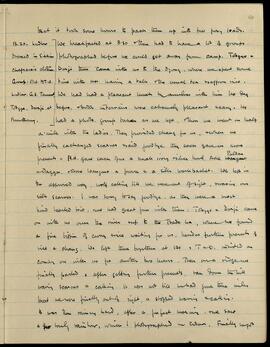
              that it took some hours to pack them up into two pony loads.

              B. 20. Ludlow

              • We breakfasted at 8.30 then had to have a lot of groups
                dressed in Sikkim
              • photographed before we could get away from camp. Tobgye and
                chaprasis clothes.
              • Dorji then came into us to the Dzong, where we spent some
                Group: F.W. H.W.
              • time with H.H. having a talk and the usual tea and saffron rice.
                Ludlow. G.S. Tenzing
              • We had had a pleasant lunch by ourselves with him the day
                Tobgye, Dorji at
              • before, and both interviews were extremely pleasant and easy. He
                Bumthang.
              • had a photo group taken as we left, and then we went on half
                a mile with the ladies. They provided chang for us, and when we
                finally exchanged scarves and said goodbye, they each gave us more
                presents — H.H. gave each of us a small ivory and silver bowl, Ashe Paldan Wangmo
                a dagger, Ashe Wangmo a purse and a silk workbasket. We left in
                the approved way, wolf calling till we were out of sight, waving our
                silk scarves. I was sorry to say goodbye, as they were a most
                kind hearted trio, and we had great fun with them. Tobgye and Dorji came
                on with us over the river and up to the Bada La, where we found
                a fine tiffin of
              LSH/1/1/1/1/135 · Part · 1933-08-15
              Fait partie de The Ludlow & Sherriff Collection

              SUMMARY:
              After an exceptionally heavy night of rain, the party crossed Pang La and collected 15 bird skins, including four adult and one young Heteroxenicus stellatus and a female blood pheasant, while finding few flowers due to lack of permanent snow. They were misinformed about the distance to camp and then made a steep descent through jungle to a long-neglected bridge that was recently strengthened, of the usual cantilever type found in Bhutan, Turkestan, and Kashmir.

              CONTENT:
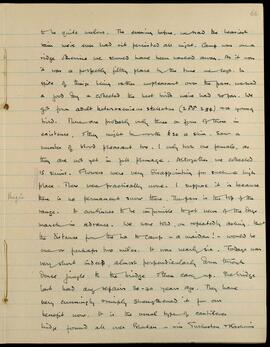
              to be quite useless. The evening before, we had the heaviest rain we've ever had and it persisted all night. Camp was on a ridge otherwise we should have been washed away. As it was it was a perfectly filthy place by the time we left. In spite of things being rather unpleasant over the pass, we had a good day and collected the best birds we've had so far. We got four adult Heteroxenicus stellatus (2 males, 2 females) and a young bird. There are probably only three or four of these in existence, and they might be worth £20 a skin. Saw a number of blood pheasant too. I only took one female, as they are not yet in full plumage. Altogether we collected 15 skins. Flowers were very disappointing for such a high place. There were practically none. I suppose it is because

              Pang La

              there is no permanent snow there. The pass is the top of the range. It continues to be impossible to get news of the day's march in advance. We were told, on repeatedly asking, that the distance from the la to camp — a maidan! — would be one or perhaps two miles. It was nearly six. Today's was very short indeed, almost perpendicularly down through dense jungle to the bridge and then easy up. The bridge last had any repairs 30–40 years ago. They have very cunningly and simply strengthened it for our benefit now. It is the usual type of cantilever bridge found all over Bhutan — in Turkestan and Kashmir.

              LSH/1/1/1/1/140 · Part · 1933-08-17
              Fait partie de The Ludlow & Sherriff Collection

              SUMMARY:
              Describes Sengai Dzong near Lachung at the junction of two glacial streams, with a small ramshackle dzong and a cliff monastery inhabited by a few lamas. Surrounding cliffs feature hanging glaciers above forests of slender firs (Abies Webbiana), with the scene marred by monsoon clouds and heavy rain.

              CONTENT:
              Aug 17
              Lachung. Sengai Dzong is situated on a
              flat - where the stream meanders
              peacefully through willow & rhododendron glades -
              at the junction of 2 glacial streams from
              the North West. The Dzong consists of a
              small ramshackle building more
              worthy of the name 'hut' than Dzong.
              There is also a small monastery
              built into a cliff in which 2 or 3 Lamas
              live. The cliffs & peaks surrounding
              the Sengai Dzong plain are sheer &
              imposing. Small hanging glaciers
              descend from every peak & below them
              are forests of rather slender firs
              (Abies Webbiana). It is a pretty spot
              but the beauty of the place was spoilt
              by monsoon clouds & drenching rain

              LSH/1/1/1/1/151 · Part · 1933-08-27
              Fait partie de The Ludlow & Sherriff Collection

              SUMMARY:
              Farewell letters with small gifts were dispatched, and several boxes of bird specimens were sent off amid improving but still rainy weather. At Narim Thang, the writer went to the Kang La pass, saw little view, and collected snow partridge, including specimens for Inglis in Darjeeling.

              CONTENT:
              Kang La morning we sent back our last bunch of letters. It was
              an awful job writing no less than nine farewell letters
              in one day, to the Maharaja, Maharani, Tobgye, Ashe
              Pedon, Ashe Wangmo, Tashi Dorji, Tashi Naku and Pintso
              Wangdu. Helped by two hot toddies, we finished up in
              good style just before dinner. This morning we did the
              letters up in parcels with a scarf in each with a
              small bottle of scent to the ladies. We also packed
              three boxes of birds and got them off too, leaving only a
              very few which we must take through Tibet with us.
              Yesterday was fine for quite a number of hours, and
              this morning has been the best for some time. But now
              at 9:30, it is again raining and mist is low down. It
              does appear to be getting gradually better though, and we
              hope for a decent day yet.

              27th August. Narim Thang. Fairly fine till the afternoon. I left at 6:00 am
              and went to the Kang La (16,300') for the first time. Took two
              hours. Practically no view, but it looks sunnier and
              drier on the other side. In fact I did see sunshine
              there. No birds or flowers seen near the pass which
              is a knife edge ridge of broken rock. Saw 50-60
              snow partridge on the way up and shot three: one for
              a skeleton and one for Inglis in Darjeeling. The
              other day I "bagged" 22 more P. eburnea at the

              LSH/1/1/1/1/158 · Part · 1933-08-31 - 1933-09-24
              Fait partie de The Ludlow & Sherriff Collection

              SUMMARY:
              Lists several bird specimens dated late August and early September 1933, followed by an outline of the journey from Lhakhang Dzong across southern Tibet. The route passes via Kuru Chu, Towa Dzong, Monda, Monda La, Tö Monastery by Pomo Tso, Tö, Ling, along Yamdrok Tso to Nangkartse, over Karo La to Gyantse, and then back to India via Phari to Kalimpong.

              CONTENT:
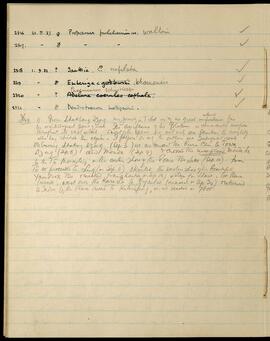
              2316 31.8.33 ♀ Propasser pulcherrimus waltoni
              2317 - ♂ - -
              2318 1.9.33 ? Ianthia c. rufilata
              2319 - ♂ Emberiza godlewskii khamensis
              2320 - ? Phoenicurus schisticeps Adelura coeruleocephala
              2321 - ♂ Dendrotreron hodgsonii

              No 11. From Lhakhang Dzong our journey in Tibet is of no great interest from the ornithological point of view. The avifauna of the plateau is remarkably uniform throughout its vast extent. Most of the species we met with are familiar to everybody who has studied this region. I propose only to outline our subsequent route. On leaving Lhakhang Dzong (Sep. 3) we ascended the Kuru Chu to Towa Dzong (Sep. 5) and Monda (Sep. 9) & crossed the unexplored Monda La to the Tö Monastery on the eastern shore of the Pomo Tso Lake (Sep. 10). From Tö we proceeded to Ling (on Sep. 11) skirted the western shore of the beautiful Yamdrok Tso reached Nangkartse (on Sep. 13) 4 stages from Lhasa. We then turned west over the Karo La to Gyantse (reached on Sep. 24) returned to India by the Phari road to Kalimpong, which we reached on

              LSH/1/1/1/1/165 · Part · 1933-09-24
              Fait partie de The Ludlow & Sherriff Collection

              SUMMARY:
              Notes damp weather, farewell to Pimbo, Kuntip, and Danong while taking on Tenduk, with praise for the Bhutanese workers; Tenduk will help with Kusho until the party returns to Sikkim. Describes dry, treeless country, the Kuru Chu gorge near Lhakang and its several local names, steady progress by coolies including many women wearing the Lhassa head dress, and few notable flowers or birds. A margin note mentions reunion at Yatung on Oct 3.

              CONTENT:
              81

              Disappointing, weather still inclined to be damp. Some rain & hills always in clouds. We parted with Pimbo & Kuntip & Danong today, but are taking on Tenduk with us. These Bhutanese have been perfectly splendid workers, on for anything at any time, never having to be told to do a thing. We shall miss them, but Tenduk is a good lad will help us a lot with Kusho till we get back to Sikkim. The country today is all dry with no trees except in the villages. The gorge of the Kuru Chu is a fine one even at Lhakang, but must be much finer further down, where it cuts right through the main Himalayan Range. It is impossible to find out the name of a river here. The Kuru Chu is known near Lhakang as the Thing Chu, further up more generally as the Lhobrak Chu. It also has other names - the Mo chi chu & so on, varying at most stages. The coolies were good today & kept up an average for the first 10 miles of about 2 1/2 m.p.h. About a third were women. The women here wear the Lhassa head dress, a triangular affair perched precariously on the head. No flowers of any interest seen, & hardly any birds at all, except one bunting, choughs (red billed) & pigeon of three kinds.

              reunited on Oct 3 at Yatung. S. 105
              B. 26. Gorge of Kuru Chu - down