India

Área de elementos

Taxonomía

Código

Nota(s) sobre el alcance

    Nota(s) sobre el origen

      Mostrar nota(s)

        Términos jerárquicos

        India

          Términos equivalentes

          India

            Términos asociados

            India

              176 Descripción archivística resultados para India

              176 resultados directamente relacionados Excluir términos relacionados
              LSH/1/1/8/1/170 · Part · 1933-06-02
              Parte de The Ludlow & Sherriff Collection

              SUMMARY:
              List of supplies and equipment including hams, tarpaulins, various tinned foods (mushrooms, beans, fruits), staples such as flour, dhal, tea, spirits (gin, whiskey, rum), cigarettes, nails, and 12-gauge cartridges. Quantities are recorded for each item, with some noted in tins or pounds. 'Delhi flour' is specified among the staples.

              CONTENT:
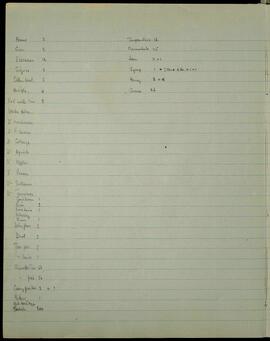
              Hams 2. Tarpaulins 16.
              Gun 2 Marmalade 25
              Essences 12. Jam 11 + 1
              Sigris 3. Syrup 1 + 7 lbs + 4 lbs + 1 + 1
              Cotton Wool. 3 Honey 2 + 4
              Antiflo. 4 Cheese 26
              1" + 2" nails tins 3
              Whalen Valves ..
              Do. Mushroom
              Do. Fr beans
              Do. Cabbage
              Do. Apricots
              Do. Apples
              Do. Prunes
              Do. Sultanas
              Do. Tomatoes
              Cornbean 1
              Gin 2
              Lime Juice 1
              Whiskey 1
              Rum 1
              Delhi flour 2
              Dhal 2
              Tea pkts 7
              " brick 1
              Cigarettes tins 56
              " pkts 50
              Curry powder 2 + 1
              Bitters 1
              12 G. cartridges 200

              LSH/1/1/9/1/4 · Part · 1949-09-13
              Parte de The Ludlow & Sherriff Collection

              SUMMARY:
              The party departs after intensive planning over the fate of Tashiding and Crockety, traveling by lorry and jeep to Rydak Tea Estate. Continuing via the Raidak toward Hatisar and then Kabare, they face repeated vehicle issues including getting stuck at a ford, fuel tank punctures, and delays at a ferry, turning short stages into long, difficult drives.

              CONTENT:
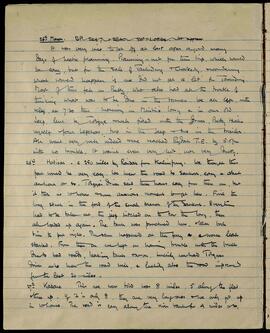
              25th March. BP 29.47 = 3840 70° = 1.0844 Ht. approx

              It was very nice to set off at last after a good many days of hectic planning. Planning - not for this trip, which would be easy, but for the sale of Tashiding and Crockety, and wondering what would happen if we did not get a 'let' for Tashiding. Most of this fell on Betty, who also had all the trouble of thinking what was to be done in the Homes. We all left, with relief, at 7.30 this morning in Mintri's lorry and in our old Jeep, lent by Tongue well filled with the driver, Betty Hicks, myself and four Lepchas, two in the Jeep and two in the trailer. All went very well indeed and we reached Rydak T.E. by 5.0 pm with no trouble. It wasn't even very hot, nor very dusty.

              26th Hatisar - c 250 miles by Raidak from Kalimpong. We thought this part would be very easy. We knew the road to Sankosh, easy and about an hour or so. Tongue's driver said three hours easy from there on, but it took us 10 hours and some anxious moments to get here. First the lorry stuck in the ford of the small branch of the Sankosh. Everything had to be taken out, the jeep hitched on to tow the lorry, then all loaded up again. The tank was punctured here, and that took time to put right. The same happened at the ferry and a worse leak started. From then on we kept on having trouble with the truck. Due to bad roads, leaking tanks and so on. Luckily we had Tongue's driver who knew the road well, and luckily also the road improved for the last 20 miles.

              27th Kabare. This we were told was 8 miles, 5 along the flat and three up. If it is only 8, they are very long ones and we only got up in 10 hours. The road is easy along the river bank for 4 miles or so,

              LSH/1/1/9/1/11 · Part · 1949-07-30
              Parte de The Ludlow & Sherriff Collection

              SUMMARY:
              A planned picnic on the 4th was postponed due to rain and mist, and surplus food was sent in. On the 5th April, H.H. visited for an extended discussion about the Treaty and forest management, including concerns over the lack of young pines due to annual grass burning for cattle grazing.

              CONTENT:
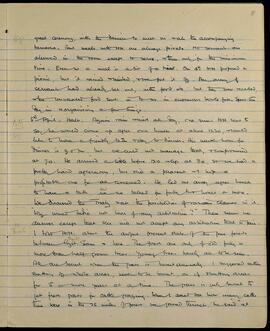
              great ceremony, with the dancers to meet us and all the accompanying tamasha. But meals with H.H. are always private. No servants are allowed in the room except to serve, and then only for the minimum time. Even so a meal is a bit of a trial. On 4th H.H. proposed a picnic, but it rained and misted, and we put it off. An army of servants had already set out, with food etc, but they were recalled, and the unwanted food sent in to us in enormous bowls full. Spent the day in reorganising a few things.

              5th April. Halt. Again rain and mist all day, no sun. H.H. sent to say he would come up after our lunch at about 12.30, and would like to have a friendly talk and stay to dinner. His usual hour for dinner is 9.0 pm, but we could not manage that, and compromised at 7.0. He arrived a little before 12.0 and left at 8.0, so we had a pretty hard afternoon, but still a pleasant and I hope a profitable one for all concerned. He led me away after lunch to have a talk, and we talked for fully two hours or more. We discussed the Treaty and all the possibilities of various clauses in it. "Why would India not hear of any arbitration?" There seems no answer except that she will not accept any arbitration that is fair.

              I told H.H. about the awful present state of the pine forests between Bigiti Sam and here. The forests are only of old fully or more than half grown trees. Young trees barely are to be seen. All are burnt when the grass is burnt annually. I suggested either shutting off whole areas, never to be burnt, or of shutting areas for 5 or more years at a time. The grass is only burnt to get fresh grass for cattle grazing. When I asked H.H. how many cattle there were in the 25 miles of forest we passed through, he said "at

              LSH/1/1/9/1/12 · Part · 1949-07-30
              Parte de The Ludlow & Sherriff Collection

              SUMMARY:
              Notes discussions with H.H. on a new treaty affecting Bhutan, mention of Tasho Jigme’s freedom to travel, and soldiers sent up the Bumthang road to collect flowers including Prim. bracteosa, a Magnolia, and a Daphne. On 8th April they watched Bhutanese dancers and later hosted H.H. for a long session reminiscing about Calcutta and P.O.'s Gould, Williamson, Bailey, and Bell; letters from Kalimpong reported Ludlow’s departure and Norman’s sale of Glenulli.

              CONTENT:
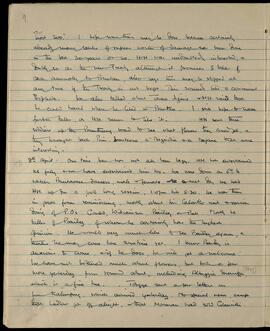
              almost 300." I hope something may be done, because certainly already many lakhs of rupees worth of damage has been done in the last 30 years or so. H.H. was undoubtedly interested, & doubly so as the new Treaty, although it promises 5 lakhs of cash annually to Bhutan, also says this may be stopped at any time if the Treaty is not kept. This sounds like a convenient loophole. We also talked about Tasho Jigme, & H.H. said that he could travel where he liked in Bhutan. I still hope to have further talks, as H.H. seems to like it. H.H. sent three soldiers up the Bumthang road to see what flowers they could get, & they brought back Prim. bracteosa, a Magnolia & a Daphne that were interesting.

              8th April. Our time here has not all been lazy. H.H. has entertained us fully & we have entertained him too. We were down on 6th to watch Bhutanese dancers, male & female, & the next day we had H.H. up for a good long session, 1.0pm till 5.30. He was then in great form reminiscing, mostly about his Calcutta visit & various doings of P.O.'s Gould, Williamson, Bailey or Bell. Mostly he talks of Bailey, of whom he certainly has the highest opinion. He would very much like to see Bailey again, & thinks he may come here sometime yet. I know Bailey is anxious to come, & if he does, he will get a welcome. We have not bothered much about flowers, but took a few more yesterday from round about, including Albizzia Sherriffii (18657), which is a fine tree. Tobgye sent a few letters on from Kalimpong, which arrived yesterday. No special news, except that Ludlow got off alright, & that Norman had sold Glenulli.

              LSH/1/1/9/1/13 · Part · 1949-07-30
              Parte de The Ludlow & Sherriff Collection

              SUMMARY:
              The party delayed departure to meet HH, discussing a Treaty, M.K., and reports from Tobgye that the Sikkim Maharani had stirred Nepalis of Sikkim to oppose the Maharaja; they later dined and played games with HH and two Maharanis. They set off around 10:00 on a short, steep march behind Kunga Rapden, noting cultivation, forest edge and grassland, and several rhododendrons including R. arboreum, R. grande, and epiphytes such as R. edgeworthii and R. rhabdotum.

              CONTENT:
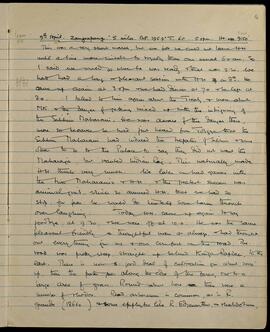
              9th April. Zangrapang. 5 miles. BP. 195.9° T. 61° 5.0pm. Ht. app. 9150'

              This was a very short march, but we felt we could not leave HH until a time more suitable to royalty than our usual 6.0 am. So I said we would go when he was ready, that was 9.30. We had had a long & pleasant session with HH & on 8th. He came up again at 3.0pm & we had dinner at 7.0 & he left at 8.0. I talked to him again about the Treaty, & more about M.K. & the danger of getting mixed up with the intriguing of the Sikkim Maharani. He was aware of the danger there, more so because he had just heard from Tobgye that the Sikkim Maharani had induced the Nepalis of Sikkim & some others to go to the Palace to say they did not want the Maharaja, but wanted Indian Raj. This naturally made HH think very much. We later on had games with the two Maharanis & HH, & the greatest success was animal snaps, which so amused HH that we had to stop for fear he would do himself some harm through over laughing.

              Today HH came up again to say goodbye, at 9.30, & we were off at 10.0. He was the same pleasant friendly & thoughtful man as always, & had thought out everything for us & our comfort on the road. The road was pretty steep, straight up behind Kunga Rapden, to the east. There is now a good deal of cultivation for about 2000' up, then the path goes along the edge of the forest, to a large area of grass. Round about here there were a number of rhodos. Rhod. arboreum is common, as is R. grande (18660) & some epiphytes like R. Edgeworthii, & rhabdotum,

              LSH/1/1/9/1/21 · Part · 1949-04-21
              Parte de The Ludlow & Sherriff Collection

              SUMMARY:
              The page describes conifer- and rhododendron-dominated terrain and extensive cultivation in the Tang valley, contrasting land use practices with those near Kalimpong. On 15th April, the party traveled from Pimi over the RUDO LA in persistent snow, observed few flowers, and received wine and food sent by Asha Wangmoo at the pass.

              CONTENT:
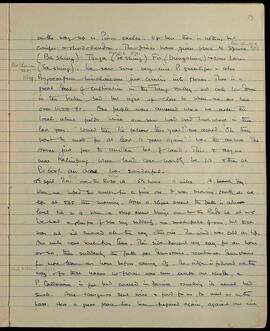
              On the way up is Pinus excelsa. Up here there is nothing but conifers & rhododendron. The pines have given place to Spruce (Picea spinulosa 18702) (Bashing), Tsuga (dumosa 18701) (Seshing), Fir (Dungshing) & some Larix (Sasuing) (Rhod. thomsonii 18697). We saw some very nice P. gracilipes — also (15699) Bryocarpum himalaicum just coming into flower. There is a great deal of cultivation in the Tang valley, not only low down in the valley bed, but right up close to where we are here, over 11,000 ft. Our people were amused when we asked the locals about fields which we saw had had buckwheat in them last year. "Would they lie fallow this year?" we asked. "Oh they won't be used for at least 12 years again!" was the answer. The owner just goes to another bit of land. This to anyone near Kalimpong, where land can hardly be got, often at Rs 600/- an acre, was wonderful.

              15th April. PIMI. over the RUDO LA (9690, 12600). 5 1/2 hours, 11 miles. A beastly day when we hoped so much for a fine one. It was snowing gently as we left at 5:45 this morning. After a slight ascent, the path is almost level till 4 when a steep ascent brings one to the Rudo La at 11:30. We had a glimpse of blue sky suddenly, & a small patch of sun, but that was all, it snowed all the way otherwise. The wind was cold on top. Our mules were back from there. This side descent very easy for an hour or so, then suddenly the path goes downstairs, & continues downstairs for more than an hour before easing off. The ridge is followed all the way, & for that reason no flowers were seen, except one Rhod. (Rhod. arboreum 18703), & P. Calderiana in fat bud, covered in farina, smelling its usual bad smell. Asha Wangmoo sent wine & food for us to meet us on the pass. Here a great place has been prepared again, against our visit.

              LSH/1/1/9/1/32 · Part · 1949-05-06
              Parte de The Ludlow & Sherriff Collection

              SUMMARY:
              A wet halt day spent scrambling on a steep rock slope near Rip la to observe rhododendrons, notably Rhododendron edgeworthii, anthopogon, and lindleyi, with signs of bear and musk deer but no sightings. Men later brought in masses of R. edgeworthii, and the diarist began a letter to Betty before receiving mail from Kalimpong.

              CONTENT:
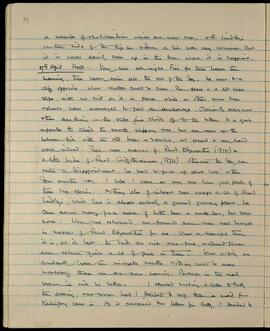
              a number of rhododendrons which are now over, and R. lindleyi
              on the side of the Rip la and down a bit was very common. But
              it is never easily seen up in the trees where it is happiest.
              27th April. Halt. Very wet all night. Fine for three hours this
              morning, then heavy rain all the rest of the day. We went to a
              cliff opposite, where Rhodos. could be seen. The place is a 45° rock
              slope, with no soil on it in places, while in others some trees
              and shrubs have managed to find an anchorage. Obviously every now
              and then anything on the slope just shoots off to the bottom. It is quite
              impossible to climb the smooth slippery rock, but we went up the
              between bits with the odd trees and bamboo, and found it very hard
              work indeed. There were masses of Rhod. edgeworthii (18777) and
              a little higher of Rhod. anthopogon (18776). Otherwise the day was
              rather a disappointment. We had to go on up above 2000' and then
              down another way. I hope I have at any rate some good photos of
              these two species. Nothing else of interest seen, except a lot of Rhod.
              lindleyi, which here is almost entirely a ground growing plant. We
              came across many fresh marks of both bear and musk deer, but saw
              none. When we returned, we found some men had brought
              in masses of Rhod. edgeworthii for me. What a beautiful thing
              it is, at its best: the buds are rich rose pink, and opened flowers
              even retain quite a lot of pink in them. What a pity we
              constantly have this miserable weather. Nothing could be more
              monsoony than we are now having. Perhaps in the real
              season it will be better. I started writing a letter to Betty
              this evening, and no sooner had I decided to stop than a mail from
              Kalimpong came in. As it contained two letters for Betty, I decided to

              LSH/1/1/9/1/35 · Part · 1949-05-06
              Parte de The Ludlow & Sherriff Collection

              SUMMARY:
              The diarist walks alone while Ngundup asks about Delhi, London, and the King; the writer reflects on the Maharaja’s authority in Bhutan and warns of leeches on routes toward Tobrang and between Denchume and Jula. During halts on 30 April and 1 May near Sulu, Pasang returns with few specimens (no primulas) and a possible Rhododendron magnificum, and the diarist notes the scarcity of dogs and consults 1937 field notes.

              CONTENT:
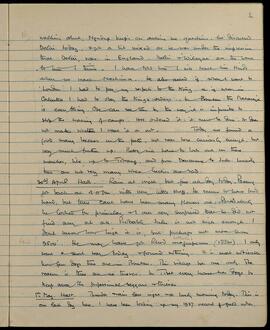
              Walking alone, Ngundup keeps on asking me questions. We discussed Delhi today, and got a bit mixed as he was under the impression that Delhi was in England. Delhi and 'Wilayat' are the same to him I think. I have told him I will teach him Hindi when we reach Nashima. He also asked if when I went to 'London' I had to pay my respects to the King, and if when in Calcutta I had to obey the King's orders. In Bhutan the Maharaja is everything. One can see this by the way it is impossible to stop the making of camps. H.H. ordered it: it must be done. It does not matter whether I want it or not. Today we found a good many leeches on the path, not near here curiously enough, but very much further up. Betty will have to look out on these marches, like up to Tobrang, and from Denchume to Jula. Luckily there are not very many where leeches are bad.

              30th April Halt. Rain at night, but fine all day today. Pasang got back at 4.0 pm, with very little stuff. He seems to have tried hard, but there can't have been many flowers out. Particularly he looked for primulas, and I am very surprised that he did not find any at all. Probably Sulu is not high enough. I don't know how high it is, but perhaps not more than 9500'. He may have got Rhod. magnificum (18801). I only went a short way today, and found nothing. It is most noticeable how few dogs there are in Bhutan. This village has one only. The reason is there are no thieves. In Tibet every house has dogs to keep away the professional beggars and thieves.

              1st May. Halt. Thunder and rain last night, a lovely morning today. This is our last day here. I have been looking up my 1937 record of field notes,

              LSH/1/1/9/1/53 · Part · 1949-05-28
              Parte de The Ludlow & Sherriff Collection

              SUMMARY:
              The diarist notes magpies and quail, sends mail to H.H., Kalimpong, and Betty, and dispatches a box of dried flowers to Byakar Dz. On 20th May they march about five miles to Takhung via the Tang chu and Takhung chu, note altitude observations, collect Primula geraniifolia, and describe a well-made camp near Bumthang. The entry opens the next day's move toward Shabejetang.

              CONTENT:
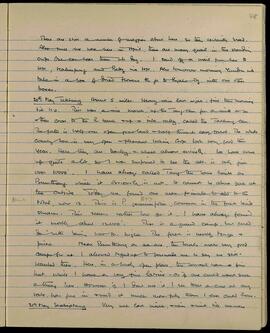
              There are still a number of magpies about here, so they certainly breed. Also since we were here in April, there are many quail in the standing crops. One can hear them all day. I send off a mail from here to H.H., Kalimpong and Betty via H.H.. Also tomorrow morning Lundrup will take in a box of dried flowers to go to Byakar Dz. into our other boxes.

              20th May Takhung About 5 miles. Heavy rain last night, fine this morning till 11.0. This was a nice march, up the Tang chu for a mile or so then cross to the R bank and up a side valley, called the Takhung chu. The path is half over open grassland and half through easy forest. The whole country here is very open and pleasant looking. Crops look very good this year. Here they are barley and wheat almost entirely. We have come up quite a lot, so I was surprised to see the alt. is only just over 10000'. I have always called Tang the same height as Bumthang which it obviously is not. It cannot be above 9000 at the outside. Today we found one more primula to add to the total, now 13. This is P. geraniifolia 18913, common in the forest beside streams. This seems rather low for it. I have always found it mostly above 12000'. This is a grand camp, but could do with being 1000 ft. higher. The forest is mostly tsuga and picea. Near Bumthang as we are, the locals make very good camps for us. I allowed Ngudup to persuade me to say we still wanted them. Here, in a lovely open place, the servants have a fine hut, while I have a very fine latrine - as if one could want such a thing here. However, if I don't use it, I see that a cow at any rate, has gone in and used it much more fully than I ever could have.

              21st May Shabejetang Very wet last night, rain until we were