India

Zone des éléments

Référentiel

Code

Note(s) sur la portée et contenu

    Note(s) sur la source

      Note(s) d'affichage

        Termes hiérarchiques

        India

          Termes équivalents

          India

            Termes associés

            India

              176 Description archivistique résultats pour India

              176 résultats directement liés Exclure les termes spécifiques
              LSH/1/1/7/1/11 · Part · 1940-05-24
              Fait partie de The Ludlow & Sherriff Collection

              SUMMARY:
              The author describes the low Tum La pass and nearby areas, noting limited finds there but abundant primulas and a notable prostrate yellow-flowered rhododendron. After wet weather they returned toward Nagu, collected aquatic and tree specimens, noted Magnolia globosa and Lilium giganteum in the Nagu Chu valley, and then proceeded toward Paka to visit the Tsanang La and Kuchala passes, observing that Tsanang La is steep and little used but botanically promising.

              CONTENT:
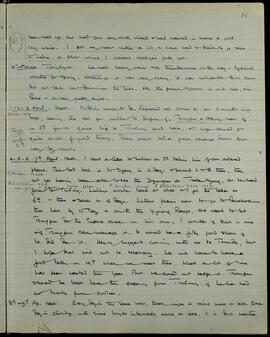
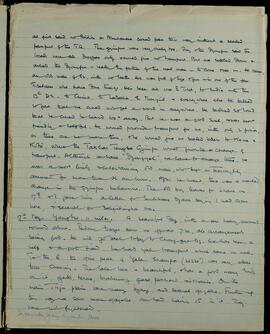
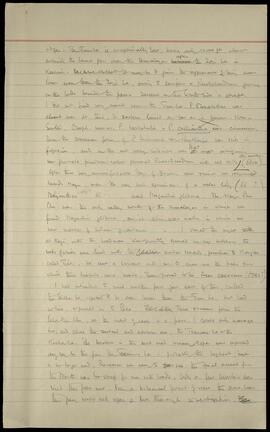
              ridge. The Tum La is exceptionally low, being only 12,000 ft, almost certainly the lowest pass over the Himalayas after the Zoji La in Kashmir. It gives the appearance of being even lower even than the Zoji La, owing to conifers & Rhododendrons growing on the hills beside the pass. Descent on the south side is abrupt. I did not find very much near the Tum La. P. Elizabethae was almost over at this, its eastern limit as far as is known. Nom-Soulei, Omph. minus, P. barbata & P. calliantha were common. Here the common form of P. Dickieana var. Pantlingii was still in profusion, and on the wet rocky hillside was that most intriguing new prostrate primrose yellow flowered Rhododendron, with red spots (6600).

              After three very uncomfortable days of driving rain & mist we returned towards Nagu, & on the way took specimens of a water lily (66?) Menyanthes trifoliata 66-- and Magnolia globosa. The Nagu Chu was the only valley north of the Himalayas in which we found Magnolia globosa, & it also was in which we saw masses of Lilium giganteum. I stayed the night at Nagu with the headman who proudly showed me his kitchen the walls of which were lined with wooden teapots, peculiar to Kongbo, called Tisti. He sent a servant with me to show me the trees from which these teapots were made. These proved to be Acer caesium (5740?).

              I had intended to visit another pass just east of this, called the Shoka La, reputed to be even lower than the Tum La, but had no time, & pushed on to Paka. Three streams form the Paka Chu Chu, at the head of each is a pass. I could only manage two, and chose the central and eastern one, the Tsanang La & the Kuchala. The western is the most used & many Lopas were expected any day by this pass. The Tsanang La is probably the highest, but is no longer used. The reason was easy to see. The final ascent from the North was too steep for men with loads. Only a few hunters ever visit this pass now. From a botanical point of view the area near this pass, would well repay a more thorough investigation.
              LSH/1/1/7/1/19 · Part · 1940-05-17 - 1940-04-22
              Fait partie de The Ludlow & Sherriff Collection

              SUMMARY:
              While awaiting Taylor’s arrival at Molo on 17 May 1940, the party planned a four-week excursion south of the Himalayas and left Molo on 22 April for the Pachakshiri district. The page notes the rich flora of Sikkim and Bhutan toward the Tsangpo gorge and recalls a 1936 split expedition in the Tsari District, where Ludlow briefly explored near Lo La and Nyug La, revealing notable alpine flora.

              CONTENT:
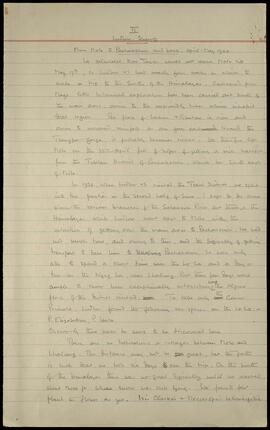
              II
              Ludlow - Sherriff
              From Molo to Pachakshiri and back. April - May 1940.

              We calculated that Taylor would not reach Molo till May 17th, so Ludlow and I had nearly four weeks in which to make a trip to the south of the Himalayas. Eastward from Mago little botanical exploration has been carried out south of the main axis, owing to the unfriendly tribes which inhabit that region. The flora of Sikkim and Bhutan is rich, and owing to increased rainfall as one goes eastward towards the Tsangpo gorge, it probably becomes richer. We therefore left Molo on the 22nd April full of hopes of getting a rich harvest from the Tibetan District of Pachakshiri, which lies southeast of Molo.

              In 1936, when Ludlow and I visited the Tsari District, we split into two parties in the second half of June. I kept to the area where the various branches of the Subansiri River cut through the Himalayas, while Ludlow went east to Molo, with the intention of getting over the main axis to Pachakshiri. He had not much time, and owing to this, and the difficulty of getting transport to take him to Pachakshiri he was only able to spend a short time near the Lo La and a day or two on the Nyug La, near Lhalung. But these few days were ample to show how exceptionally interesting was the Alpine flora of the district visited. To take only the Genus Primula: Ludlow found the following new

              LSH/1/1/8/1/4 · Part · 1946-10-14
              Fait partie de The Ludlow & Sherriff Collection

              SUMMARY:
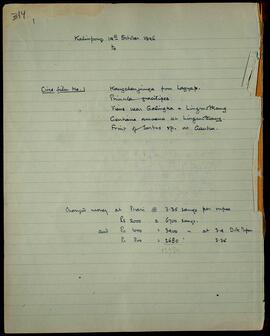
              Notes on Cine film No. 1 with views of Kangchenjunga from Lagyap, scenes near Galingka and Lingmothang, and plant observations at Lingmothang and Gautsa. Records currency exchanged at Phari with rates and totals.

              CONTENT:
              314

              Kalimpong 14th October 1946
              to

              Cine film No. 1 Kangchenjunga from Lagyap.
              Primula gracilipes
              Views near Galingka & Lingmothang
              Gentiana amoena at Lingmothang.
              Fruit of Sorbus sp. at Gautsa.

              Changed money at Phari @ 3.35 sangs per rupee
              Rs 2000 = 6700 sangs.
              and Rs 1000 = 3400 sangs at 3.4 Doke Ripon
              Rs 800 = 2680 ? 3.35
              12780

              LSH/1/1/8/1/5 · Part · 1946-10-14
              Fait partie de The Ludlow & Sherriff Collection

              SUMMARY:
              Travel from Gyantse to Dochen via Phari and Tuna with notes on weather, flowering plants, and limited seed collecting. Transport disputes with local headmen lead to a bribe; Pangdatshang intervenes, the party meets Dorje Tsering, exchanges currency, attempts wildfowl hunting, and receives letters of introduction from Tsarong.

              CONTENT:
              21st October. Gyantse. Very fine day after three days of heavy rain. We are not taking any specimens yet, but only a few seeds here & there. Today there were several fine clumps of Gentiana amoena in full bloom. Besides these there are many of a sp. of small blue Swertia, some Asters, Cyananthus lobatus, the usual odd blooms of Rhod. cinnabarinum which always appear in October. The Headmen of Yatung lived up to their reputation. They will not supply transport at the rates laid down. We have transport from Kalimpong to Gyantse, & yesterday the headmen tried to stop it going beyond Yatung. However Pangdatshang ordered them to let us go without hindrance.

              22 October. Phari. Very cold in the morning, with thin clouds. Cleared up later and was lovely. Met by Dorje Tsering this time. Exchanged rupees at 3.35 sangs per rupee. The only seeds collected were P. bellidifolia. I could not find P. tenella under the snow.

              23rd October. Tuna. A clear but very cold day indeed until we reached Shabra Shubra, about 12.15. As usual we could not get off to time, even though we had our own through transport. Last night the Phari headmen demanded a bribe. We could take our own transport if we liked, they said: if we did then they would of course not supply any other sahibs. Rs 20 bribe paid that night. Saw no gazelle or game of any kind.

              24 October. Dochen. Fine still. Went after duck & geese in the afternoon. Have seen but we could get near nothing. Got a large letter from Tsarong enclosing several letters to people on our way. These should be very useful later on. All are in Tibetan, so we have not been able to see yet who they are addressed to.

              LSH/1/1/8/1/7 · Part · 1936-10-25 - 1936-11-04
              Fait partie de The Ludlow & Sherriff Collection

              SUMMARY:
              Entries record weather, lakes and birdlife near Kala, transport difficulties along the Kalimpong–Gyantse route, and stages from Samoda and Kangmar to Gyantse and on to Gobshi, Ralung, and Nangartse. The party met Hugh Richardson and Pailthorpe at Gyantse, and noted snow, winds, and logistics issues with local headmen and supplies.

              CONTENT:
              25 October Kala. There was a curious low fog all over the plain from the main Range to the hills to the N. of us, only 50 ft up. This did not dissolve till about 1130. Then the views were wonderful again. The Rham Tso is very high & the Kala lake higher than any of us have ever seen it. Ludlow shot two cranes & 2 gadwall & 1 garganey teal. Many birds about, but all very wild. Saw three white fronted geese.

              26th October. Samoda. Cloudy & cold with bright patches. Weather all along is most unlike October weather. We did well to get through transport from Kalimpong to Gyantse. Chowkidars report difficulties all along the line. The headmen of Chumbi - upper & lower - started the objection to our through transport, but Pangdatshang stopped trouble. Then Phari. Then Tuna. At Dochen & Kala the headmen will not give any dung or other supplies & it is much the same here. They give, but the chowkidar complains he always has trouble. In my opinion the trouble is likely due to two causes - the rate of exchange is against the locals, & there is only a head clerk at both Gyantse & Yatung.

              27th October KANGMAR. Fine but very cloudy. Saw no game at all on the river or partridge on the hill side.

              28th October. Sunkang. Fine but more cloudy than yesterday. No game. Berberis on the hillside very fine colour indeed, but no seed.

              29 October. Gyantse. Cold when we arrived, & gradually got colder. Snow at night. Met & lunched & tea'd with Hugh Richardson & Pailthorpe.

                1. 1st. Halt. Snowed hard on 30th. 31st v. fine indeed.

              2nd. Nov. Gobshi. Fine, but v. cold in the evening. Camped at Gobshi.

              3rd Nov. Ralung. Fine, but strong wind up valley after 9.30.

              4th Nov. Nangartse. Fine & warm. Wind strong down valley to Nangartse. Left at 0615. In at 1615 & kit about 1 hour later.

              LSH/1/1/8/1/21 · Part · 1946-12-11
              Fait partie de The Ludlow & Sherriff Collection

              SUMMARY:
              The diarist describes sparse official presence across Tibetan towns, then records halts and short marches with bullocks en route toward Tsela Dzong. A pony carrying Ludlow and Elliot’s bedding goes missing and is later recovered; Sandup returns to Kyindong, and difficult road conditions near Risho require manhandling loads, with mention of skin ferries.

              CONTENT:
              There can be no other country which runs itself like Tibet. Since we left Gangtok we have not come across many officials in their place of business. The T.T.A. Yatung is hardly ever anywhere but in Kalimpong. There was a dzongpon in Phari. There was one in Gyantse. But there were none in Nangkarbe, Pede or Gongkar. The Nethong Dzongpon was in residence, and we have seen none since then.

              3rd Dec. Halt. Very windy last evening, but clear and cold at night, with not a very low temp. No one appeared this morning early, but by 11.0 some 30 bullocks had come. The men are a pleasant friendly - several having been with us before both in 1933 and 1938 in Langong or beyond Kyindong Dzong. They remember us, apparently quite happily, and they even remember Jill. They are going to Tsela Dzong with us, and we should have no trouble when once away from here. The only troublesome people are the representatives of the Dzong. The village here is very poor, but they seem friendly enough.

              4th Dec. Kamchang. Bullocks got off in good time, last party leaving at 8.0. We were in at 11.30 - it is a short march. But bullocks take a very long time. One pony with Ludlow and Elliot's bedding never arrived in. Kamchang is the lower of two villages, each only with a few houses. Pollarded walnut trees are much in evidence.

              5th Dec. Halt. Again had to halt, this time owing to the lost pony. It strayed up a side valley 2 miles from here. Sandup has gone back to Kyindong. Pony came in late at night - or rather the bedding was brought in - the pony had fallen and hurt itself.

              6th Dec. Camp 2 m. beyond Chongrong on S. bank, left at 7.30: in with bullocks at 4.30pm. Road very bad for bullocks in 3 places, the worst being 1 1/2 m beyond Risho, where all loads had to be manhandled for 100 yds over a cliff. There are 'skin' ferries at 1 1/2 m above Risho, -

              LSH/1/1/8/1/29 · Part · 1946-12-20
              Fait partie de The Ludlow & Sherriff Collection

              SUMMARY:
              The diarist acquires a sheep and extra ponies to reach Temu La, aiming for views of snow mountains, and notes various birds including geese, a kite, Lophobasileus, a crossbill, a black woodpecker, a Sitta, and a large flock of Grandala. At Latsa Lunang above Tumbatse, poor visibility prevents mountain views; seeds of Notholirion hyacinthinum and two Berberis are collected, and weather and snow conditions are recorded before proceeding to Lunang.

              CONTENT:
              26

              very obliging, ready to help. We are getting a sheep here, & taking on 2 extra ponies to the Temu La. About 2 miles from here there were many geese, some duck on the open plain & on some odd water. I also saw one kite - only the second to be seen since India. Our main idea in coming on is to try to get views of the snow mountains from the Temu La while the good weather lasts, but I wonder if it will last. Clouds came up fast today & we would not have had good views had we been there today. Yesterday B & I were out up the valley for birds & got 2 more Lophobasileus, a crossbill, a black woodpecker & a Sitta which seems different to any we have yet got, & different to anything in the Fauna of B.I.

              19th Dec. Latsa Lunang (above Tumbatse). Left 7.30: in 3.30: transport 7.30 to 4.30 ponies. Clouded up during the day, & nothing visible from the La except hazy up the Tsangpo. An ice mass lay at 40° & another at approx 80°, but nothing could be identified - a great disappointment to us. We did not try to reach Tumbatse. This is a good camping ground, with about five houses. The Sancha can almost be seen from here, & seems to have more snow on it. Here the locals tell me, snow hardly falls at all. I got seed of Notholirion hyacinthinum within 500' of the La, SE side, & two Berberis, one blue fruit, one red N of the La. There was hardly a bird to be seen or heard in the forest on either side, particularly N side, till we got here - I heard a few calling only, but when we reached here, saw a large flock of Grandala, males & females, about 100 together. They were constantly on the move, between a tall Picea & some Hippophae which were covered with fruit. Shot one male or female. This evening it is heavily overcast, is snowing low down to the N beyond Tumbatse, perhaps even down to Lunang. Saw a jay, above Temo.

              20th Dec. Lunang. Left at 8.0: in about 2.0. Road very easy & open.

              LSH/1/1/8/1/43 · Part · 1947-01-13
              Fait partie de The Ludlow & Sherriff Collection

              SUMMARY:
              Entries for January 6–9 describe a snowy halt, peak angle measurements from a Dzong, and marches to Layoting and Camp Namdi. The writer disputes Ward and Bailey on the visibility of Gyala Peri, notes friendly villages, a nearby peak Gelung Jokpo, forests transitioning from pine to dense broadleaf, and observations of birds, clematis, and abundant Lilium giganteum.

              CONTENT:
              letters. He says he will arrive in about 22 days. Our own next mail will not leave here for 7 or 8 weeks or so until we reach India in 3 months from now, so this is worth while.

              Jan 6th & 7th Halt. Snowed night of 6-7th then cleared up to a beautiful day. On 7th I took the angles to peaks from the Dzong. They are: - to left-hand peak 114° : to two peaks in centre 132° to big right-hand nearest peak 150°. I disagree with Ward's identification of Gyala Peri. Everyone in Tongkyuk says it cannot be seen from Tongkyuk.

              Jan 8th LAYOTING. 9 miles. A good fine day. Left at 10.0 got in at 3.30. Road good mostly fit for loaded animals. At mile 2 from the bridge pass village of DABLA, about 4 houses. Layoting has about 12 houses. People here very friendly. From here a fine snow peak with cut top lies to the South up a bleak looking valley in which are said to be many 'takin', locally called CHIMNYA. There is a sling or cane bridge over to this valley. The peak at the head of the valley is called GELUNG JOKPO. From down near the river, Gyala Peri can be seen in the distance. Forest is first almost entirely pine, then changes to pretty dense mixture of pine, holly oak & shrubs.

              Jan 9th Camp NAMDI. On the whole the road was uninteresting. It keeps beside the river all the way till about 1 mile from camp. As soon as it left the river & went up a bit to the forest, we found many things of interest, both birds & flowers. The change was most marked. At camp the forest is dense, evergreen broadleaf & shrubs. Bailey mentions that Gyala Peri is visible at the head of the Netrang Chu, but in this I think he is wrong. The peak seen there is very close indeed. I took a photo of it. It lies almost due S of the Netrang Chu junction with the Tongkyuk Chu. At camp we found three clematis in seed, the flowers of two were seen later on. There is a great deal of Lilium giganteum in this forest from here on.

              LSH/1/1/8/1/85 · Part · 1938-03-31 - 1938-04-09
              Fait partie de The Ludlow & Sherriff Collection

              SUMMARY:
              Heavy spring rain at Tongkyun with peach blossom in Pasha; several halt days used to repack for a two‑month return journey while letters were exchanged rapidly with Ludlow via Dzeng. Tsungpen and Akong visited Trulung; plans were made for Ludlow to go to Pemakochung and the Yigrong Range, possibly leaving Suowa to Tsungpen, and Henry may accompany the diarist to Tromda. The writer, feeling heart trouble, decides to return to India amid persistently dull, rainy weather.

              CONTENT:
              been held up, but had gone very slowly indeed & had waited in Lhasa a very long while. I felt my heart rather a lot, & have had to decide to go back to India, a blow which I haven't realized fully yet.

              31st March. Tongkyun. We had heavy rain & a thunderstorm on the way - typical weather for spring. Although it was very heavy, it was noticeable that snow did not fall low down on the hills. All the peach blossom is out here, in Pasha - a very pretty sight.

              1-2-3 April. Halt. Nothing much to do. Repacked all stores for our 2 months trip back, leaving the rest for Ludlow to dispose of. Tsungpen & Akong went to Trulung on 3rd for a quick trip to Trulung and back, & hope secured for quite a lot of good things. There must be a great change down that way by now.

              4-5-6-7th April. Halt. I sent a letter to Ludlow on 3rd telling him of our altered plans. The lad took it to Dzeng in 2 days & found L & S there, they not yet having been able to see the Dzongpen at Tsola Dzong, as he had gone to Trulung. Ludlow wrote back at once & I got the letter on 6th - there & back in 4 days. Ludlow plans now to go to Pemakochung, then here by 15 May & on to the Yigrong Range. He wants to let Tsungpen do the Suowa area on his own. I wonder if that is wise & if Tsungpen can manage it. It would be a jolly good show if he did do it. Henry suggests coming with me to Tromda, but I hope that will not be necessary. We will have to have a good talk on 14th when we meet there. What a lot of time has been wasted this year. But we could not help it. Tsungpen should be back here this evening from Trulung, if he has had no trouble from coolies.

              8th & 9th Ap. Halt. Every day is the same now. Each night it rains more or less. Each day is cloudy, with some bright intervals, more or less. It is dull weather,

              LSH/1/1/8/1/111 · Part · 1952-05-17
              Fait partie de The Ludlow & Sherriff Collection

              SUMMARY:
              The party negotiates passage with an elderly Dzongpen (father of the acting official), who promises limited pony transport and sealed letters to Kome and Koto, while the diarist sends letters to Surkhang Dzasa and to Darjeeling. On 17 May at Yangtso they depart with yak transport, seen off by Pedong Dorji, and note clear views of Yala Shampo, lake birds, and herds of kyang and gazelle.

              CONTENT:
              At first, they said no British or Bhutanese could pass this way without a sealed passport of the T.G. The Dzongpens were very sticky too. The other Dzongpen said the locals were all Drokpas and only owned five, with no transport. But we settled down and asked the Dzongpen—really the father of the real man—to come see us. He came, an old man of 62, with no teeth. He was full of life and fun and is one of the few Tibetans who have done things. He's been all over East Tibet, to India with the 13th Dalai Lama, to China, to Ladakh, to Monyul, and everywhere else. He talked so fast that we could not get a word in anywhere. He talked so loud that he could be heard 100 yards away. But he was a good soul, and was most friendly and helpful. He would provide transport for us, with only 2 ponies, as there are no more there, and he would give us sealed letters to Kome and Koto, where the Takhar Tengba Dzongpen would find us a change of transport. Although we have "Dzongyel", we have to change there. He was a most lively and entertaining old man, who kept us thoroughly amused for more than half an hour. After he went, there was a marked change in the Dzongpen's behaviour. The old boy leaves for Lhasa on the 17th, and I gave him a letter for Surkhang Dzasa saying I had come here, and several for Darjeeling too.

              17th May. Yangtso. 11 miles. A beautiful day, with a few heavy showers round about. Pedong Dorji saw us off at 7:30, all arrangements being good. He will go back today to Chong-gye Dzong. He has been a help and a good friend. We had yak transport which came on well. To the east, the fine peak of Yala Shampo (20,230') was very clear this evening. The lake here is beautiful, and has a good many birds on it: gulls, terns, brahminy geese, pochard, and redshanks. On the main Triju plain were many kyang and several gazelle. Further up this way we saw more gazelle, one herd having 15 in it. They were not frightened.

              In car with young husband 17/5/52