Showing 6828 results

Archival description
2091 results with digital objects Show results with digital objects
LSH/1/1/9/1/138 · Part · 1933-09-01
Part of The Ludlow & Sherriff Collection

SUMMARY:
Notes a fine Aconite in flower but seeds largely unripe; mail arrived quickly from Kalimpong. On 13 September, after heavy rain and new snow down to 14,500 ft, the party halted and went up the Chachhu La route toward Nanda La to seek Notholirion bulbs and possible seed, planning to take roots on return from Waitang.

CONTENT:
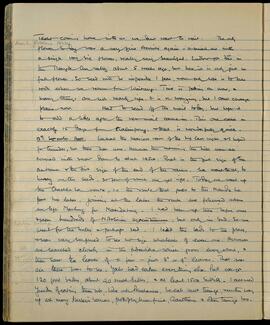
Tashi coming home with us, we don't want to wait. The only flower today was a very fine Aconite again - a small one with a single very big flower, really very beautiful. Ludlow got this in the Rongde Chu valley about 5 weeks ago, but here it is only just in full flower. So seed will be impossible I fear, and our only hope is to take roots when we return from Waitang. Time is getting on now, and many things are not nearly ripe. It is very worrying, but I can't change plans now. Had to send off the mail today, but kept it to add a little after the new mail came in. This one came in exactly 15 days from Kalimpong, that is wonderfully quick.

13th September. Halt. We had the heaviest rain of the trip last night, and hoped for thunder, but there was none. However this morning the hills were all covered with snow down to about 14500. That is the first sign of the autumn and the first sign of the end of the rains. We want that, to hurry on the seeds, so few of which are yet ripe. Today we went up the Chachhu La route, i.e. the route that goes to the Nanda La past two lakes, joining at the lakes the route we followed when we left Marlung for Mandating. I had been up there before once and seen hundreds of Notholirion hyacinthinum, but only in bud. So we went for the bulbs and perhaps seed. I
LSH/1/1/3/3/53 · Part · 1934-03-10
Part of The Ludlow & Sherriff Collection

SUMMARY:
The diarist reads Cooper's article and concludes specimen 1166 is a Primula petiolaris, collects three young buds to send via air mail from Trashigong, and notes widespread smoke from jhumming across Bhutan. On 13 March they travel from Sanden to the Nyakhsung La, encountering snow, taking bearings, and searching for seeds, with primulas flowering at around 14,000 ft.

CONTENT:
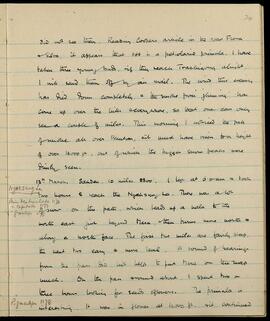
did not see them. Reading Cooper's article in the New Flora and Silva, it appears that 1166 is a petiolaris primula. I have taken three young buds, if they reach Trashigong alright, I will send them off by air mail. The wind this evening has died down completely, and the smoke from 'jhumming' has come up over the hills everywhere, so that one can only see a couple of miles. This morning I noticed the pall of smoke all over Bhutan, it must have risen to a height of over 16,000 ft, out of which the bigger snow peaks were dimly seen.

13th March. Sanden. 10 miles. 9,800'. I left at 6:00 am and took two hours to reach the Nyakhsung La. There was a lot of snow on the path, which leads up a nala to the north east just beyond Mera, then turns more north and along a north face. The first two miles are fairly steep, the next two easy and more level. A round of bearings from the pass did not help to put Mera on the map much. On the pass around about, I spent two or three hours, looking for seeds of flowers. The primula is interesting. It was in flower at 14,000 ft., and it continued

[Marginal notes: Nyakhsung La; Primula denticulata 1176; Primula capitata 1177; Primula gracilipes 1178]

LSH/1/1/9/1/74 · Part · 1949-06-15
Part of The Ludlow & Sherriff Collection

SUMMARY:
Relentless monsoon rain at Haeth leads to a day of packing flowers and preparing to return to Pangotang, with a brief outing to collect mulch and attempt monal photography/hunting in poor conditions. The party then marches back to Pangotang in continuous rain, finds dwarf rhododendrons in bloom, and notes frustration that Pasang hesitates to press specimens.

CONTENT:
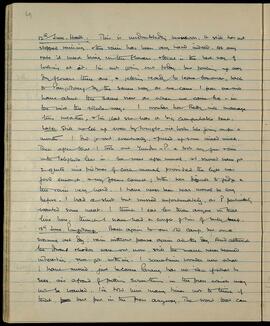
12th June - Haeth. This is undoubtedly monsoon. It still has not stopped raining, the rain has been very hard indeed. At any rate it must bring out the flowers, that is the best way of looking at it. I'm not going out today, but packing up all my flowers there are, & getting ready to leave tomorrow, back to Pangotang by the same way as we came. I fear we will have about the same view as when we came too - in the mist the whole way. I wonder how Betty will manage this weather, though Lloyd said she has a big comfortable tent.

Later. Still no let up even by tonight, it looks like going on for a month. I did go out eventually, & picked up some mixed mulch. Then after that I took out Tundra - P. & took my gun camera with telephoto lens in. We were after monal, & I should have got 2 quite nice pictures of cock monal provided the light was good enough, & my focus correct; both were difficult to judge & the rain very hard. I have never been near monal so long before. I had a shot but missed unfortunately, as P particularly wanted some meat. I think I eat less than anyone in that line here, though I have had a couple of tins of bully beef.

13th June. Pangotang. Back again to our old camp, but on a soaking wet day; rain without pause again all the day. And although the dwarf rhodos were out now, still the march never seemed interesting, & we got nothing. I sometimes wonder how what I have missed, just because Pasang has no idea of what he sees, & is afraid of putting something in the press which may not be wanted. I've told him many times not to think of that, but put in the press anyway. The worst that can...

LSH/1/1/1/1/131 · Part · 1933-08-18
Part of The Ludlow & Sherriff Collection

SUMMARY:
Entries describe heavy rain, leeches at 10,000 ft, and travel to Tobrang followed by a steep ascent to East Pangola camp at 11,500 ft. The party caught Bhutan Glory butterflies, received mail from Bumthang with photos to Paro, and noted poor camping space and dense jungle.

CONTENT:
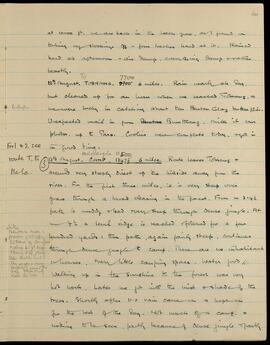
at 10000 ft. we are back in the leech zone, as I found on taking my stockings off - four leeches hard at it. Rained hard all afternoon - air damp, everything damp or rather beastly.

12th August. TOBRANG. To 7700 6 miles. Rain nearly all day, but cleared up for an hour when we reached Tobrang. and we were lucky in catching about ten Bhutan Glory butterflies. Unexpected mail in from Bumthang, with it our photos. up to Paro. Coolies were complete today, and got in in good time.

13th August. CAMP. East Pangola 11500 6 miles. Route leaves Tobrang and ascends very steeply direct up the hillside away from the river. For the first three miles, it is very steep over grass through a broad clearing in the forest. From mile 3-4 1/2 path is muddy and bad and very steep through dense jungle. At mile 4 1/2 a level ridge is reached and followed for a few hundred yards: then path, again fairly steep, continues through dense jungle to camp. There are no inhabitants or houses, and very little camping space. Water good. Walking up in the sunshine to the forest was very hot work. Later we got into the mist and shade of the trees. Shortly after 11.0 rain came on and kept on for the rest of the day. Not much of a camp. and nothing to be seen, partly because of dense jungle and partly

Butter

LSH/1/1/4/1/69 · Part · 1933-08-12 - 1933-08-13
Part of The Ludlow & Sherriff Collection

SUMMARY:
Diary describes a fine-weather traverse from below Karpo over Sokpo Pass with steep shale and scree, turning near Chioling and reaching a yak encampment at the foot of Mihrang La; the route recalls Tulung La. Botanical notes include several gentians and Swertia; one young Cremophilum was shot and bharal were seen, with identifications discussed with Sherriff. The following day begins with a steep ascent to Mihrang La from camp between Cha La and Chorten Namo.

CONTENT:
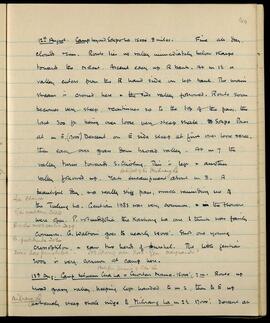
12th August. Camp beyond Sokpo La, 15,000 feet, 8 miles. Fine all day,
clouds and sun. Route lies up the valley immediately below Karpo
towards the North East. Ascent easy up the right bank. At mile 1 1/2, a
valley enters from the right-hand side on the left bank. The main
stream is crossed here and the side valley followed. The route soon
becomes very steep and continues so to the top of the pass, the
last 300 feet being over loose, very steep shale. Sokpo Pass
at mile 5 (17,000 feet). Descent on the east side is steep at first over loose scree,
then easy over grass down a broad valley. At mile 7, the
valley turns towards S. Chioling. This is left and another
valley followed up. At the foot of the Mihrang La, a yak encampment at about mile 8. A
beautiful day and a really stiff pass, much reminding me of
the Tulung La (Gen. kherica). Gentian 1983 was very common and the flowers
were open (Gen. waltonii 2028). P. rotundifolia, the Kashong La one I think, was fairly
common (Swertia multicaulis 2029). G. waltonii goes to nearly 14,000 feet. Shot one young
Cremophilum (Ph. pectinibunda 2030) and saw two herds of bharal. The little gentian
2034 (Gent. punctulata - Sherriff says 2035 = Gen. marquandii?) is very common at camp here.

(Mile from summit of Cha La)
13th August. Camp between Cha La and Chorten Namo, 15,000 feet, 7 miles. Route up
a broad grassy valley, keeping left-handed to mile 2, then to the east up
an extremely steep shale ridge to Mihrang La at mile 2 1/2 (17,000 feet). Descent at...

LSH/1/1/5/1/111 · Part · 1937-06-07
Part of The Ludlow & Sherriff Collection

SUMMARY:
Mail from Sarshang reports mixed results with new Meconopsis seed: Hay and Sandeman failed while Anderson succeeded; Taylor comments on germination methods. The diarist moves from Camp Kangchukka on the Pele La range with detailed route notes, persistent rain, and remarks on Primula no. 3249 possibly being P. stirtoniana. Camps, meadows, and forest routes are described en route toward Rukubzhi and Longte Chu.

CONTENT:
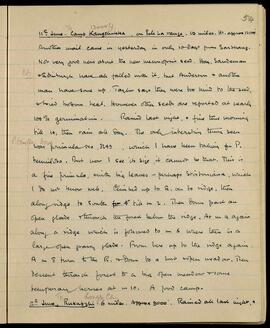
11th June. Camp Kangchukka, on Pele La range. 10 miles. Ht. approx 12000' (To 12000 ft.)

Another mail came in yesterday in only 10 days from Sarshang. Not very good news about the new Meconopsis seed. Hay, Sandeman & Edinburgh have all failed with it, but Anderson & another man have some up. Taylor says they were too kind to the seed, & tried bottom heat. However other seeds are reported at nearly 100% germination. Rained last night, & fine this morning till 10, then rain all day. The only interesting thing seen was Primula no. 3249, which I have been taking for P. tenuiloba. But now I see its size, it cannot be that. This is a fine Primula, with big leaves - perhaps Stirtoniana, which I do not know well. Climbed up to E. on to ridge, then along ridge to South till m 2. Then down past an open glade through the forest below the ridge. At m 4 again along a ridge which is followed to m 6 where there is a large open grassy glade. From here up to the ridge again. At m 8 turn to the R. & down to a lush open meadow. Then descent through forest to a big open meadow & some temporary houses at m 10. A good camp.

12th June. Rukubzhi (To Longte Chu) 6 miles. Approx 9000'. Rained all last night, &

LSH/1/1/4/1/67 · Part · 1933-07-23
Part of The Ludlow & Sherriff Collection

SUMMARY:
Route from Karpo over the Trakan La is described, with an easy ascent and gradual descent into valleys and grassy hills. Few flowers noted, but some Saxifraga and Cyananthus are mentioned; Lumsden shot a young musk deer which Ramzana halal-slaughtered. The party suffered slight headaches and celebrated with a large birthday dinner.

CONTENT:
Saxifraga tangutica 2003, punctulata 2004, signatella 2007.
not yet ripe, but we are taking some on with us. All of us again had slight headaches. We had a huge birthday dinner of hare soup, roast partridge, pate de foie gras, apricot cream, and mushrooms on toast. Perhaps it was no wonder we slept badly.

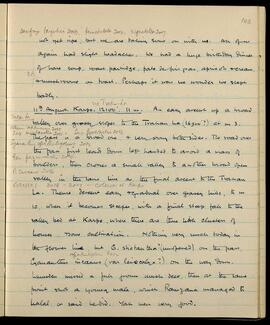
11th August. Karpo via Trakan La. 12100'. 11 m. An easy ascent up a broad valley over grassy slopes to the Trakan La (16900'?) at m 3. The pass is a broad one & very stony both sides. The road over the pass first leads down left handed to avoid a mass of boulders, then crosses a small valley to another broad open valley in the same line as the final ascent to the Trakan La. Thence descent easy & gradual over grassy hills, to m 10, when it becomes steeper, with a final steep fall to the valley bed at Karpo, where there are three little clusters of houses, some cultivation. Nothing very much today in the flower line, but G. stictantha? (unopened) on the pass, Cyananthus incanus (var leiocalyx?) on the way down. Lumsden missed a fluke from musk deer, then at the same point shot a young male, which Ramzana managed to halal, or said he did. Yak meat very good.

10th May, CHANGU TSOMGO
LSH/1/1/1/1/23 · Part · 1933-05-10
Part of The Ludlow & Sherriff Collection

SUMMARY:
Notes describe a caravan of lamas stopping at a minimal shelter, continued snowfall around the bungalow, and attempts to find and identify very large snipe, with few flowers due to lack of sun. On 10th May at CHANGU TSOMGO there was a fine morning after fresh snow, a further search for the snipe yielded little, and bird activity seemed to have moved lower.

CONTENT:
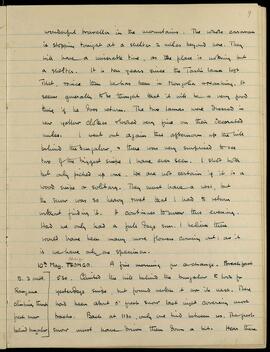
wonderful traveller in the mountains. The whole caravan is stopping tonight at a shelter 2 miles beyond here. They will have a miserable time, as the place is nothing but a shelter. It is ten years since the Tashi Lama left Tibet, since then he has been in Mongolia & Nanking. It seems generally to be thought that it will be a very good thing if he does return. The two lamas were dressed in new yellow clothes & looked very fine on their decorated mules. I went out again this afternoon up the hill behind the bungalow, & there was very surprised to see two of the biggest snipe I have ever seen. I shot both but only picked up one. We are not certain if it is a wood snipe or solitary. They must have a nest, but the snow was so heavy over that I had to return without finding it. It continues to snow this evening. Had we only had a few days sun, I believe there would have been many more flowers coming out: as it is we have only one specimen.

10th May. CHANGU TSOMGO. A fine morning for a change. Breakfast 5.30. Climbed the hill behind the bungalow to look for yesterday's snipe, but found neither it nor its nest. There had been about 6" fresh snow last night covering most tracks. Back at 11.30, only one bird between us. The fresh snow must have driven them down a bit. Hear there

B. 3 contd.
Ramzana
climbing through
fresh snow
behind bungalow

GB 235 RBG/2/GDS/6/2 · File · 1802 - 1905
Part of Royal Botanic Garden Edinburgh Institutional Archives

A series of 10 letters transcribed and typed onto 27 pages of letters from George Don to Nathaniel J. Winch, copied by the Linnaean Society of London by B. Daydon Jackson [see correspondence in the Don scrapbook, GDS/1] 1802-1812, some reproduced in Notes of the Royal Botanic Garden Edinburgh, v.iii, pt xiv, February 1905. There are some annotations / corrections by Isaac Bayley Balfour.

Don, George