
GB 235 MCW/4/2/10
·
Item
·
undated
Part of John MacWatt Primula papers
2091 results with digital objects
Show results with digital objects
GB 235 MCW/4/2/8
·
Item
·
undated
Part of John MacWatt Primula papers
GB 235 MCW/4/2/4
·
Item
·
undated
Part of John MacWatt Primula papers
GB 235 MCW/4/2/1
·
Item
·
undated
Part of John MacWatt Primula papers
LSH/1/1/2/1/235
·
Part
·
1969-04-29
Part of The Ludlow & Sherriff Collection
SUMMARY:
Clear views were obtained toward the Dongkar range and passes including Gorpo La, Pun Sum La, and Warha La, with a local belief noted about the 'Thief' near Orka La at Sakden. Danang returned from Bum La beyond Tawang with seed collections, though some desired plants were missing or eaten, and further collecting and short stays are planned.
CONTENT:
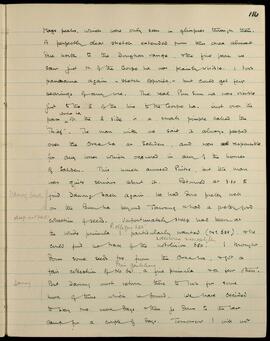
Mago peaks, which were only seen in glimpses through them.
A perfectly clear stretch extended from this area almost
due north to the Dongkar range, and the fine peak we
saw just N. of the Gorpo La was plainly visible. I took
panorama again - sketch opposite - but could get few
bearings of any use. The real Pun Sum La was visible
just to the E of the line to the Gorpo La. Just over the
pass (Warha La) on the E side is a small pimple called the
"Thief". The man with us said it always peeped
over the Orka La at Sakden, and was responsible
for any losses which occurred in any of the houses
of Sakden. This much amused Purbo, but the man
was quite serious about it. Returned at 3.30 to
find Danang back again. He had done pretty well
on the Bum La beyond Tawang and had a pretty good
collection of seeds. Unfortunately sheep had been at
the white primula I particularly wanted (No: 655, P. obliqua), and he
could find no trace of the Notholirion macrophyllum (650). I brought
down some seeds too from the Orka La, and got a
fair collection of No 641 (Prim. gambeliana), a fine primula and a few others.
But Danang must return there to look for some
more of these which he found. We have decided
to stay two more days and then go down to the last
camp for a couple of days. Tomorrow I will not

LSH/1/1/3/3/160
·
Part
·
1983-05-05
Part of The Ludlow & Sherriff Collection
SUMMARY:
The diarist reflects on abandoned homes after visiting a derelict house in the city, describing its severe decay. They imagine the once-happy family who lived there and the hardship that led to their departure.
CONTENT:
There are to be seen in each country houses which had
been abandoned. In the old days a man lived
in such a house with his wife and children and
they were happy and content.
But then came a day when the husband died and the
wife was left alone with her little children.
Because there was no one to work and earn a
living for them, they had to leave their old home
and seek a home in some other place. I will
describe such a house. I visited the other day an
old house in the city and it was really very sad to
see it in such a condition. The roof had fallen in and
the walls had fallen down in many places. The windows
were broken and there was no glass in them. The
doors were off their hinges and they were lying on
the floor. The floor was covered with dust and dirt.
There was no furniture in the house and it was
empty. The garden was overgrown with weeds and
there were no flowers in it. The trees were old and
dead. It was a very sad sight to see such a house.
It made me think of the people who had lived
in it and how happy they must have been.

LSH/1/1/1/1/38
·
Part
·
1933-05-23
Part of The Ludlow & Sherriff Collection
SUMMARY:
Diary note records Ludlow traveling to Sharithang via a valley leading to the Cam La Thada in western Bhutan. The valley is forested with firs (Abies webbiana) and has luxuriant undergrowth of Ilex, willows, and Viburnum.
CONTENT:
W. Bhutan
20th May Ludlow goes to Sharithang via
a valley leading to the Cam La Thada
Both sides of the valley were forested
firs (Abies webbiana) with a luxuriant
undergrowth of Ilex, willows, Viburnum, etc.
GB 235 SYK
·
Collection
·
1947 - 2018
The collection comprises diaries, notebooks, correspondence, photographs, slides, negatives, and articles relating to Sykes’ 1952 and 1954 expeditions to Nepal, organised by the British Museum and the Royal Horticultural Society. Also includes slides, correspondence, articles, maps, and other material from the 1980s to 2018.
Note on slides and photographs: slides are labelled on the mount (except for metal mounts) with details of date, locale, a descriptive caption, and, sometimes, elevation. Sykes’s handwritten notes (in pocket preceding each group of slides) supply more details. Photographs are labelled on the verso with details of date, locale, a descriptive caption, and, sometimes, elevation.
Aside from the expected botanical images and mountain views and scenery, the subjects of Sykes’s slides and photographs are wide-ranging, including villages and villagers, village houses, street scenes, bazaars, markets, festivals, porters, camp sites, camp activities, nomadic people, Hindu and Buddhist temples, shrines, monks, nuns, and monasteries, Buddhist statues, plant processing, seed drying, animals, cultivation and crops, activities such as wool processing, making ropes and mats, spinning and weaving, and brick making.
Sykes, William Russell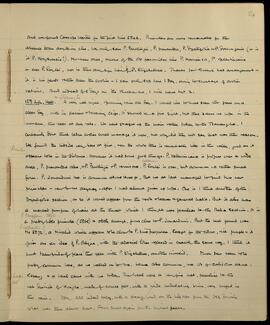
LSH/1/1/6/1/103
·
Part
·
1933-07-05
Part of The Ludlow & Sherriff Collection
SUMMARY:
At W. Tsanangho, the diarist reports heavy rain and poor visibility, explores the Tsanangha valley, and notes scarce primulas overall but finds two primulas new to them (No. 5865 of the Dryadifolia section and No. 5872, a nivalid close to P. sino-purpurea). Logistics are disrupted due to Kushu’s arrangements, reducing planned time on the Kuchaha; Kesang and a local accompany the outing, with observations of musk deer and local attire from Kongbo.
CONTENT:
And we found Cassiope wardii for the first time 5846. Primulas are more remarkable for their absence than anything else. We only saw P. Paulingii, P. prenantha, P. Dryadifolia & P. doshongensis (or is it P. Kongboensis?). No new ones, none of the old favorites like P. baileyensis, P. valentiniana or even P. Rockii, nor is there any sign here of P. Elizabethae. Thanks to Kushu's bad arrangements—it is his fault rather than the coolies—I can only stop here 1 day, owing to shortage of coolies' rations. And instead of 6 days on the Kuchaha, I will have but 2.
W. Tsanangho
18th July. Halt. A very wet night, & pouring rain all day. I would like to have seen this place on a clear day, with its glaciers & towering cliffs. It should be a fine sight, but there seems no hope in the monsoon, this year at any rate. We went straight up the main valley today to the Tsanangha. I certainly don't think laden coolies could manage it now, but why did they not say that was their reason.
We found the hillside very bare at first, on the whole there is remarkably little in this valley, good as it appears to be in the distance. However it had some good things. P. Valentiniana is profuse over a wide area, P. prenantha also, & P. Paulingii & P. vernicosa. P. Rockii is over, but common—a rather small form. P. Jonarduni too is common above 14000 ft. But we at last managed to find two new primulas—new to us anyway—after I had almost given up hope. One is I think another of the Dryadifolia section, or so it would appear from the roots & leaves & general habit. But it also has a marked pompom of hairs at the throat, which I thought was peculiar to the Bella section. It is a pretty little primula (5865) & oddly enough, grows close to P. Jonarduni. But the best found was No 5872, a Nivalid which appears to be close to P. sino-purpurea. Except for the colour, rich purple—it gives one an idea of P. obliqua, with the adaxial lobes reflexed in exactly the same way. I think it must take pride of place this year with P. Elizabethae, another nivalid. Musk deer seem to be pretty common here, as we walked on to two. Lerwa also common, & a lot of Coelicolor above.
Kesang & a local came with me today. The local wore a vampire hat, peculiar to the wet districts of Kongbo, made of coarse felt, with a wide undulating brim, very useful in this rain. Very cold indeed today, with a strong wind on the hilltops from the SW, driving what was then almost sleet. Fresh snow again on the highest peaks.