Buff sheet (274 x 198mm) mounted with 4 cuttings, 3 of which are labelled in ink in John MacWatt’s hand, regarding his entries in the Royal Caledonian Horticultural Society’s Spring Show, from The Garden 1910, and Edinburgh Spring Show 13-14 February 1910, from Journal of Horticulture; short note with illustration regarding a Polyanthus in his collection, from Country Life, 30 April 1910; also ‘The Hardy Heaths’, a note of his own from an unidentified journal.
SUMMARY:
Clear, frosty day at Amelungnang with notes on Hicks needing to cross the Rudo La in Bhutan. The writer reflects that the Dhur Chu area would have yielded better flowers than Waitang, noting climatic differences after crossing the Tolegang La; Pasang and Yundru arrived later with a good haul of seed despite a foot of snow on boulder scree, and there was disappointment regarding Mec. bella near the Sin La.
CONTENT:
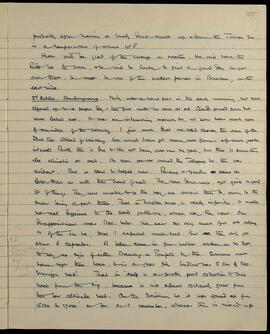
probably, after having a lonely duck swoosh up and down the Tumen Su in a temperature of about 10° F.
Hicks will be glad of the change in weather. He will have the Rudo La to cross, and he will be lucky to find a good day to get over that. It must be one of the wetter passes in Bhutan, on the east side.
3rd October. Amelungnang. Misty, with a hard frost in the early morning, but soon cleared up to a perfect day - the first with no rain at all. Clouds formed soon but never looked wet. It was an interesting march, too, and I now have much more of an idea of the country. I just wish that we had chosen the area of the Dhur Chu instead of Waitang. We would have got many more flowers and of much greater interest. Partly this is due to the area not being overrun by yaks, but there is something else climatic as well. As soon as we crossed the Tolegang La, this was evident. But it can't be helped now. Pasang and Yundru came on later than us with their haul of seed. They have done well, and got quite a good lot of things. They were unable to go the way we meant them to, owing to the snow being a foot thick. That on boulder scree, is really impossible. It made no real difference to the seed gathering, which way they went. One disappointment was Mec. bella. We saw so very much of it all along N of the Sin La, that I expected
SUMMARY:
On the diarist’s birthday at Chensi Rongang, Tasho—the girls’ brother—arrived from herding, and local girls sought medicine, including for gonorrhoea; the diarist departed after declining to host them. Reports accuse the headman of Kuoma of extracting rice and supplies despite H.H.’s contrary order, prompting the need for action. The route climbed over Latsi La and continued to Tongnanying before a steep, muddy descent into dense forest after overnight rain.
CONTENT:
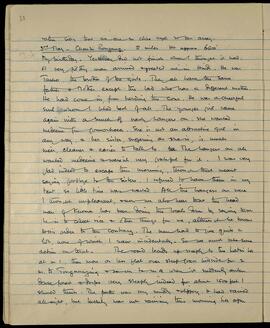
rather silly that we are so close and so far away.
3rd May - Chensi Rongang. 8 miles Ht approx. 6500'
My birthday. Yesterday did not finish when I thought it had. A very filthy man arrived and greeted me in Hindi. He was Tasho, the brother of the girls. They all have the same father and mother except the lad who has a different mother. He had come in from herding the cows. He was a cheerful soul whom I liked best of all. The younger girl came again with a bunch of hangers-on: she wanted medicine for gonorrhoea. She is not an attractive girl in any way, and her sister, suffering as she is, is much nicer, cleaner and easier to talk to. The hangers-on all wanted medicine and were not very grateful for it. I was very glad indeed to escape this morning, though that meant saying goodbye to the sisters. I refused to have them in my tent, so little time was wasted. All the hangers-on were, I thought, unpleasant; now we also hear that the headman of Kuoma has been doing the locals down by saying that he is to collect rice and other things for me, although he knows H.H.'s order to the contrary. The men had to give quite a lot, none of which I saw incidentally. So we must take some action on that.
The road leads up steeply to the Latsi La at m 1, then more or less flat over steep grass hillside for 2 m. to Tongnanying and so on to m 4 where it suddenly enters dense forest and drops very steeply indeed for some 1500 feet I should think. The path was very muddy and slippery. It had rained all night, but luckily was not raining this morning till after
SUMMARY:
Notes on the death of the Thimbu penlop and Tobgye’s sending of English medicine, causing concern with the Maharaja. On 30th June Ludlow and the author travelled to Lomi-Tsa-wa via Do Kyong La in clearing weather, collecting flowers including Magnolia globosa and observing that vegetation in the Trashi-cho-dzong valley and at the pass resembled Sikkim.
CONTENT:
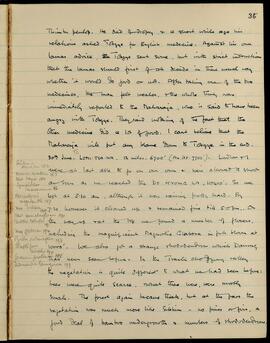
35
Thimbu penlop. He died of dropsy & a short while ago his
relations asked Tobgye for English medicine. Against his own
lamas advice, Tobgye sent some, but with strict instructions
that the lamas should first of all decide in their usual way
whether it would do good or not. After taking one of the two
medicines, the man felt weaker, & the whole thing was
immediately reported to the Maharaja, who is said to have been
angry with Tobgye. They said nothing of the fact that the
other medicine did a lot of good. I can't believe that the
Maharaja will put any blame down to Tobgye in the end.
30th June. TO LOMI-TSA-WA. 12 miles - 6700' (An. Ht. 7700'). Ludlow & I
Embelia oleracea 182
Anemone rivularis 183 were at last able to go on our own & were allowed to shoot
Rhod. Keysii 184
Symplocos ramosissima 186 as soon as we reached the DO KYONG LA, 10410'. So we
Pedicularis megalantha 187
left at 5.30 am, although it was raining pretty hard. By
Meconopsis villosa 189
Rhod. camelliaeflorum 190 7.30 however it cleared up & remained fine till 5.0 pm. On
Berberis celestina 191
the way up & at the top we found a number of flowers,
Mag. globosa 192
Pyrola rotundifolia 193 including the magnificent Magnolia Globosa in full bloom at
Streptopus simplex 194
10000'. We also got a strange rhododendron which Dawang
Geranium pratense 198
Didissandra lanuginosa 199 has never seen before. In the Trashi-cho-dzong valley
the vegetation is quite different to what we had seen before:
trees were quite scarce, & what there were, were mostly
small. The forest again became thick, but at the pass the
vegetation was much more like Sikkim - no pines or firs, a
good deal of bamboo undergrowth & numbers of rhododendrons.
SUMMARY:
Notes prolific flowering and collections including a new primula (P. jaffreyana 2257), an iris (2251), Incarvillea lutea (2252), and Thalictrum chelidonii. Reports shortage of drying paper, and mail issues: the runner found no mail at Tsona but had a chit from the Dzongpen; outgoing mail was forwarded by the Dzongpen and more is to be sent via Chayul.
CONTENT:
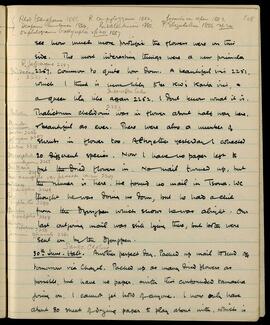
Rhod. sanguineum 1881, R. campylogynum 1882, forrestii var. repens 1883.
Diapensia himalaica 1884, Prim. valentiana 1885. P. Elizabethae 1886 sp. nov.
Omphalogramma bathysepala sp. nov. 1887
...see how much more prolific the flowers were on this side. The most interesting things were a new primula P. jaffreyana 2257. Common to quite low down. A beautiful iris 2251, which I think is near the K.W.'s Karta iris, a queer lily-like affair 2252 (Incarvillea lutea), I don't know what it is.
Thalictrum chelidonii was in flower about halfway here, beautiful as ever. There were also a number of shrubs in flower too. Altogether yesterday I collected 20 different species. Now I have no paper left to put the dried flowers in. No mail turned up, but the runner is there. He found no mail in Tsona. We thought he was doing us down, but he had a chit from the Dzongpen which shows he was alright. Our last outgoing mail was still lying there, but both were sent on by the Dzongpen.
30th June. Halt. Sanga Choling. Another perfect day. Packed up mail to send off tomorrow via Chayul. Packed up as many dried flowers as possible, but have no paper; with this confounded tamasha going on, I cannot get hold of anyone. I now only have about 80 sheets of drying paper to play about with, which is...
[Marginal Notes:]
P. jaffreyana 2257
Iris decora 2251
Thalictrum 2253
Meconopsis 2256
Jeffreyana 2257
Tibetica 2258
Dracocephalum 2255
Primula 2255
Rosa macrophylla var. farreri 2259
Gentiana 2249
Cryptantha 2250
Clematis 2254
Gentiana tibetica 2258
Jasminum officinale 2261

SUMMARY:
The diarist attempts to get Test match scores by wireless without success, then travels 8 miles to LILUNG noting entry into a dry zone, changing flowers, and observations of woodpeckers and a jay. The next day they go 9 miles to SIMBITANKA in fine weather, remarking on the marked change in the Tsangpo valley over a short distance.
CONTENT:
not at all bad, the hillsides look as if they showed how something, but near the valley had been done how much. For the last three evenings I have had the wireless up, trying to get the Test match scores, but it is very bad just now, I could not get the final result. I wish it would function well just now, as it would be nice to hear all the sport news from home.
30th June. LILUNG. 8 miles. A fine & bright day, with a few very heavy very short showers. The country changes completely today, we are obviously in the dry zone again. It is nice to be in it too, to feel so dry, even if it does rain a little. Flowers changed rapidly, now found quite a lot on the way here. There is a lily on the hillside, but not yet in flower. We only saw a very few. Birds have also changed. I saw 3 or 4 of the big black woodpecker in the pine forest, & fired three times at one (2-6's & 1 brush) with no effect at all. Later on for a green woodpecker & a jay, none of the nuthatches I saw when at Tholo before.
1st July. SIMBITANKA. 9 miles. A lovely fine day with bright sun all day. Clouds over the hills N & S, but the valley is clear. There was not much of interest today, but it is interesting to see the great change in the Tsangpo valley in such a short distance. Here the con
SUMMARY:
During a three-day halt, the party planned to head toward Sakden, while noting a Primula from Yonpu La as P. Boothii, previously found by Cooper and K. Ward in the Nyamjang chu. Lumsden treated many patients, the Dzongpen provided supplies and huts for the route up the Gamri Chu, and Ahmad Sheikh made excuses when tasked with making mince pies.
CONTENT:
all he said, though with some difficulty. Plans have been made for us to go almost anywhere we like, and we will, after three days here, go off towards Sakden again. Weather perfect, with no sign of rain for a while yet. The Primula found on the Yonpu La 1147 must be P. Boothii, a Petiolaris primula. It is uncommon, but was found by Cooper three times and by K. Ward in the Nyamjang chu. It has some farina on unopened buds, though nowhere else. The colour is beautiful, but might not last in sunshine. I have two excellent colour Lumière photos of it.
3rd, 4th, 5th March Halt. We are in no hurry, so halted here for three days and did nothing but eat, write, and sleep. Lumsden, however, had his work cut out and had many patients, some sham and many real. The Dzongpen has been very kind indeed to us, supplied us with all sorts of stores and other things, and prepared huts for us on our way up the Gamri Chu. Ahmad Sheikh continues to produce wonderful excuses for anything he does not know. We told him to make mince pies yesterday,
SUMMARY:
In heavy rain at Yonpu La, the party travels and, at Yusu’s request, writes to Neoli Basu to arrange bullock carts if vehicles cannot reach Darang Mela; they are lent mules to Darang and find lodging near a new lhakang built by Dopala. Local requests for medical aid are noted, and Betty falls ill with stomach trouble, likely food-related.
CONTENT:
we may be able to send paludrine later on. They also want injections for syphilis. Tobgye sent someone to Darang Mela once that was very popular & they say did a great deal of good. I doubt if it did permanent good, but it was much appreciated. We are being lent 3 mules to Darang, & everything else we suggest is done at once.
3rd June Yonpu La Heavy rain all night again & rain most of the day today. Left 7.30: in at 10.30. Yusu apparently thinks the rains have started, as he asked us to write another letter to Neoli Basu asking for arrangements to be made for bullock carts if the lorry or cars cannot get through to Darang Mela. This we have done. We were surprised to find up here a big new Hlakang, built by Dopala 3 years ago. We are housed in a small but clean quarter inside the compound, with another as cookhouse. It is very convenient. Betty has fallen sick with some pretty bad tummy trouble, worse than she has had since we started the trip. I hope it was only caused by some hot chang regg - a special dish made for us - which she had last night. I hope it is not any kind of infection from the millions of flies of the last week. Here there are few flies anyway, & we have got rid of good many bugs, fleas & ticks. If she gets better quickly we should not have much trouble till we leave Dmanjin now.
SUMMARY:
Notes bird activity near camp, including a ruby throat nest with two young, redstarts, pipits, and ravens. Sends a letter to Ludlow and discusses a three-day route to Shao through jungle and passes, considering going to Tsona, with plans to wait about a week and then return via the Tulung and Dza las.
CONTENT:
The text from the image is transcribed below:
3rd Aug. Mago.
49
Gent. bryoides 756
" elwesii 758
Prim. involucrata 757
" macrophylla 761
Corydalis 759
Lonicera parvifolia 760
Meconopsis bella 806
Sax. sphaerulifera 807
" montanella 808 & 809
Rhod. aganniphum 811
Anemone rupicola 813
Don't know, or a youngster. I think there should be some good birds about here if one had the time to look, or it were clear enough to see. A raven has been at camp often, p. thura thura are everywhere; another dark finch keeps to the clearings, sits tight in the primulas. Today I found a ruby throat nest with two young in it. Redstarts abound, as do pipits probably hodgsoni. Sent a letter off to Ludlow today. There is no doubt one can get to Shao from here. It is a three days journey, mostly through jungle, & crossing three passes. I think it would be worth our while to try to go to Tsona that way. Our plans just now are to wait for a week or so then return as we came by the Tulung & Dza las. Until I can get a view of the country I cannot tell where to go
SUMMARY:
The party camps on a ridge above the right bank of the Tirganz Chu, noting no water for tomorrow’s march and the need to cook beforehand. They traverse a small side valley, then climb steeply through open forest to the Dunkar La (c. 7900 ft), with fine weather until heavy mist from the southwest after 2:10 pm and no notable flowers observed.
CONTENT:
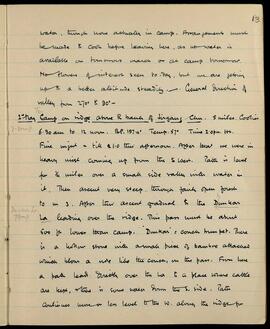
water, though none actually in camp. Arrangements must
be made to cook before leaving here, as no water is
available on tomorrow's march or at camp tomorrow.
No flowers of interest seen today, but we are getting
up to a better altitude steadily. General direction of
valley from 270° to 90° -
2nd May Camp on ridge above R bank of Tirganz Chu. 5 miles. Coolies
7-8000 ft. 6.30 am to 12 noon. BP. 197.4° Temp. 57° Time 2.0 pm. Ht.
Fine night & till 2.10 this afternoon. After that we were in
heavy mist coming up from the S West. Path is level
for 1/4 miles over a small side valley with water in
it. Then ascent very steep through fairly open forest
to m 3. After this ascent gradual to the Dunkar
Dunkar La
7900 ft La leading over the ridge. This pass must be about
500 ft lower than camp. "Dunkar" = conch trumpet. There
is a hollow stone with a small piece of bamboo attached
which blows a note like the conch, on the pass. From here
a path leads directly over the La to a place where cattle
are kept, there is some water down the S. side. Path
continues more or less level to the W. along the ridge for