Showing 6828 results

Archival description
2091 results with digital objects Show results with digital objects
LSH/1/1/6/1/95 · Part · 1933-07-09 - 1933-07-05
Part of The Ludlow & Sherriff Collection

SUMMARY:
Heavy rain at Tum La hampers collecting; most Primula are over, though a yellow-flowered Meconopsis is noted. On 9–10 July the party faces flooding on the Nagü Chu, Kusho warns the coolies, threats are reported from local Lopas about going to Nagü, and the plan shifts to bypass Shoka La and proceed to Lando.

CONTENT:
Tum La
Mola - Milung - Nagu Trip no more successful than Langong Trip

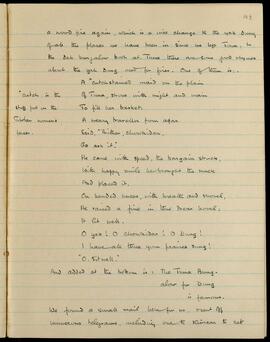
Primula etc. P. calliantha are all over. (5785). It is a nivalis primula & I think has yellow flowers. Omphalogramma elwesiana? 5786 is also common, flowers just about over, & P. valentiniana is also about over. The nivalis p. is the only new one, & I was awfully sorry not to be able to find even one plant with a flower on it. The one bright spot was a Meconopsis lyrata or horridula? 5790, which reminds me much of M. argemonantha, but it has yellow flowers, and not white ones. We left enough for seed, if we can again find the place, which will be difficult as we could recognize nothing to mark it by today, in the mist. It is a nice little thing, & should do well enough at home, judging by the altitude. This Tum La must surely be the lowest Pass in the Himalayas, only 12250 ft. I had thought of trying somewhere else after today, but will go south towards the Lopa village tomorrow, & look for low altitude flowers. We saw one of monal today & some snipe - no other game. Out at 5.00 am, back at 4.00 pm.

9th July. Halt. Tum La. Rained all night, & very hard all today. We are going to have some difficulty getting back to Nagü I think. Kusho went off today to warn the coolies to come early tomorrow, & he was twice nearly up to his waist in water. And some of the coolies say the loads will get wet, which must mean they expect about 3 ft of water somewhere. Some Lopas yesterday, going down to Nagü told my people that they did not want me to go down there & that if I did, they would shoot us with arrows - a nice cheerful welcome. However we went up again to the Tum La this morning & down the other side for a couple of miles. But it would be necessary to go much further to be of any use so I returned. Up to then we saw nothing. The path is very narrow, in dense forest of abies & rhododendron & we could not get off it. So I returned & went up the main Nagü Chu as far as we could conveniently. The whole valley is full of water & we were in 6" to 1 ft the whole time. The river does not seem able to carry it away fast enough. This little trip is now over, & it has not been any more successful than Langong really. As the Shoka La is said to be as low as the Tum La, I will miss it out & go on direct to Lando & hope for better things there. It will be nice again to get to a drier zone, though I hardly expect the Tsangpo valley below this is really dry. Primula alpicola 5801 - often blue.

10th July. To Camp in Nagü Chu, same as on 5th July. 12 1/2 miles. Rain all night & all today, but not very heavily. The path was worse than when going up, but luckily there are logs over the worst places,
LSH/1/1/6/1/93 · Part · 1938-07-08
Part of The Ludlow & Sherriff Collection

SUMMARY:
The diarist travels through swampy valleys near Tum La in persistent rain, noting mallard and snipe, yakherd huts, and that the pass is very low. Botanical work records several Primula species mostly past flowering; an attempt to explore the ridge in thick mist results in getting lost and retracing the route with help from a local.

CONTENT:
Tum La

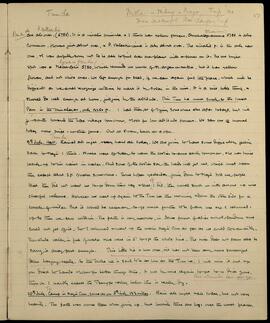
the whole valley bed is a huge swamp, which made walking here an extremely wet job. But these lakes contain water lilies in profusion. Up here I came across about 30 mallard, this evening I hear many snipe flying round and calling. Occasionally one of them drums. Brahmins are also here in considerable numbers. The mixture of Tibetan and Lopa coolies I have all seem quite cheerful. They are an infinitely nicer lot here than round about Molo and Langong. This pass must be one of the lowest, if not the lowest along the whole Range. I would guess its height at little over 12000 ft from here, but we will see tomorrow or the next day. We are still far too far away from the Pass to make camp for our three days, so must go on tomorrow.

7th July. Camp. 1 m N of Tum La. 4 miles. Rain at night, then rain all day today except for an hour or two at midday. We came on through a swamp the whole way here, past a few huts with yakherds. Camp is at the foot of the steep ascent to the Tum La. I am too late here. This pass is very low indeed, and although there are some good things on it, it is not high enough for many primulas. P. Elizabethae is still just in flower and there are some others over, one like P. Boothii, another with leaves like P. Roylei, P. prenantha and one which is perhaps P. alpicola violacea (3770) or like it, with deep velvety purple flowers. Rhododendrons are over. We went down the S side of the pass for ½ mile, but there was nothing much to be seen. Rain very heavy indeed today. The main valley continues beyond this - in fact the Nyam Chu is a very large river still - quite unfordable I should say. It comes in from 285° M.

8th July. Halt. Tum La. Rained hard all night and all today except from 4.0 to 6.0 am. I went up to the Tum La, (B.P. 190.4. Temp. 55° T. 7.0 am. Ht approx. 12243') then turned East, keeping roughly along the ridge. But the mist was very thick and we could see nothing of the country. In fact it was so bad, that we were completely lost for over an hour on our way back: this in spite of having a local with us who had often been up that way. We luckily recognized one place we had passed, and the Lopa was able to track our footsteps in the grass, till we knew where we were. It was a disappointing day though, on the whole. There are P. vernicosa (in seed). P. Roylei (seed) P. Elizabethae, nearly over, P. aff. alpicola (5770) P. prenantha, P. barbatula No 5791 a primula I have never seen before, but unfortunately the flowers

LSH/1/1/6/1/92 · Part · 1938-07-08
Part of The Ludlow & Sherriff Collection

SUMMARY:
Field notes from Tum La on 7–8 July record multiple Primula and other alpine species, with observations on colour forms, abundance, and habitat. The page also notes a path from near Nagu toward the Tunga La and describes the easier south-side descent of Tum La, with the village of Datang reported as two marches away.

CONTENT:
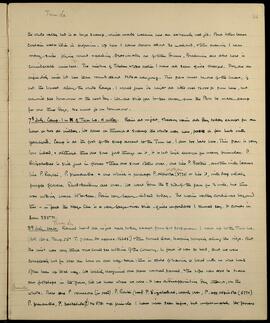
46a
Tum La 7 & 8 July

  1. Primula reticulata flexitipes? Nagu Chu
  2. Primula aff. alpicola violacea. Tum La. I don't know this colour variation, if this is P. alpicola. A very pretty primula, constant as far as I saw. Only on the Pass from the South side.
    8/7. Common to the E of the Tum La.
  3. Primula calliantha nivalis Sect. Tum La. No flowers seen. Two very wet & quite withered flowers were found on one plant, often seemed to be yellow, I have not seen this primula before. Not common here.
  4. Omphalogramma elwesiana minus? Tum La. Common, but flowers nearly all over.
  5. Primula barbata? Tum La. Very like 3990, but rather bigger, perhaps because taken later.
  6. Primula vernicosa. Tum La. Leaves were rather like P. Boothii for which I at first took it, but the short pedicels put it as P. vernicosa I think. P. elizabethae 5777.
  7. Meconopsis lyrata var. flava aff. argemonantha. Tum La. Although the colour is "pale lemon yellow" the yellow is very distinct, & could not be mistaken for white ever. Otherwise appears very like P. argemonantha, obtained from a very similar habitat. 8-10 left for seed numbered, but the place will be hard to find, as the mist was so thick today we could see nothing of the ridge we were on even.

Rhod. cerasina 5768, Chariessa 5769, Diapensia multiflora 5772. Tofieldia yunnanensis 5773. Rosa sericea 5776.
Cremanthodium reniforme 5780. Rhod. trilectorum sp. nov. 5782.

X. Near the bridge this side of our first camp & Nagu a path leads to the East, to the Tunga La, over which Lopas come in August (a different sort to these). The Tunga La would be a day's march from the Nagu Chu.

X. Descent on South side of Tum La is easier than on the North, but the path very bad indeed, in heavy rain, is a torrent. Direction at first South, then S.E. The distance to the first village, called DATANG is said to be two marches for laden men, about 15-20 miles probably.

LSH/1/1/1/1/209 · Part · 1933-10-01
Part of The Ludlow & Sherriff Collection

SUMMARY:
The diarist enjoys a wood fire after relying on yak dung fires since leaving Towa and quotes a humorous rhyme about yak dung from the Tuna dak bungalow book, signed by O. Sitwell. They receive some mail and send several telegrams, including one to Kinnear.

CONTENT:
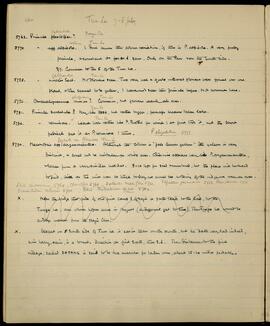
103

a wood fire again, which is a nice change to the yak dung
of all the places we have been in since we left Towa. In
the dak bungalow book at Tuna there are some good rhymes
about the yak dung used for fires. One of them is:-

"cutch is the
stuff put on the
Tibetan women's
faces.

A "cutchstained maid on the plain
Of Tuna, strove with might and main
To fill her basket:
A weary traveller from afar
Said, "Thither, chowkidar,
Go ask it."
He came with speed, the bargain struck,
With happy smile he brought the muck
And placed it.
On bended knees, with breath and shovel,
He raised a fire in this drear hovel:
It lit well.
O yak! O chowkidar! O Dung!
I have all three your praises sung!
"O. Sitwell."

And added at the bottom is: The Tuna Bung-
alow for Dung
is famous.

We found a small mail here for us, and sent off
numerous telegrams, including one to Kinnear to set

Turner, Alexander (Alick) J.
GB 235 TUR · Collection · 2015

•6 notebooks of sketches (South Africa, Australia, New Zealand, Scotland) donated to D. Henderson and RBGE.

Turner, Alexander (Alick) J.
GB 235 RBG/2/GDS/8/6 · File · 1904 - 1905
Part of Royal Botanic Garden Edinburgh Institutional Archives

Two copies of the Notes of the Royal Botanic Garden Edinburgh, comprising numbers XII, XIII and XIV, November 1904 and February 1905 containing, amongst information about RBGE's Principal Gardeners, George Claridge Druce's account of George Don's life and work.

Royal Botanic Garden Edinburgh (Creator)
GB 235 HOR · File · 1801 - 1803

•2 letters, dated 1801 & 1803, from Thomas Horsfield in Batavia to Dr. Roxburgh, Calcutta, previously filed under “Roxburgh, Dr. Wm.” At this time, Batavia was the capital of the Dutch East Indies, and corresponds with Jakarta, Indonesia today.
Second letter relates to Thomas Horsfield exploring the vegetation of Java, learning of indiginous knowledge of medicinal plants and his thoughts of publishing a 'Plantae Javanicae Rariores', which he eventually did.

Horsfield, Thomas
GB 235 RBG/2/GDS/8/1-2 · File · 1903
Part of Royal Botanic Garden Edinburgh Institutional Archives

Two photocopied letters between Claridge Druce and Bayley Balfour regarding Druce’s account of Don and the suggestion that it be published in the Notes of the Royal Botanic Garden Edinburgh. February-March 1903.