Showing 6828 results

Archival description
2091 results with digital objects Show results with digital objects
LSH/1/1/2/1/122 · Part · 1933-07-18
Part of The Ludlow & Sherriff Collection

SUMMARY:
The party left Tsona for Dongkar via the Gorpo La, re-entering the Nyam Jang Chu valley in dry, sunny conditions and noting several bird records. They descended the Nyam Jang Chu, crossed the Cho La into the wetter Taree Rong Chu Valley, then on 22 Aug crossed the Me La to resume camp at Shengbe, with views over the Nyam Dzong Chu Valley from the Tibetan plateau. Notes reference related descriptions in Ludlow’s pages 89–92.

CONTENT:
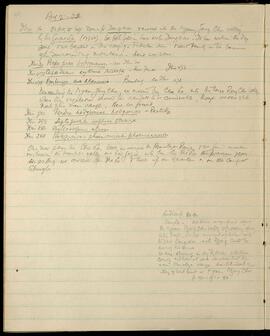
Aug 15-22

Hrs 16. On Aug 15 left Tsona for Dongkar, re-entered into the Nyam Jang Chu valley by the Gorpo La, (17,750). We both fell in love with Dongkar. It lies within the dry zone & we basked in the rays of a Tibetan sun & saw beauty in the bareness of the surrounding mountains. Here we saw
Hrs 30 Pica pica bottanensis - see Hrs 30
Hrs 473 Carpodacus erythrinus roseatus - Rose Finch Hrs 473
Hrs 478 Emberiza cia khamensis - Bunting see Hrs 478

Descending the Nyam Jang Chu, we crossed the Cho La into the Taree Rong Chu Valley, where the vegetation showed the rainfall to be considerable, though we were still north of the main range. Here we found
Hrs 501. Perdix hodgsoniae hodgsoniae - Partridge
Hrs 293 Leptopoecile sophiae obscura
Hrs 386 Phylloscopus affinis
Hrs 268 Hodgsonius phoenicuroides phoenicuroides

Our new pass, the Cho La, took us across the Himalayan Range, & we overlooked the beautiful valley we had gazed into from the Me La the previous year. On 22 Aug we crossed the Me La & took up our quarters in our old camp at Shengbe.

Ludlow p. 89-90
Sangla - we had a magnificent view of
the Nyam Dzong Chu Valley stretching away
to the North, whilst immediately below us to
the west Dongkar with Dzong could be
easily discerned.
We were standing on the Tibetan plateau
country & it was at once realized that the
main Himalayan range was to the south of us.
Story of lost bird in Nyam Dzong Chu
p. 90-91-92
LSH/1/1/4/1/171 · Part · 1933-11-08 - 1933-11-09
Part of The Ludlow & Sherriff Collection

SUMMARY:
At Tsona on 8 November, after a very cold night, the diarist arrived early; Pintso prepared for departure toward the Kechen La, while Ludlow, delayed at Tawang and Sakden, had reached Trashigang on 28 October with seeds and flowers. The diarist dealt with a Dzongpen, noted missing post, and had mail from Chayul forwarded; on 9 November the party left Tsona joyfully for a camp north of Kechen La amid evening clouds over the Nyam Jang Chu, though yaks were delayed.

CONTENT:
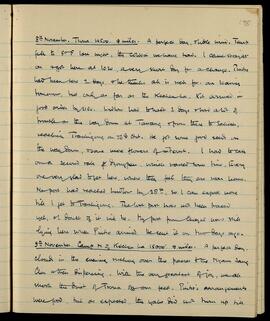
8th November. Tsona. 14500. 9 miles. A perfect day, and little wind. Temp fell to 5°F last night, the coldest we have had. I came straight on and got here at 10:30, a very short day for a change. Pintso had been here 2 days, and he thinks all is well for our leaving tomorrow, but only as far as the Kechen La. Kit arrived in good order by 11:30. Ludlow had to halt 2 days and had a lot of trouble on the way down at Tawang and from there to Sakden, reaching Trashigang on 28th Oct. He got some good seeds on the way down, and some more flowers of interest. I had to call on a second rate of Dzongpen, which wasted some time. Everyone very glad to get here, where they feel they are near home. No post had reached Ludlow by 28th, so I can expect none till I get to Trashigang. The lost post has not been traced yet, and I doubt if it will be. My post from Chayul was still lying here when Pintso arrived. He sent it on two days ago.

9th November. Camp N of Kechen La 15000' 9 miles. A perfect day. Clouds in the evening rushing over the passes of the Nyam Jang Chu and then dispersing. With the very greatest of joy, we all shook the dust of Tsona off our feet. Pintso's arrangements were good, but as expected, the yaks did not turn up till

LSH/1/1/3/3/91 · Part · 1933-04-09
Part of The Ludlow & Sherriff Collection

SUMMARY:
A perfect day after earlier delays from missing yaks and money wrangles in Tsona; the party moved north over a pass to Tre with easy gradients. Lumsden attempted but missed a gazelle. Tre is noted as having 73 houses, and a visit toward Thang to look for blackbirds resulted in a difficult chase without success.

CONTENT:
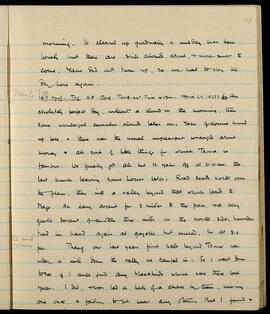
morning. It cleared up gradually and midday has been lovely, but there are still clouds about, and more snow to come. Yaks did not turn up, so we had to stay the day here again.

Tsona to Tre
16th April. Tre B.P. 186.4 Temp. 44° Time 4.0pm. Approx ht. 14272 ft. An absolutely perfect day, without a cloud in the morning, then some wonderful cumulus clouds later on. Yaks of course turned up late, and there was the usual unpleasant wrangle about money and all sorts of little things for which Tsona is famous. We finally got all but 12 yaks off at 11.0 am, the last bunch leaving some hours later. Road leads north over the plain, then into a valley beyond that which leads to Mago. An easy ascent for 3 miles to the pass, and a very gentle descent of another three miles on the north side. Lumsden tried his hand again at gazelle, but missed. In at 3.0 pm.

Tre counts 73 houses
Thang, our last year first halt beyond Tsona was under a mile down the valley we camped in. So I went down to see if I could find any blackbirds which were there last year. I did, and was led a hell of a chase by them, missing one once, and failing to get near any others. But I found a

LSH/1/1/3/3/87 · Part · 1933-04-09
Part of The Ludlow & Sherriff Collection

SUMMARY:
Notes local customs of refusing meat and sending honey to the Dzongpon. Describes a 12-mile march to Tsona over a snowy pass around 14,500 ft with clear but windy conditions, and records observations of Primula species and flocks of grandala.

CONTENT:
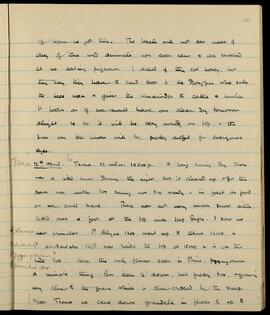
The locals will not eat meat of any of these wild animals, nor even hens, and are shocked at us eating pigeons. I asked if they eat honey, but they say they have to send that to the Dzongpon, who sells the beeswax and gives the remainder to cattle and mules. It looks as if we should have our clear day tomorrow all right. If so it will be very windy on top, and the sun on the snow will be pretty awful for everyone's eyes.

Tsona 12th April. To Tsona. 12 miles. 14500 ft. A long tiring day. There was a little snow during the night, but it cleared up and for the pass was neither too sunny nor too windy - in fact as good as we could have. There was not very much snow either, little over a foot at the top with deep drifts. I saw no new primulas. P. obliqua 1300 went up to about 14000, and P. atrodentata 1278 was beside the top at 15000 and is on this side too. Here the only flower seen is Prim. pygmaeorum, a minute thing less than 1/2 inch across, but pretty too, and growing very close to the grass which is close cropped by the sheep. Near Tsona we came across grandala in flocks of up to

LSH/1/1/2/1/61 · Part · 1933-07-08
Part of The Ludlow & Sherriff Collection

SUMMARY:
The diarist describes finding Paraquilegia like the Kashmir flower, coping with inquisitive locals while praising Ahmad Sheikh’s patience, and taking flower photographs with notes on shutter speeds; a coolie is noted for not stealing a cash box. On 17th July at Tsong, the Dzongpens requested portraits and four colour photographs were taken and copies sent.

CONTENT:
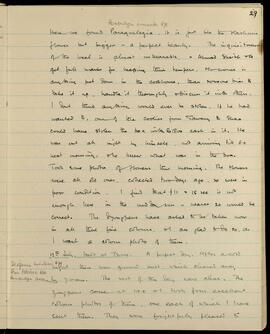
Paraquilegia anemonoides 678

Here we found Paraquilegia. It is just like the Kashmir flower but bigger - a perfect beauty. The inquisitiveness of the local is almost unbearable, and Ahmad Sheikh etc. get full marks for keeping their tempers. No sooner is anything put down in the cookhouse, than someone tries to take it up, handle it thoroughly and discuss it with others. I don't think anything would ever be stolen. If he had wanted to, one of the coolies from Tawang to Shao could have stolen the box with Rs 1800 cash in it. He was out all night by himself, not arriving till 6:00 next morning, and he knew what was in the box. Took some photos of flowers this morning. The flowers were all old ones, collected two days ago, so were in poor condition. I find that 1/10 and 1/15 sec is not enough here in the midday sun - nearer 1/20 would be correct. The Dzongpens have asked to be taken now in all their fine colours, and I am glad to do so, as I want a colour photo of them.

17th July. Halt at Tsong. A perfect day. After a cold night, there was ground mist, which cleared away by 7:00 am. The rest of the day was clear. The Dzongpens came at 10:00 and I took four excellent colour photos of them, one each of which I have sent them. They were frightfully pleased to

Diapensia himalaica 679
Prim tibetica 680
Paraquilegia anemonoides

Tsongpa
LSH/1/1/5/1/18 · Part · 1935-11-27
Part of The Ludlow & Sherriff Collection

SUMMARY:
The page contains only the single word 'Tsongpa' with no further context. No dates, places, or persons are evident.

CONTENT:
Tsongpa

LSH/1/1/3/3/66 · Part · 1936-03-10
Part of The Ludlow & Sherriff Collection

SUMMARY:
Brief notes referencing L. p. 36 on a tubular spring balance using Cook's principle, followed by a series of numerical entries. The right margin contains abbreviated notations.

CONTENT:
L. p. 36 Tubular spring balance - Cook's principle

1909 6.29
1.0577
10.50
321.00
415.40
44
520.43

NB

Right margin:
Prin
C
Pr
Rh
P. 8
L

LSH/1/1/2/1/77 · Part · 1933-07-18
Part of The Ludlow & Sherriff Collection

SUMMARY:
Notes from Tulung La pass describe harsh weather, sparse flowers on unstable shale, and a notable Meconopsis (bella, 708), with a sighting and attempted stalk of six bharal. At Longur there are acres of primulas, and on 23 July the party travels to Mago (Dyuri) in showery conditions, recording temperature, elevation, and abundant primulas along the route.

CONTENT:
37

Tulung La 22nd July pass.
Anemone rupicola 704
Primula sikkimensis 705
Primula bellidifolia 707
Meconopsis bella 708
With rain, mist, and wind, it was chilly up there. On the North side we saw 6 burhel, which I stalked. But we had only a 12-bore with lethal bullets, and I missed at 70 yards four times. Flowers we thought would be profuse, but the hillside is almost continually on the move, shale gradually falling down to the river bed, and everything gets covered with it. The most interesting flower was a new Meconopsis (708) [Meconopsis bella (708)], a pretty little thing, which we thought at a distance to be Paraquilegia.

NB: Here at Longur there are again acres of primulas, white and yellow—a wonderful sight.

184 23rd July. To MAGO (DYURI) 9 3/4 miles. B.P. 191.7° Temp. 53° = Corr. ht. 11350'. Again rather a disappointing day. After a clear night, it rained till noon then cleared up till 2.0 pm.
Primula tibetica (Sikkim?)
We walked through masses of primulas for several miles today. One would think that there should be plenty of flowers in that case. So there

LSH/1/1/7/1/11 · Part · 1940-05-24
Part of The Ludlow & Sherriff Collection

SUMMARY:
The author describes the low Tum La pass and nearby areas, noting limited finds there but abundant primulas and a notable prostrate yellow-flowered rhododendron. After wet weather they returned toward Nagu, collected aquatic and tree specimens, noted Magnolia globosa and Lilium giganteum in the Nagu Chu valley, and then proceeded toward Paka to visit the Tsanang La and Kuchala passes, observing that Tsanang La is steep and little used but botanically promising.

CONTENT:
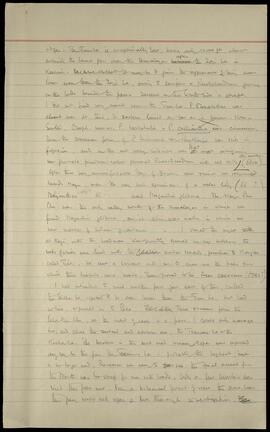
ridge. The Tum La is exceptionally low, being only 12,000 ft, almost certainly the lowest pass over the Himalayas after the Zoji La in Kashmir. It gives the appearance of being even lower even than the Zoji La, owing to conifers & Rhododendrons growing on the hills beside the pass. Descent on the south side is abrupt. I did not find very much near the Tum La. P. Elizabethae was almost over at this, its eastern limit as far as is known. Nom-Soulei, Omph. minus, P. barbata & P. calliantha were common. Here the common form of P. Dickieana var. Pantlingii was still in profusion, and on the wet rocky hillside was that most intriguing new prostrate primrose yellow flowered Rhododendron, with red spots (6600).

After three very uncomfortable days of driving rain & mist we returned towards Nagu, & on the way took specimens of a water lily (66?) Menyanthes trifoliata 66-- and Magnolia globosa. The Nagu Chu was the only valley north of the Himalayas in which we found Magnolia globosa, & it also was in which we saw masses of Lilium giganteum. I stayed the night at Nagu with the headman who proudly showed me his kitchen the walls of which were lined with wooden teapots, peculiar to Kongbo, called Tisti. He sent a servant with me to show me the trees from which these teapots were made. These proved to be Acer caesium (5740?).

I had intended to visit another pass just east of this, called the Shoka La, reputed to be even lower than the Tum La, but had no time, & pushed on to Paka. Three streams form the Paka Chu Chu, at the head of each is a pass. I could only manage two, and chose the central and eastern one, the Tsanang La & the Kuchala. The western is the most used & many Lopas were expected any day by this pass. The Tsanang La is probably the highest, but is no longer used. The reason was easy to see. The final ascent from the North was too steep for men with loads. Only a few hunters ever visit this pass now. From a botanical point of view the area near this pass, would well repay a more thorough investigation.