Showing 6828 results

Archivistische beschrijving
2091 results with digital objects Show results with digital objects
LSH/1/1/9/1/33 · Part · 1949-05-06
Part of The Ludlow & Sherriff Collection

SUMMARY:
A local messenger is sent over the Sebri La to Charkakora to arrange a meeting at Pangkar. After heavy rain, the Kuomo Chu bridge is washed away; two Tibetans visit from Tsari Chikchar, Pasang departs for Julu to collect mice, and Ngudup recounts a recent landslip that killed 11 people. The following day brings more rain, little of botanical interest, and hopes for a letter from Betty.

CONTENT:
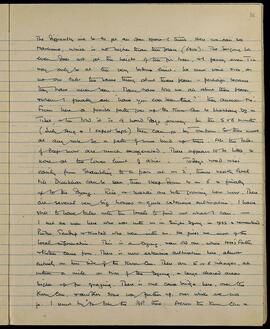
by sending a local over the Sebri La to Charkakora. I said then back in four days, so as to meet me at Pangkar. A man agreed at the great cost of Rs 7/- + the chance of a tip! So off he goes early tomorrow.

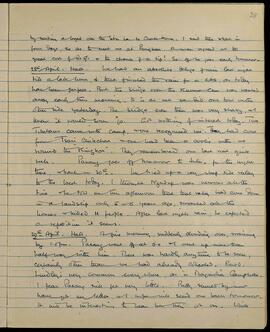
28th April. Halt. We had an absolute deluge of rain last night till a late hour, & that finished the rain for a little, as today has been perfect. But the bridge over the Kuomo Chu was washed away early this morning. It is as well we did our tour on the other side yesterday. The bridge even then was very shaky, & I knew it would soon go. Got nothing of interest today. Two Tibetans came into camp, & one recognized me. They had come from Tsari Chikchar, & one had been a coolie with me round the "Kingkor". They remembered our last visit quite well. Pasang goes off tomorrow to Julu, for the mice there, & back on 30th. We tried up a very steep side valley to the west today. I thought Ngudup was nervous all the time, & he told me this afternoon that that valley had come down in a landslip only 5 or 6 years ago, smashed all the houses & killed 11 people. After last night's rain he expected a repetition it seems.

29th April. Halt. A fine morning, suddenly clouding over, & raining by 1.0 pm. Pasang went off at 6.0 & I went up more than half way with him. There was hardly anything to be seen, certainly other than we had already collected. Rhod. Lindleyi very common everywhere, as is Magnolia Campbellii. I fear Pasang will get very little. Betty should by now have got my letter, & I hope will send one back tomorrow. It will be interesting to hear how they got on. While
LSH/1/1/9/1/34 · Part · 1949-05-06
Part of The Ludlow & Sherriff Collection

SUMMARY:
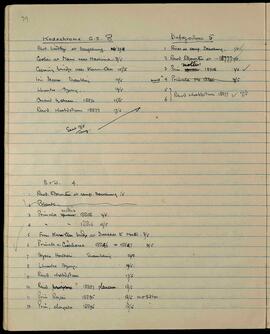
Page lists Kodachrome, Dufaycolor, and black‑and‑white images documenting rhododendrons, primulas, iris, styrax, river and bridge scenes, and views of Lhuntse Dzong across late April and May. Locations include Deungchung, Kuru Chu (and its bridge at Dunkhar), Shamshing, Lhuntse Dzong, and Tang, with a note of items sent on 19/5 to Tang.

CONTENT:
29

Kodachrome G.S. 8
Rhod. lindleyi at Deungchung. 28/29/4
Coolies at Mani near Mashina 8/5
Crossing bridge over Kuru Chu 10/5
Iris decora Shamshing 12/5
Lhuntse Dzong. 14/5
Orchid by stream. 18870 15/5
Rhod. rhabdotum 18877 17/5
Sent 19/5 Tang.

Dufaycolor 5
1 River at camp. Deungchung. 1/5
2 Rhod. edgeworthii at .. 18777 2/5.
3 Prim. mollis. 18806. 2/5.
moved 4 Primula No 18846 9/5
5 } Rhod. rhabdotum .18877 17/5
6 }

B & W. 4.
1 Rhod. edgeworthii at camp. Deungchung 1/5
2 Blank.
3 Primula mollis 18806 2/5.
4 Primula mollis 18816 4/5
5 From Kuru Chu bridge at Dunkhar to North. 8/5.
6 Primula cochlearea 18846 & 18847 9/5
7 Styrax hookeri. Shamshing. 13/5.
8 Lhuntse Dzong. 14/5.
9 Rhod. rhabdotum 17/5.
10 Rhod. primulaeflorum? 18887 glaucum. 18/5
11 Prim. roylei 18895 18/5 red filter.
12 Prim. elongata 18896 18/5

LSH/1/1/9/1/35 · Part · 1949-05-06
Part of The Ludlow & Sherriff Collection

SUMMARY:
The diarist walks alone while Ngundup asks about Delhi, London, and the King; the writer reflects on the Maharaja’s authority in Bhutan and warns of leeches on routes toward Tobrang and between Denchume and Jula. During halts on 30 April and 1 May near Sulu, Pasang returns with few specimens (no primulas) and a possible Rhododendron magnificum, and the diarist notes the scarcity of dogs and consults 1937 field notes.

CONTENT:
Walking alone, Ngundup keeps on asking me questions. We discussed Delhi today, and got a bit mixed as he was under the impression that Delhi was in England. Delhi and 'Wilayat' are the same to him I think. I have told him I will teach him Hindi when we reach Nashima. He also asked if when I went to 'London' I had to pay my respects to the King, and if when in Calcutta I had to obey the King's orders. In Bhutan the Maharaja is everything. One can see this by the way it is impossible to stop the making of camps. H.H. ordered it: it must be done. It does not matter whether I want it or not. Today we found a good many leeches on the path, not near here curiously enough, but very much further up. Betty will have to look out on these marches, like up to Tobrang, and from Denchume to Jula. Luckily there are not very many where leeches are bad.

30th April Halt. Rain at night, but fine all day today. Pasang got back at 4.0 pm, with very little stuff. He seems to have tried hard, but there can't have been many flowers out. Particularly he looked for primulas, and I am very surprised that he did not find any at all. Probably Sulu is not high enough. I don't know how high it is, but perhaps not more than 9500'. He may have got Rhod. magnificum (18801). I only went a short way today, and found nothing. It is most noticeable how few dogs there are in Bhutan. This village has one only. The reason is there are no thieves. In Tibet every house has dogs to keep away the professional beggars and thieves.

1st May. Halt. Thunder and rain last night, a lovely morning today. This is our last day here. I have been looking up my 1937 record of field notes,

LSH/1/1/9/1/36 · Part · 1949-05-06
Part of The Ludlow & Sherriff Collection

SUMMARY:
The writer plans to push higher toward Tiu beyond Nashima, arranging for a local to collect seeds for Betty and noting an afternoon earth tremor. On 2nd May at Khoma, after weather changes and a climb toward the Rip La, they observe an unusual Primula possibly distinct from known species.

CONTENT:
I see that by mid May I was collecting a good deal at 12-13,000'. So we must push up a bit and see what is to be found in Tiu, beyond Nashima. I wish I knew a bit more about the country, and also how the height will affect me. Here it is all right. Flower specimens are drying very well here, with a good wind up and down the valley, and with all the sun we have had. But I don't feel there is really anything of interest down here which we will want seed of badly. I have told a local to collect seed of two things for Betty if he can, if they are ripe, one is Styrax, which he calls Tralishing, the other a shrub with pretty hanging clusters of long tubed slightly pink flowers, which we first took on the Rudu La, and which here they call Pumpa shing. This afternoon at 3:30 (my time) there was a sharp severe earth tremor, immediately preceded by what sounded like thunder, but which was presumably not. It only lasted 5 or 6 seconds.

2nd May. Khoma. What a day — one full of incident from beginning to end — or what almost amounts to end now, that is 4:00 pm. It was fine till we got in at 1:00 pm, then rainy and then fine again. We left at 5:05 and walked down to the bottom of the ascent to the Rip La, about 2 hours going. Then we started to climb, and almost at once I saw a Primula I've never seen before, unless it can be a Cortusa, which I don't think. I can think of nothing which this one could be. [Primula mollis 18856] It is dark purplish red with a yellow eye, has very large soft round leaves, hairy stems and petioles, and then appears to be a Candelabra Primula. By the leaves it might be Obconica or Cortusoides, but I don't think

LSH/1/1/9/1/37 · Part · 1949-05-06
Part of The Ludlow & Sherriff Collection

SUMMARY:
The writer instructs Chengala of Dengchung to show a plant to Betty and collect seeds of several trees, including one used locally for yellow dye, with earlier material taken at Panghar. After a strenuous day crossing the Rip La, the diarist visits the half sisters of H.H., two of whom come to the tent, and later receives a letter from Betty while expressing concern about Hicks.

CONTENT:
they have flowers in whorls. And the flowers of this one (18806) are not yet out, but already the second whorl is 1 1/2" above the first. So I can't think what it is. We have not got good specimens as regards flowers, but I hope we will get seed alright as it is on Betty's route. I have left instructions with the man of Dengchung called Chengala that he must show this to Betty & get seed. He has also to collect seed of another tree which I took at Panghar, with attractive Daphne like flowers, from the leaves of which the locals make a good yellow dye, used in all their clothes. So Chengala has to get seed if possible of the following:- "Trali shing" (Styrax hookeri) 18802. "Pumpa shing", probably Viburnum erubescens 18706. The new mother primula (18806) and the tree used for dye (Daphniphyllum himalayense) (18733). I have given him a letter.

There were no flower excitements during the rest of the day, but we climbed to the Rip La, certainly 3000', then dropped a similar amount on the W. side, & finally climbed a good 2000 or 2500' up here. I should think we have climbed or dropped nearly 11000 ft. today, & the same coolies did it all. This is the home of the half sisters of H.H. There are three. They sent their mule down for me. One is a leper in such a bad way that she can't appear. The other two came to my tent & for 2 hours I had to do my best by myself to talk to them. The elder is also a leper or has lupus - her nose is disappearing - but she is quite nice & reasonably easy to get on with. The other was rather difficult. No sooner had they gone than Betty's letter came & that finished a good day. I fear poor Betty will have a bad time with Hicks, but she will have a good time with flowers. It was very very nice hearing from her, it really seems

LSH/1/1/9/1/38 · Part · 1949-05-06
Part of The Ludlow & Sherriff Collection

SUMMARY:
On the diarist’s birthday at Chensi Rongang, Tasho—the girls’ brother—arrived from herding, and local girls sought medicine, including for gonorrhoea; the diarist departed after declining to host them. Reports accuse the headman of Kuoma of extracting rice and supplies despite H.H.’s contrary order, prompting the need for action. The route climbed over Latsi La and continued to Tongnanying before a steep, muddy descent into dense forest after overnight rain.

CONTENT:
rather silly that we are so close and so far away.
3rd May - Chensi Rongang. 8 miles Ht approx. 6500'

My birthday. Yesterday did not finish when I thought it had. A very filthy man arrived and greeted me in Hindi. He was Tasho, the brother of the girls. They all have the same father and mother except the lad who has a different mother. He had come in from herding the cows. He was a cheerful soul whom I liked best of all. The younger girl came again with a bunch of hangers-on: she wanted medicine for gonorrhoea. She is not an attractive girl in any way, and her sister, suffering as she is, is much nicer, cleaner and easier to talk to. The hangers-on all wanted medicine and were not very grateful for it. I was very glad indeed to escape this morning, though that meant saying goodbye to the sisters. I refused to have them in my tent, so little time was wasted. All the hangers-on were, I thought, unpleasant; now we also hear that the headman of Kuoma has been doing the locals down by saying that he is to collect rice and other things for me, although he knows H.H.'s order to the contrary. The men had to give quite a lot, none of which I saw incidentally. So we must take some action on that.

The road leads up steeply to the Latsi La at m 1, then more or less flat over steep grass hillside for 2 m. to Tongnanying and so on to m 4 where it suddenly enters dense forest and drops very steeply indeed for some 1500 feet I should think. The path was very muddy and slippery. It had rained all night, but luckily was not raining this morning till after

LSH/1/1/9/1/39 · Part · 1949-05-06
Part of The Ludlow & Sherriff Collection

SUMMARY:
The party marches through dense forest near Rongang, noting many Primula mollis (first not in flower, then found flowering) but few other plants of interest, with capsules of a lily and some rhododendrons observed. Route discussions mention Nashina as not promising, Serdong La lacking nearby water, and Tiu as the best first halt, while Ngudup grows increasingly depressed about their plans.

CONTENT:
we were in. Then at about mile 5 the path levels off till just before reaching here it drops suddenly again. In the dense forest, both close to Rongang and in the very steep bit, there was any amount of the new primula 18806 (P. mollis), but again not in flower. Apart from that the march was very uninteresting. Poor Ngudup gets more and more depressed as he hears of where we are going and how long we will stay there. We still don't get very good information though. It seems Nashina would be much good, though the Serdong La might be good, but there is no water within miles of the pass. Tiu seems our best bet for the first halt.

4th May. Shambling. 6 miles. Very heavy rain all last night until just as we started. Fine but mist and cloud today. We found our primula in flower today (P. mollis 18816), very close to Rongang, and also just beside camp here. Otherwise nothing of interest seen - in fact these last two days have really been remarkable for the absence of flowers. There were, near the pass yesterday, capsules of a lily - either Lilium nepalense or L. nepalense var. concolor, and there were many Rhododendron virgatum and Rhododendron griffithianum. But today we really saw nothing at all. We can however, see the snows, not the main range, but a subsidiary running South. Today's road climbs for the first mile round a spur and

LSH/1/1/9/1/40 · Part · 1933-05-05 - 1933-05-07
Part of The Ludlow & Sherriff Collection

SUMMARY:
Rain and an injured companion (Nyudup) force halts, while a man from H.H. delivers a large box of tinned supplies. Letters mention fishing in Ha and Richardson’s note that Ludlow should have little difficulty making a final visit to Tibet; little botanical progress is made despite searches with Pasang. Mail is sent to Kpong, Betty, H.H., and Wangmoo, and the party marches 7 miles to Dunkhar hoping for fine weather to reach Thu.

CONTENT:
there is another village close to. Rain again this evening.
5th May. Halt. A fine day, lovely morning, till 5.0 pm when the
rain came on again. No flowers, although we went high up
the hillside - open oak forest. But I must stay yet another
day as Nyudup has got a poisoned foot & can't walk. This
afternoon a man from H.H. arrived with a huge box (70 lbs)
of tinned things! I don't know how to stop him. We have all
we need here with us, & now he has sent nearly half as
much again. It is very very kind. Tobgye sent on a letter
from Ludlow to him, in which he describes the fishing in
Ha as quite wonderful. He also sends Richardson's latest
letter in which it seems there will be little difficulty in
Ludlow getting in his last visit to Tibet. That is a good thing
for Ludlow. With H.H.'s present came a mail from Kpong
13th April, but little news in my part of it. I hear H.H. has
sent on even more to Betty than to me. We must stop this
somehow.

6th May. Halt. Fine again up till 2.0 pm then clouded & some rain.
Pasang & I tried another direction this morning, but we failed
to find anything. The last week hasn't produced more than
15 specimens I believe. We must get on up. Mail to Kpong
& to Betty & H.H. & Wangmoo all go off tomorrow morning.

7th May. Dunkhar 7 miles. Another fine day. I just hope that we
will have three more fine days. It would make a lot of
difference could we but get into Thu or wherever it is we
are to stay on a fine day, when we can see where we
are going. From here we get some idea, but not much.

LSH/1/1/9/1/41 · Part · 1933-05-07
Part of The Ludlow & Sherriff Collection

SUMMARY:
The diarist describes views of Hashina, a possible route up the Kuru Chu to Lhakhang Dz in Tibet (said to be a four-day journey in July–September by tom-tom), and a day's road from Shambling past a pass toward Diukkhar and a Dzong. Snow at the lower limit of Abies is minimal, rice and makai are growing, and the writer met a man who had been with them at Singhi Dzong in 1933.

CONTENT:
The difficulty will be to get an open space trunk. Here we can see
Hashina, which is no higher than this place (6400'). The Serjong La
even does not get the height of the fir trees, and fancy even Tin
may only be at the very bottom limit. We must wait and see, as
no one tells the same thing about these places - perhaps because
they have never seen. Many have told me all about these places,
and when I finally ask "have you ever seen them?" they answer "no".
From here a possible path goes up the Kuru Chu to Lhakhang Dz in
Tibet, and they told it is 4 hard days journey. In the 5 or 6 months
(July Aug and I expect Sept) they can go by tom-tom. So there must
at any rate be a path of some kind up there. All the tales
of deep snow are much exaggerated. There appears to be little, or
none at the lower limit of abies. Today's road rises
easily from Shambling to a pass at m 2, thence nearly level
till Diukkhar can be seen, then steep down to m 6 and finally
up to the Dzong. Rice and makai are both growing here now. There
are several very big houses and quite extensive cultivation. I have
still to have talks with the locals to find out what I can. —
I met a man here who was with us in Singhi Dzong in 1933 and

LSH/1/1/9/1/42 · Part · 1933-05-07
Part of The Ludlow & Sherriff Collection

SUMMARY:
A hot spring called Nye Chachhu lies below Dunkhar, and the village where the party is staying belongs to Dopala, the Trashigang Dzongpon; a few butterflies were seen. On 8 May at Mashina, in very hot weather with afternoon thunder and rain, they refused Ngudup’s request to stay and marched about six miles via the Panyong Chu to Phumpe, crossed a cane bridge, passed Chaksum and Chusa, and climbed steeply toward the Sergon Chu, walking without ponies while Ngudup’s foot improved with M&B 760 pills.

CONTENT:
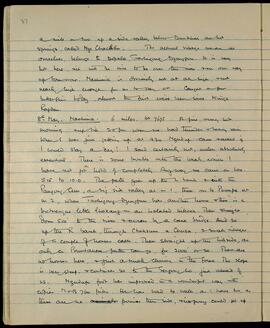
a mile or two up a side valley below Dunkhar are hot springs, called Nye Chachhu. The actual village we are at ourselves, belongs to Dopala, Trashigang Dzongpon. It is very hot here, and it will be nice to be over the river on our way up tomorrow. Mashina is obviously not at all high, but nearly high enough for us to stay at. Caught a few butterflies today, almost the first we've seen since Kunga Rapden.

8th May. Mashina. 6 miles. Ht 7675 A fine, very hot morning, up till 2.0 pm when we had thunder and heavy rain. When I was just setting up at 4.30 Ngudup came and asked if I would stay a day! I said certainly not, unless absolutely essential. There is some trouble with the locals, which I have not got hold of completely. Anyway we came on here. 5.15 to 10.0. The path goes up the L bank and into the Panyong Chu, a big side valley at m 1, then on to Phumpe at m 2, where Tashigang Dzongpon has another house, and there is a picturesque little lhakang on an isolated hillock. Then straight down 500' to the river and across by a cane bridge. And so up the R bank, through Chaksum and Chusa, 2 small villages of a couple of houses each. Then straight up the hillside, as only a Bhutanese path can go, for 2000' or so. There are no houses here, and just a small clearing in the forest. The slope is very steep, and continues so to the Sergon Chu, just ahead of us. Ngudup's foot has improved in a wonderful way with copious M&B 760 pills. He has had to walk, as I have too, as there are no ponies this side, and no pony could get up.