
Mostrando 6828 resultados

Descripción archivística
2091 resultados con objetos digitales Muestra los resultados con objetos digitales
Diary page (OCR unreadable)
LSH/1/1/9/1/3 · Part · 1949-09-13
Parte de The Ludlow & Sherriff Collection

SUMMARY:
No readable text was captured by OCR; the page appears blank or illegible.

CONTENT:
...
...
...
...
...
...
...
...
...
...
...
...
...
...
...
...
...
...
...
...
...
...
...
...
...
...
...
...
...
...
...
...
...
...
...
...
...
...
...
...
...
...
...
...
...
...
...
...
...
...
...
...
...
...
...
...
...
...
...
...
...
...
...
...
...
...
...
...
...
...
...
...
...
...
...
...
...
...
...
...
...
...
...
...
...
...
...
...
...
...
...
...
...
...
...
...
...
...
...
...
...
...
...
...
...
...
...
...
...
...
...
...
...
...
...
...
...
...
...
...
...
...
...
...
...
...
...
...
...
...
...
...
...
...
...
...
...
...
...
...
...
...
...
...
...
...
...
...
...
...
...
...
...
...
...
...
...
...
...
...
...
...
...
...

LSH/1/1/9/1/4 · Part · 1949-09-13
Parte de The Ludlow & Sherriff Collection

SUMMARY:
The party departs after intensive planning over the fate of Tashiding and Crockety, traveling by lorry and jeep to Rydak Tea Estate. Continuing via the Raidak toward Hatisar and then Kabare, they face repeated vehicle issues including getting stuck at a ford, fuel tank punctures, and delays at a ferry, turning short stages into long, difficult drives.

CONTENT:
25th March. BP 29.47 = 3840 70° = 1.0844 Ht. approx

It was very nice to set off at last after a good many days of hectic planning. Planning - not for this trip, which would be easy, but for the sale of Tashiding and Crockety, and wondering what would happen if we did not get a 'let' for Tashiding. Most of this fell on Betty, who also had all the trouble of thinking what was to be done in the Homes. We all left, with relief, at 7.30 this morning in Mintri's lorry and in our old Jeep, lent by Tongue well filled with the driver, Betty Hicks, myself and four Lepchas, two in the Jeep and two in the trailer. All went very well indeed and we reached Rydak T.E. by 5.0 pm with no trouble. It wasn't even very hot, nor very dusty.

26th Hatisar - c 250 miles by Raidak from Kalimpong. We thought this part would be very easy. We knew the road to Sankosh, easy and about an hour or so. Tongue's driver said three hours easy from there on, but it took us 10 hours and some anxious moments to get here. First the lorry stuck in the ford of the small branch of the Sankosh. Everything had to be taken out, the jeep hitched on to tow the lorry, then all loaded up again. The tank was punctured here, and that took time to put right. The same happened at the ferry and a worse leak started. From then on we kept on having trouble with the truck. Due to bad roads, leaking tanks and so on. Luckily we had Tongue's driver who knew the road well, and luckily also the road improved for the last 20 miles.

27th Kabare. This we were told was 8 miles, 5 along the flat and three up. If it is only 8, they are very long ones and we only got up in 10 hours. The road is easy along the river bank for 4 miles or so,

Page 5
LSH/1/1/9/1/5 · Part · 1949-09-13
Parte de The Ludlow & Sherriff Collection

CONTENT:
Then turn up a side valley on the left bank; it ascends very steeply for about 2000 feet. Over the pass one loses 1000 ft at once, then starts up again a long climb which continues till within a mile of Kazare. This climb is on the ridge most of the way. Kazare must be about 4500 ft or so. Nothing interesting botanically seen.

28th March. Surelakha B.P. 204.7 = 3840. 70° 1.0844. Ht approx. 4164'
This is only three miles. An easy ascent to a pass over the ridge, and down about 1000' this side. Again nothing of interest, no Rhododendrons at all seen. In 1937 I did not come this awful up and down route, neither did I reach this village, but I went to a place called Surelakha, which must have been down in the valley from here. It struck me as very much easier than this route; what's more, there were many rhodos in the trees. All the inhabitants so far are Nepalis. It seems very wrong that there should be political agitation here, but there has been, stirred up by a Kalimpong Nepali who came here just to do that. One wonders if he does this on his own, for what he can collect, or if he is instructed by others higher up. Hot and clear today.

29th March. Camp 6 m. beyond Chungsing or Chungsemo. Cultivation at Surelakha is now quite extensive & extends from where we camped at over 4000' down to about 1500', and up the other side of the valley. We lost nearly all yesterday's altitude at once, dropping into the valley bottom and crossing the river at about m 2. Then steeply up 500' or so to a pass at m 3. Then more or less level through dense forest to Chungsing or Chungsemo at m 5. There are no huts here, but H.H.'s cattle come here in winter. The only pretty flowering trees seen were Bauhinia variegata & an Erythrina. I think I saw Albizzia Shuffii, but not in flower. Beyond Chungsing the path continues up for a mile, then

LSH/1/1/9/1/6 · Part · 1949-09-13
Parte de The Ludlow & Sherriff Collection

SUMMARY:
Travel continues through dense forest to a camp at mile 11. On 30 March the party goes 9 miles to Byiti Sam over Mön La, descending into pine forests along the Mangde Chu and collecting Bauhinia and Erythrina flowers; Bhutanese porters are fewer than expected. On 31 March they proceed 8 miles to Shamagong Dzong (~6500'), crossing the Mangde Chu on a bamboo 'Pin' raft after confusion about the bridge and making a cautious detour.

CONTENT:
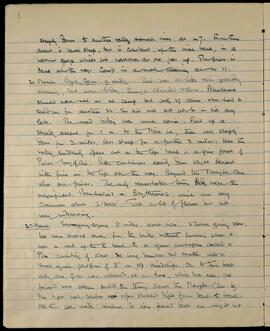
...steeply down to another valley small river at m 7. From there
ascent is never steep, but is constant, up the river bank, in a
narrow gorge which gets narrower as one goes up. The forest is
dense all the way. Camp in a small clearing at m 11.

30 March Byiti Sam 9 miles. There was a little rain yesterday
evening, but none today, though clouded and close. Bhutanese
should have met us at camp, but only 27 came, one had to
send on for another 22. So kit will not all be in till very
late. The road today was much easier. First up a
steady ascent for 1 mile to the Mön La, then very steeply
down for 3 miles, less steep for a further 2 miles. Here the
valley suddenly opens out and the left bank is a fine forest of
Pinus longifolia. Path continues easily down slight descent
with pine on the left all the way. Beyond the Mangde Chu
also are pines. The only remarkable things today were the
magnificent Bauhinias and Erythrinas, which are very
common about 2-3000'. Took a lot of flowers but not
very interesting.

31st March Shamagong Dzong 8 miles. about 6500'. 5 hours going slow.
We were shooed away from the bridge, without knowing where it
was and went up the right bank to a queer contraption called a
'Pin', consisting of about 20 long bamboos tied together with a
small square platform of 8' on top amidstships. On to this boat
only one of us was allowed at a time, while two men, one
forward and one astern pushed the thing across the Mangde Chu by
two tight male bamboo ropes stretched tight from bank to bank.
A detour was made because it was feared that we might not

LSH/1/1/9/1/7 · Part · 1949-09-13
Parte de The Ludlow & Sherriff Collection

SUMMARY:
The party crosses a high swinging bridge, climbs steeply through burnt pine forests to the Tata La, and reaches Shamgong Dz/Dzong amid clouds and afternoon thunderstorms. The next stage begins with a descent to the Wangdi Chu near the Mangde Chu, followed by a steep ascent to the Bruksong La en route to Tesar.

CONTENT:
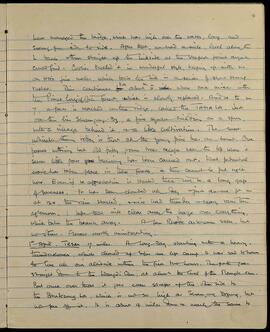
have managed the bridge, which was high over the water, long, and swung from side to side. After that, we had a mile, level along the L bank, then straight up the hillside at the steepest point anyone could find - Coolies tackled it in wonderful style, keeping up with us on H.H.'s fine mules, which took the hill in a series of short sharp rushes. This continues for about 5 miles, where oak mixes with the Pinus longifolia forest, which is slowly replaced. And so to mile 7, a pass is reached on the ridge, called the TATA LA. Just over this lies Shamgong Dz, a fine square building on a spur, with a village behind it, and a little cultivation. The most noticeable thing today is that all the young pine trees are burnt. One passes nothing but old fully grown trees, except near the top where it seems little grass burning has been carried out. What potential waste has taken place in these forests, and this cannot be put right now. Even if re-afforestation is started, there will be a long gap of bareness. It has been clouded all day, and just as we got in at 12:00 the rain started, and we've had thunder and heavy rain this afternoon. I hope that will clear away the haze over everything, which takes the beauty away. A few Rhodo arboreum seen, but no others. Flowers mostly uninteresting.

1st April. Tesar 17 miles. A long day, starting with a heavy thundershower, which cleared up before we left camp. It was sad to have to lose all our altitude within the first two hours. The path goes straight down to the Wangdi Chu, at almost the level of the Mangde Chu. But once over that it goes even steeper up the other side to the Bruksong La, which is not so high as Shamgong Dzong, but not far off it. It is about 4 miles down and nearly the same to

LSH/1/1/9/1/8 · Part · 1949-09-13
Parte de The Ludlow & Sherriff Collection

SUMMARY:
The party traversed steep paths through alternating pine and mixed rain forest, relying on H.H.’s mules, with Tsungpin proving especially helpful; the hypsometer was unavailable and camp stood around 4000 ft. On 2nd April they went 9 miles to Kinga Rapden (5800 ft), ascending near Yundu Choling before dropping to Kinga, where they were met by two of H.H.’s men with tea and saffron rice, received fine ponies from H.H., and encountered dancers with a small orchestra.

CONTENT:
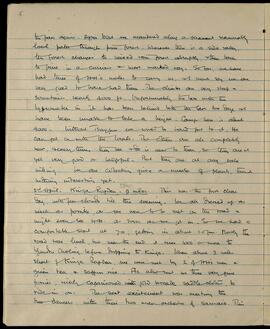
the pass again. After that we meandered along a pleasant reasonably level path through pine forest. Wherever there is a side valley, the forest changes to mixed rain forest abruptly, then back to pine in a curious and most marked way. So far, we have had three of H.H.'s mules to carry us, and I must say we are very glad to have had them. The climbs are very steep and sometimes nearly 4000 ft. Unfortunately the box with the hypsometer in it has been behind both the last two days, and I have been unable to take a height. Camp here is about 4000'. Without Tsungpin we would be hard put to it. He can get on with the locals. The others are all completely new, every thing they see and do is new to them, so they are not yet very good or helpful. But they are all very safe and willing. We are collecting quite a number of plants, though nothing interesting yet.

2nd April. Kinga Rapden. 5800 ft. 9 miles. This was the first clear day, with few clouds till the evening. We all dressed up as much as possible, as we were to be met on the road and might even see H.H. as soon as we got in. So we had a comfortable start at 7:00, getting in about 1:00 pm. Mostly the road was level, but near the end it rises 1000' or more to Yundu Choling, before dropping to Kinga. When about 3 miles short of Kinga Rapden, we were met by 2 of H.H.'s men and given tea and saffron rice. He also sent us three very fine ponies, richly caparisoned with gold brocade saddle cloths, to ride in on. The next excitement was meeting the two dancers, with their two man orchestra of sarnais. This

Procession to camp and arrival of H.H.
LSH/1/1/9/1/9 · Part · 1949-09-13
Parte de The Ludlow & Sherriff Collection

SUMMARY:
A colourful procession with dancers and sarnai players accompanied the party to a well-prepared camp with multiple tents and a kitchen. After preparing in case the R. or two Maharanis were there (they were not), H.H. arrived at 3.0; the writer notes he seemed aged, overweight, and short of breath, though still pleasant and thoughtful.

CONTENT:
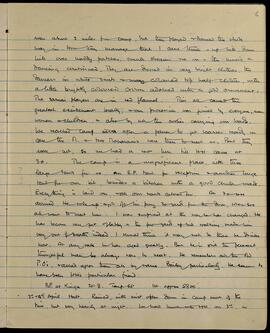
was about 2 miles from camp, we then played & danced the whole way in. How they manage that I can't think - up hill, down hill, over muddy patches, small streams & so on - the music & dancing continued. They are dressed in very bright clothes, the dancers in white skirts & many coloured top half clothes, with a little brightly coloured crown adorned with a few ornaments. The sarnai players are in red flannel. This all caused the greatest excitement locally, & our procession was joined by everyone, men, women & children, & also by all the coolies carrying our loads. We reached camp soon after a pause to get scarves ready in case the R. or two Maharanis were there to meet us. But they were not, so we had a rest here till H.H. came at 3.0. The camp is a magnificent place, with three large tents for us, an E.P. tent for reception & another huge tent for our kit, besides a kitchen with a good chula made. Everything is laid on & all our wants catered for. At 3.0 H.H. arrived. He rode up & got off his pony 30 yards from the door, where we all went to meet him. I was surprised at the way he has changed. He has become very fat & flabby & the few yards up hill walking made him very out of breath indeed. I should think it may well be that he drinks now. At any rate he has aged greatly. But he is still the pleasant, thoughtful man he always

LSH/1/1/9/1/10 · Part · 1949-04-06 - 1949-07-30
Parte de The Ludlow & Sherriff Collection

SUMMARY:
Page lists estimated costs for moving coolies and living expenses for routes involving Bumthang, Lhuntse, Tiyangsi, Shingbe, and Narimthang, including separate estimates for Betty and G.S. It records cash taken from H.H. on two dates in 1949.

CONTENT:
7

Estimated Cost.

All 50 coolies to Bumthang 150
" " " Lhuntse 300
450 + Rs 150 exp. 600

Betty 35 " " Tiyangsi 210
" " " Shingbe 140
350 + Rs 150 exp. 500

Six weeks in Shingbe 500 expenses 500
35 coolies to Narimthang 12 days 420 + 420
2½ weeks in " 250 expenses 250
35 coolies to Bumthang 420 + 230 exp. 500
2170
Say Rs 2500
Take 3000

G.S. 18 coolies at 35 days moving 660
Expenses 340
1000 Say 1500 Take 2500

Cash taken from H.H. 2000 + 3000 Rs 5000/- 6.4.49
1000/- 30.7.49

LSH/1/1/9/1/11 · Part · 1949-07-30
Parte de The Ludlow & Sherriff Collection

SUMMARY:
A planned picnic on the 4th was postponed due to rain and mist, and surplus food was sent in. On the 5th April, H.H. visited for an extended discussion about the Treaty and forest management, including concerns over the lack of young pines due to annual grass burning for cattle grazing.

CONTENT:
great ceremony, with the dancers to meet us and all the accompanying tamasha. But meals with H.H. are always private. No servants are allowed in the room except to serve, and then only for the minimum time. Even so a meal is a bit of a trial. On 4th H.H. proposed a picnic, but it rained and misted, and we put it off. An army of servants had already set out, with food etc, but they were recalled, and the unwanted food sent in to us in enormous bowls full. Spent the day in reorganising a few things.

5th April. Halt. Again rain and mist all day, no sun. H.H. sent to say he would come up after our lunch at about 12.30, and would like to have a friendly talk and stay to dinner. His usual hour for dinner is 9.0 pm, but we could not manage that, and compromised at 7.0. He arrived a little before 12.0 and left at 8.0, so we had a pretty hard afternoon, but still a pleasant and I hope a profitable one for all concerned. He led me away after lunch to have a talk, and we talked for fully two hours or more. We discussed the Treaty and all the possibilities of various clauses in it. "Why would India not hear of any arbitration?" There seems no answer except that she will not accept any arbitration that is fair.

I told H.H. about the awful present state of the pine forests between Bigiti Sam and here. The forests are only of old fully or more than half grown trees. Young trees barely are to be seen. All are burnt when the grass is burnt annually. I suggested either shutting off whole areas, never to be burnt, or of shutting areas for 5 or more years at a time. The grass is only burnt to get fresh grass for cattle grazing. When I asked H.H. how many cattle there were in the 25 miles of forest we passed through, he said "at

LSH/1/1/9/1/12 · Part · 1949-07-30
Parte de The Ludlow & Sherriff Collection

SUMMARY:
Notes discussions with H.H. on a new treaty affecting Bhutan, mention of Tasho Jigme’s freedom to travel, and soldiers sent up the Bumthang road to collect flowers including Prim. bracteosa, a Magnolia, and a Daphne. On 8th April they watched Bhutanese dancers and later hosted H.H. for a long session reminiscing about Calcutta and P.O.'s Gould, Williamson, Bailey, and Bell; letters from Kalimpong reported Ludlow’s departure and Norman’s sale of Glenulli.

CONTENT:
almost 300." I hope something may be done, because certainly already many lakhs of rupees worth of damage has been done in the last 30 years or so. H.H. was undoubtedly interested, & doubly so as the new Treaty, although it promises 5 lakhs of cash annually to Bhutan, also says this may be stopped at any time if the Treaty is not kept. This sounds like a convenient loophole. We also talked about Tasho Jigme, & H.H. said that he could travel where he liked in Bhutan. I still hope to have further talks, as H.H. seems to like it. H.H. sent three soldiers up the Bumthang road to see what flowers they could get, & they brought back Prim. bracteosa, a Magnolia & a Daphne that were interesting.

8th April. Our time here has not all been lazy. H.H. has entertained us fully & we have entertained him too. We were down on 6th to watch Bhutanese dancers, male & female, & the next day we had H.H. up for a good long session, 1.0pm till 5.30. He was then in great form reminiscing, mostly about his Calcutta visit & various doings of P.O.'s Gould, Williamson, Bailey or Bell. Mostly he talks of Bailey, of whom he certainly has the highest opinion. He would very much like to see Bailey again, & thinks he may come here sometime yet. I know Bailey is anxious to come, & if he does, he will get a welcome. We have not bothered much about flowers, but took a few more yesterday from round about, including Albizzia Sherriffii (18657), which is a fine tree. Tobgye sent a few letters on from Kalimpong, which arrived yesterday. No special news, except that Ludlow got off alright, & that Norman had sold Glenulli.