1925, May, Royal Horticultural Society Chelsea; Silver Gilt Medal for Primulas (54mm diameter), cased.
1920, June, Royal Horticultural Society; Silver Lindley Medal (44mm diameter), cased, inscribed on the edge ‘TO JOHN MACWATT FOR PRIMULAS CHELSEA 1920’.
1920, June, Royal Horticultural Society; Silver Lindley Medal for Primulas Certificate (157 x 227mm) awarded to Dr J MacWatt.
1912, Royal International Horticultural Exhibition London; Silver Medal (155mm diameter), lacking inscription, case and associated certificate.
1911, November, Scottish Horticultural Association; Silver Medal Certificate for Primulas (184 x 242mm) awarded to Dr John McWatt.
1924, May, Royal Horticultural Society Chelsea; Silver Medal for Primulas (54mm diameter), cased.
•5 boxes including papers regarding the bequest of the herbarium, British plants field notes and India and Malaya field notes.
Sinclair, James (1913-1968)SUMMARY:
Notes describe views of Singhi Dzong and the Kuru Chu gorge, photographing types and views at Lala, and local reactions to camp gear and flowers (including delphinium used as a 'louse killer'). The Jongpen has gone to Lhasa with Williamson, affecting transport, while the party camps in a sheltered field and tends seedlings amid wind and impending frost.
CONTENT:
B 27.
View up side valley - Singhi Dzong: from bridge over Kuru Chu looking up: from ridge above looking down gorge.
Types & views at Lala.
Petunias
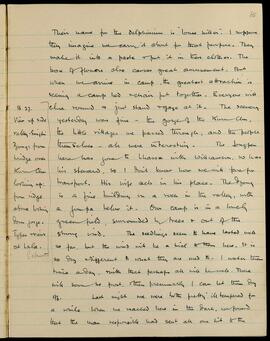
Their name for the delphinium is "louse killer". I suppose they imagine we carry it about for that purpose. They make it into a paste & put it in their clothes. The box of flowers also causes great amusement. But when we arrive in camp, the greatest attraction is seeing a camp bed & chair put together. Everyone will close round & just stand & gaze at it. The scenery yesterday was fine - the gorge of the Kuru Chu, the little villages we passed through; and the people themselves - all were interesting. The Jongpen here has gone to Lhasa with Williamson, so has his steward, so I don't know how we will fare for transport. His wife acts in his place. The Dzong is a fine building on a rock in the valley, with a gompa below it. Our camp is in a lovely green field, surrounded by trees & out of the strong wind. The seedlings seem to have lasted well so far, but the wind will be a trial to them here. It is so dry & different to what they are used to. I water them twice a day, with that perhaps all will be well. There will soon be frost, then presumably I can let them dry off. Last night we were both pretty ill-tempered for a while. When we reached here in the dark, we found that the man responsible had sent all our kit to the
SUMMARY:
A rain-soaked, leech-infested approach to camp in dense jungle is described, with note that Tsekang is deserted as people have gone to Samang. On 17th August at SINGHI DZONG, specimens of Spotted winged Grosbeak, Scaly breasted wren, and Blandford's Rose finch were obtained, and the route is detailed along the Khoma Chu past a mani wall at TOSUMANI with multiple river crossings.
CONTENT:
68
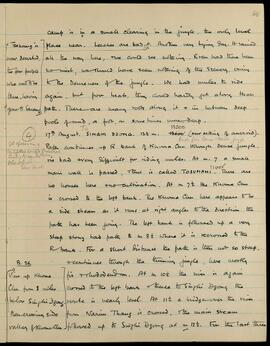
Camp is in a small clearing in the jungle, the only level place near. Leeches are bad!! Another very trying day. It rained all the way here, we could see nothing. Even had there been no mist, we should have seen nothing of the scenery, owing to the denseness of the jungle. We had mules to ride again, but poor beasts, they could hardly get along the path. There are many roots along it & in between deep pools of mud, a foot, or sometimes more deep.
Tsekang is now deserted, the few people who used to be there, having gone to Samang.
17th August. SINGHI DZONG. 12 ½ m. To 12900 +3600' (new setting of aneroid).
4 Got specimens of the Spotted winged Grosbeak: Scaly breasted wren. Blandford's Rose finch.
Path continues up R bank of Khoma Chu through dense jungle, birch, fir, larch & rhod. jungle is bad & very difficult for riding mules. At m. 7 a small mani wall is passed, this is called TOSUMANI 11000. There are no houses here & no cultivation. At m 7 ½ the Khoma Chu is crossed to the left bank. The Khoma Chu here appears to be a side stream as it runs at right angles to the direction the path has been joining. The left bank is followed up a very steep stony bad path to m 8 ½ where it is recrossed to the

SUMMARY:
The party departs after collecting at Narim Thang, crossing a difficult snowy pass with poor weather; Ludlow develops a cold. Notes discuss hopes for drier conditions at Khakang on the Kuru Chu and provide a route description from Hamo toward Menchumin via a lake.
CONTENT:
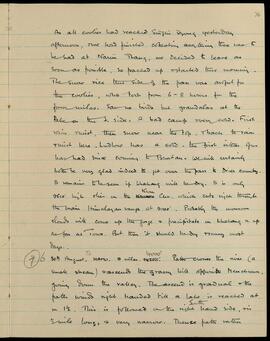
As all coolies had reached Singhi Dzong yesterday afternoon, and we had finished collecting everything there was to be had at Narim Thang, we decided to leave as soon as possible, so packed up and started this morning. The snow and ice this side of the pass was awful for the coolies, who took from 6-8 hours for the four miles. Saw no birds but grandalas at the Pass on the S. side. A bad camp and very cold. First rain and mist, then snow near the top, and back to rain and mist here. Ludlow has a cold - the first either of us has had since coming to Bhutan. We will certainly both be very glad indeed to get over the pass to drier country. It remains to be seen if Khakang will be dry. It is only 9500' high and lies on the Kuru Chu, which cuts right through the main Himalayan range at 9000'. Probably the monsoon clouds will come up the gorge and precipitate on Khakang and up as far as Towa. But then it should be dry and sunny most days.
30th August. HAMO. To 9 miles. 14000'. Path crosses the river (a small stream) and ascends the grassy hill opposite Menchumin, going down the valley. The ascent is gradual and the path winds right handed till a lake is reached at m 1 1/2. This is followed on the south right hand side, is 1/2 mile long, and very narrow. Thence path rather