Showing 6828 results

Archivistische beschrijving
2091 results with digital objects Show results with digital objects
LSH/1/1/8/1/43 · Part · 1947-01-13
Part of The Ludlow & Sherriff Collection

SUMMARY:
Entries for January 6–9 describe a snowy halt, peak angle measurements from a Dzong, and marches to Layoting and Camp Namdi. The writer disputes Ward and Bailey on the visibility of Gyala Peri, notes friendly villages, a nearby peak Gelung Jokpo, forests transitioning from pine to dense broadleaf, and observations of birds, clematis, and abundant Lilium giganteum.

CONTENT:
letters. He says he will arrive in about 22 days. Our own next mail will not leave here for 7 or 8 weeks or so until we reach India in 3 months from now, so this is worth while.

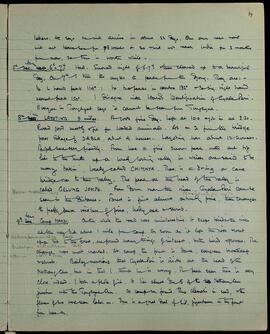
Jan 6th & 7th Halt. Snowed night of 6-7th then cleared up to a beautiful day. On 7th I took the angles to peaks from the Dzong. They are: - to left-hand peak 114° : to two peaks in centre 132° to big right-hand nearest peak 150°. I disagree with Ward's identification of Gyala Peri. Everyone in Tongkyuk says it cannot be seen from Tongkyuk.

Jan 8th LAYOTING. 9 miles. A good fine day. Left at 10.0 got in at 3.30. Road good mostly fit for loaded animals. At mile 2 from the bridge pass village of DABLA, about 4 houses. Layoting has about 12 houses. People here very friendly. From here a fine snow peak with cut top lies to the South up a bleak looking valley in which are said to be many 'takin', locally called CHIMNYA. There is a sling or cane bridge over to this valley. The peak at the head of the valley is called GELUNG JOKPO. From down near the river, Gyala Peri can be seen in the distance. Forest is first almost entirely pine, then changes to pretty dense mixture of pine, holly oak & shrubs.

Jan 9th Camp NAMDI. On the whole the road was uninteresting. It keeps beside the river all the way till about 1 mile from camp. As soon as it left the river & went up a bit to the forest, we found many things of interest, both birds & flowers. The change was most marked. At camp the forest is dense, evergreen broadleaf & shrubs. Bailey mentions that Gyala Peri is visible at the head of the Netrang Chu, but in this I think he is wrong. The peak seen there is very close indeed. I took a photo of it. It lies almost due S of the Netrang Chu junction with the Tongkyuk Chu. At camp we found three clematis in seed, the flowers of two were seen later on. There is a great deal of Lilium giganteum in this forest from here on.
LSH/1/1/8/1/44 · Part · 1947-01-13
Part of The Ludlow & Sherriff Collection

SUMMARY:
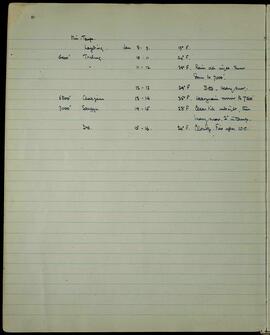
Log of minimum temperatures, altitudes, and weather for successive camps at Layshing, Trulung, Chakzam, Sangyu, and Dre over January 8–16. Notes include heavy rain, snowfall, snow levels, and a 2-inch snowfall at camp.

CONTENT:
40

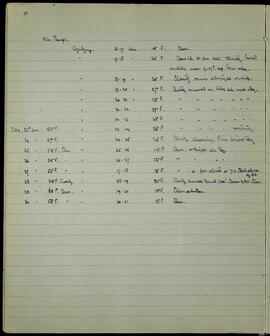
Min. Temps.
Layshing. Jan 8 - 9. 19° F.
6400' Trulung. 10 - 11 24° F.
" 11 - 12 34° F. Rain all night. Snow down to 7000'.
12 - 13 34° F Ditto. Heavy snow.
6800' Chakzam 13 - 14. 35° F. Heavy rain snow to 7500'
7000' Sangyu 14 - 15 23° F Clear till midnight, then heavy snow. 2" in camp.
Dre. 15 - 16. 24° F. Cloudy. Fine after 10.0.

LSH/1/1/8/1/45 · Part · 1947-01-13
Part of The Ludlow & Sherriff Collection

SUMMARY:
Travel from Namdi to Trulung was exhausting with frequent ascents and descents, few rhododendrons observed, and views over the junction of the Po Tsangpo and Tanghyuk Chu towards Gompo Ne; takin were reported abundant, and kalij pheasants were shot en route. After halting at Trulung with rain and snow, Sandup found the first rhododendron; the party then moved to Chakzam opposite Tangme at the junction of the Po Tsangpo and Yigrong Chu.

CONTENT:
Jan
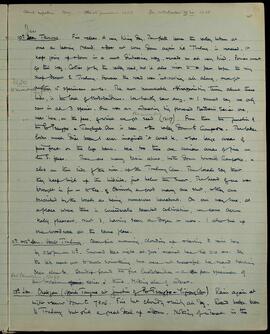
10th Jan. TRULUNG. Fine and clear. A very tiring day. The path leaves the valley bottom at once on leaving Namdi and does not come down again till Trulung is reached. It keeps going up and down in a most distressing way, and made us all very tired. Ponies must go this way. Coolies go by the valley road, but it also rises to a pass before the very steep descent to Trulung. However the road was interesting all along, and we got another 15 specimens or so. The most remarkable and disappointing thing about these hills, is the lack of Rhododendrons. We hardly saw any, or I should say we only saw in all 3 species. One was an interesting big flowered Maddenii Series one, near here, on the pass, of which we got seed (12117). From there the junction of the Po Tsangpo and Tanghyuk Chu is seen, and the valley down to Gompo Ne. The latter looks much drier than I ever imagined it could be, and has large areas of pine forest on the left bank. Here too there are curious areas of pine on the S. faces. There are many takin about, both down towards Gompo Ne, and also on this side of the river, up the Trulung Chu. The locals say that they keep high up the hillside, just below the snow. The head of one was brought in for us to see, and obviously a good many are shot, and they are described by the locals as being numerous hereabouts. On our way here, at a place where there is considerable deserted cultivation, we came across kalij pheasant, shot 3, having seen a dozen or more. I also put up one woodcock at the same place.

11th & 12th Jan. Halt Trulung. Clear fine morning, clouding up and starting to rain here by 5.30 pm on 11th. Snowed that night at 7000' and rained here till 11.0 am. All the lads went out to shoot something, but were not successful. We heard barking deer close to. Sandup found the first Rhododendron — a poor specimen of an arboreum series of trunk. Nothing else of interest.

13th Jan. Chakzam (Opposite Tangme at junction of Po Tsangpo and Yigrong Chu) Rain again at night and snow down to 7500'. Fine but cloudy and misty all day. Road better than to Trulung but still a great deal up and down. Nothing of interest in the

LSH/1/1/8/1/46 · Part · 1947-01-13
Part of The Ludlow & Sherriff Collection

SUMMARY:
Brief notes and Kodachrome photo captions mention views near Yigrong Tso, including downstream scenes and a view from near camp. There is a note about types from Dre for medicine and movement up and down the valley to the Yigrong Range from camp at Gyadzong.

CONTENT:
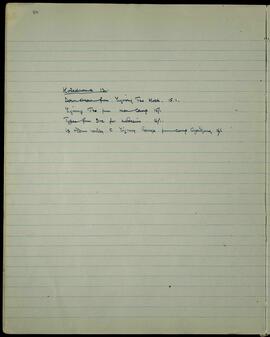
Kodachrome 12-
Downstream from Yigrong Tso block. 15.1.
Yigrong Tso from near camp 15/1
Types from Dre for medicine 16/1.
Up & down valley to Yigrong Range from camp Gyadzong 16/1.

LSH/1/1/8/1/47 · Part · 1947-01-13
Part of The Ludlow & Sherriff Collection

SUMMARY:
The diarist describes very tall pines and junipers, birches and oaks, and notes the striking jade-green colour of the Po Tsangpo river. On 14th Jan. near Sangyü, Ludlow and Henry took the pony path while the diarist and B. followed the riverside through dense wet forest with massive junipers, passing Rhododendron trees near Chahzam and old cultivated flats with ruins said to have been destroyed by the Chinese in '12.

CONTENT:
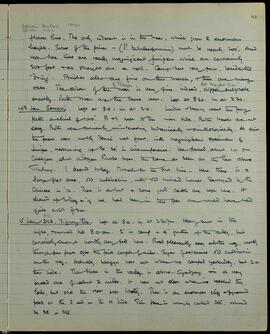
Cupressus torulosa 12141
Cedrela 12142

43

flower line. The only interest is in the trees, which grow to enormous heights. Some of the pines - (P. tabulaeformis) must be nearly 200 feet. And near here there are really magnificent junipers which are certainly 200 feet and straight as a rod. Camp here very poor, beside the 'spring'. Birches also are fine on this march, and there are many oaks. The colour of the Po Tsangpo river is very fine indeed, copper sulphate (pale 'deep jade green') exactly. Both rivers are the same now. Left at 8.30. In at 2.30.

14th Jan. SANGYÜ. Left at 9.0 : in at 2.0. Ludlow and Henry went the pony path, a climb of 1000 feet. B. and I kept to the river side. Both tracks are not easy. Both were curiously uninteresting botanically and ornithologically. At first the forest was mostly dense wet forest, with magnificent specimens of Juniper, measuring up to 20 feet in circumference. We passed, about 1 mile from Chahzam, about a dozen Rhododendron trees, the same as seen on the Pan above Trulung. I heard today Monal for the first time. Here there is a large flat area, old cultivation, with old ruined houses, destroyed by the Chinese in '12. There is a hut and

LSH/1/1/8/1/48 · Part · 1947-01-13
Part of The Ludlow & Sherriff Collection

SUMMARY:
Log of minimum and maximum temperatures at Gyadzong for 16–31 January, with notes on weather conditions. Frequent snow on surrounding hills is recorded early in the period, followed by several clear days, a windy interval on the 23–24th, snow down to 7000' on the 28–29th, and clear conditions thereafter.

CONTENT:
114

Min. Temps.
Gyadzong. 16-17 Jan. 14° F. Clear.
" 17-18 " 20° F. Clear till 10 p.m. then cloudy. Snowed
on hills most of 17th esp. down valley.
" 18-19 " 30° F. Cloudy snow all night on hills.
" 19-20 " 27° F. Cloudy snowed on hills all night & day.
" 20-21 " 29° F. " " " " " "
" 21-22 " 27° F. " " " " " "
" 22-23 " 25° F. " " " " " "
Max. 23rd Jan. 43° F. " 23-24 26° F. " " " " windy.
24 " 47° F. " 24-25 24° F. Cloudy, clearing. Fine bright day.
25 " 53° F. Clear. " 25-26 14° F. Clear & bright all day.
26 " 54° F. " " 26-27 12° F. " " " "
27 " 56° F. " " 27-28 13° F. " a few clouds at 7.0. Cloud above
by 12.0.
28 " 54° F. Cloudy. " 28-29 30° F. Cloudy, snow fell down to 7000'. Clearer by 8.0. Clear.
29 " 61° F. Clear. " 29-30 14° F. Clear all day.
30 " 58° F. " " 30-31 15° F. Clear.

LSH/1/1/8/1/49 · Part · 1947-01-13
Part of The Ludlow & Sherriff Collection

SUMMARY:
The party camps 1 mile west of Gyadzong after crossing to the left bank and reports friendly but guarded locals fearful of the Phokpon official. Notes describe exploitative tax practices leading to depopulation and poverty in nearby areas. Subsequent entries record a halt day for organization and cold, cloudy weather with snow on the 18th.

CONTENT:
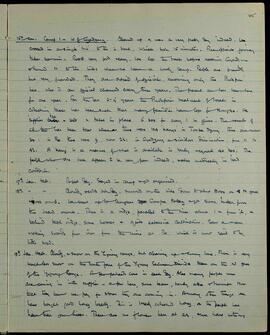
16th Jan. Camp 1 m W of Gyadzong. Cleared up & was a very pretty day indeed. We crossed in a single trip to the L bank, which took 15 minutes. Rear opposite journey takes 20 min. Road very bad ready. We left the track before reaching Gyadzong & turned N to the links where we have a lovely camp. People are friendly but very guarded. They are afraid of officials, knowing only the 'Phokpon' here, who is an official changed every three years. The present one has been here for one year. For the last 3-4 years the Phokpon's treatment of locals in collecting taxes has been such that many families have left for Kongbo. He supplies tea, butter & salt & takes in place 6 bos for every 1 he gives. The result of all this has been that whereas there were 104 'kangs' in Tembe Dzong, there are now 34: in Be there were 9, now 2 1/2: in Gyadzong a similar diminution, from 11 to 4 1/2. A kang is a measure of what is available in barley & equals 40 bos. The people who are here appear to be very poor indeed, & also medically in bad condition.

17th Jan. Halt. Perfect day. Stayed in camp & got organized.

18th Jan. Cloudy & cold all day: snowed on the links down to about 8000 on the N

LSH/1/1/8/1/50 · Part · 1947-01-13
Part of The Ludlow & Sherriff Collection

SUMMARY:
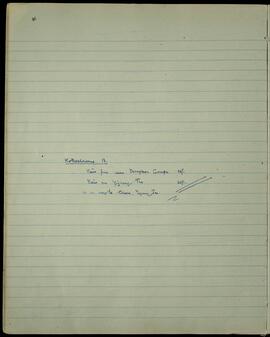
Notes for Kodachrome film 13 list views from near Dongkar Gompa and on Yignung Tso, including scenes taken on the way to Chara. The page records locations for photographic views.

CONTENT:
46

Kodachrome 13.
Views from near Dongkar Gompa 25/.
Views on Yignung Tso 26/.
on way to Chara, Yignung Tso.

LSH/1/1/8/1/51 · Part · 1947-01-13
Part of The Ludlow & Sherriff Collection

SUMMARY:
The diarist notes failed banana trees in Dongkar, widespread illness, and persistent bad weather during a series of halts while collecting birds. They visit Denchan Gompa, hunt game birds with local shikaris, and criticize Elliot’s contribution. Bill visits Yigong Tso and learns from the Be Gyimpon of a summer route to Tongkyuk over the TRESUR LA; Ludlow departs for Suowa with companions.

CONTENT:
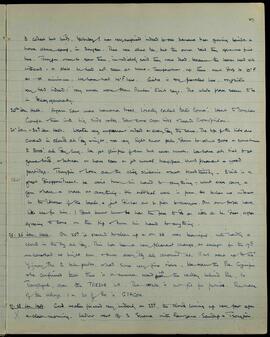
to collect bush birds. Yesterday I was very surprised indeed to see banana trees growing beside a house above camp, in Dongkar. There were about ten, but the owner said they gave no fruit here. Tseringpon, when he saw them, immediately said they were dead, because the leaves had all withered - a state he had not seen at home. Temperatures up there must drop to 10°F as a minimum. We have had 14°F here. Goitre is very prevalent here, syphilis very bad indeed - "very much worse than Bhutan" Elliot says. The whole place seems to be in decay generally.

20th Jan Halt. Again saw more banana trees, locally called 'tali loma'. Went to Denchan Gompa then into big side valley. Saw some crossbills & heard Crossoptilon.

21st Jan - 24th Jan. Halt. Weather very unpleasant indeed & every day the same. The tops of the hills are covered in clouds all day & night, & a very light snow falls, down to about 9000' or sometimes to 8000', all day long. We get glimpses of sun but never much. We have all tried to get game birds, & between us have seen or got monal, tragopan, blood pheasant & wood partridge. Tseringpon & Laku are the chief shikaris & most bloodthirsty. Elliot is a great disappointment. He won't turn his hand to anything; won't even carry a gun & have a crack at anything. His medical work is poor. He takes no interest in the illnesses of the locals, & just dishes out 2 pills to everyone. Our own people have little use for him. I don't know how he has the face to do as little as he does, after agreeing to come on this trip & turn his hand to anything.

25-26 Jan. Halt. On 25th it started to clear up & on 26 was beautiful, with hardly a cloud in the sky all day. This has been a very pleasant change, as except for the 19th we have had no bright sun, & snow every day all around us. Bill went up to the Yigong Tso to take photos, & had some very fine views. He saw the Be Gyimpon who confirmed that there is a summer road up from the valley behind Be, to Tongkyuk, over the TRESUR LA. The route is not fit for ponies. The name of the village 1 m W of Be is GYAGON.

27-28 Jan. Halt. Good weather finished very suddenly on 28th, the clouds coming up very fast after a clear morning. Ludlow went off to Suowa with Ramzana, Sandup & Tseringpon.

Blank lined page
LSH/1/1/8/1/52 · Part · 1947-01-13
Part of The Ludlow & Sherriff Collection

SUMMARY:
This page is blank and contains no text to extract.

CONTENT:
The provided image is a blank page of lined paper and contains no text to extract.