Showing 6828 results

Archivistische beschrijving
2091 results with digital objects Show results with digital objects
LSH/1/1/7/1/21 · Part · 1940-04-22
Part of The Ludlow & Sherriff Collection

SUMMARY:
After a snowfall delay, the party crossed the Lo La on April 24 and descended the steep south side into the Rhododendron–Abies forest. Along the Chudi Chu they observed numerous Rhododendron and Primula species, including the new Primula P. chionogenes and another unnamed Primula on an inaccessible cliff.

CONTENT:
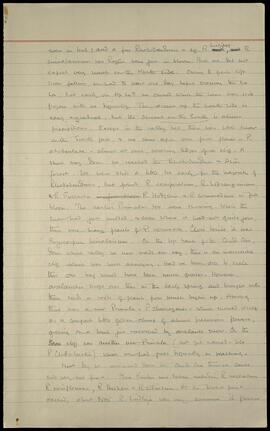
were in bud, and a few Rhododendrons - e.g. R. hirtipes, and R. cinnabarinum var. roylei were just in bloom. But we did not expect very much on the North side. Owing to fresh soft snow falling, we had to wait one day before crossing the Lo La, but early on April 24th we crossed while the snow was still frozen with no difficulty. The ascent up the North side is easy and gradual, but the descent on the South is almost precipitous. Except in the valley bed, there was little snow on the South face, and we came upon our first flower - P. atrodentata - almost at once, covering ledges of a cliff. A short way down we reached the Rhododendron - Abies forest. We were still a little too early for the majority of Rhododendrons, but found R. exasperatum, R. lopsangianum, R. forrestii, R. hodgsonii, and R. commodum in full bloom. The earlier Primulas too were showing. Where the snow had just melted, and even where it had not quite gone, there were many plants of P. vernicosa. Close beside it was Bryocarpum himalaicum. On the left bank of the Chudi Chu, down which valley we now made our way, there is an inaccessible cliff which was most annoying. Had we been able to scale this our bag would have been much greater. However, avalanches swept over this in the early spring and brought with them seeds or roots of plants from much higher up. Among these was a new Primula - P. chionogenes - which showed itself as a compact little golden clump of almost precocious flowers, growing on a bank just uncovered by avalanche snow. On the cliff was another new Primula (not yet named - like P. clutterbuckii) which we had great difficulty in reaching.

Next day we continued down the Chudi Chu through dense and very wet forest. More Rhodos were taken, including R. uvariifolium, R. neriiflorum, R. hookeri and R. ciliatum. At the lowest point reached, about 8500', R. lindleyi was very common in flower.

LSH/1/1/7/1/23 · Part · 1940-04-22
Part of The Ludlow & Sherriff Collection

SUMMARY:
The diary describes the poorly maintained Molo–Lhalung path, the heavy loads carried by local coolies, and observations of Primula species along the route, including P. Normaniana and P. latisecta with notes on their phenology. From a camp on the Chindi Chu the party climbed over the Nyug La through dense forest with Rhododendron and bamboo, noted P. tsariensis var. porrecta and P. Boothii, and obtained a view of the Lhalung valley, with P. Boothii extending its known distribution from the type locality in Bhutan.

CONTENT:
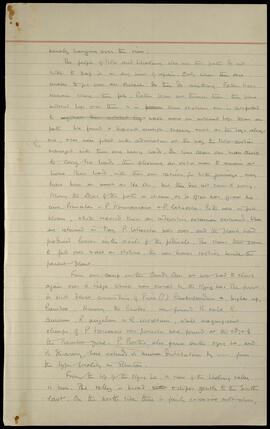
usually hanging over the river.

The people of Molo and Lhalung who use this path do not bother to keep it in any kind of repair. Only when they are unable to get over an obstacle do they do anything. Fallen trees remain where they fell. Rather than cut through them, they place notched logs over them and in some stretches one is compelled to walk more on notched logs than on path. We found it difficult enough, slippery and wet as the logs always are, and we were filled with admiration at the way the Molo coolies managed with their very heavy loads. In some cases one man chose to carry two loads, thus allowing an extra man to remain at home. These loads, with their own rations for both journeys, may have been as much as 160 lbs, but they did not seem to worry. Along the edges of the path or stream, as it often was, grew two new Primulas - P. Normaniana and P. latisecta. Both were in full bloom, and both records show an interesting extension westward. When we returned in May P. latisecta was over, and the plants had produced leaves in the axils of the pedicels. The stems then seem to fall over and act as stolons, the new leaves rooting beside the parent plant.

From our camp on the Chindi Chu we now had to climb again over a ridge which was crossed by the Nyug La. The forest is still dense, consisting of Picea (?) Rhododendron and, higher up, Bamboo. Among the Rhodos, we found R. rude, R. aureum, R. arizelum and R. uvarifolium, while magnificent clumps of P. tsariensis var porrecta were found at the edge of the Bamboo zone. P. Boothii also grows on the Nyug La, and its discovery here extends its known distribution by —— from the type locality in Bhutan.

From the top of the Nyug La, a view of the Lhalung valley is seen. The valley is broad and slopes gently to the South East. On the north side there is fairly extensive cultivation,

Blank lined page
LSH/1/1/7/1/24 · Part · 1940-04-22
Part of The Ludlow & Sherriff Collection

SUMMARY:
The page contains no diary text; it is a blank sheet of lined paper.

CONTENT:
The provided image contains no text to extract. It is a blank sheet of lined paper.

LSH/1/1/7/1/25 · Part · 1940-04-22
Part of The Ludlow & Sherriff Collection

SUMMARY:
The writer describes attempts to follow scarce paths in the Himalayas, requiring hard work cutting through dense vegetation and yielding little progress. Citing Captain K. Ward, they note that collecting would be easier with more paths, while locals warn of hunters' poisoned arrow traps and a missing hunter, making one route unsafe until traps decay.

CONTENT:
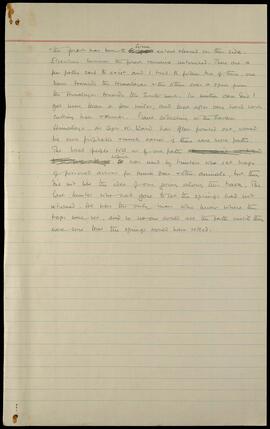
The forest has been to some extent cleared on this side. Elsewhere however the forest remains untouched. There are a few paths said to exist and I tried to follow two of these, one back towards the Himalayas and the other over a spur from the Himalayas towards the Southwest. In neither case did I get more than a few miles, and that after very hard work cutting trees and shrubs. Plant collecting in the Eastern Himalaya, as Captain K. Ward has often pointed out, would be more profitable and much easier, if there were more paths. The local people told us of one path which was used by hunters who set traps of poisoned arrows for musk deer and other animals, but they did not like the idea of our going along this track. The last hunter who had gone to set the springs had not returned. He was the only man who knew where the traps were set, and so no one could use the path until they were sure that the springs would have rotted.

Blank lined page
LSH/1/1/7/1/26 · Part · 1940-04-22
Part of The Ludlow & Sherriff Collection

SUMMARY:
This page is a blank sheet of lined paper with no diary text.

CONTENT:
The provided image is a blank sheet of lined paper and does not contain any text to extract.

Damaged antique book cover
LSH/1/1/8/1/1 · Part
Part of The Ludlow & Sherriff Collection

SUMMARY:
The page shows a heavily worn and damaged antique book cover with no legible text. No transcribable content is present.

CONTENT:
Based on the image provided, there is no legible text to extract. The image shows a heavily worn and damaged antique book cover with no visible printing or handwriting that can be transcribed into a structured format.

LSH/1/1/8/1/2 · Part
Part of The Ludlow & Sherriff Collection
  • SUMMARY:
    Notes mention dyeing white paper labels and list a series of numerical calculations. Rimsu is mentioned.

CONTENT:
SHERRIFF

dyeing white
paper paper labels

1000

  • 1500
  • 1500
    1800 12 12000 1500
  • 2000 125 12000

  • 1000
  • 1500
  • 1500
    ---- 130 13500
  • 3800 -----------

  • 500
  • 1000
  • 800
    13500 14
    14 100
    145 1500 15000

    15000 -15800 800

    Rimsu.