Showing 6828 results

Archivistische beschrijving
2091 results with digital objects Show results with digital objects
LSH/1/1/7/1/1 · Part · 1940-05-24
Part of The Ludlow & Sherriff Collection

SUMMARY:
The expedition splits, with Ludlow and Taylor heading to passes east of Tsela Dzong while Sherriff works the Lanyong area and passes between Roro and Bela Dzong, departing Roro on 24 May. The page describes the Lanyong Chu valley, its isolated inhabitants and seasonal conditions, and notes early-season floral observations on high slopes, including Rhododendron repens and Primula species.

CONTENT:
1940.

Sherriff - May - July -

In order to cover as much ground as possible, we now decided that we should divide into two parties. Ludlow and Taylor were to visit as many passes East of Tsela Dzong as time allowed, while Sherriff worked the Lanyong area and other passes over the Himalayas between Roro and Bela Dzong. On 24th May therefore we all left Roro, and Sherriff went up the Lanyong Chu in easy stages to Lanyong.

The Lanyong Chu here is not unlike the Tsari Chu further to the West. It runs parallel to and about four miles North of the Himalayas. But whereas the Tsari Chu cuts through the axis, the Lanyong Chu turns North to the Tsangpo. Several side streams of considerable size, unfordable in summer, join the Lanyong from the South.

The valley, which is from 300-600 yards wide, flows gently through the valley bed. The inhabitants are very isolated. They grow no crops, but breed cattle and yaks. Here and there along the valley bed, one sees a few chalet-like huts, used by men and yaks alone in the winter months when snow lies deep. The rain of the summer turns to snow about the end of October or mid-November, and the inhabitants remain in their huts till March when they are able to get about again.

There was not much in flower in the valley bed, as it was still rather early for the passes over the Himalayas, which here vary between 13,500 - 15,000'.

The South sides of the passes were now almost free of snow, but North faces were still deeply covered. However on the open slopes about 14,000' a little North of the main axis, Rhododendron repens was just coming into flower, and with it (P. valentinianum and P. franchetii). On the same day as I first saw the latter in flower, I was also able to make a large collection of its seed. A north facing slope on which it grew P. vernicosa.

LSH/1/1/7/1/3 · Part · 1940-05-24
Part of The Ludlow & Sherriff Collection

SUMMARY:
The diarist describes a difficult crossing of the Chubumbu La in mist, rain, and snow, followed by notable finds of Primula species and hybrids on the southern slopes. They also note a later visit to the Chimi La, where melting snow revealed several bodies of Lhopas from the previous autumn.

CONTENT:
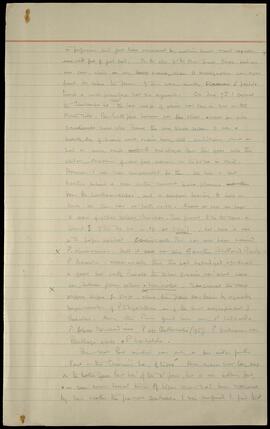
In profusion had just been uncovered by melting snow, and seed capsules were still full of good seed. On the edge of the Abies forest, Omphalogramma minus was seen, while on very damp swampy slopes, O. brachysiphon was again found. As before, the flowers of this were mostly 5-partite, though a small percentage had six segments. On June 7th, I crossed the Chubumbu La (13,900'), the last 1,000 ft of which was deep in snow on the North side. The South face, however, was clear except for piles of avalanche snow 1,000' down the very steep slopes. It was a beastly day of driving mist and rain, over cold conditions which we had on every single Himalayan Pass this year, with the solitary exception of one fine morning on the Ka La in April. However, I was soon compensated for this. We took a last breather behind a rock on the summit before plunging down the southern slopes, and a compass bearing to keep us right as there was no path visible. Almost at once, we saw a mass of golden yellow Primulas. This proved to be the same as found south of the Do La in Ap at 11,500'; but here it was with proper habitat. This has now been named P. chionogenes. With it was also another Petiolarid Primula - P. tsariensis, and occasionally these two had hybridized and produced a queer but pretty Primula, the colour of which was about halfway between golden yellow and blue-violet. These covered the steep, slippery slopes for 500 ft, where their place was taken by equally large numbers of P. elizabethae, one of the most magnificent of Primulas. Among other Primulas found here were P. pudibunda, P. firma, P. normandiana, P. aff. clutterbuckii (3937), P. dickieana var. pantlingii, and P. barbatula.

The next Pass visited was only a few miles further East - the Chimi La, of 15,000'. Here again, snow lay deep on the North face, the last 1,000' of the N face, but it was melting fast, and we came across several bodies of Lhopas who had been overcome by bad weather the previous Autumn. I was surprised to find that

LSH/1/1/7/1/4 · Part · 1940-05-24
Part of The Ludlow & Sherriff Collection

SUMMARY:
Page lists plant notes: Lonicera (dwarf yellow), Lonicera hispida var. setulosa (seeds), Paraquilegia, 'Nom Soulei', Rhod. 5544, Primulas 5537-41, and Daphne. Also notes the height of the conifer zone.

CONTENT:
Lonicera dwarf yellow

/ Lonicera hispida var. setulosa
Seeds

Paraquilegia
Nom Soulei
Rhod.
5544

Primulas 5537, 38, 39, 40
41

Daphne

Height of conifer zone

LSH/1/1/7/1/7 · Part · 1940-05-24
Part of The Ludlow & Sherriff Collection

SUMMARY:
The diarist notes bodies with bows left beside them and observes alpine flora on nearby snow slopes and streambeds. Accompanied by Langong coolies, they visit the Tsari Sama (Sarpa) pilgrimage area, finding it rich in Primula, Rhododendron, and a new white-flowered Daphne near the pass to Lopa territory. Trashiyang is mentioned as the starting and finishing point of the pilgrimage.

CONTENT:
Beside each body, the owner's bow had been stuck in the ground. All arrows had been taken away, but all their other possessions seemed to have been left intact, even to their meagre rations of food. Near here, at the top of the snow slopes, were vertical cliffs. Tucked away in dust-dry pockets, completely sheltered from rain, were fine clumps of P. littledalei.

A little lower down, at 14,000', the first Meconopsis simplicifolia were coming into flower. Beside this, P. chamaethauma was in flower, and on a steep bank just above this, a little creeping Lonicera, only an inch or two off the ground, showed its yellow flowers. Some of the open swampy flats held masses of a fine Allium (No. ). On stony beds beside streams grow P. macrophylla v. macrocarpa.

There remained, near Langong, one area to visit, that was Tsari Sama. This is a place of pilgrimage, called Tsari Sama or Sarpa—the new Tsari—to distinguish it from the better-known, more important Tsari Chikchar. The Langong coolies were not anxious to go round the pilgrimage, for which I could not blame them. However, they took me, and it was a most interesting trip. As at the Lo La, there is in Tsari Sama a fairly extensive, reasonably open flat bit of country, just north of the immediate Himalayas, gradually rising to a steep rocky ridge. The whole of this area was very rich in flora. This, to a certain extent, can, I think, be put down to the fact that no yaks are kept here in the summer. None of the dwarf rhodos were now in flower, and R. campylogynum (5560), R. trichocladum (5555), R. glaucum (5565). Also 5568.

A Primula not seen elsewhere, P. Kingii covered acres of open ground with its deep wine-coloured blooms, P. laeta, a glorified form of P. Roylei. Primula, P. gracilipes.

Perhaps the most interesting Rhododendron was 5571 (yellow, red spots). Growing among rocks just below the ridge before reaching the pass to Lopa territory, we came across a fine large, white-flowered new Daphne. No seeds.

At Trashiyang, the starting and finishing point of the pilgrimage,

LSH/1/1/7/1/8 · Part · 1940-05-24
Part of The Ludlow & Sherriff Collection

SUMMARY:
Notes compare vegetation in the Tsangpo valley with that near Kyimdong Dz, highlighting distribution differences. Plants usually confined to south slopes are observed north of the Himalayas due to increased rainfall passing the barrier, with examples including Magnolia globosa, Lilium giganteum, and possibly Nymphaea.

CONTENT:
Contrast in Tsangpo valley
vegetation from that near
Kyimdong Dz-
Lil. Wardii.

Shape of side valleys Swamp

Various plants normally on South slopes only,
now appear north of the Himalayas, owing to the
increased rainfall which passes the barrier. Among these are Magnolia globosa, Lilium
giganteum, (Nymphaea?)

LSH/1/1/7/1/9 · Part · 1940-05-24
Part of The Ludlow & Sherriff Collection

SUMMARY:
The diarist describes abundant Primula species on swampy valley slopes and notes that by October seed and leaves were scarce due to yak grazing. On June 19th they returned to Lanyong, then departed for Molo via the Tse La, later traveling down the Tsangpo valley to Mayu and making difficult river crossings (including by skin coracles and a log raft) before proceeding up the Nagu Chu valley toward the Tam La over the Himalayas.

CONTENT:
there are two huts & a small monastery. A few men
from Lanyong had just arrived, with their yaks for the summer -
On the swampy slopes in the valley bed were masses of most beautifully
coloured primulas - P. alpicola in several and a P.
sikkimensis subsp in every conceivable colour. One of these was
constant in colour down the rocky sides of cascades, until the
rich & marshy flat yak pasture was reached. Here it broke out into
all colours & shades. I marked many for seed collecting in
the Autumn, but in October I could hardly find a seed & indeed I
could hardly see a Primula leaf - all had been grazed by yaks.
On June 19th we were back in Lanyong, which we left then,
bound for Molo, by a different route, over the Tse La, 15000'.
I had time to visit two other valleys before we all met at
the end of July, so went down the Tsangpo valley to Mayu on the
R bank of the Nagu River - All these rivers from the Himalayas
running N. to the Tsangpo were by now in spate.
Bridges in every case had been carried away by flood water &
we had some difficulty in crossing, clear days sometimes fording, sometimes by
the skin coracles called Kowas and sometimes by a heavy

Waterlily 5749 unmanageable craft called a 'tru', which consisted of three or
Smilacina 5756 four long logs tied together. Crossing a rapid river by 'tru' was
Lil. giganteum 5743 a full day's business: first it was towed some hundreds of yards
Smilacina 5754 upstream, where it was loaded till the logs were awash. Then two men
Rhod. floribunda would paddle frantically with sticks making a yard across for every
Magnolia globosa twenty yards they were carried down stream. Just after crossing the
Nagu Chu in this way, the weather cleared after three days we had
sunshine. I went up the Nagu Chu valley to a pass at over the
Himalayas called the Tam La. The ascent, until within a mile
of the pass was very slight & for miles we plodded through
swamps. Then reaching the Main Range suddenly on the third
short day's march, the path climbed abruptly to a knife edge

LSH/1/1/7/1/10 · Part · 1940-05-24
Part of The Ludlow & Sherriff Collection

SUMMARY:
Notes indicate the western extremity for Mec. florindae and where P. caliantha begins, with P. elizabethae meeting it at this point and not occurring eastward. The writer first found these further west in Bari Tana or Umkumbala.

CONTENT:
add Mec. florindae, west extremity
P. caliantha starts here, not seen W of
this.
P. elizabethae meets it here, not seen
E of this
I first found further W in Bari Tana
or Umkumbala