Showing 6828 results

Archival description
2091 results with digital objects Show results with digital objects
LSH/1/1/3/3/198 · Part · 1996-06-18
Part of The Ludlow & Sherriff Collection

SUMMARY:
Notes from a camp east of Lang La on June 20 mention Ludlow at Lang La and describe the pass with rhododendron, juniper, and fir forest. Plant records include P. macrophylla (1843, 1844), Mec. simplicifolia (1845), and Corydalis (1846).

CONTENT:
L. p. 174 June 20 Camp east of Lang La. 14290 Ludlow at Lang La
Description of pass. - Rhod. Junip. Fir forest P. macrophylla 1843, 1844
Mec. simplicifolia 1845
Corydalis 1846
LSH/1/1/2/1/221 · Part · 1934-10-14
Part of The Ludlow & Sherriff Collection

SUMMARY:
The diarist reports a night disturbed by insects, rainy weather clearing after an east wind, and ongoing concern for a Tibetan companion with an abscess. They note mixed attitudes from locals, observations on extensive rice cultivation compared to Rungzyung and the Trashiyangsi valley, and remarks on rhododendron flowering and regional snow/frost levels. They remain in the same camp as before.

CONTENT:
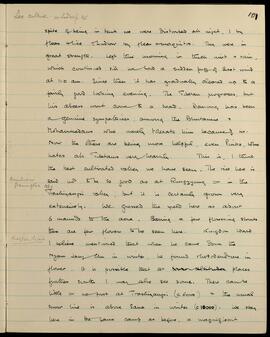
In spite of being in tents we were disturbed all night, I by fleas and lice, Sherriff by fleas and mosquitoes. They were in great strength. Left this morning in thick mist and rain, which continued till we had a sudden puff of East wind at 11:00 am. Since then it has gradually cleared up to a fairly good looking evening. The Tibetan progresses, but his abscess won't come to a head. Dorong has been a genuine sympathiser, among the Bhutanese and Mohammedans who merely tolerate him because of us. Now the others are being more helpful, even Pinbo, who hates all Tibetans very heartily. This is, I think, the best cultivated valley we have seen. The rice here is said not to be so good as at Rungzyung or in the Trashiyangsi valley, but it is certainly grown very extensively. We guessed the yield here as about 6 maunds to the acre. Barring a few flowering shrubs there are few flowers to be seen here. Kingdon Ward, I believe, mentioned that when he came down the Nyam Jang Chu in winter, he found rhododendrons in flower. It is possible that at lower altitude places further south I may also see some. There is little or no frost at Trashiyangsi (c. 6,000') and the usual snow line is above Sana in winter (c. 10,000'). We stay here in the same camp as before, a magnificent

LSH/1/1/5/1/149 · Part · 1933-07-04
Part of The Ludlow & Sherriff Collection

SUMMARY:
The diarist records alpine plant finds along a high, windy ridge, including Diapensia, several Primula, Paraquilegia anemonoides, Rhododendron anthopogon, and a Meconopsis bella with a 56-inch taproot. On reaching Camp Changsethang, they note rain, brief sunshine, a steep drop past Thampe Tso into forest, and encountering an unfordable river.

CONTENT:
73

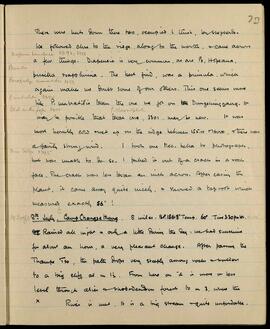
There were huts down there too, occupied I think, by shepherds.

We followed close to the ridge, along to the north, and came across a few things. Diapensia (Diapensia himalaica 3392, 3398) is very common, as are Primula hopeana, P. pusilla and P. sapphirina. The best find was a primula (Paraquilegia anemonoides 3399), which again makes me doubt some of our others. This one seems more like P. umbratilis (3394) than the one we got on the Dungshinggang. It (Rhododendron anthopogon 3400) may be possible that that one, P. chasmophila (3301), may be new. It was most horribly cold right up on the ridge between 15,500 and 16,000; there was a fairly strong wind. I took one Meconopsis bella (3395) to photograph, but was unable to do so. I pulled it out of a crack in a rock face. The crack was less than an inch across. After easing the plant, it came away quite nicely, and showed a taproot which measured exactly 56"!

(14,200 ft.) 8th July. Camp Changsethang. 8 miles. B.P. 186.8° Temp. 60° Time 3:30 p.m.

Rained all night and only a little during the day: we had sunshine for about an hour, a very pleasant change. After passing the Thampe Tso, the path drops very steeply among rocks and boulders to a big cliff at mile 1 1/2. From here on it is more or less level through Abies and Rhododendron forest to mile 3, where the river is met. It is a big stream and quite unfordable.

LSH/1/1/8/1/39 · Part · 1947-02-23
Part of The Ludlow & Sherriff Collection

SUMMARY:
Travel from Tongkyuk up the Sobshe La valley to a camp below the pass, with notes on pine, spruce, Tsuga, Quercus ilex, and a quince-like shrub locally called 'Tingle' (Chaenomeles lagenaria). Reports widespread bamboo die-off mentioned in Kongbo and camping near a clearing with a wooden hut and yak.

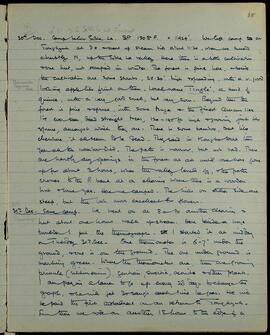
CONTENT:
35

L.D. 96 to Sobshe La with thermograph

30th Dec. Camp below Sobshe La. B.P. 190.8° F. = 11424'. We left camp at Tongkyuk at 9.0 and went up stream till about 11.30, when we turned abruptly N, up the Sobshe La valley. Here there is a little cultivation, some huts, not occupied in winter. The forest is pine here, and beside the cultivation are some shrubs, 25-30' high spreading, with a very good looking apple-like fruit on them. Local name 'Tingle' (Chaenomeles lagenaria 12061), a kind of quince, with a very good smell, but very sour. Beyond this the forest is pine & spruce, with some Tsuga & the finest Quercus ilex I've ever seen, dead straight trees, 120-140 ft high & growing just like spruce, amongst which they are. There is some bamboo, but like elsewhere, it all seems to be dead. They said in Kongbo that last year all the bamboo died. The path is narrow, but not bad. There are hardly any openings in the forest at all until one has gone up for about 3 hours, when the valley levels off, the path crosses to the R bank at a clearing where there is a wooden hut & some yak. Here we camped. The hills on either side are steep, but

LSH/1/1/3/3/157 · Part · 1983-05-05
Part of The Ludlow & Sherriff Collection

SUMMARY:
Botanical and route notes describe a smaller valley near Tsona with Primulas, and a fine day. On 21st May the party camps 2 miles below Podzo Sumdo at about 10,500 ft, traveling along the Chidichar river and the Tsari through forest and gorge, passing Podzo Sumdo and the valley from the Bimbi La, with observations of Meconopsis, Berberis, and rhododendrons.

CONTENT:

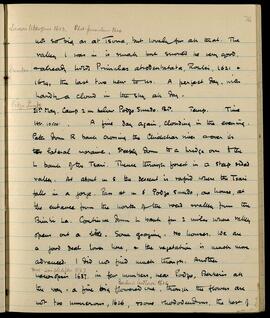
  • "not so big as at Tsona, but lovely for all that. The valley I was in is small but should be very good, already holds Primulas atrodentata, roylei, 1621 & 1614, the last two new to us. A perfect day, with hardly a cloud in the sky all day."
  • "21st May. Camp 2 m below Podzo Sumdo. BP. Temp. Time Ht. 10500'. A fine day again, clouding in the evening. Path down R bank crossing the Chidichar river over its lateral moraine, steeply down to a bridge over to the L bank of the Tsari. Thence through forest in a steep sided valley. At about m 5 the descent is rapid where the Tsari falls in a gorge. Pass at m 6 Podzo Sumdo, one house, at the entrance from the north of the broad valley from the Bimbi La. Continue down L bank for 2 miles where valley opens out a little. Some grazing. No houses. We are a good deal lower here, & the vegetation is much more advanced. I did not find much though. Another Meconopsis 1637, in few numbers, near Podzo, Berberis all the way - a fine big flowered one, though the flowers are not too numerous, 1626, some rhododendrons, the best of"

Wait, I missed the marginal notes in the final text. I'll include them as they appear

LSH/1/1/6/1/19 · Part · 1938-03-21
Part of The Ludlow & Sherriff Collection

SUMMARY:
Accounts of a sandy riverbank camp below Chora with severe winds and a night-long dust storm, alongside observations of large numbers of geese and cranes. The following day they travelled by kowa to Tsetang amid gale conditions, waited at a ferry while Puibo sought transport, saw many geese near the ferry, and found poor lodgings in town with loads from Tamalung still missing.

CONTENT:
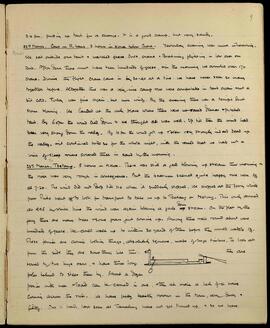
2:00 pm, putting up tents for a change. It is a good camp, but very sandy.

22nd March. Camp on R. bank. 9 hours in kowa below Chora. Yesterday evening was most interesting. We sat outside our tents and watched geese, duck, crane and Brahminy flighting in low over our tents. After dark there must have been hundreds of geese, in the morning we counted over 170 crane. During the flight, crane came in by 30-40 at a time: we have never seen so many together before. Altogether this was a very nice camp and we were comfortable in tents again but a bit cold. Today was fine again, but more windy. By the evening there was a terrific dust storm blowing. We landed at the only place where there were no sand dunes and pitched tents. By 6:00 pm the wind died down and we thought all was well. Up till then the wind had been very strong down the valley. By 10:00 pm the wind got up and blew very strongly indeed dead up the valley, and it continued to do so for the whole night, with the result that we had not a wink of sleep and were covered thick in sand by the morning.

23rd March. To Tsetang. 5 hours in kowa. There was still a gale blowing up stream this morning and the river was very rough in consequence. But the boatmen seemed quite happy and we were off at 7:20. The wind did not drop till 11:00 when it suddenly stopped. We stopped at the ferry while poor Puibo went off to look for transport to take us up to Tsetang or Netong. This only arrived at 4:45 by which time the wind was again blowing a gale down stream. On the flat by the ferry there are many trees and some grass just coming up. Among these all round about were hundreds of geese. We could walk up to within 30 yards of them before they would waddle off. These ferries are comic looking things, absolutely square, made of huge timbers. To look at from the side they are something like this: they are steered by two huge oars, and have three long poles behind to steer them by. About a dozen ponies with men and loads can be carried in one, and they all make a hell of a noise coming across the river. We have pretty beastly rooms in the town, very dusty and filthy. Our 11 loads, last seen at Tamalung have not yet turned up, and so we have

LSH/1/1/9/1/57 · Part · 1949-06-01
Part of The Ludlow & Sherriff Collection

SUMMARY:
The diarist observes several alpine plants in flower and feels unwell, possibly from bad meat sent by the Nyerchen Trepa. They have established a substantial camp, are coordinating with the local Sokpon who will provide yaks, and plan to ride to Waitang before moving camp. The site is at the junction of two rivers, one from Waitang and another from the west and the Chach.

CONTENT:
...were just opening on 18th. Rhododendron setosum and anthopogon are just in flower, while Rhododendron campanulatum is really beautiful in full flower. Rhododendron cinnabarinum (velvet) is also very prolific, and Rhododendron campylocarpum common. Cassiope found also, and Pinguicula. Obviously we are nearer the real thing now; the only stupid thing is that I am not feeling too good. Ever since last night I have felt rather poor, partly heart and partly I think a cold or flu or poison from a tin of bad meat sent up by the Nyerchen Trepa. Anyway, here we must stay for a while, as we have such a hell of a place built for us. I am enclosed in a fir zareba, which is nice enough here where there is a strongish wind. The servants have a palatial wooden silver hut, big enough for dozens. The local Sokpon, in charge of all the Drogpas, is here, and a nice man. He will be the man we rely on from now on, and I gather that we will have 12 or 13 yaks always with us, and can move about as we like from now on. I will first ride up to Waitang to see what the place is like, then we will move camp. But we cannot move the servants' place. They must now learn to live in a tent for a change. This is at the junction of two equal rivers - that from Waitang and the other, shorter, from the west and also from the Chach

LSH/1/1/2/1/248 · Part · 1969-04-29
Part of The Ludlow & Sherriff Collection

SUMMARY:
The page describes a well-laid-out camp at Khona Nagri where dense spider webs made movement difficult and hindered bird collecting. It notes the collection of several birds, including a rare Elachura formosa in fine plumage.

CONTENT:
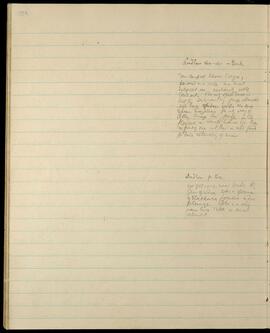
Ludlow 160-161 - Birds

"Our camp at Khona Nagri, perched on a ridge, was a most delightful one and very well laid out. The only drawback was that the surrounding jungle abounded with huge spiders' webs which are seen everywhere. The only way of getting through this jungle is to flourish a small branch in front of one—this is not good for bird collecting, of course."

Ludlow p. 162.

We got some nice birds here, one of which was a specimen of Elachura formosa in fine plumage. This is a very rare bird; little is known about it.

LSH/1/1/2/1/143 · Part · 1933-07-18
Part of The Ludlow & Sherriff Collection

SUMMARY:
Notes an incident where Kurtip was thought to be under a 'mantra' by Tawang people after a dispute, and remarks on the Tulung La tree. Describes the route from Re over the steep Cho La to Karmu via Mena, following the Mena Chu through forested terrain.

CONTENT:
very bad, had come to the conclusion that it was
not an illness, but that Kurtip had had some
'mantra' put on him by the Tawang people because
he beat them up a bit when they failed to get a
move on between Muktur & Tawang. Noticed
the small Tulung La tree here again. It must
grow all along these hills, but only or mostly in
the main range.

21st August. Camp at KARMU. 8 miles. 12995'. (B.P of
Cho La 183.8 Temp 52° = 16151' BP of Karmu 189.1 Temp
55° = 12295'.). After leaving the thang at Re,
path ascends steeply to the south keeping to the left bank
of the stream. At m 1 a small plateau is reached.
The final ascent to the CHO LA at m 2 is very steep
indeed. The pass itself is an absolute knife edge,
steeper on the north than the south. Descent over
bare hillside to the south into a beautiful valley,
thickly fir clad on the north north west face. A
river is met at m 3 1/2 & followed down being
crossed occasionally. At m 5 a plain is reached,
called Mena, where there are usually yak herds. The
Mena Chu is followed down first over open country,
then through thick forest. The path keeps up the
R bank after m 5 & is more or less level to

LSH/1/1/2/1/95 · Part · 1933-07-18
Part of The Ludlow & Sherriff Collection

SUMMARY:
The diarist reports climbing and observing several Meconopsis species (including No. 708) and rose finches, with fine early weather turning to mist from the Mayo Chu and rain later. On 2nd August at Camp at Chigupnaga (~14,000'), they note confusion among locals about the route beyond Chera, discovering a well-used yak road despite claims to the contrary.

CONTENT:
seem to know about it. There are some yaks here, but the herdsmen are further up north. I spent from 12 to 3:30 climbing all over the place, saw a fair number of flowers, but there is nothing new here. Meconopsis horridula is high up, the white Meconopsis also in places near M. horridula, & the little blue Meconopsis taken first near the Tulung La is very much in evidence on all the cliffs round about. That is No. 708. It is a beauty, & should do well at home in rockeries. There are a number of rose finches here in the scrub jungle, others besides Thura thura, but I have not shot any yet. Between 4 or 5 am the morning was as perfect as we have yet had, but then a huge mass of mist rolled up the Mayo Chu, & spread everywhere. It kept fine till 11:30, & since then has rained most of the day.

2nd August. CAMP at CHIGUPNAGA. 6 miles. 14000' (approx). I cannot understand what these people are trying to do. They all but one said yesterday that they had never been here before & that there was no road beyond Chera. That there was a road I soon found out, & it is one well used by yaks. Yesterday evening I was asking the man we have appointed to stay