Showing 6828 results

Archival description
2091 results with digital objects Show results with digital objects
LSH/1/1/2/1/139 · Part · 1933-07-18
Part of The Ludlow & Sherriff Collection
  • SUMMARY:
    The writer discusses limited views of the main range, suggesting Cho La is on the main range and that the area between it and the pass may belong to Bhutan; they note it is the transition zone they sought and should have visited instead of Mago, with similar zones at Shao and north of Tulung La. They record altitude preferences, expecting Plumbago lower along the Nyamjang Chu, and note Primula eburnea along the Cho La cliffs north of the Rung Chu at a lower elevation than at Narim Thang.

CONTENT:
68

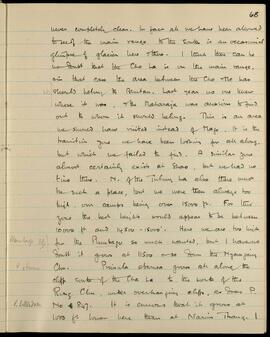
never completely clear. In fact all we have been allowed
to see of the main range to the south is an occasional
glimpse of glacier here and there. I think there can be
no doubt that the Cho La is on the main range,
in that case the area between the Cho and the La
should belong to Bhutan. Last year no one knew
where it was, and the Maharaja was anxious to find
out to whom it should belong. This is an area
we should have visited instead of Mago. It is the
transition zone we have been looking for all along,
but which we failed to find. A similar zone
almost certainly exists at Shao, but we had no
time there. N. of the Tulung La also there must
be such a place, but we were then always too
high, our camps being over 15000 ft. For this
zone the best heights would appear to be between
10000 ft and 14500 - 15000'. Here we are too high
Plumbago NB

  • for the Plumbago so much wanted, but I have no
    doubt it grows at 11500 or so down the Nyamjang
    P. eburnea
  • Chu. Primula eburnea grows all along the
    cliff side of the Cho La to the north of the
    Rung Chu, under overhanging cliffs, as does P.
    P. lilledale
  • No 847. It is curious that it grows at
    1000 ft lower here than at Narim Thang. I
LSH/1/1/2/1/142 · Part · 1933-07-18
Part of The Ludlow & Sherriff Collection

SUMMARY:
Notes record barometric pressure and temperature observations at Cho La, including means and elevation calculations (e.g., 15382 x 1.05 = 16151; 12377 x 1.05 = 12995').

CONTENT:
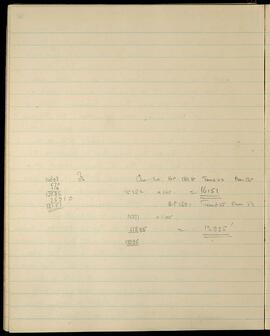
14698 57 Cho La. B.P. 183.8° Temp 52 Mean 54.0
570 --- 15382 x 1.05 = 16151
114 114
----- B.P. 189.1 Temp 55 Mean 54
15382
769.10 12377 x 1.05
----- 618.85 = 12995'
16151 12995

LSH/1/1/2/1/89 · Part · 1933-07-18
Part of The Ludlow & Sherriff Collection

SUMMARY:
The diarist describes cloud formations spilling over a saddle near Tse La–Nyingsang La and forming a barrier across Lap valley. On 29 July they returned to Chirachum (Gorjo Chu) en route to Mago with rain in the afternoon and noted primulas, a lily, and Meconopsis nepalensis. On 30 July they traveled to Dyuri, ascended to the Chera La to take heights and bearings, enjoyed clear views, and planned to explore hills west of Nyuri Dyuri.

CONTENT:
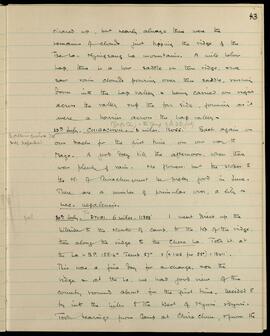
cleared up, but nearly always there were the
remains of clouds just tipping the ridge of the
Tse La - Nyingsang La mountains. A mile below
Lap, there is a low saddle on this ridge, we
saw rain clouds pouring over this saddle, rushing
down into the Lap valley and being carried on right
across the valley and up the far side, forming as it
were a barrier across the Lap valley.

29th July. CHIRACHUM (Gorjo Chu - the camp of the 26 July). 6 miles. 13055'. Back again on
our track for the first time, on our way to
Mago. A good day till the afternoon, when there
was plenty of rain. No flowers: but the slopes to
the N. of Chirachum must be pretty good in June.
There are a number of primulas over, a lily and
mec. nepalensis.

30th July. To DYURI. 6 miles. 11352' I went direct up the
hillside to the North of camp, to the top of the ridge,
then along the ridge to the Chera La. Took ht. at
the La - B.P. 188.4° Temp 57° = (x 1.05 for 55°) = 13411'.
This was a fine day for a change, and on the
ridge and at the La, we had good views of the
country round about for the first time. Decided to
try into the hills to the West of Nyuri Dyuri.
Took bearings from camp at Chirachum, and from the

LSH/1/1/7/1/23 · Part · 1940-04-22
Part of The Ludlow & Sherriff Collection

SUMMARY:
The diary describes the poorly maintained Molo–Lhalung path, the heavy loads carried by local coolies, and observations of Primula species along the route, including P. Normaniana and P. latisecta with notes on their phenology. From a camp on the Chindi Chu the party climbed over the Nyug La through dense forest with Rhododendron and bamboo, noted P. tsariensis var. porrecta and P. Boothii, and obtained a view of the Lhalung valley, with P. Boothii extending its known distribution from the type locality in Bhutan.

CONTENT:
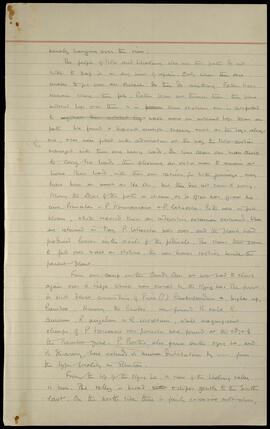
usually hanging over the river.

The people of Molo and Lhalung who use this path do not bother to keep it in any kind of repair. Only when they are unable to get over an obstacle do they do anything. Fallen trees remain where they fell. Rather than cut through them, they place notched logs over them and in some stretches one is compelled to walk more on notched logs than on path. We found it difficult enough, slippery and wet as the logs always are, and we were filled with admiration at the way the Molo coolies managed with their very heavy loads. In some cases one man chose to carry two loads, thus allowing an extra man to remain at home. These loads, with their own rations for both journeys, may have been as much as 160 lbs, but they did not seem to worry. Along the edges of the path or stream, as it often was, grew two new Primulas - P. Normaniana and P. latisecta. Both were in full bloom, and both records show an interesting extension westward. When we returned in May P. latisecta was over, and the plants had produced leaves in the axils of the pedicels. The stems then seem to fall over and act as stolons, the new leaves rooting beside the parent plant.

From our camp on the Chindi Chu we now had to climb again over a ridge which was crossed by the Nyug La. The forest is still dense, consisting of Picea (?) Rhododendron and, higher up, Bamboo. Among the Rhodos, we found R. rude, R. aureum, R. arizelum and R. uvarifolium, while magnificent clumps of P. tsariensis var porrecta were found at the edge of the Bamboo zone. P. Boothii also grows on the Nyug La, and its discovery here extends its known distribution by —— from the type locality in Bhutan.

From the top of the Nyug La, a view of the Lhalung valley is seen. The valley is broad and slopes gently to the South East. On the north side there is fairly extensive cultivation,

LSH/1/1/6/1/156 · Part · 1938-10-22
Part of The Ludlow & Sherriff Collection

SUMMARY:
Snow blocks progress near Bimbi La and limits collecting; the party arrives to deep cold and finds a large, roughly handled mail, with Kesang bringing it in by sunrise. Despite brief clear spells at Chikchar and Chosam, persistent snowfall yields only a few seeds and some Primula winteri roots from Senjuti, and pony transport is arranged toward Zimsati. The writer notes inability to send anything to Taylor or Ludlow.

CONTENT:
80a

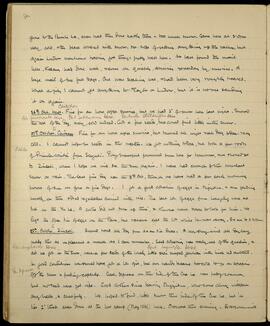
gone to the Bimbi La, even had they done badly there — too much snow. Came here at 3:00 pm
very cold, the place covered with snow. No hope of getting anything up the valley, but
again Ludlow mentions having got things pretty well here. At last found the mail
here. Kesang had done well, came on quickly, arriving yesterday by sunrise. A
huge mail of two full bags. One was soaking wet, and had been very roughly treated.
What a pity I cannot get anything to Taylor or Ludlow, but it is no use sending
it on again.

Chikchar
26th Oct. Halt. Fine for an hour after sunrise, but we had 3 inches of snow here last night. Snowed
Gen. sino-ornata 6640. Gent. sikkimensis 6641. Gentianella stellarifolia 6642.
the rest of the day, very cold indeed. Got a few seeds, but could find little in the snow.

27th October. Chosam. Fine for an hour after sunrise, but snowed all night and day today. Very
cold. I cannot hope for seeds in this weather. We got nothing today, but took a few roots
P. sibirica
of Primula winteri from Senjuti. Pony transport promised from here for tomorrow, and should get
to Zimsati, where I hope we will see the sun again. I have had enough of this constant
snow

LSH/1/1/3/3/155 · Part · 1983-05-05
Part of The Ludlow & Sherriff Collection

SUMMARY:
Notes on identifying Meconopsis 1613 and a small primula found by Tenduk with Lumsden in the Chickchar valley. On a halt day, Pintso is unwell; the party visits Chickchar, with Ludlow and the author exploring different routes, finding primula Nos. 1621 and 1614 common, and Paraquilegia in flower.

CONTENT:
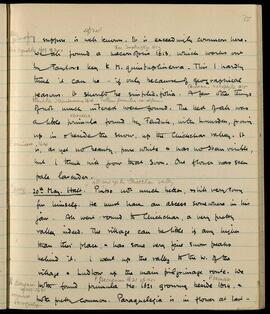
I suppose it is well known. It is exceedingly common here.

We all found a Meconopsis 1613, which works out by Taylor's key to M. quintuplinervia. This I hardly think it can be - if only because of geographical reasons. It should be simplicifolia. A few other things of not much interest were found. The best of all was a little primula found by Tenduk, with Lumsden, growing up in or beside the snow, up the Chickchar valley. It is, as yet no beauty, pure white & has no stem visible, but I think it will grow that soon. One flower was seen pale lavender.

20th May. Halt. Pintso is not much better, still very sorry for himself. He must have an abscess somewhere in his jaw. All went round to Chickchar, a very pretty valley indeed. The village can be little if any higher than this place, & has some very fine snow peaks behind it. I went up the valley to the W. of the village & Ludlow up the main pilgrimage route. We both found primula No. 1621 growing beside 1614, & both are pretty common. Paraquilegia is in flower at last -

LSH/1/1/3/3/183 · Part · 1983-05-05
Part of The Ludlow & Sherriff Collection

SUMMARY:
At Chichechar, the party searched in the evening for new game birds; Ludlow heard them and later saw one, while Pintso also saw one, yielding two skins for identification. Danong returned from Thijijitum with flowering magnolia, a rhododendron, and Meconopsis but no primula. The group then split, with Ludlow and Sherriff joining M. over the Bimbi La while the writer proceeded to do the Kingkor.

CONTENT:
Chichechar 12th June
Pr. prenanthoides 2126. P. alpina violacea 2128, Pedicularis corydaloides 2127, Lonicera cyanocarpa var. porphyrantha 2129. 89

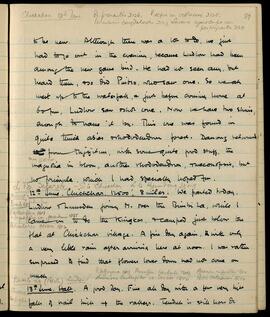
to be new. Although there was a lot to do, we just had to go out in the evening, because Ludlow had been among the new game birds. He had not seen any, but heard them, as did Pintso, who saw one. So we all went up to the waterfall, and just before coming home at 6 p.m., Ludlow saw another one. Now we have two skins, enough to name it by. This one was found in quite thick Abies rhododendron forest. Danong returned from Thijijitum, with some quite good stuff, the magnolia in bloom, another rhododendron, Meconopsis, but no primula, which I had specially hoped for.

L. & S. Separate - S. to Chichechar - L. to Kyimdong Dzong.
Sieru
Bimbi La
P. bellidifolia 1801
P. bryophila var. jerdoniana 1895
Pedicularis oederi 1802

12th June. Chichechar. 12500', 8 miles. We parted today, Ludlow and Sherriff joining M. over the Bimbi La, while I came on to do the Kingkor,

LSH/1/1/3/3/154 · Part · 1983-05-05
Part of The Ludlow & Sherriff Collection

SUMMARY:
Notes describe a beautiful side valley with massive peaks and Chicacun village, which has two monasteries and takes about 2.5 hours to reach. Riding ponies beyond Chicacun village is not allowed; even the late Dalai Lama reportedly dismounted when visiting on pilgrimage.

CONTENT:
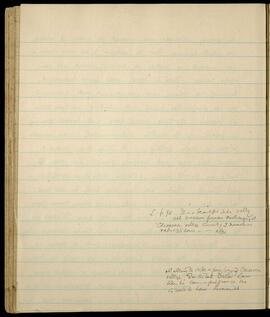
L. p 95. It is a beautiful side valley
with massive peaks overhanging it.
Chicacun village consists of 2 monasteries
takes 2.5 hours -- etc

not allowed to ride a pony beyond Chicacun
village. Even the late Dalai Lama
when he came on pilgrimage here
is said to have dismounted

LSH/1/1/6/1/65 · Part · 1937-06-05
Part of The Ludlow & Sherriff Collection

SUMMARY:
From Chianang the diarist reports illness among companions, a reconnaissance with Kunio toward Chubumbu La with notable rhododendrons and Nomocharis, persistent rain, and route details. Plans to attempt the Chubumbu La despite local advice are noted, along with Brahminy Ducks near Lanyong; subsequent halts include botanical collecting and bird observations, before proceeding up-valley toward a pass.

CONTENT:
Chianang.

...vomiting everything he tried to swallow. He has no strength today at all. I went with Kunio towards Chubumbu La, which is about 6 miles from here, and has not too much snow on it to be crossed. There was nothing to be seen till we reached the head of the valley, then rhododendrons in profusion, P. pauliana all over the place, Nomocharis souliei the best of all, masses of Rhod. aff. repens, in full flower.

3rd June. CAMP CHIANANG. 5 miles. B.P. 189.0° Temp. 50° Time 11:30 am. Ht. approx. 12929'.
Rained most of the night and all today without a stop. Path follows the left bank for 2 miles, then crosses by a foot bridge to right bank. At mile 3 a side valley from the Chubumbu La is reached and crossed. The Chubumbu La lies at a bearing of 162° Magnetic and from here is about 4 miles distant. Follow up this valley left bank for ½ mile, then turn up a side valley. Ascent fairly steep for 1½ miles to a plateau, where there are 3-4 houses, where yaks are grazed in summer. Very swampy ground. We saw nothing at all today, as Lin was not yet too fit and Tsungpen only just able to come up, we did nothing today, but sat in camp and changed flowers. I'm afraid this valley is not as good as I had hoped: we are still too early. So I remain only two days and then go to the Chubumbu La for a day, to see if I can get across. It does not look impossible, though the locals say it is, and will remain so for another 2 months or more, when the Lhopas will come over. There are Brahminy Duck near Lanyong, and I saw they have their young one now and quite big.

4th June. Halt. Chianang. Fine intervals with a little sun up till 12:00 noon, then rain all day. Went up to the South, and had a fairly good day. Rhod. repens is abundant, but not above 14000'. With it were P. harrisii, and P. valentiniana 3953. This must cover the hillside, but is hardly in flower yet. Just as at Tsari Chikchar, it comes just after P. harrisii. First one gets a blue violet hillside, which is then turned into a deep velvety crimson one. P. vernicosa 3951, is here about half blue and half white. Saw a good many Grandala coelicolor above, some rubythroats; the latter is not the Yunnan bird.
Diapensia himalaica 3949, Potentilla leucanota 3950 - Bell common, Pot. stenophylla 3956, Pot. microphylla 3957 & 41, Pedicularis formis 3959.

5th June. Halt Chianang. Rain early at night, but a fine day till 2:00 pm, then thunder and rain and snow on the hills. Cleared 2 hours later. Went up the valley, past two more yak grazing grounds to a pass,

LSH/1/1/5/1/55 · Part · 1933-05-09
Part of The Ludlow & Sherriff Collection

SUMMARY:
Listened to the Coronation broadcast by wireless with Puntso, Tenduk, and another Puntso from Ha, and prepared outgoing mail. Halted at Chendesi with heavy rain and collected rhododendrons, primulas, and conifers. Marched from Chendesi to Phobsikha with notes on weather, altitude, timing, route, and nearby cultivation.

CONTENT:
27

I don't know. The wireless behaved very well, and we have heard the whole Coronation show from 2.45 pm onwards – that is from the very beginning. We even heard the Oath taken by the King. Puntso and Tenduk were joined by the other Puntso from Ha, and all came into my tent and listened. I am sending off a mail on 14th, so have been writing a good deal this afternoon.

13th May. Halt Chendesi. 8000 ft. Fine till 2.0 pm, then very heavy rain and hail for a few hours. Overcast in the evening. Went up the forest to the south of Chendesi, and found Rhod. Thomsonii, Rhod. Keysii and a variation of Rhod. Falconeri (?). There are lots of Prim. erythrocarpa up that way in open fields and edges of forest. Took specimens of all the conifers seen. Packed up a mail, to be sent off tomorrow morning early.

14th May. Phobsikha 98 miles. BP. 193.8° Temp. 58° Time 4.30 pm. Ht. 10500 ft. Left Chendesi at 5.30 am, reached here at 2.0 pm. Very heavy rain yesterday evening and a good deal through the night. Clear this morning: rain began falling at 2.0 pm. Path leaves Chendesi and follows a rough bearing of 250° Magnetic. At first fairly steep, but on the whole easy, with a good deal of level going. It passed several cultivated areas on the hillside.