
GB 235 MCW/4/3/35
·
Item
·
undated
Part of John MacWatt Primula papers
2091 results with digital objects
Show results with digital objects
GB 235 MCW/4/3/34
·
Item
·
undated
Part of John MacWatt Primula papers
LSH/1/1/6/1/110
·
Part
·
1933-07-21
Part of The Ludlow & Sherriff Collection
SUMMARY:
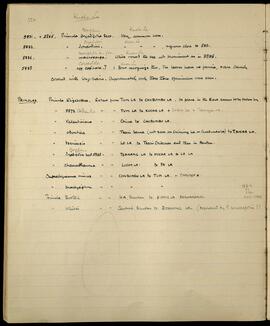
Notes record Primula specimens at Kucha La, including forms of P. dryadifolia and an unidentified capitata-like plant with densely hairy, non-farinose leaves. The page lists distribution ranges for several Primula and Omphalogramma taxa across passes from Tum La and Chubumbu La through Kucha La, Lusha La, Tamnyen La, and into Bhutan and China.
CONTENT:
55a Kucha La
- = 5865. Primula Dryadifolia Sect. (Tsongpen) Kucha La. Very common here.
- " " Jonarduni (Dryadifolia). " " " " , grows close to 5931.
- " " macrocarpa (macrophylla true form). Kucha La. White round the eye not prominent as in 3895.
- " " aff capitata.? (Concholoba) Kucha La. I don't recognize this. The leaves have no farina, rare, densely
covered with long hairs. Unfortunately, only these three specimens were seen.
PRIMULAS. Primula Elizabethae. Extent from TUM LA to CHUBUMBU LA. Its place in the East seems to be taken by
" 5872 Calliantha " " TUM LA to KUCHA LA + Lusha La + Tamnyen La.
" Valentiniana " " China to CHUBUMBU LA.
" odontica " " Tsari Sama (not seen on Chining La or Chubumbu La) to TAKAR LA.
" tsariensis " " LO LA to Tsari Chikchar and then in Bhutan.
" Dryadifolia sect. 5865 (Tsongpen) " " TSANANG LA to KUCHA LA + LO LA
" Chamaethauma " " LUSHA LA to PA LA
Omphalogramma minus " " CHUBUMBU LA to TUM LA. + TAMNYEN LA.
" brachysiphon " " " " " " " " 186-2 57 2.6pm 140.7 = 148.5
Primula Boothii " " HA, Bhutan to NYUG LA PACHAKSHIRI.
" Whitei " " Central Bhutan to DOSHONG LA. (replaced by P. sonchifolia?)

LSH/1/1/9/1/141
·
Part
·
1933-09-01
Part of The Ludlow & Sherriff Collection
SUMMARY:
Notes on Primulas from Karponang grown at 4500', highlighting unusual rose coloration, leaf variation, and difficulty matching key characters; possible identification as elongata is questioned. Field observations report local abundance up to about 8500' near Sergong La, and above 12500' white forms of P. calderiana and natural hybrids become more common than the deep violet true P. calderiana.
CONTENT:
133
Primulas from Karponang in our garden at 4500' have grown leaves like bracteosa. Due to low altitude?
Never seen the rich rose colour before.
Locally quite common.
Eventually found very common, highest altitude about 8500' near Sergong La.
This does not answer the key 'tube 3 times as long as calyx'. It is nothing like it.
Might be elongata, but leaves are pretty rotund.
Not common.
This seemed to be the same as 18946, but leaf varies. Probably both are the same thing.
A gathering with very few old capsules even some old seed.
These three are all natural hybrids. As one gets above 12500', so white forms of P. Calderiana become more & more common until at 13000 & a little above - just at the top edge of the abies zone - these hybrids become much more common than the true P. Calderiana, which here is deep violet. What are the parents?
P.T.O.
LSH/1/1/5/1/77
·
Part
·
1937-05-22
Part of The Ludlow & Sherriff Collection
SUMMARY:
Notes several Primula species near a small lake and along a route ascending to the Naszi La. Describes the path up the stream through rhododendron and fir forest, provides hypsometer readings on the pass, and lists magnetic bearings to nearby peaks including Chomolhari, Kula kangri, Black Mountain, and Wangchelakha.
CONTENT:
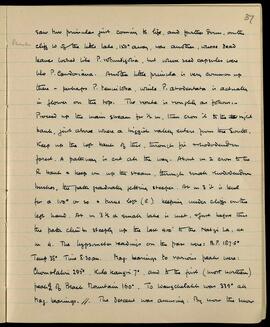
saw two primulas just coming to life, and further down, on the
cliff W of the little lake, 150x away, was another, whose dead
leaves looked like P. rotundifolia, but whose seed capsules were
like P. Cawdoriana. Another little primula is very common up
there - perhaps P. tenuiloba, while P. atrodentata is actually
in flower on the top. The route is roughly as follows:-
Proceed up the main stream for 1/2 m, then cross it to the right
bank, just above where a biggish valley enters from the South.
Keep up the left bank of this, through fir & rhododendron
forest. A pathway is cut all the way. About m 2 cross to the
R bank & keep on up the stream, through small rhododendron
bushes, the path gradually getting steeper. At m 3 it is level
for a 100x or so & turns left (E) keeping under cliffs on the
left hand. At m 3 1/2 a small lake is met, & just before this
the path climbs steeply up the last 400' to the Naszi La, at
m 4. The hypsometer readings on the pass were: B.P. 187.5°
Temp 38° Time 8.30 am. Mag. bearings to various peaks were:
Chomolhari 295°, Kula kangri 7°, and to the first (most northern)
peak of Black Mountain 160°. To Wangchelakha was 339° all
Mag. bearings. // The descent was amusing. By now the snow
LSH/1/1/7/1/9
·
Part
·
1940-05-24
Part of The Ludlow & Sherriff Collection
SUMMARY:
The diarist describes abundant Primula species on swampy valley slopes and notes that by October seed and leaves were scarce due to yak grazing. On June 19th they returned to Lanyong, then departed for Molo via the Tse La, later traveling down the Tsangpo valley to Mayu and making difficult river crossings (including by skin coracles and a log raft) before proceeding up the Nagu Chu valley toward the Tam La over the Himalayas.
CONTENT:
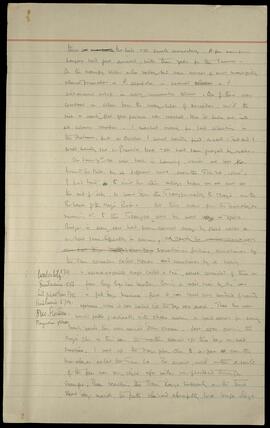
there are two huts & a small monastery. A few men
from Lanyong had just arrived, with their yaks for the summer -
On the swampy slopes in the valley bed were masses of most beautifully
coloured primulas - P. alpicola in several and a P.
sikkimensis subsp in every conceivable colour. One of these was
constant in colour down the rocky sides of cascades, until the
rich & marshy flat yak pasture was reached. Here it broke out into
all colours & shades. I marked many for seed collecting in
the Autumn, but in October I could hardly find a seed & indeed I
could hardly see a Primula leaf - all had been grazed by yaks.
On June 19th we were back in Lanyong, which we left then,
bound for Molo, by a different route, over the Tse La, 15000'.
I had time to visit two other valleys before we all met at
the end of July, so went down the Tsangpo valley to Mayu on the
R bank of the Nagu River - All these rivers from the Himalayas
running N. to the Tsangpo were by now in spate.
Bridges in every case had been carried away by flood water &
we had some difficulty in crossing, clear days sometimes fording, sometimes by
the skin coracles called Kowas and sometimes by a heavy
Waterlily 5749 unmanageable craft called a 'tru', which consisted of three or
Smilacina 5756 four long logs tied together. Crossing a rapid river by 'tru' was
Lil. giganteum 5743 a full day's business: first it was towed some hundreds of yards
Smilacina 5754 upstream, where it was loaded till the logs were awash. Then two men
Rhod. floribunda would paddle frantically with sticks making a yard across for every
Magnolia globosa twenty yards they were carried down stream. Just after crossing the
Nagu Chu in this way, the weather cleared after three days we had
sunshine. I went up the Nagu Chu valley to a pass at over the
Himalayas called the Tam La. The ascent, until within a mile
of the pass was very slight & for miles we plodded through
swamps. Then reaching the Main Range suddenly on the third
short day's march, the path climbed abruptly to a knife edge
LSH/1/1/6/1/42
·
Part
·
1938-04-24 - 1936-06-22
Part of The Ludlow & Sherriff Collection
SUMMARY:
Field notes describe several Primula taxa, including a probable new species with bright golden flowers, habitat details around Lalung, and a reassessment of P. Normaniana. Records include a species list for Nyug La on April 26 and a bearing note from Nyug La to Lalung.
CONTENT: Lo La Chronologies of No. *
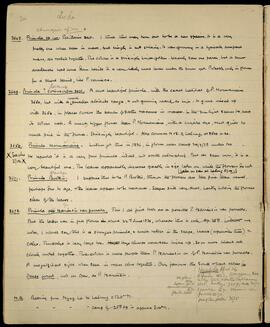
3648. Primula sp nov. Petiolaris sect. I think this may turn out to be a new species. It is a very pretty one when seen in mass, but single is not striking. It was growing in a typically compact mass, all rooted together. The colour is a strikingly bright golden. We only saw one patch, but a snow avalanche had come down beside it, a very likely more lurks under the snow yet. Probably only in flower for a short period, like P. vernicosa.
3649. Primula ? laciniata cortusoides sect. A most beautiful primula, with the exact habitat of P. Normaniana 3650, but with a much smaller altitude range, not growing nearly so high. It grows mixed up with 3650. In places covers the banks of small streams in masses. In the sunlight seems to keep its colour well. A much bigger flower than P. Normaniana, with a brighter eye, not quite so much pink in the flower. Strikingly beautiful. Also common N.W. of Lalung, at 8500 or so.
3650. Primula Normaniana. Ludlow got this in 1936, in flower near camp 24/4/38 under No. He reported it is a very poor primula indeed, not worth cultivating. But as seen now, it is a very beautiful one. The leaves apparently increase greatly in size later on, while the flowers do not. [Later on seen at Lalung 6700.]
X See also 3700. X
3671. Primula gracilipes Boothii. I suppose this to be P. Boothii, though the flowers are less pink than usual, perhaps due to age, the leaves appear to be narrower. Scapes still very short, hardly holding the flowers clear of the leaves.
3673. Primula aff tsariensis var. porrecta. This I at first took as a possible P. tsariensis var porrecta. But the latter was in full flower in about 22nd June 1936, whereas this is early Ap. 25th. Without my notes, I would say this is a stronger primula, a much redder in the scape, bracts (especially these) & calyx. The calyx is very large too. Huge clumps were seen higher up, 30 or more plants all closely rooted together. The colour is more purple than P. tsariensis or aff. tsariensis var porrecta. A magnificent sight when seen in mass close together. Only favours the South-west slopes in dense forest, not in open, as P. tsariensis.
Nyug La April 26.
arizelum 3674
R Grande 3663, (Sarcococca) 3664
Hookeri 3676
Lindleyi 3665, Xanthostephanum 3666, Lindleyi 3667, nite 3670
ramsdenianum 3677
P. gracilipes 3671. Tsariensis var porrecta 3673.
pand. 3680
Mag. Campbellii 3675
N.B. Bearing from Nyug La to Lalung = 120° M. " camp of 25th Ap is approx 300° M.

LSH/1/1/3/3/185
·
Part
·
1983-05-05
Part of The Ludlow & Sherriff Collection
SUMMARY:
The party revisited their old valley south of Chichchar, documenting nine Primula species in flower across avalanche-swept slopes and cliffs, with several specimens noted (e.g., 1614, 2141, 2153, 2154) and P. macrophylla around 15,500 feet. Tsongpen left at 6:00 am and returned at 3:00 pm, and one member is convalescing with a knee injury.
CONTENT:
convalescing, with his knee, which is doing well. Tsongpen at
left at 6.0 am and came back at 3.0 pm. We went up our old
valley south of Chichchar. It is a beautiful valley, and good for
flowers too. Above the snow avalanche we found many
primulas in flower. P. roylei still holds on, but the most
numerous was the beautiful blue-purple one first collected
here last time. It is in masses, the whole hillside, where
bare, being covered with it. P. atrodentata is also
there, but over now. The little white primula 1614, where
the snow melts, comes into flower for its short season.
P. macrophylla at about 15,500 is fairly common, and the
lovely little blue primula 2154 was found in full flower on
the cliff on the right of the avalanche. It is a beauty, with
such minute leaves and huge flower. 2141, a white sikkimensis
is common, but the pick of the white lot is a new one to
us, No. 2153, which is a bright claret colour and is common
on the bare slopes from which the avalanche sweeps every
year. The ordinary sikkimensis too is fairly common.
There are therefore 9 primulas all flowering in this one
quite small valley. We are still a little early for
LSH/1/1/6/1/69
·
Part
·
1937-06-05
Part of The Ludlow & Sherriff Collection
SUMMARY:
The diarist records extensive Primula and Omphalogramma observations around a steep pass, notes multiple slips on a difficult grass slope, and experiences photographic mishaps in wind, mist, and rain. They glissade down avalanche snow, then travel to Langong in heavy rain, buy a young yak, develop photographs, and plan to go to the Lo La on the 10th.
CONTENT:
Omph brachysiphon
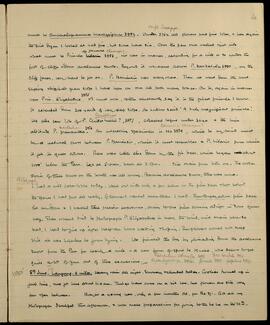
must be Omphalogramma brachysiphon 3982. Under 3762 all flowers had five lobes, & here again the first dozen I looked at had five, but some have six. Over the pass we walked right into what must be Primula aff strumosa chionantha 3983, it was in masses, extending for a mile or so under the foot of cliffs & down avalanche shoots. Beyond it we came across P. barbatula 3990, on the cliff faces, very hard to get at. P. tsariensis was everywhere. Then we went down the most slippery & difficult grass slope I have been on and all took many tosses. On it, again in masses was Prim. Elizabethae 3985 or must now, rather reluctantly, say it is the finest primula I know. It extended down 200 yards of very steep slope. As Ludlow said "A truly magnificent primula". We also saw lots of P. Geraldinae 3987, collected before under 3640 + the high altitude P. mosheoidea 3986. An interesting specimen is No 3984, which to my mind must be a natural cross between P. tsariensis (tsariensis x chionantha?), which it most resembles & P. hilaris from which it gets its queer colour. There was little else down to the fir trees, which began about 1000' below the Pass. Left at 5.0 am, back at 3.0 pm. Mist & rain from then on. The coolies' stories of thick snow on the south was all wrong. Barring avalanche snow, there was none.
Photograph
I had a wild catastrophe today. Went out with only a few films in the film pack case behind the spares I had put all ready. Of course I wanted more than I had. The Dufaycolor film pack let me down & I wasted three precious exposures, owing to one film coming adrift in some queer way. Then when I tried to photograph P. Elizabethae in mass, the wind, mist & rain were so bad, I had to give up after half an hour's walking & hoping. The flowers would not keep still & it was hopeless to form trying. We finished the day by glissading down the avalanche snow from the Pass for nearly a mile - a new form of sport to Kusho, who seems to get quite a bit of fun out of these excursions. R. campylocarpum 3994, vernicatum 3991, forrestii 3995, populare 3997, etc. louloula 3992.
11900' 8th June. To Langong. 6 miles. Heavy rain all night. Scenery occluded today. Coolies turned up in good time, and for here about 11.0 am. Things have come on a bit here, but flowers are still very few & far between. Bought a young yak, only a few months old, for Rs. 3/-. Got all my photographs developed this afternoon, & will make preparations for going to the Lo La on the 10th.
LSH/1/1/8/1/40
·
Part
·
1947-02-23
Part of The Ludlow & Sherriff Collection
SUMMARY:
The page lists Primula species observed on Sosheha, including notes on identification and collection details such as specimen numbers and seed collection. Species noted include forms related to P. nivalis, P. calderiana, P. hyacinthina, P. whitei, and P. capitata.
CONTENT:
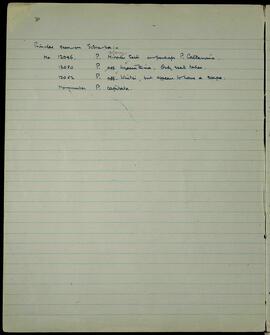
36
Primulas seen on Sosheha:-
No. 12046. P. Nivalis Sect or perhaps P. Calderiana.
12050 P. aff. hyacinthina. Only seed taken.
12052 P. aff. Whitei, but appears to have a scape.
No number P. capitata.