
GB 235 MCW/4/3/18
·
Item
·
undated
Part of John MacWatt Primula papers
2091 results with digital objects
Show results with digital objects
GB 235 MCW/4/3/19
·
Item
·
1912
Part of John MacWatt Primula papers

LSH/1/1/6/1/6
·
Part
·
1938-06-06
Part of The Ludlow & Sherriff Collection
SUMMARY:
Notes record Primula gracilipes as common above and below Lingti and east of Jelep La at about 11,000 ft. Ludlow S. remarks that the Amo Chu River would make a wonderful trout stream and envisions the Chumbi valley as a fine hill station with a road through Bhutan up the Amo Chu.
CONTENT:
- Primula gracilipes. Common above & below Lingti.
3580 Prim. gracilipes. Common on E of Jelep La at about 11000 ft.
Ludlow S.
What a wonderful trout stream the Amo Chu River would make. I can see trout of prodigious size lurking in its beautiful pools.
Ludlow S.
What a magnificent hill station the Chumbi valley would make with a road through Bhutan up the Amo Chu.
GB 235 MCW/4/3/20
·
Item
·
undated
Part of John MacWatt Primula papers
GB 235 MCW/4/3/22
·
Item
·
undated
Part of John MacWatt Primula papers
GB 235 MCW/4/3/21
·
Item
·
undated
Part of John MacWatt Primula papers
LSH/1/1/9/1/143
·
Part
·
1933-09-01
Part of The Ludlow & Sherriff Collection
SUMMARY:
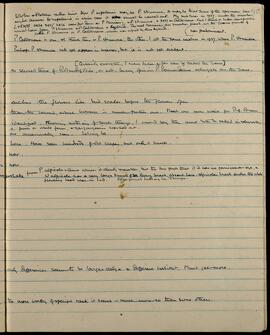
Notes reconsidering identifications of Primula specimens, suggesting 1937 L+S mixtures (3433–3437) are P. strumosa × P. calderiana hybrids rather than tsariensis, and discussing affinities among P. Barnardoana, elongata, involucrata, and alpicola. Mentions observations at Lussing La and references comments by Fletcher and a possible need to await Prof. Brown.
CONTENT:
Words of Fletcher rather hint that P. nepalensis may be P. strumosa. It may be that some of the specimens here which answer to nepalensis, in which case it should be washed out. My mixtures in 1937, under the numbers L+S 3433, 3434, 3435, 3436 were put down as P. tsariensis, & P. strumosa, & 3437 as Calderiana. But I think a better identification would have been P. strumosa & P. Calderiana hybrids. The real tsariensis are smaller plants, and the coarse growth of either P. strumosa or P. Calderiana, which was copied in these hybrids, was predominant. P. Calderiana is one, I think this is P. strumosa, the other. I got the same mixture in 1937, where P. strumosa
Perhaps P. strumosa will yet appear in masses, but it is not yet evident.
[Certainly everything I have taken so far can be called the same]
as showed those of Rotundifoliae, or not. In my opinion P. Barnardoana & elongata are the same.
enclose the flowers like bud scales before the flowers open.
than the second, which however is much further on. Must one now wait for Prof. Brown
identified. Knowing nothing of such things, I would say they must both be called involucrata,
a pink or white form, or any orangeing washed out.
are occasionally seen. Lussing La.
here. Have seen hundreds of old scapes, but only 1 bunch.
now.
now.
unshakable from P. alpicola v. luna which it closely resembles, but the two facts that i) it has no farinaceous eye, &
ii) alpicola has a very large bunch of leafy bracts, absent here. alpicola bracts enclose the whole
flowering head when in bud. Also found Lussing La. Tsampa.
only differences seem to be larger calyx & different habitat. Must get more.
the more worthy of specific rank it seems - much more so than some others.

LSH/1/1/5/1/153
·
Part
·
1933-07-04
Part of The Ludlow & Sherriff Collection
SUMMARY:
Notes confirm several Primula identifications from Dungshinggang and describe the scented P. obtusifolia under boulders. At about 15,500 feet the diarist found and photographed a grandala nest with nearly fledged young and a fragment of eggshell. A halt day is noted with intermittent fine weather and heavy rain before heading up a valley.
CONTENT:
unforgivable. P. menziesiana is the primula we got on the Dungshinggang 3301. I don't think there can be any doubt of that now. 3374 - 3384 are P. umbratilis, I have already taken P. bellidifolia, or a subspecies on Dungshinggang, 3288. P. obtusifolia is a most beautiful flower, with a strong scent, and looks particularly nice under the huge boulders where it grows, where the pale colour of the flower is thrown up by the black background.
At about 15,500' today I heard grandala, and when the mist cleared, saw a pair, each with a mouthful of food. They were a little worried obviously waiting for us to go. Eventually the male flew into the rocks, and gave the site of the nest away. It was built on a very small ledge on a rock face. This time I could with difficulty get to 3 ft away and saw the nest clearly, with two nearly fully fledged young. I took a few photos, then waited in between two huge boulders for the female to come, which she did, and I got a photo of her feeding the chicks. Away below, lying on some snow, I found about half an egg shell, enough to give a rough idea of what the egg is like.
10th July. Halt. Rained all night: fine part of the morning and one hour's sun this afternoon, then very heavy rain. We went up a valley to
GB 235 MCW/4/3/24
·
Item
·
undated
Part of John MacWatt Primula papers
GB 235 MCW/4/3/23
·
Item
·
undated
Part of John MacWatt Primula papers