Showing 6828 results

Archival description
2091 results with digital objects Show results with digital objects
LSH/1/1/5/1/169 · Part · 1933-07-21
Part of The Ludlow & Sherriff Collection

SUMMARY:
Notes on Codonopsis subsimplex and several Primula species, correcting earlier identifications to P. bracteosa, with collecting of P. Boothii seed and roots and observations on leech altitude. Messages arrived from Domkhar and Bumthang, and the party proceeded 5 miles to Dhomkhar where they received an army reception with bands.

CONTENT:
88

Codonopsis subsimplex 3469
ridge to the north to a hill called on the map Kampojohn 13800'.

P. bhutanica 3468
Close to the pass there is lots of P. Boothii 3468, & I took some seed, & roots. I now see that I was mistaken in thinking the Mara Chu one & the Lamse La one P. Boothii. They must both be P. bracteosa. Further on, we came across a great deal

P. obliqua 3470
of P. obliqua, the yellow form, & also of really magnificent

P. sikkimensis 3471
P. sikkimensis, with very fine flowers, well over 40 in a head. Barring these, there was nothing of much interest. Leeches, I am sorry to say, go up to 13500 in this area, but there were very few.

22nd July. A lovely day, with a strong E wind & big cumulus clouds gradually coming up. We were rather lazy, & only collected & packed roots of P. Boothii today. More people came
presents
up with presents & messages from Domkhar & Bumthang.

To
23rd July. Dhomkhar. 5 miles. BP. 204.8° Temp. 64° Time 5.0pm. Ht. 4000ft
Picea likiangensis 3473
A fine day, with only a little rain in the evening. We started off late, about 6.30 & walked down the first 2 miles, where we were met by a pony & tea. Then on till we were met by the
reception
Army, all dressed up in very smart khaki drill. They played us in with their three bands, a pipe band, fifes & bugles. All were
LSH/1/1/3/3/15 · Part · 1936-02-09
Part of The Ludlow & Sherriff Collection

SUMMARY:
The diarist notes continuous rain since arrival, a hail thunderstorm on the night of the 21st followed by a clear day with greylag geese flying north over Chungkar. On the 22nd they march to SATSALOR (2700'), with coolies departing early, observe birds including partridges, and remark on Lumsden’s early rising and lengthy shaving routine; Tongue is asked to dissuade a time-consuming visitor.

CONTENT:
5

got Tongue to put him off that. He is very nice, & a jovial man, but takes up too much of our time. I am very glad we came when we did. Since we arrived here, it has rained every day. The road must be in an awful mess now.

21st Feb. Heavy hail thunderstorm last night again, but a perfect cloudless day today. Others than us realized the weather had changed, as this morning at 6.15 we saw a number of geese (grey lag) passing over us & heading due North over Chungkar.

22nd Feb. SATSALOR. 2700' Another good day up to 1.0 pm when it clouded over. Our army of coolies left by 7.30 am - not bad for the first march. We came along slowly, getting here by 1.0 pm. There are still no flowers to be seen, but we got some good birds, including a pair of partridge which do not seem to agree quite with authorities in the book. Lumsden is getting very good at early rising already. If it wasn't that he took about half an hour over shaving, he would be ready as soon as us.

LSH/1/1/3/3/59 · Part · 1936-03-10
Part of The Ludlow & Sherriff Collection

SUMMARY:
Botanical notes describe conifers, prunus, primulas, and rhododendrons, followed by short march entries between Rungzyung toro, Trashigong, and GHUNKARA. Lumsden treated many patients; the party met the Dzongpon at Trashigong, packed specimens and mail, and calculated food supplies before crossing the river.

CONTENT:
27

almost entirely conifer - either Pinus nepalense or P. longifolia. A most beautiful prunus tree was seen in several places. It reaches a height of about 60 ft. and its flowers are really beautiful. (Rhododendron arboreum 1185). I took another primula from the waterfall. There seem to be two there, both pink. One has flowers which are deeply cut, and the one I took today has almost entire petals.

Prunus cerasoides var. magnifica 1192
Primula gracilipes 1188
" filipes 1189
Rhododendron irroratum 1193

17th March. Rungzyung toro. A short and uninteresting march, but not very hot. Thunder is coming up and I fear we will soon have a bad storm. Lumsden has more and more patients each day and must have seen 25 today.

Elaeagnus umbellata 1196
Caesalpinia sepiaria 1197
Hypericum griffithii 1198

18th March Trashigong. An uninteresting march, with nothing much to be seen. The bauhinias on the river banks are fine. The Dzongpon met us, and we spent most of the day in packing up birds, flowers and getting off a big mail in two bags. We had awful calculations about the amount of butter, atta and rice to take with us, and now have I think 13 bags of rice and 3 of atta.

19th March GHUNKARA. Cross the river up up the R bank,

LSH/1/1/5/1/163 · Part · 1937-07-14
Part of The Ludlow & Sherriff Collection

SUMMARY:
The diarist receives supplies from H.H.'s man, then moves to Chendebi where they bathe and have clothes washed by Tenduk. Mail and wireless batteries arrive from Tobgye during a halt at Chendebi, and they then march to Tsanka amid heat, leeches, and flies, with few notable flowers. Notes include photography of Lil. nepalense and comparison of a large Primula with related species.

CONTENT:
80

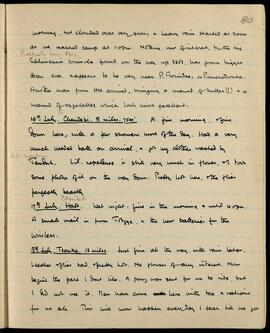
morning, but clouded over very soon, and heavy rain started as soon as we reached camp at 1:00 p.m. Nothing new of interest, but the big Sikkimensis primula (P. alpina have 3353) found on the way up 3353, has grown bigger than ever, and appears to be very near P. florindae, or P. microdonta. Another man from H.H. arrived, bringing a maund of butter (!) and a maund of vegetables, which look most excellent.

16th July. To Chendebi. 8 miles. 7,500'
A fine morning, and fine down here, with a few showers most of the day. Had a very much needed bath on arrival, and got my clothes washed by Tenduk. Lil. nepalense is still very much in flower, and took some photos of it on the way down. Pretty hot here, and the flies perfectly beastly.

17th July. Chendebi Halt.
Wet night: fine in the morning and until 4:00 p.m. A small mail in from Tobgye, and the new batteries for the wireless.

18th July. Tsanka. 13 miles.
Just fine all the way, with rain later. Leeches and flies bad, and pretty hot. No flowers of any interest. Now begins the part I don't like. A pony was sent for me to ride, but I did not use it. Men have come here with tea and rations for us all. This will now happen every day I fear till we get

LSH/1/1/9/1/77 · Part · 1933-06-16 - 1933-06-17
Part of The Ludlow & Sherriff Collection

SUMMARY:
The diarist worked high above the Sokpon's huts near Haeth on 16 June, collecting several Primula species and observing many Grandala. On 17 June at Waitang, after a mishap with a shying pony that broke the diarist's glasses, Lundrup found a white variety of Primula caveana near the junction of two rivers.

CONTENT:
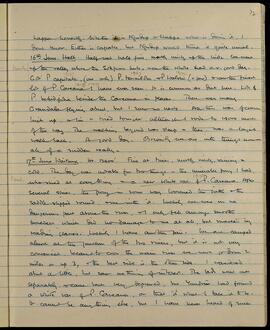
happen honestly. Whether it is Ngudup or Lhakpa who is doing it, I don't know. Either is capable, but Ngudup would think it quite usual.

16th June. Haeth. Half wet half fine, mostly misty up the hills. We went up the valley above the Sokpon's huts, and on the whole had a good day. Got Primula capitata (one only), P. tenuifolia, P. walshii (very few) and saw the finest lot of P. caveana I have ever seen. It is common as dirt here. Lots of P. bellidifolia beside the caveana in places. There were many Grandala flying about, but I saw no nests. All this was of course high up, and I'm very tired tonight, although I rode to 14,000' most of the way. The walking beyond was steep and there was a longish walk back. A good day. Obviously we are into things now all of a sudden really.

17th June Waitang. Height 13,400'. Fine at times, mostly misty, raining and cold. The day was notable for two things - the miserable pony I had, who shied at everything and a new white variety of P. caveana. After several shies, the pony in some way loosened the girth and the saddle slipped round, and me with it. Luckily we were on no dangerous part above the river, and I only fell among smooth boulders which did no damage to me at all, but smashed my reading glasses. Luckily I have another pair. We are camped almost at the junction of the two rivers, but it is not very convenient because to cross the main river we must go down 2 miles or up 3, and the best side is the other side. I wandered about a little, but saw nothing of interest. The lads went out separately, and came back very depressed, but Lundrup had found a white variety of P. caveana, or that is what I take it to be. It cannot be anything else, but I have never heard of such

LSH/1/1/3/3/168 · Part · 1983-05-05
Part of The Ludlow & Sherriff Collection

SUMMARY:
Hot weather and continuous work on a row and fence are described. Richard Shepherd visits with his horse; he and the diarist’s mother go to church while others remain at the house or visit a neighbor. Work continues the following days with the party returning home tired.

CONTENT:
Sunday Oct 12. The weather was hot all day and we worked
hard all day. We were about finished a row when Tom
returned. I finished up the fence. Richard Shepherd
came down here with his horse and got in our lot
and stayed all day. I stayed at the house. Richard
and mother went to church. Tom stayed at the house
all day. Ben and Charlie went to the house of the
neighbor. Charlie stayed with his cousin, Charlie
Black, all night.

Oct 13. We worked hard all day.
We finished the row. It was a hot day. We
worked hard all day. Tom and the boys were
at work all day. We got through with the row
and went home. I finished the row and went
home. I finished the row and went to the
house. I went to the house and stayed a while. I
came to the house and went to bed. I was
tired. Tom and the boys went to bed. I went
and the boys went to bed and I went to bed.

Tuesday Oct 14. We were at the house this

LSH/1/1/9/1/47 · Part · 1933-05-07
Part of The Ludlow & Sherriff Collection

SUMMARY:
Notes a new rucksack carrier named Taphirk and heavy local demand for worm medicine and remedies for stomach and 'heart' complaints. On 12 May at Shamshering, after rain and mist, two messengers arrived (one from Wanguco and one from Lhumbe Dzongpen) while the writer awaited letters from Betty via Holt's man; strawberries and possibly raspberries were sought for dinner. On 13 May at Timyung Dzong, very short marches are described and Ngudup is blamed for misjudging distances.

CONTENT:
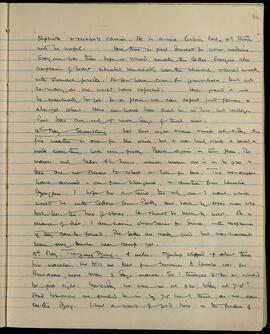
Taphirk, a rucksack carrier. He is a nice looking lad, and I think he will be useful. Here there is great demand for 'worm' medicine. Everyone has them, tape or round, usually the latter. Everyone also complains of 'heart' situated remarkably near the stomach, cured usually with stomach powder. A few have come for gonorrhoea, but not so many as one would have expected. How grand it will be eventually to get to a place we can expect food, flowers, and above all air. Here we have been shut in, in low, hot valleys. But there are only 5 more days of that now.

12th May. Shamshering. Last night rain, mist all today. Our fine weather is over for the winter, but it was lovely while it lasted, and made everything look very pretty. Back again in this place. The march only takes 4 1/2 hours, which means one is in by 9:30, and there are no flowers to collect or look for here. Two messengers have arrived - one from Wanguco, and another from Lhumbe Dzongpen. I hope for a third, the only one I want, which would be with letters from Betty, sent back by Holt's man who took her the box of stores. He should be back by now. As a change of diet, I am having strawberries for dinner, with raspberries if they can be found. The latter are really good, but we haven't seen any bushes near camp yet.

13th May. Timyung Dzong. 4 miles. Ngudup slipped up about these two marches. He told me that from Dumahan to Lhumbe was for Bhutanese more than 2 days march. So I thought 3 for us would be just right. Yesterday we were in at 9:30, today at 7:15! And tomorrow we should be in by 7:15 too I think, as we can see the Dzong. What a waste of good time in the foulest of

LSH/1/1/2/1/253 · Part · 1969-04-29
Part of The Ludlow & Sherriff Collection

SUMMARY:
The party halts at Chungkar, notes many Great Hornbills, and meets the Dzongpen of Jonghar, who previously reported on Tobgye to H.H. They march to Satsalor with views of the snows, collect primulas, lily bulbs, and seeds, send off letters and seeds, then proceed to Diwangiri in Assam by following and repeatedly fording a clear, mahseer-filled river.

CONTENT:
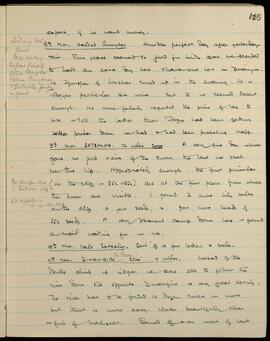
experts, if he wants money.

8th Nov. Halted Chungkar. Another perfect day after yesterday's rain. This place seemed so good for birds that we decided to halt an extra day here, and have one less in Diwangiri. The Dzongpen of Jonghar turned up in the evening. He is Tobgye's particular bête noire, but to us seemed decent enough. He once falsely reported the price of lac to H.H. and told the latter that Tobgye had been getting better prices than he had and had been pocketing half.

[Marginal notes: Ludlow p. 165. Birds: large numbers of the Great Hornbill below Chungkar, between Chungkar and Satsalor feeding on fruit.]

9th Nov. SATSALOR. 12 miles 3000'. A very fine day which gave us good views of the snows, the last we shall see this trip. Appropriately enough, the first primulas (on the cliff - 552 and 554) are at the first place from which the snows are visible. I found 2 more lily bulbs on the cliff, a few seeds, and four more heads of 552 seeds. A very pleasant camp down here — found a mail waiting for us too.

[Marginal notes: Pri. Sherriffae 552 and ludlowii 554. Lil. nepalense var. concolor 559.]

10th Nov. Halt Satsalor. Sent off a few letters and seeds.

11th Nov. DIWANGIRI (in Assam). 2500' 7 miles. Instead of the double climb up ridges, we were able to follow the river down till opposite Diwangiri, a very great blessing. The river has to be forded a dozen times or more, but that is now easy. Water beautifully clear and full of mahseer. Rained off and on most of last

LSH/1/1/4/1/123 · Part · 1936-10-05
Part of The Ludlow & Sherriff Collection

SUMMARY:
Travel from above Natrampa to Karubra and then near Kashongla with generally cloudy, wet weather and some snow higher up. Seeds of several plants were collected, and the party met a Sikkim lama from near Trashi Trongmo who spoke some Nepali. Distances and times between camps are noted.

CONTENT:
7th October. Camp above Natrampa. 6 miles. 11500'. Cloudy all day, with a little fine drizzle. The clouds come rushing up the valley from Lung, and gradually fade away, but it is still generally wet. Found some seed of Gent. Waltoni ripe, the little yellow sedum, and the yellow Dracocephalum: also the Thalictrum collected at Zumsati. Coolies very happy but exceptionally slow. Left camp at 6.30, reached here at 12.0 noon.

8th October. Karubra. Another very short day, in at 11.00. We could see that beyond the Duchung La it was absolutely clear all morning. Here the sun shone most of the day, but it also rained nearly all afternoon. Monsoon clouds come up to the main range, and just fade away. Got seeds of the blue Dracocephalum and P. pulchelloides, an aquilegia and the big scrophularia, and a few of the small androsace. The big one is not yet ripe. Here we met a Sikkim lama, who had forgotten all his Lepcha but could talk a little Nepali. He comes from near Trashi Trongmo, where he has been for 14 years: a nice man.

9th October. Camp 2 m W of Kashongla. 14000'. A most disappointing day. It rained all night, and snow was down to 500' above Karubra.