SUMMARY:
The page notes that 'Lud.' is at Davangiri, with the phrase repeated. No dates are provided.
CONTENT:
Lud. at Davangiri
Lud. at Davangiri
Lud. at Davangiri
RBGE acknowledges that our collections contain historic materials which may contain, either in their content or catalogue descriptions, terminology which is inappropriate, outdated, offensive or distressing. Such information does not reflect the current views and values of RBGE.
We welcome feedback about the language in our catalogues. While we cannot change fixed attributes connected to items in the collection (e.g. published titles, names or contents) we will always consider requests for changes to be made to other aspects of the records in our catalogues. Please contact archives@rbge.org.uk
SUMMARY:
The page notes that 'Lud.' is at Davangiri, with the phrase repeated. No dates are provided.
CONTENT:
Lud. at Davangiri
Lud. at Davangiri
Lud. at Davangiri
SUMMARY:
Brief note mentions a plate to cover a slit hole, with an entry dated 15th Aug at Ludowskie Chere La.
CONTENT:
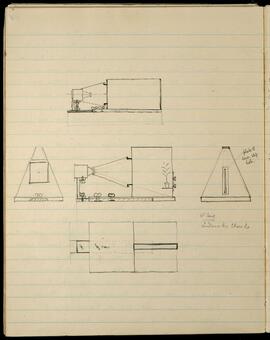
plate to cover slit hole.
15th Aug
Ludowskie Chere La
SUMMARY:
The diarist notes receiving Wright-Smith's list of last year's primulas and describes relentless rain flooding the Thimbu Chu while marching 11 miles to Pyimitanka and then 10 miles to Paro. Local officials from Paro sent extra servants and a mule, which proves inconvenient, and a specimen of Ceratostigma is collected.
CONTENT:
91
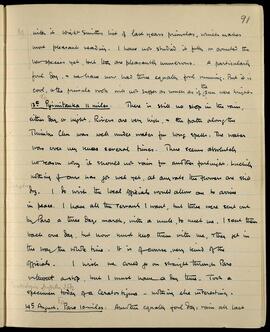
with it Wright-Smith's list of last year's primulas, which makes more pleasant reading. I have not studied it fully or counted the new species yet, but they are pleasantly numerous. A particularly foul day, and we have now had three equally foul running. But it is cool, and the primula roots will not suffer as much as if the sun were bright.
13th To Pyimitanka 11 miles. There is still no stop in the rain, either day or night. Rivers are very high, and the path along the Thimbu Chu was well under water for long spells. The water was over my knees several times. There seems absolutely no reason why it should not rain for another fortnight. Luckily nothing of ours has got wet yet, at any rate the flowers are still dry. I do wish the local officials would allow one to arrive in peace. I have all the servants I want, but three were sent out by Paro a three days' march, with a mule, to meet me. I sent them back one day, but now must keep them with me, they get in the way the whole time. It is of course, very kind of the officials. I wish we could go on straight through Paro without a stop, but I must have a day there. Took a specimen today of a Ceratostigma - nothing else interesting.
14th August. To Paro 10 miles. Another equally foul day: rain all last
SUMMARY:
Notes include orchid records and a visit from Tobgye, who brought provisions and discussed concerns about a lama from Kham influencing the Maharaja. The party describes dense woods cleared for grazing by Bhutanese herders and hopes the lama will not be in Bumthang to avoid restrictions on shooting. They have been invited to Ha for lunch and tea on the 8th and plan to go.
CONTENT:
24
Bletia palustris 60.
Cephalanthera longifolia 58
Pleione hookeriana 59.
Tobgye brought presents of beer, cake, mangoes, vegetables.
5th June. Fine till 10.0, then rain till 2.0 & fine in the evening. Tobgye arrived at midday, we gave him our very best tiffin. He went on again about 3.0pm. He is rather worried about the lama who is getting at the Maharaja. He comes from Kham & is a nephew of an old lama who used to be a great friend of Ugyen Wangchuck. This man is a hunchback; he gives out that he is collecting money for a monastery in Kham, & according to Tobgye he is doing pretty well: but he is also doing pretty well for himself, & is collecting a good deal of money & presents in kind. Tobgye dislikes him & mistrusts him, thinking him able to hypnotise. We all hope he will not be in Bumthang when we get there, or our shooting may be curtailed.
Ha - 8 miles down valley.
Ludlow
The woods are very dense, in some cases impenetrable but here & there the Bhutanese have cleared open spaces, with fire & axe to provide grazing grounds for their numerous herds of zhos (said to be a cross between the yak & the common horned cow) yaks & cows. No sheep.
We are asked to Ha to lunch & tea on 8th & have decided to go
SUMMARY:
The writer notes heavy tick infestations, photographs a Lopa at Lung identified as a Ding Abor, and mentions Giris and a third tribe down the Subansiri. On 3rd May at Trün (his birthday), Danang and Tenduk return with an anemone (1540) and a distinct rhododendron (1541), report a gompa and nearby houses on an upper road, and the writer observes flowering loniceras, attractive podophyllum (1538), and a primula from Natrampa.
CONTENT:
60
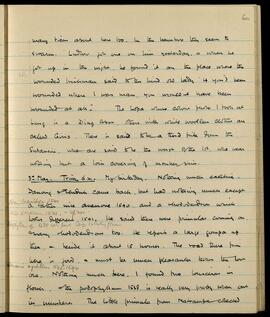
many ticks about here too. In the bamboo they seem to swarm. Ludlow got one on him yesterday. And when he got up in the night, he found it on the place where the wounded Irishman said to the kind old lady "if you'd been wounded where I was ma'am, you wouldn't have been wounded at all".
The Lopa whose colour photo I took at Lung is a Ding Abor. Others with white woollen clothes are called Giris. There is said to be a third tribe down the Subansiri, who are said to be the worst of the lot, who wear nothing but a loin covering of monkey skin.
3rd May. Trün 6 am. My birthday. Nothing much exciting. Danang and Tenduk came back, but had nothing much except a rather nice anemone 1540, and a rhododendron which looks different 1541. He said there were primulas coming on, and many rhododendrons too. He reports a large gompa up there, and beside it about 15 houses. The road there from here is good, and must be much pleasanter than the low one. Nothing much here. I found two loniceras in flower, and the podophyllum 1538, is really very pretty when out in numbers. The little primula from Natrampa collected.
SUMMARY:
The writer lists several plant specimens and reports poor botanical results around the Nyang Sang La–Tse La ridge, with Ludlow’s northern reconnaissance similarly unproductive. They decide to move toward a snow mountain west of Nyuri or to Lujuthang, having slaughtered a yak and now needing extra yaks to carry the meat, and note high surrounding peaks and relatively dry conditions.
CONTENT:
Lap - 28th July.
Mec. lancifolia var. concinna 728
Aconitum fletcherianum 729
Mec. glabra 734
Gentiana tubiflora 735
Pedicularis trichoglossa 736
Potentilla eriocarpa 737
In July and first half August, there should, one would be flowers all over the place. Flowers there are, but more of the Tibetan type than we want. The Nyang Sang La - Tse La range seems to form more of a barrier than we had expected. It was this ridge which we had expected would make the area so particularly good. Anyway we are wrong. I was out all yesterday, going over the ridge, and a little down the Lohpa side, but there was nothing of any interest at all. Ludlow went up to the North, with the same result. There are Tibetan potentillas, and even some grammopetala, a sure sign that we are in the wrong area. One morning we had a clear hour or two, and saw a snow mountain away to the West of Nyuri, and to there we have now decided to go. It is either there or to Lujuthang, and of the two that seems the more hopeful. We bought a yak up here for Rs 18/- and halaled it yesterday, thinking we should be here for a while. Now we need two extra yaks to carry its meat back with us!
Decided lap 6/7
This valley is rather a queer place. At its head are peaks of over 20,000', up to 23,000 odd. I saw some of them yesterday. But they seem not to get a great deal of rain. Yesterday evening we saw an extraordinary sight. The weather in the valley had
SUMMARY:
The party marches through dense forest near Rongang, noting many Primula mollis (first not in flower, then found flowering) but few other plants of interest, with capsules of a lily and some rhododendrons observed. Route discussions mention Nashina as not promising, Serdong La lacking nearby water, and Tiu as the best first halt, while Ngudup grows increasingly depressed about their plans.
CONTENT:
we were in. Then at about mile 5 the path levels off till just before reaching here it drops suddenly again. In the dense forest, both close to Rongang and in the very steep bit, there was any amount of the new primula 18806 (P. mollis), but again not in flower. Apart from that the march was very uninteresting. Poor Ngudup gets more and more depressed as he hears of where we are going and how long we will stay there. We still don't get very good information though. It seems Nashina would be much good, though the Serdong La might be good, but there is no water within miles of the pass. Tiu seems our best bet for the first halt.
4th May. Shambling. 6 miles. Very heavy rain all last night until just as we started. Fine but mist and cloud today. We found our primula in flower today (P. mollis 18816), very close to Rongang, and also just beside camp here. Otherwise nothing of interest seen - in fact these last two days have really been remarkable for the absence of flowers. There were, near the pass yesterday, capsules of a lily - either Lilium nepalense or L. nepalense var. concolor, and there were many Rhododendron virgatum and Rhododendron griffithianum. But today we really saw nothing at all. We can however, see the snows, not the main range, but a subsidiary running South. Today's road climbs for the first mile round a spur and
SUMMARY:
The writer records numerous alpine plants and seed collections, endures a foul, windy camp, and notes Ahmad Sheikh down with fever while lamenting that Lumsden left the quinine behind. They describe irrigation channels reminiscent of Hunza and then march 7 miles to Trün along river galleries, passing a side gorge bridge and the old village of Tenzika, with environmental measurements noted.
CONTENT:
51
contained a great deal, would be thoroughly worth visiting later. I saw Paraquilegia, Meconopsis (a small one), 4 Primulas, the seeds of one sikkimensis one I collected a few of (1327). An Androsace (1328) a few seeds. Gentians, saxifrages, rhododendrons and many other good looking things. A foul camp with an awful wind and dust. Ahmad Sheikh down with fever, I suppose malaria again. Lumsden left the quinine behind, dash him, but between us we can muster about 20 pills. Birds interesting. The valley is obviously wetter, but is a dry one till the rains come. South face still pretty bare even high up. Up this side valley I noticed two water channels had been taken off the main stream. The engineering reminded me forcibly of Hunza. They must have been a mile or two long and were for the most part along cliff faces.
25th April. To Trün 7 miles. Barometer 194°. Temp 60° Time 4.0 pm. Approximate height 10426'.
Road easy, but along galleries keeping 100 ft or so above the river. At mile 1½ cross a side gorge by a bridge and at mile 3 an old village called Tenzika. Then level past several gorge side nalas to a
SUMMARY:
Notes on high-altitude collecting near Maruthang, including marked Primula uniflora, and concern over snow making work difficult. The writer reports that Ludlow has given up hopes of visiting Tibet and booked passage home, while at Haat heavy rain and snow are foretold by 'Lerwa' calls and a local drogpa’s warning.
CONTENT:
pretty well finished the high altitude stuff, but Pasang and Mundru will have to get some high altitude things beyond Maruthang, and an inch or two of snow makes that very difficult indeed. One of Mundru's primulas there is P. uniflora, which is only 2-2½" high when in flower. He has marked all these plants, but even so, it will not be easy. Ludlow will be having a very chilly time now. We are only at 13500' here, air is quite cold enough. His camps will often be higher than that. It will be a great blow to him not to be able to visit Tibet once more, but from what he said in his last letter, he has definitely given up all hope, and even ordered his passage home on the same ship as we go on. If we could both have managed one more trip to the Gorge country, it would have finished things off very nicely. I wonder if any of the other applicants for permission to visit Tibet next year will go. It seems most unlikely.
29th September Haat. Yesterday while we were out, and while it was merely raining, a couple of coveys of 'Lerwa' called a great deal, and the local drogpa who was with us said that was a bad sign. When they called like that there would be much rain and snow. Well, he and they were quite right. It has barely stopped raining for our 3 days up here, and yesterday and today have been as bad as we've had all year. Last
SUMMARY:
The party halts amid difficulties with the Chanjö and then travels from Gor through the Nyam Sang Chu gorge, crossing the Nyam Sang Chu and Rong Chu, and passing small settlements like Men and Ngang en route toward Trimo. They camp near Trimo and reach Marmang, noting weather, logistics, and several plant collections, and are met by the Dzongpon at Trimo.
CONTENT:
104
20th May. Halt. No one here is very nice. The Chanjö's staff are a lot of nasty sharks. But at any rate we are getting off tomorrow. The Chanjö himself is the worst of the lot. Fine day but too windy.
21st May. Camp in Nyam Sang Chu gorge. Yaks took us only as far as Gor, about 5 miles. From there we took coolies from Gor village, a place of some size. They were ready for us and we got off with little delay. (Rhod. cinnabarinum in flower 12469. Rhod. wallichii 12470. Campylocarpum 12484. Prim. atrodentata 12473.)
The path is good to Gor, high above the river and more or less level. From Gor on it is good for a couple of miles, then drops very suddenly down to the river where the Rong Chu comes in. Here the gorge is very steep sided. We crossed the Nyam Sang Chu then the Rong Chu. Thence the path is up and down along the very steep R bank. No houses are passed, but a clearing is reached about 8 m below Gor where camp is possible. It was fine all day - a little rain in the evening. Although we had been told no animals could go beyond Gor, this was untrue, like most things the Dongkar people told us. Flowers quite interesting again after the dry plateaus.
22nd May. Camp about 6 m N of Trimo. As usual we find it hard to get information about the route, how far it is to anywhere. Route like yesterday, up and down steeply, with one or two big climbs, all on the R. bank, passing Men, 1 house on R bank, and Ngang, 2 or 3 houses on L bank. (Rhod. hylaeum 12485. R. baileyi 12490. arboreum 12491. tsariense 12498. Prim. calderiana 12493.) It is a tiring march the whole way. The gorge is narrow, but there is not a pronounced drop in the river anywhere yet. Cross to the L bank a mile before camp.
23rd May. Marmang. I was worried about whether we would get transport at Trimo, and had almost decided to halt a day there. We arrived early - about 10 am. The Dzongpon met us, a (Rhod. pendulum 12525. campylocarpum 12526, glaucophyllum 12535, keysii 12536, ciliatum 12537. Prim. dickieana 12538, waltonii 12540.)