Showing 6828 results

Archival description
2091 results with digital objects Show results with digital objects
Page with hand-drawn diagram
LSH/1/1/2/1/228 · Part · 1934-10-14
Part of The Ludlow & Sherriff Collection

SUMMARY:
This page contains only a hand-drawn diagram and notebook lines, with no textual content.

CONTENT:
There is no text in this image to extract. The page contains only a hand-drawn diagram and notebook lines.

LSH/1/1/10/1/125 · Part · 1933-10-10
Part of The Ludlow & Sherriff Collection

SUMMARY:
The page contains the question 'Can you see the writing?' followed by multiple repetitions of the sentence 'I am a boy.' No dates, places, or persons are mentioned.

CONTENT:
Can you see the writing?
( ... )

I am a boy
I am a boy
I am a boy
I am a boy

I am a boy
I am a boy
I am a boy
I am a boy
I am a boy
I am a boy

LSH/1/1/6/1/99 · Part · 1933-07-05
Part of The Ludlow & Sherriff Collection

SUMMARY:
The diarist reports hiring a new Khampa servant named Kesang, a difficult crossing of the broken bridge at Shona where Jill fell, and short, largely uneventful marches. In Paka they met an exiled Tibetan from Lhasa who assisted with transport arrangements, and later heavy rains delayed travel toward Samo; a coolie from Lando reportedly drowned while fording the river.

CONTENT:
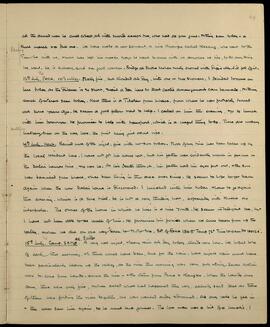
all the armed men he could collect, all with swords except two, who had old flint guns. Nothing seen today - a short march and a dull one. We have made a new servant, a nice Khampa called Kesang, who went to the Tumba with us, and has left his master says he wants to come with us anywhere we like, to do anything we want. He is a cheery soul and a good worker. Bridge at Shona broken and only crossed with difficulty. Jill fell off it.

13th July. PAKA. 10 1/2 miles. Mostly fine, but clouded all day, with one or two showers. I decided to come on here today as the distance is so short, and wait a day here so that coolie arrangements can be made. Nothing much of interest seen today. Here there is a Tibetan from Lhasa, from where he was probably turned out some years ago. He seems a good fellow and out to help. I called on him this evening, and go to lunch with him tomorrow. He promises to help with transport, which is a useful thing to do. There are many mulberry trees on the way here, the fruit being just about ripe.

14th July. Halt. Rained most of the night, fine with no sun today. Most of my time has been taken up by the local resident here. I have not got his name yet, but his father was evidently much in favour in the Dalai Lama's time, and so was he. At his death though, his father had his eyes put out, and the son was banished from Lhasa, and has been living in this area ever since. He seems to hope to get back again when the new Dalai Lama is discovered. I lunched with him today, and have to go again this evening, which is a sore trial. He is not a very thrilling host, especially with Kusho as interpreter. The owner of the house in which he lives is a nice youth. He seems intelligent too, but I have not been able to see much of him. He promises his ponies when we come back from up the valley, and when we are on our way back to Molo too. BP. of Paka 194.8' Temp 72° Time 10.0 am. Ht 10012.4'.

15th July. Camp. SAMO. To AR. 8 miles. A very wet night, and heavy rain all day today, clouds very low. We hoped to be off early this morning, or think would have been, but for the rain. Last night's rain must have been particularly heavy up the valley, as the river this morning was very full and dirty. Seven coolies were to come from Lando - across the river - and the others from Paka and Kangka. When the Lando ones came, there were only five, and when asked what had happened they very calmly said that as three of them were fording the river together, one was washed away and drowned. At any rate he fell in and they never saw him again, so he must be a goner. The lost man was a bit of a lunatic. I

LSH/1/1/4/1/42 · Part · 1936-04-28
Part of The Ludlow & Sherriff Collection

SUMMARY:
Notes on rubythroats at camp and the yak man's account of 'Kuling' birds and their habitat, with mention that blood pheasants are present though not seen. Entries for July 20 and 21 record Ludlow in Paka Valley near Kyim Dzong with plant taxa and brief faunal observations, and a note referencing a description of the journey to Kyimdong Dzong.

CONTENT:
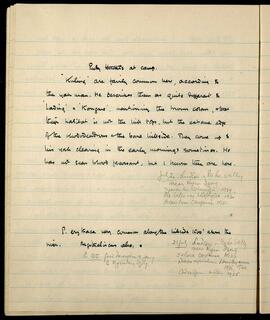
Rubythroats at camp.

'Kuling' are fairly common here, according to the yak man. He describes them as quite different to 'Lading' & 'Kongmo', mentioning the brown colour, & that their habitat is not the hill tops, but the extreme edge of the rhododendrons & the bare hillside. They come up to his yak clearing in the early mornings sometimes. He has not seen blood pheasant, but I know they are here.

July 20 - Ludlow in Paka Valley
near Kyim Dzong.
Cyananthus sherriffii 1939.
Rhod. bella var. holophylla 1930.
Aconitum tangense 1931

P. erythraca very common along the hillside 1500' above the river. Aegithaliscus also.

L. 155. food description of journey to Kyimdong Dzong.

21 July - Ludlow in Paka Valley
near Kyim Dzong.
Salvia castanea 1932
Dracocephalum hemsleyanum 1936, 1934.
Codonopsis mollis 1935

LSH/1/1/1/1/135 · Part · 1933-08-15
Part of The Ludlow & Sherriff Collection

SUMMARY:
After an exceptionally heavy night of rain, the party crossed Pang La and collected 15 bird skins, including four adult and one young Heteroxenicus stellatus and a female blood pheasant, while finding few flowers due to lack of permanent snow. They were misinformed about the distance to camp and then made a steep descent through jungle to a long-neglected bridge that was recently strengthened, of the usual cantilever type found in Bhutan, Turkestan, and Kashmir.

CONTENT:
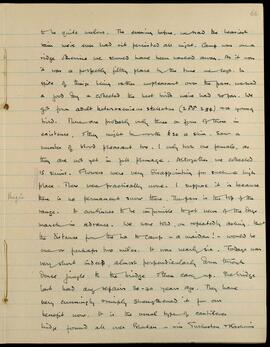
to be quite useless. The evening before, we had the heaviest rain we've ever had and it persisted all night. Camp was on a ridge otherwise we should have been washed away. As it was it was a perfectly filthy place by the time we left. In spite of things being rather unpleasant over the pass, we had a good day and collected the best birds we've had so far. We got four adult Heteroxenicus stellatus (2 males, 2 females) and a young bird. There are probably only three or four of these in existence, and they might be worth £20 a skin. Saw a number of blood pheasant too. I only took one female, as they are not yet in full plumage. Altogether we collected 15 skins. Flowers were very disappointing for such a high place. There were practically none. I suppose it is because

Pang La

there is no permanent snow there. The pass is the top of the range. It continues to be impossible to get news of the day's march in advance. We were told, on repeatedly asking, that the distance from the la to camp — a maidan! — would be one or perhaps two miles. It was nearly six. Today's was very short indeed, almost perpendicularly down through dense jungle to the bridge and then easy up. The bridge last had any repairs 30–40 years ago. They have very cunningly and simply strengthened it for our benefit now. It is the usual type of cantilever bridge found all over Bhutan — in Turkestan and Kashmir.

LSH/1/1/3/3/71 · Part · 1936-03-10
Part of The Ludlow & Sherriff Collection

SUMMARY:
Notes describe a valley with magnolia and pine, a Jasminum dispermum at a bamboo bridge, and Primula gracilipes at a waterfall by the Chorten, thought to be where Kingdon Ward previously collected it. On 28th March at Pangchen, a few orchids and Mahonia sidneyi sp. nov. were found; ticks were troublesome, and the party decided the locality was poor but stayed due to illness.

CONTENT:
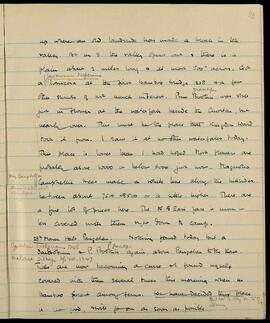
up where an old landslide has made a block in the
valley. At mile 9, the valley opens out and there is a
plain about 2 miles long and at most 500 acres. Got
a Jasminum dispermum at the first bamboo bridge 1238, and a few
other shrubs of not much interest. Primula gracilipes was still
just in flower at the waterfall beside the Chorten, but
nearly over. This must be the place that Kingdon Ward
took it from. I saw it at no other waterfalls today.
This place is lower than I had hoped. Most flowers are
probably above 10,000 or below 6,000 just now. Magnolia
campbellii trees make a white line along the hillsides,
they are abundant and beautiful, between about 7,500 - 8,500 or a little higher. There are
a fine lot of pines here. The East face is more or
less covered with them right down to camp.

28th March. Halt Pangchen. Nothing found today but a
Cymbidium hookerianum 1245, Mahonia sidneyi sp. nov. 1247,
Dendrobium and Primula gracilipes again, above Pangchen to the East.
Ticks are now becoming a curse; I found myself
covered with them several times this morning when in
bamboo forest among ferns. We have decided this place
is no good, will go on as soon as possible, but had to stay on account of illness.