Showing 6828 results

Archival description
2091 results with digital objects Show results with digital objects
LSH/1/1/2/1/211 · Part · 1933-10-09
Part of The Ludlow & Sherriff Collection

SUMMARY:
The diarist, after a sleepless night, spends the day labelling and packing seeds and bulbs of lilies (including L. giganteum and L. wallichianum), notes a recovering Tibetan companion who will continue as far as Trashigong, and awaits mail. He reprimands Kurtip for distributing quinine, struggles with scarce coolies, sends on 20 loads, and records the next stage to Shali with a brief route note.

CONTENT:
704

Lilies. giganteum
Lil. wallichianum
Lil. karsum 1041
Notholirion bulbuliferum 717

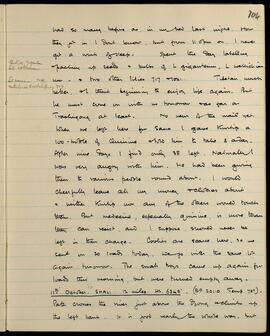
had so many before as in my bed last night. How they got in I don't know, but from 11:00 pm on, I never got a wink of sleep. Spent the day labelling and packing up seeds and bulbs of L. giganteum, L. wallichianum and two other lilies 717 and 1041. Tibetan much better, and think beginning to enjoy life again. But he must come on with us tomorrow as far as Trashigong at least. No news of the mail yet.

When we left here for Sawa I gave Kurtip a 100-bottle of Quinine and told him to take 3 a day. After nine days I find only 38 left. Naturally was very angry with him. He had been giving them to various people round about. I would cheerfully leave all my money and clothes about and neither Kurtip nor any of the others would touch them. But medicine, especially quinine, is more than they can resist, and I suppose, should never be left in their charge. Coolies are scarce here, so we sent on 20 loads today. We go with the same lot again tomorrow. The small boys came up again for loads this morning, but were turned empty away.

11th October. To SHALI. 12 miles. Ht. 6349'. (BP 201.0 Temp 78°).
Path crosses the river just above the Dzong and climbs up the left bank. It is good nearly the whole way, but
Page 105
LSH/1/1/2/1/105 · Part · 1933-07-18
Part of The Ludlow & Sherriff Collection

CONTENT:
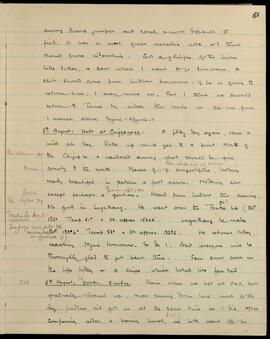
among dwarf juniper and scrub, most difficult to find. It has a most queer metallic note, and I think it should prove interesting. Got a glimpse of the higher hills today, and saw where I want to go tomorrow. A chit should come from Ludlow tomorrow: if he is going to return soon, I may move on. But I think we should return to Tsona by either this route or the one from the march above Dyuri-Nyuri.

5th August. Halt at Chujupnaga. A filthy day again, rain and mist all day. Rode up on a yak to a point North of the Chujup la and wandered among what should be fine country to the north. Masses of P. congestifolia, looking really beautiful in patches a foot across. Nothing new except perhaps a gentian. Heard from Ludlow this evening. No good in Luguthang. He went over the Truka La (B.P.? 185° Temp 51° = Ht. approx 15246'). Luguthang he made B.P. 188.4° Temp 53° = Ht approx. 13283'. He returns today, reaching Nyuri tomorrow. So do I. And everyone will be thoroughly glad to get back there. Saw snow cock on the tops today and a snipe, which looked like fan tail.

6th August. To DYURI. 5 miles. Rain when we left at 6.45, but gradually cleared up, was sunny down here

Page 121
LSH/1/1/4/1/121 · Part · 1936-10-05
Part of The Ludlow & Sherriff Collection

CONTENT:
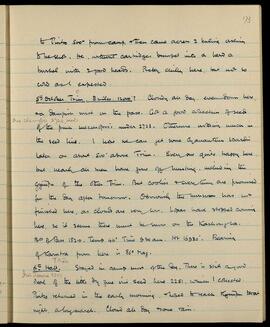
to Pimbo 500' from camp, and then came across 2 coolies asking
to be shot. He, without cartridges, bumped into a herd of
bharal with 2 good heads. Pretty chilly here, but not so
cold as I expected.

5th October Trün, 8 miles. 12,000'? Cloudy all day even down here,
a dampish mist on the pass. Got a good collection of seed
(coll. Sherriff 2723. seed) of the pink Meconopsis under 2723. Otherwise nothing much in
the seed line. I hope we can get some Cyananthus wardii
later on about 500' above Trün. Everyone quite happy here,
but nearly all men have gone off hunting, including the
Gyimpu of the Other Trün. But coolies and everything are promised
for the day after tomorrow. Obviously the monsoon has not
finished here, as clouds are very low. Lhopas have stopped coming
here, so it seems there must be snow on the Kashong La.
BP of Pass 182.0. Temp 46° Time 9:30 am. Ht 16,930'. Bearing
of Karutra from here is 86° Mag.

6th Halt. (Trön) Stayed in camp most of the day. There is still a good
(Iris decora 2251.) deal of the little dry zone iris seed here 2251, which I collected.
Pimbo returned in the early morning, and hoped to reach Kyimpu that
night, a long march. Cloud all day, some rain.

Page 125
LSH/1/1/1/1/125 · Part · 1933-08-06
Part of The Ludlow & Sherriff Collection

CONTENT:
Sh. Aug. Prim. tenuiloba 395. Prim. pygmaeana of rev. 397. Prim. macrophylla 400. Prim. dickieana 401.
Prim. calderiana 412. Gentiana tubiflora 398, Gent. infelix 399. Diapensia himalaica v. typica 403,
Draba stella-aurea var. polyadena 406. Cyananthus spathulifolius 408, Sax. hispidula 410
Notholirion bulbuliferum 411. Cremanthodium thomsonii 414.
Time for heavy rain vs thunderstorm.
at Shingbe

5th August. I went up myself to a spot close to the Meba & took the flower photographing app. with me, & there collected & photographed 12 species. Before leaving camp, took a further eight. Then home & spent till 6.0 pm developing - a good 12 hours work. Heavy rain in the evening. There are some Tibetans here, whose remarks about my flower photography are amusing. They told our men, that it had rained hard till we came here, but that I was like a lama, & with my box of tricks was putting off the rain. They also thought the reason we were collecting butterflies was to take home & make new dyes for our clothes. The present dirtiness of our clothes may have warranted this remark.

at Shingbe
6th Aug. Fine from 6.0 am till 12.0 noon. Went up towards the Meba, & wandered about the hillside. I climbed up a rocky hill & found snow cock, but failed to shoot any. The day was completely spoilt for me by my discovering that Damong has been very lazy & has not been changing the drying paper. He has made an awful mess of all the fine flowers collected here. I haven't had time to check him, & he has taken advantage of that. It is a great disappointment to me. I thought he was a better man than that. I photographed a little Tibetan girl who is up here with some yakherds from Tibet. She is a pretty little thing,

Prim. capitata subsp. crispata 451
Aconitum 452 (aff. leucanthum)

Page 157
LSH/1/1/5/1/157 · Part · 1933-07-04
Part of The Ludlow & Sherriff Collection

CONTENT:
now a good many yaks at the Thiba Tso, as also on the way up to Changsethang. Below the cliffs on the N side, there were just masses of flowers: Primulas hopeana, pusilla, roylei, atrodentata, sapphirina, 3383 & glabra: Meconopsis bella, horridula & paniculata; geraniums, saxifrages, salvias, & many more. It was all very pretty, & the big cushions of Androsaces make it look nicer than ever.

13th July. Chore. 6 miles. BP. 18.67 Temp. 57° Time 2.0pm. Ht. 15000 odd.
One of the nicest days I have ever had. Except for one shower, it was fine till 3.0pm when we came in. I have come on with only 8 loads, Tenduk & Son open: the remainder of the kit has gone down direct to Ram thang. The path leads up West of Thiba Tso, then keeps SE of the ridge which separates the Tang Chu & Rinchen Chu, at about 15500 - 16000 ft. We first saw a lot of 3383, it certainly is a beauty. When I stopped to admire that, I was standing on a primula very like P. menziesiana, but which seems different (No 3438.) There also was Gent. phyllocalyx in plenty. I have never seen so many alpines out together as on this march. In places the hillsides & cliffs were just covered with them, & the variety was great. At about 2 miles we came to a little grassy hollow & here we found the most extraordinary collection of coloured primulas. There must have

Page 163
LSH/1/1/1/1/163 · Part · 1933-09-24
Part of The Ludlow & Sherriff Collection

CONTENT:
to Gyantse. He promises to do this, in return we will send
his photos to him here via a friend in Lhasa.

2nd Sept. Halt at Lhakang.

3rd September. TO MUG-SINGH DZONG. 13 miles. Ht. 11000'. Path
descends 600' steeply below Lhakang to the Lhakang Chu crossed
by a good bridge. It then climbs up the R. bank crossing
a shoulder at m 1. Thence down to the Lhobrak River (here called
the THING CHU) & up the R bank to THING at m 2. Ponies
are changed here. From Thing the path, which is very
good the whole way, rises gradually, keeping 1500 ft or so
above the Kuru Chu. Villages & cultivation are passed and
at m 6 Damé (change ponies) m 7 1/2 (change ponies) and 9 1/2
Kesho (change ponies). Beyond this, route continues level,
turning up the side valley for a mile, then crossing this
valley on the left bank on which at m 13 is situated
MUG. Water fuel & some supplies. // A tiring day
owing to the constant changes from one pony to
another - all extremely uncomfortable. At Kesho the
Jongpen met us, having ridden out to see us off - a
kindly action. The rate he quoted for the 10 miles
there was 4 tenkhas a pony: the rate for the last 3 1/2
miles was 1 tenkha per 3 men or 1 tenkha for 2
ponies. A tenkha is 14 to the rupee, so that each coolie
was due about 1/2 d for that work. Views rather

Page 167
LSH/1/1/2/1/167 · Part · 1933-08-30
Part of The Ludlow & Sherriff Collection

CONTENT:
seems almost incredible that that should have been done after our instructions. Puibo hopes to retrieve it, and bring it on with him when he comes. He wrote from Dosum Zampa - 'the bridge of the three rivers'. Flies are very bad in this camp all through the day, and a tiny midge with a most annoying bite appears in the mornings and evenings. We have smoke fires lit round the camp to try to cope with them. The walking stick gun has been unable to keep up the uneven struggle. I have tried to patch it up, but the whole thing is made of soft metal and brass, which cannot stand up to the discharge of the cartridge and buckles. So it is being discarded. It is a great pity, because some such other weapon - we have one .22 rifle - is necessary in the thick jungle when after birds like Pnoepyga, Tesia, Neornis and Heteroxenicus. They are all inveterate skulkers, and if one sees them, it is only in the densest jungle at a range of a few yards.

4th September. Tobrang. Fine nearly the whole day, after a downpour during the night. It is very hot and oppressive when the sun shines, but certainly preferable to the rain. We spent, as usual, the