Showing 6828 results

Archival description
2091 results with digital objects Show results with digital objects
LSH/1/1/4/1/87 · Part · 1933-08-15
Part of The Ludlow & Sherriff Collection

SUMMARY:
The party deals with persistent wet weather, a lost sheep that escaped capture, and transport troubles including missing bedding later found on the path. On 31st August at a halt camp above Nga La, they experienced sun turning to mist and heavy rain, went over Pang La to Dza La, recorded pass heights with a hypsometer, and noted the path from Mijitun.

CONTENT:
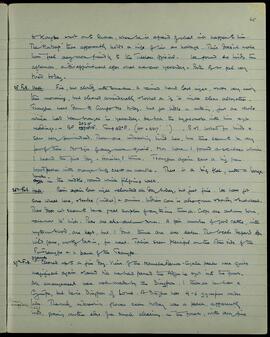
are more than likely to have rain here the whole time we are
here, and to be in the mist all the time. Some excitement was
caused by finding the sheep this morning. It had been
bought by the servants at Tso Bunang and brought down alive, but
broke its rope soon after getting here. Although seen at the
time, no one could catch it, and it was finally lost for three days.
Pintso went off after it this morning with the rifle to shoot it,
but only got a glimpse of it, so it remains free. The coolies
and everyone here are shirkers. We had a lot of trouble over
transport, and one woman with Ludlow's bedding failed to turn up by
2:00 pm. The bedding was found dumped at the side of the path
half a mile short of here. This is a very wet camp, and I expect
we will all be glad to leave.

31st August. Halt. Camp above Nga La.
A perfect day of sun and clouds, the clouds coming
gradually lower, till we were in mist by 3:00 pm and later heavy rain.
Went up over the Pang La to the Dza La. The hypsometer gives
these heights as: Na La 12,800', Pang La 13,960', Dza La 15,550'.
From Mijitun path leads up valley to East for about 1 mile, then turns
more South and is
LSH/1/1/4/1/153 · Part · 1933-10-19
Part of The Ludlow & Sherriff Collection

SUMMARY:
The diary records a halt with fine weather, Tsonpen’s recovery, collecting G. Waltoni seeds, paying off coolies, and concern about snow on the Drichung La and Le La while planning to reach Chayul to meet Tenduk and Danang. The next day brought strong winds, continued seed searches including Ceratostigma, and frustration that many seeds (Primula, Meconopsis, Rhododendron) were eaten by bugs.

CONTENT:
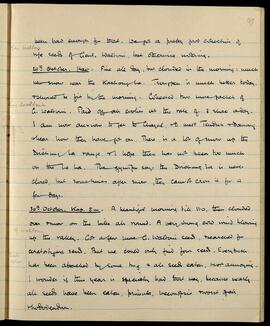
...been bad enough for that. We got a pretty good collection of ripe seeds of Gent. Waltoni, but otherwise nothing.

29th October. Halt. Fine all day, but clouded in the morning: much new snow near the Kashong La. Tsonpen is much better today, & should be fit by the morning. Collected two more packets of G. Waltoni. Paid off all coolies at the rate of 3 shao a day. I am now anxious to get to Chayul, & meet Tenduk & Danang & hear how they have got on. There is a lot of snow up the Drichung La range, & I hope there has not been too much on the Le La. The gyunpo says the Drichung La is never closed, but sometimes after snow, they cannot cross it for a few days.

30th October. Kap. 8m. A beautiful morning till 11.0, then clouded over snow on the hills all round. A very strong cold wind blowing up the valley. Got a few more G. Waltoni seed, searched for Ceratostigma seed. But we could only find four seeds. Every bush has been attacked by some bug & all seeds eaten, most annoying. I wonder if this year is specially bad that way, because nearly all seeds have been eaten, Primula, Meconopsis & worst of all, Rhododendron.

LSH/1/1/8/1/98 · Part · 1947-05-06
Part of The Ludlow & Sherriff Collection

SUMMARY:
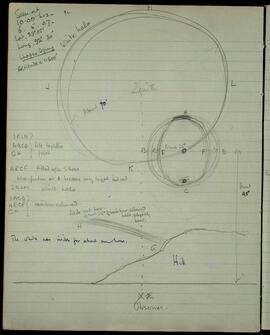
Seen at 10.00 hrs at Lhapso Dzong (Lat. 29° 05', Long. 92° 30', Altitude c 11500'), a white halo and rainbow coloured arcs near the zenith (about 70°) were recorded, with segments noted as JKLM (white halo), ABCD and AECF (rainbow coloured), and GH. The display was visible for about one hour and faded to about 25° of slightly bent, rainbow coloured halo; a hill was about 45°.

CONTENT:
Seen at
10.00 hrs - 9½

    1. 47
      Lat. 29° 05'
      Long. 92° 30'
      Lhapso Dzong
      Altitude c 11500'

White halo
Zenith
About 70°

JKLM }
ABCD } All together
GH } first

AECF Added after ½ hour
When portion at A became very bright indeed

JKLM white halo

ABCD }
AECF } rainbow coloured.
GH }

fade out here:
about 25° of rainbow coloured halo, slightly bent.

The whole was visible for about one hour.

Hill
About 45°

Observer.

LSH/1/1/8/1/71 · Part · 1947-02-20
Part of The Ludlow & Sherriff Collection

SUMMARY:
Notes describe worries about a Kutsap at Showa, poor birding and fatigue, and at Hall a hypsometer reading, Tsongpen’s trip to Gampo Ne, and pilgrims circling a boulder. Further notes list local crops and livestock with reliance on takin across the Po Tsangpo. On 27 Feb the party moved to Dzama with fine views of Namcha Barwa and the Gyala peaks, crossing the Adju La, with arrangements made by the Dingpon of Lome and a wild peach observed.

CONTENT:
to Kongbo out onto Showa, where he is afraid what will happen to him. The 'Kutsap' there apparently holds a wife of his as hostage. This doesn't make him feel any more friendly to the Tibetan official. We found no birds this afternoon, a disappointment after what we saw yesterday. Both of us feel very tired today.

25 Feb. Hall. Fine, but cloudy, with some sun. It rained hard last night, and was very misty this morning, but cleared considerably and looked as if it would clear altogether. Tsongpen went down to Gampo Ne today, but got little or nothing, just one rhodo which had been brought in yesterday. He took the hypsometer with him and got readings: - BP 203.0° F. Temp 48° F. (Ht = 4917') B and I looked for birds and saw very few indeed. There are interesting birds here, but there seem to be very few of them. No sign of any more quail. Nor have I found a skulker which I heard the first day - Horaites, I think. Tsongpen again saw a big green woodpecker with orange buff crest or mantle. There is a big flat, with a large boulder in the middle, round which pilgrims walk.

26th Feb. Hall. Rain again last night and clouded all day today, but just fine. We have got some wheat here, tsatse (millet) and onions. Indian corn is also grown and barley and buckwheat. There does not seem to be a great surplus of anything though. Crops are autumn sown, and are now 10" high. Peas are also autumn sown. A fair number of good cattle, with mithun blood, are kept, but I don't think are ever eaten. The locals depend on wild game, mostly takin, for meat. Takin seem plentiful on the other side of the Po Tsangpo on the left bank of the Tsangpo.

27th Feb. Dzama. Cleared up to a fine day. Views of the Namcha Barwa - Gyala peaks were quite magnificent again and lasted till we had passed the Adju La and got into the forest. All arrangements were well made by the Dingpon. I thought he was a Gyimpon, but he is Dingpon of Lome. A Dingpon has 4-6 gyimpons under him. The only interesting flower seen today was a peach, apparently wild, growing on the edge of a small clearing in the forest, with very fine

LSH/1/1/9/1/79 · Part · 1933-06-18 - 1933-06-19
Part of The Ludlow & Sherriff Collection

SUMMARY:
From Ha-li on 18 June, the party explored the Dirupnang valley toward a pass to Geormotangka, finding notable Primula and Cassiope on wet cliff ledges in mist and rain. On 19 June they remained in camp at Ha-li, planning for the Rhularkarchung Pass, and were awakened at night by a rockfall that came toward the camp, with Lhakpa alerting the party.

CONTENT:
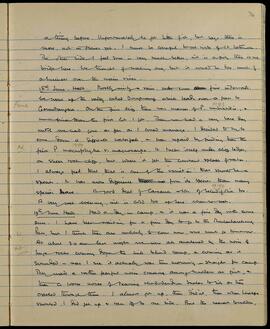
a thing before. Unfortunately he got little seed, but says there is more, not in flower yet. I must be careful to get roots of it later on. The other side I feel sure is very much better, but it is a pity there is no bridge here. We thought of making one, but it would be too much of a business over the main river.

18th June. Ha-li. Mostly misty & rain, with some fine intervals. We went up the valley called Dirupnang which leads over a pass to Geormotangka. On the first cliff there were masses of P. umbratilis (19183), much finer than the first lot I got. Then we had a very bare day until we had gone as far as I could manage. I decided to try to come down a difficult waterfall, & was repaid by finding then the fine P. macrophylla v. macrocarpa (19189). It tucks itself under cliff ledges, on sheer rock cliffs, but where it gets the constant splash of water. I always feel that that is one of the varieties that should be a species. It has more difference from its species than many species have. A good deal of Cassiope also, of bellidifolia (19190) too. A very wet evening, & it is cold too up here when so wet.

19th June Ha-li. Had a day in camp, & it was a fine day with some sun. I have been waiting for a fine day to go to the Rhularkarchung Pass, but I think they are unlikely to come now, so we must go tomorrow. At about 3.0 am last night we were all awakened by the noise of huge rocks coming down the hill behind camp, & coming as it sounded — as I see it actually was this morning — straight for camp. They made a rather fearful noise crashing among boulders at first, & then a worse noise of tearing rhododendron bushes to bits as they crashed through them. I almost got up, then didn't, then when Lhakpa shouted I did get up & ran off to one side. But the nearest boulder,

LSH/1/1/2/1/239 · Part · 1969-04-29
Part of The Ludlow & Sherriff Collection

SUMMARY:
At Hala Sahden the diarist records a hard frost and makes an early ascent toward Warga La and Nyuk-sang La, noting views of the Mayo peaks and Kulu Kangri and a spoiled film pack. They describe Ha people making tea from maple leaves and wood-ash water. On 26 October they march to Taktoo in perfect weather with a porter group composed mostly of women and children.

CONTENT:
118

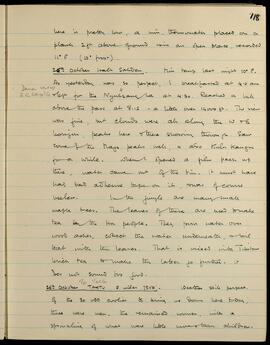
here is pretty low, a min. thermometer placed on a plank 2 ft above ground in an open place, recorded 11° F (19° frost).

25th October Hala Sahden. Min temp last night 10° F.

As yesterday was so perfect, I breakfasted at 4.0 am. Dawa went up to the Warga La. Left for the Nyuk-sang La at 4.30. Reached a hill above the pass at 8.15 - a little over 14000 ft. The view was fine, but clouds were all along the W & E horizon, peaks here & there showing through. Saw some of the Mayo peaks well, & also Kulu Kangri for a while. When I opened a film pack up there, water came out of the tin. It must have had bad adhesive tape on it, & was of course useless. In the jungle are many small maple trees. The leaves of these are used to make tea for the Ha people. They pour water over wood ashes, collect the water underneath, & boil that with the leaves. That is mixed with Tibetan brick tea to make the latter go further. It does not sound too good.

26th October To Taktoo TAKTU 5 miles 7800'. Weather still perfect.

Of the 30 odd coolies to bring us down here today, three were men, the remainder women, with a sprinkling of what were little more than children.

LSH/1/1/8/1/91 · Part · 1938-04-09
Part of The Ludlow & Sherriff Collection

SUMMARY:
The diarist reports failed transport arrangements at Haet Tse, a visit to the Dzong, and a river crossing by kowa, noting river levels and unsettled weather. On moving to Shoka in heavy rain, there were still shortages of pack animals and help; conditions improved as more servants and a helper from the Dzongpon arrived, though Samdup and much of the kit were still missing.

CONTENT:
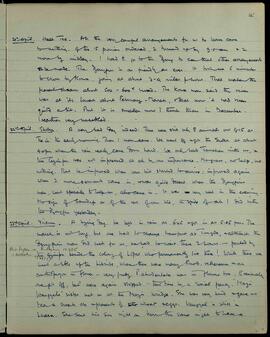
21st April. Haet Tse. All the very careful arrangements for us to leave came to nothing. Of the 15 ponies ordered, 2 turned up by 9.0 am and 2 more by midday. I had to go to the Dzong to see that other arrangements be made. The Dzongpon is as friendly as ever. It took me 6 minutes to cross by Kowa, going at about 3-4 miles per hour. That makes the present stream about 500 - 600 yards broad. The Kowa man said the river was at its lowest about February - March, and that now it had risen quite a bit. But it is smaller now I think than in December. Weather very unsettled.

22nd April. Shoka. A very bad day indeed. There were still only 8 animals out of 15 at Tse in the early morning. Then 1 more came. We went off for the Shoka at about 4.0 pm when the rain really came down hard. We only had Tamchen with us, and the Gyimpu was not impressed at all by our importance. No grass, no help, no nothing. But he improved when our kit started to arrive; improved again when 2 more servants came in, and was quite decent when the Dzongpon's man, sent specially to help us, also came in. It was very wet in the evening. No sign of Samdup or of the rest of our kit, in spite of all I did with the Dzongpon yesterday.

23

LSH/1/1/9/1/101 · Part · 1949-07-12
Part of The Ludlow & Sherriff Collection

SUMMARY:
At Haer, the diarist reports persistent rains and mist, a strenuous climb through gullies yielding no new finds but abundant Primula (including P. macrophylla var. macrocarpa, P. soldanelloides, P. sapphirina, P. tenuiloba, and P. caveana), and intentions to cross toward the Trongsa valley. With the monsoon returning, the diarist remains in camp doing photos while Pasang and Tundru explore a nearby nala; Ngudup’s reports of heavy rains and Tundru’s sore feet are noted.

CONTENT:
One more fine day, before the break comes again. There was lots of rain in the night, and has been since the fine days came. Long may it continue thus. Ngudup always gives such awful accounts of the rain from about now on for a month, that I can hardly expect much more clear weather. Tundru's feet don't improve much. We will miss him, as he always was a good boy, and always for some good things. And he had learnt to press flowers well, though not to change them well.

13th July. Haer. Thick mist in the morning up till 10:00 am, by which time we had climbed one of the awful gullies just below and behind camp. What a climb, and there was nothing new at all. What was there, in greater numbers than I've ever seen, was P. macrophylla v macrocarpa - in the hundred. We looked over the other side, but it was all too misty to see anything. We came down one gully this side of the one we went up, equally steep, and almost as hard work among all the boulders with very unsteady rocks. Again nothing new, but we marked a place where roots of P. soldanelloides could be taken. There were very few in flower, but a number of plants. Beside it grows P. sapphirina, and close to, also P. tenuiloba and P. caveana. The P. caveana up there was remarkably behind time, still in perfect flower. All these days now are disappointing, and I'll be glad to get over the pass to the Trongsa valley. Perhaps it won't be any better, but it will have many new places for us to try in any way.

14th July. Haer. The monsoon is back in all its fierceness again today, with thick mist and heavy rain all day, and last night. But we have had a really good break since the 8th, and can't complain. I again stayed in camp today, did photos, while Pasang and Tundru went out and up the nala on the right bank some distance up, but not too farther up, which leads...

LSH/1/1/3/3/37 · Part · 1937-02-27
Part of The Ludlow & Sherriff Collection

SUMMARY:
The writer notes extensive cultivation in the Ha-chu valley of Bhutan and few interesting finds, recording Fumaria (1160, 1161) and Gentiana capitata (1127). The Dzongpen reports a fast message from Calcutta warning of an impending earthquake amid widespread rumors. A grand magnolia in bloom is noted beyond Shungphu on the Hira Road, and two kalij pheasants are shot.

CONTENT:
16

mornings, clouds very soon appear later on and by midday
are all over the sky. I found nothing of any
interest up here. Most of the country is cultivated: there
is more extensive cultivation in this valley (Ha-chu)
than any other part of Bhutan. Two Fumariaceae were
Fumaria 1160, 1161; Gentiana capitata 1127: 1160 and 1161, both a dull pinkish colour. Gentian 1127 also is
out in many places. The Dzongpen said he had a
special message sent up fast, from Calcutta, to say that
there would be a bad earthquake up here. This is the
day worked out for it. The papers also say Calcutta is
full of rumours about an earthquake, and people are so
ready to believe it all that many have even left
Calcutta. When I was out this evening I found a
Mag. campbellii 1164: grand magnolia tree in full bloom (1164). I have no book
giving descriptions of magnolia and cannot say what it is.
It is about a mile beyond Shungphu on the Hira Road,
on the left at the edge of the thick evergreen forest. On
my way back, I put up 6 kalij and shot a couple of
them - a hen and a cock. The hen bird was a fine
specimen with a good crest, nearly as long as the

LSH/1/1/10/1/18 · Part · 1933-10-01
Part of The Ludlow & Sherriff Collection

SUMMARY:
The diarist reports severe infestation of P. umbratilis seed capsules by caterpillars, difficulty finding other seeds, snow melted up to about 15,500 ft, and the drogpas leaving the high pastures. On 2nd October at Ha-chu, after clear frosty weather, they observed a large herd of burhel, finished work in the Tsampa area (Bumthang Chu watershed), planned to cross to the Dhur Chu to meet Pasang and Yundon, and reflected on concluding Himalayan trips first planned with Ludlow in 1929 at Kashgar.

CONTENT:
From among the seeds of P. umbratilis which I collected today, I extracted 67 caterpillars, which shows the difficulty with seed. Practically every capsule I take now has worms or caterpillars. I can't find any seed of a big Swertia. All capsules have 3-4 red worms in them. None of the aconites were ready yet, and I have had to take roots of some. Snow is not now lying here. It has all melted up to 15500' or so. The drogpas have all gone down from these high grazing grounds, I am surprised to see. They come in the 5th month (July) and leave in the 7th or 8th (Sept). It is a very short season. I sympathize with them going down now, but I think they should come up much earlier, when the grass is good.

2nd October. Ha-chu. This is the best day we have had. There was rain and some snow last night, but it cleared up to a beautiful morning and there was hard frost. Up till midday today there was lovely bright sun, and then huge clouds collected, but it has not snowed, and I should think we will now have several similar days. I got a little more of the same seed today, but nothing special. We walked onto a huge herd of 58 burhel on our way back. And now we have finished with the area called Tsampa, which includes the watershed of the Bumthang Chu, but not the Dhur Chu. Tomorrow we cross to the head of the Dhur Chu, and there meet Pasang and Yundon. It is difficult now to think that we have practically finished our work this year, and that there are now but 5 more days left. In a month I will be in Sikkim. And this is the last of our Himalayan trips, which Ludlow and I started planning in 1929, sitting in front of the fire in the drawing room of the Consulate General in Kashgar.