Showing 6828 results

Archival description
2091 results with digital objects Show results with digital objects
LSH/1/1/4/1/57 · Part · 1933-07-23
Part of The Ludlow & Sherriff Collection

SUMMARY:
After camping in the same garden and awaiting news of Ludlow, the party notes on a halt at Sanga Choling that Ludlow and company had arrived from the other side of the Char La. A lost dog was replaced by a friendly newcomer, and Ludlow secured notable bird specimens and many primulas, with the best collecting on the Lo La and abundant flowers and rhododendrons around the lake.

CONTENT:
twice on the way here. No sign of Ludlow, and no news of him either, but I am hoping he may arrive tomorrow. Camped in the same garden as before.

L. & S. join forces again
3rd August. Halt Sanga Choling. Ludlow & Co arrived on the evening of 30th July, having come from the other side of the Char La, a long march. All very fit: Ludlow pretty thin.

The party only differed in the dogs: Tumshu was fortunately lost, having proved a complete washout. In his place a nondescript bitch - now named Wamo the fox - attached herself. She is a great improvement, full of life & friendly. Ludlow did well. In the bird line, he got two new species - another fulvetta & a woodpecker, & rediscovered an Ixops. He also got 3 juveniles of my wren & two adults. About 150 flowers, including some lovely primulas. And among the primulas are 8 or 10 different to the collection. So we should now have nearer 50 species than 40. On the whole it has been fully worth while our separating. The best ground for collecting seems to have been the Lo La. South of the main range there was nothing. Round the lake, there were a great many flowers, & rather surprisingly a great no. of rhododendrons.
LSH/1/1/2/1/227 · Part · 1934-10-14
Part of The Ludlow & Sherriff Collection

SUMMARY:
The diarist halts at Sanden and makes an early ascent to the Nyungsang La to take bearings and panoramas, noting clear views toward Mago, Milakatung La, and near Tsona after recent poor weather in Bhutan. Mago lamas arrive with some seeds; Danang is sent to the Bum La to collect white Meconopsis and Primulas, while previously bagged seed flowers from July are brought in. Plans and routes for retrieving seed bags and collecting around Bum La, Takpa, Tsona, and Mago are outlined.

CONTENT:
112

retrieve seed bags left in these places. The missing dak is not traced yet, but at least it seems that it has not gone as far from its P.O. as Trashigang.
Danang(?) to Bum La, Takpa and to Tsona, or there to Mago - all to collect seeds.

19th October. Halt Sanden. A perfect day. Mist was low & it rained a spot or two in the evening, then cleared up by 10 pm to a beautiful night. I left in the early morning before light (5:30) & went up quickly to the Nyungsang La to take bearings & panoramas of the country to the North. Rough sketch opposite. The Mago hills (West of Mago) were very fine, but clouded over soon after 9:00 am. I could see to the Milakatung La, & to some hills near Tsona. The air was an absolute treat after all the dampness & beastliness we have had so much of in Bhutan. And it will be fine tomorrow too. When I returned I found the Mago lamas had just arrived & brought some seed. They have no white Meconopsis seeds, but have the small Tulung La one. Also Thalictrum, & an assortment of rubbish which they thought might be of use. But Danang is off (horridus 659) to the Bum La & should get the white Meconopsis up there, besides some Primulas. The seed flowers which I bagged here in July were brought in yesterday. There are only a few, but I think I can get more.

Ludlow p. 148. S. went to the Nyung Sang La for a beautiful view of Tawang & the peaks to the East of it - the same peaks we saw looking West from Mago.

LSH/1/1/2/1/191 · Part · 1933-09-22
Part of The Ludlow & Sherriff Collection

SUMMARY:
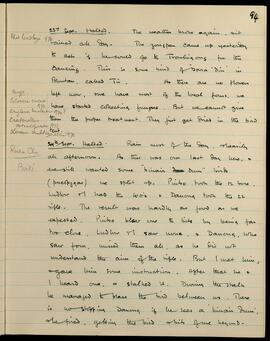
Halted in rain; the Jongpen asked to go to Trashigang for dancing during a Bhutan festival called Tü, and with few flowers or ferns left they began collecting fungi. The next day, still halted at Rocha Chu in heavy rain, the party split up to hunt “binain dum” birds, with Puibo, Ludlow, and Danang taking different guns and achieving mixed results, including a shot that struck both the bird and the narrator.

CONTENT:
94

23rd Sept. Halted. The weather broke again, and it
Rhod. lindleyi 976 rained all day. The Jongpen came up yesterday
to ask if he could go to Trashigang for the
dancing. This is some kind of 'Bara Din' in
Bhutan, called Tü. As there are no flowers
Fungi. left now, and we have most of the local ferns, we
Calocera viscosa 973 have started collecting fungus. But we cannot give
Amylaria himalaica 974? them the proper treatment. They just get dried in the bird
Craterellus cornucopioides 977 tent.
Stereum multizonatum 978

24th Sept. Halted. Rain most of the day, and heavily
Rocha Chu all afternoon. As this was our last day here, and
Birds we still wanted some "binain dum" birds
(puepygas) we split up. Puibo took the 12 bore,
Ludlow and I had the 410's and Danang took the 22
rifle. The result was hardly as good as we
expected. Puibo blew one to bits by being far
too close, Ludlow and I saw none, and Danang, who
saw four, missed them all, as he did not
understand the aim of the rifle. But I met him,
and gave him some instruction. After that he and
I heard one, and stalked it. During the stalk
he managed to place the bird between us. There
is no stopping Danang if he sees a 'binain dum',
and he fired, getting the bird and bits of me beyond.

LSH/1/1/9/1/32 · Part · 1949-05-06
Part of The Ludlow & Sherriff Collection

SUMMARY:
A wet halt day spent scrambling on a steep rock slope near Rip la to observe rhododendrons, notably Rhododendron edgeworthii, anthopogon, and lindleyi, with signs of bear and musk deer but no sightings. Men later brought in masses of R. edgeworthii, and the diarist began a letter to Betty before receiving mail from Kalimpong.

CONTENT:
a number of rhododendrons which are now over, and R. lindleyi
on the side of the Rip la and down a bit was very common. But
it is never easily seen up in the trees where it is happiest.
27th April. Halt. Very wet all night. Fine for three hours this
morning, then heavy rain all the rest of the day. We went to a
cliff opposite, where Rhodos. could be seen. The place is a 45° rock
slope, with no soil on it in places, while in others some trees
and shrubs have managed to find an anchorage. Obviously every now
and then anything on the slope just shoots off to the bottom. It is quite
impossible to climb the smooth slippery rock, but we went up the
between bits with the odd trees and bamboo, and found it very hard
work indeed. There were masses of Rhod. edgeworthii (18777) and
a little higher of Rhod. anthopogon (18776). Otherwise the day was
rather a disappointment. We had to go on up above 2000' and then
down another way. I hope I have at any rate some good photos of
these two species. Nothing else of interest seen, except a lot of Rhod.
lindleyi, which here is almost entirely a ground growing plant. We
came across many fresh marks of both bear and musk deer, but saw
none. When we returned, we found some men had brought
in masses of Rhod. edgeworthii for me. What a beautiful thing
it is, at its best: the buds are rich rose pink, and opened flowers
even retain quite a lot of pink in them. What a pity we
constantly have this miserable weather. Nothing could be more
monsoony than we are now having. Perhaps in the real
season it will be better. I started writing a letter to Betty
this evening, and no sooner had I decided to stop than a mail from
Kalimpong came in. As it contained two letters for Betty, I decided to

LSH/1/1/5/1/59 · Part · 1933-05-09
Part of The Ludlow & Sherriff Collection

SUMMARY:
The diarist describes local opposition to ascending Dungshigon due to fears of hail damaging crops, noting that Pintso mentioned the Tsari pilgrimage to reassure them. On 15 May at Phobshikha, after variable weather, the party explored a cliff and mountain, recording Primula strumosa (3060), Rhododendron triflorum (3061), masses of Primula winteri (3053), and several rhododendron species.

CONTENT:
going up Dungshigon. That has caused some worry. The locals don't like the idea: let the Sahib go anywhere else, some will gladly take him. But if he goes up Dungshigon, it will bring disaster to us in the form of hail, which will ruin our crops. I'm sorry they thought of that. I must go, but this is the time of hail storms. They are certain to come, and I will be blamed for all the damage they do. Pintso has told them how I did the pilgrimage of Tsari, perhaps that will help.

15th May. Halt Phobshikha. Rain last evening and night. Fine today till 4:00 pm, except for a shower or two, then heavy rain. We went across the valley to a grand looking cliff, and three of us went up by different routes, but the only find was Rhododendron triflorum, 3061.

But on the extreme top of the mountain we found 3060, Primula strumosa. It was just out near the top, but in full flower rather lower down. It grows in moss under Abies and Rhododendron. Up there Primula winteri 3053 was in masses. Every time I see that Primula I think it is the prettiest one I have ever seen, and I always feel elated however many times I see it. Rhododendrons are not very numerous here, except a few kinds, Rhododendron arboreum, R. thomsonii and the big R. falconeri.

LSH/1/1/3/3/111 · Part · 1933-04-09
Part of The Ludlow & Sherriff Collection

SUMMARY:
Route described from the right bank past Dotrang to Natrampa, with notes on dense, Bhutan-like jungle and a good camp site. At Natrampa they halt and collect several notable plants, including rhododendrons, a yellow primula, Paraquilegia, and Diapensia, and later find unusual rhododendrons near a cascade along the Lung road.

CONTENT:
The road keeps pretty high over the Right bank, up and down, till about mile 3, when it is 800 ft or so above the valley bed. Here a ridge is crossed, where the path used to go down a ladder. Two miles further on a fair sized village is passed, called Dotrang. The path keeps below this, crosses a small side stream, and leads on more or less level for a while, then down hill to Natrampa. A good Camping Ground just beyond. The jungle gradually becomes thicker and more wet zone-like, till here it is just like Bhutan, on the North face, but dry, except for small watercourses, mostly high falls, where vegetation is dense. On Left bank at a waterfall I saw rhododendron 1346 and a yellow sikkimensis primula 1348, while looking for these found a Paraquilegia 1350 in flower. Lumsden found one or two rhododendrons, and Pinko and Tsongpen came in with a lovely mass of rhododendrons and a Diapensia, from the North face cliff. There is any amount of stuff here, so we stop a day.

27th April. Halt at Natrampa. A really good day. We went out along the Lung road to the first cascade, about a mile downstream. There we found a most unusual red rhododendron 1352, a beautiful mauve one 1354, and an unusual yellow one.

LSH/1/1/6/1/36 · Part · 1933-05-17
Part of The Ludlow & Sherriff Collection

SUMMARY:
The party halts at Molo awaiting coolies and notes conditions on Loda, sowing vegetable seeds with hopes of benefiting on their autumn return (see Sherriff April 19). Detailed route notes describe the Lilung/Langong Chu towards the Tsangpo, bridges, bearings, mileages, a poor camp at mile 8, and a note on Rhododendron dasycladum.

CONTENT:
Halted Molo waiting for coolies & conditions on Loda

Ludlow 39. We are sowing some vegetable seeds here in the hope that we may reap the benefit when we return in the autumn - see Sherriff April 19.

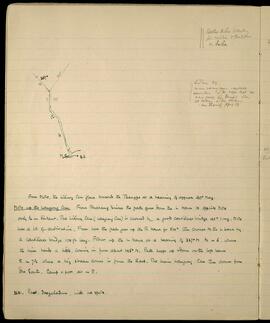
From Molo, the Lilung Chu flows towards the Tsangpo at a bearing of approx 40° Mag.

Molo up the Langong Chu. From Bharang Suika the path goes down the left bank to opposite Molo only ½ mile distant. The Lilung Chu (Langong Chu) is crossed by a good cantilever bridge 40 ft long. Molo has a lot of cultivation. From here the path goes up the right bank for 500 yards then crosses to the left bank by a cantilever bridge 100 ft long. Follow up the left bank at a bearing of 337° M to mile 6, where the river bends a little, coming in from about 145° M. Path keeps up stream on the left bank to mile 7½ where a big stream comes in from the East. The main Langong Chu then comes from due South. Camp very poor at mile 8.

  1. Rhododendron dasycladum, with no spots.
LSH/1/1/5/1/91 · Part · 1933-05-29 - 1933-05-30
Part of The Ludlow & Sherriff Collection

SUMMARY:
The party halts in the Mara Chu valley amid heavy rain, severe damdim flies, and increasing leeches, taking hypsometer readings and collecting rhododendrons including R. rhabdotum and a Maddenii-series specimen (No. 3147). Pintso and the diarist visit the confluence with the Mara Chu; mail is to be sent via Chirang to Sarbhang, and plans are made to return to Phobjikha after one more day.

CONTENT:
extending down the valley for a considerable way. Tenduk has just turned up.

8000ft 29th May. Halt Mara Chu valley. Rained very heavily all last evening almost all the night. No sun today, but fine till 12.0 after which heavy rain onset. Pintso & I went down to the meeting of the path with the Mara Chu, probably rather more than 2 miles from here. Hypsometer readings here were: BP. 203.8°, Temp. 73°. Time 9.0 am. This would be a little lower, if anything than Adao on the L. bank, but there are some houses on the R. bank too. We saw plenty of R. rhabdotum, & I took one specimen of another rhod. under No 3147, which is a Maddenii series, but which I can't make out. It is scarce here, has a beautiful scent, & grows rather like R. rhabdotum. Otherwise the things we got were of no great interest. Trongpen & Tenduk were equally unlucky. As the damdim flies are so awful here, we are only going to stay one more day, & then return to Phobjikha. Leeches fairly numerous, & probably increasing every day now. Pintso will take a small mail to Adao tomorrow, & have it sent off next day via Chirang to Sarbhang.

30th May. Halt. Rained till about midnight heavily. Fine in the morning & most of the day. Damdim flies awful. They seem to get

LSH/1/1/2/1/93 · Part · 1933-07-18
Part of The Ludlow & Sherriff Collection

SUMMARY:
The party halts at Mago to reduce loads and arrange transport for a split, with A. Sheikh baking and preparing meat for Ludlow. Yak meat is dried and salted. The next day the group divides, Ludlow going to Luguthang while the diarist camps in the hills west of Mago near the top of the conifer forest, noting altitude around 13,500 feet and intentions to move higher.

CONTENT:
the only loads they are used to, which are bags of maize, butter or milk. We will halt tomorrow, to cut things down to the minimum outside the meat etc.

31st July. Halt at Mago. To make arrangements for transport split, we had to halt a day here. A. Sheikh is the cook, so he has been busy making bread and cakes, and cooking meat for Ludlow to take. As it has been a good day, we have hung up the yak meat in strips to dry. The tongue is being salted, and all arrangements made to keep as much meat as possible.

1st August. CAMP in hills W. of Mago CHERA 6 miles. Height approx 13500'. We split up this morning, Ludlow going to Luguthang, and I coming here. He left with yak transport, while I had to take coolies. But although the locals said that yaks could not reach here, they loaded up half the loads on yaks, and only had to carry them for a couple of hundred yards. This place is up a side valley leading to the west, from about 2 miles N. of Mago. Camp is pitched just at the top of the conifer forest, among rhododendrons. I reached here at 11:30, but I do not think I am high enough, and want to get on tomorrow further up onto the South. No information was available about this place at all; but now it seems several

LSH/1/1/2/1/98 · Part · 1933-07-18
Part of The Ludlow & Sherriff Collection

SUMMARY:
The party halts at Lukuthang and concludes the Mago district must be abandoned due to the late season. They expect little elsewhere, though hope to find a few early specimens between the Pö La and the Me La.

CONTENT:
Ludlow p. 76. Halt at Lukuthang - "a vile day"
"I'm afraid the Mago district must be given up as a
failure. A pity, for we had wanted the best part
of a season at it, it is too late now to hope for much
in other areas. We may get a few early things between
the Pö La & the Me La but we cannot expect much."