Showing 6828 results

Archival description
2091 results with digital objects Show results with digital objects
LSH/1/1/9/1/29 · Part · 1949-05-06
Part of The Ludlow & Sherriff Collection

SUMMARY:
Cold, clear halt day in camp plagued by ticks and foul water. Betty was to cross the Dongala la while the diarist and Pasang attempted collections, securing Primula listeri filipes and noting seven primula species so far. Wind scattered drying papers, later recovered by Bhutanese from the camp.

CONTENT:
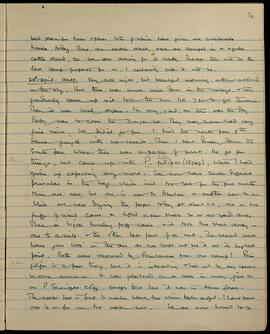
bad place for ticks and fleas, both of which have given me considerable trouble today. There are cattle about, and we are camped in a regular cattle stand, so we are asking for it really. Perhaps this will be the last camp prepared for us. I certainly hope it will be.

24th April. Halt. Very cold night, but beautiful morning, without a cloud in the sky. But there was much mist down in the valleys, and this gradually came up and it took the sun till 7.30 to get through. Then it was lovely again. I'm very glad, as this was the day Betty was to cross the Dongala la. They may have had very fine views. We didn't go far. I tried the north face of the dense jungle with no result. Then I sent Pasang down the south face where there was a patch of forest. He got few things, but came up with P. listeri filipes (18749), which I had given up expecting any more. We now have seven different primulas in the bag, which isn't too bad for the first month. None are new, but one is new to Bhutan, and another new to us.

While we were drying the paper today at about 1.0, one or two puffs of wind came and lifted a few sheets 30 or 40 yards away. Then a bigger twirling puff came, and it took two sheets away — one 1/2 a mile and the other best part of a mile. The second must have gone 1000' in the air, as we could not see it at its highest point. Both were recovered by Bhutanese from our camp!

Prim. listeri filipes is a poor thing, but it is interesting that it has not by any means become common. It was plastered on a rock in moss, just as on P. Sherriffae cliff, except that here it was in dense forest.

The water here is foul. It makes black tea which tastes awful. I have sent over 1/2 mile for our tea water now. We are now bound to go

LSH/1/1/3/3/121 · Part · 1933-04-09
Part of The Ludlow & Sherriff Collection

SUMMARY:
The party halted while Purbo and Danong were sent to explore beyond the previous day’s route; Lopa traders carrying madder en route to Tirim visited the camp, were photographed, and their attire was described. Weather held until evening rain, and a decision was made to return to Charme rather than go up the Char River. The following day they marched to Natrampa but saw nothing of note.

CONTENT:
30th April. Halt. I did not go out today, but sent Purbo and Danong up beyond where I reached yesterday. In the morning some Lopas arrived here with loads of madder, going up to Tirim. They were at first frightened, but soon became quite happy, and eventually allowed us to photograph them. They are Abors of some kind. Some had most wonderful headdresses on, made of fibre stained black, and falling down over the back. Others had the little neatly woven bamboo hat with a small spout at the back. It is used either as a hat or as a drinking cup - very neat. Others wore very little indeed. Some were much bigger and stronger looking than others. The smaller ones cannot have been more than four feet high.

The route I was on yesterday leads to the Chupung La. Danong returned in the evening, but with no flowers at all - a great disappointment. I was sure something good would come from up there, but he could see nothing, except a primula or two which was just coming up. Today was fine again till the evening, when it rained a little, but nothing to worry about. Decided to return to Charme, not go up the Char River to Charme.

1st May. Natrampa. 7 m. Overcast, but no rain. Saw nothing.

LSH/1/1/9/1/85 · Part · 1949-06-30
Part of The Ludlow & Sherriff Collection

SUMMARY:
The writer reports that meat set aside by Lhahpa was stolen overnight, likely by a dog, while Lhahpa suspects passing Tibetans. A letter from Rani Chuni relays that H.H. says the Maharajkumar may go to England with them for several months, prompting logistical concerns; on 27 June they halt, deem the area poor after working all surrounding valleys, plan to leave tomorrow, and note certain plants absent here but present at the Mela.

CONTENT:
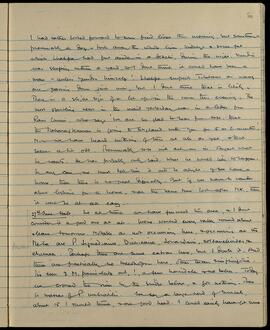
I had rather looked forward to some fried liver this morning, but something - presumably a dog - took away the whole liver, kidneys & some fat which Lhahpa had put aside in a dekchi, during the night. Yundru was sleeping within a yard, so I don't think it could have been a man - unless Yundru himself! Lhahpa suspects Tibetans as many are passing down just now, but I don't think that is likely.

There is a slight sign of a let up in the rain this evening. The most startling news in the mail yesterday was in a letter from Rani Chuni, who says 'we are so glad to hear from H.H. that the Maharajkumar is going to England with you for 5 or 6 months'. Now we have heard nothing of this at all as yet, which seems a bit odd. Presumably H.H. will ask us in August what he wants. He has probably only said what he would like to happen. In any case we must tell him it will be alright. If we have a house, then there is no real difficulty. But if we have to wander about looking for a house, & at the same time look after M.K., then it won't be at all easy.

27th June Halt. We all think we have finished this area, & I don't consider it a good one at all. We've worked every valley round about & leave tomorrow. Notable as not occurring here, & occurring at the Mela are P. sikkimensis, dich

LSH/1/1/5/1/117 · Part · 1870-03-15
Part of The Ludlow & Sherriff Collection

SUMMARY:
The diarist records abundant Primula species near camp between two passes on the way to Wangchelabh, noting P. stirtoniana (No. 3258), P. obliqua (3257), and others, with P. umbratilis not yet flowering and a small nivalis primula of special interest. During a halt at Tsophu and Dungchewang they experienced rain and thunder with brief views of snow mountains toward Tibet.

CONTENT:
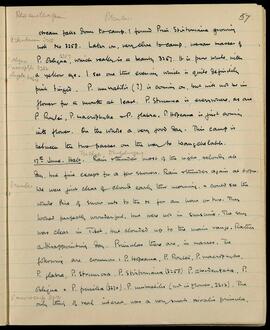
Rhododendron Primulas 57

...stream falls down to camp. I found Primula stirtoniana growing well No. 3258. Later on, very close to camp, we saw masses of P. obliqua, which really is a beauty 3257. It is pure white, with a yellow eye. I see one this evening which is quite definitely pink tinged. P. umbratilis (?) is coming on, but will not be in flower for a month at least. P. strumosa is everywhere, as are P. roylei, P. macrophylla and P. glabra. P. hopeana is just coming into flower. On the whole a very good day. This camp is between the two passes on the way to Wangchelabh.

17th June. Halt. Tsophu. Dungchewang. Rain and thunder most of the night, and cloudy all day, but fine except for a few showers. Rain and thunder again at 6:00 pm. We were just clear of clouds early this morning, and could see the white line of snow mountains to the N for an hour or two. They looked perfectly wonderful, but were not in sunshine. The sky was clear in Tibet, but clouded up to the main range. Rather a disappointing day. Primulas there are, in masses. The following are common: P. hopeana, P. roylei, P. macrophylla, P. glabra, P. strumosa, P. stirtoniana (3258), P. atrodentata, P. obliqua and P. pusilla (3270). P. umbratilis (not in flower, 3213). The only thing of real interest, was a very small nivalis primula,

LSH/1/1/2/1/59 · Part · 1933-07-08
Part of The Ludlow & Sherriff Collection

SUMMARY:
The party halts at Tsona, moving from an unsuitable hovel to a happier campsite above the village, drying gear in rare sunshine. They exchange visits with two accommodating dzongpens, discuss a possible trip to Lhasa, arrange to go to Mago on the 19th, and note Dawa’s and the ailing but recovering Kuntup’s arrival. Botanical observations include new primula, saxifrage, and gentian, with dwarf pink rhododendron on bare hills and snowy peaks west of Tsona.

CONTENT:
28

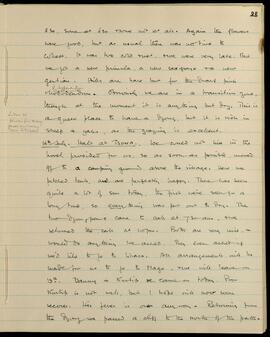
5:30, some at 6:30, some not at all. Again the flowers were good, but as usual there was no time to collect. It was too cold and wet, and we were very late. But we got a new primula, a new saxifrage, and a new gentian. Hills are bare but for the dwarf pink rhododendron (R. hypenanthum). Obviously we are in a transition zone, though at the moment it is anything but dry. This is a queer place to have a dzong, but it is rich in sheep and yaks, as the grazing is excellent.

Ludlow 44. There are fine snowy peaks overlooking Tsona to the west.

16th July. Halt at TSONA. We could not live in the hovel provided for us, so as soon as possible, moved off to a camping ground above the village. Here we pitched tents, and are perfectly happy. There has been quite a lot of sun today, the first we've seen for a long time, so everything was put out to dry. The two dzongpens came to call at 7:30 am, and we returned the call at 1:00 pm. Both are very nice, and would do anything we asked. They even asked if we'd like to go to Lhasa. All arrangements will be made for us to go to Mago, and we will leave on the 19th. Dawa and Kuntup came on today. Poor Kuntup is not well, but I hope will now soon recover. His fever is over anyway. Returning from the dzong we passed a cliff to the north of the path—

LSH/1/1/1/1/85 · Part · 1933-07-11
Part of The Ludlow & Sherriff Collection

SUMMARY:
Notes leech-bite injuries and a halt at Trongsa with a visit to the Dzong and lunch with Dorji, followed by archery and photo work. The next day they march to Gye Tsa via Yuto La, collect plants, and describe contrasting vegetation across the pass.

CONTENT:
40

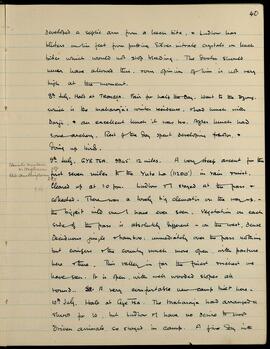
developed a septic arm from a leech bite, & Ludlow has
blisters on his feet from putting silver nitrate crystals on leech
bites which would not stop bleeding. The doctor should
never have allowed this. Our opinion of him is not very
high at the moment.

8th July. Halt at TRONGSA. Fair for half the day. Went to the Dzong,
which is the Maharaja's winter residence, & had lunch with
Dorji, & an excellent lunch it was too. After lunch had
some archery. Rest of the day spent developing photos, &
doing up bird.

9th July. GYE TSA. 9845' 12 miles. A very steep ascent for the
Clematis montana
V. tongluensis 252
Rhod. camelliiflorum 253
RH
first seven miles to the Yuto La (11200') in rain & mist.
Cleared up at 1.0 pm. Ludlow & I stayed at the pass &
collected. There was a lovely big clematis on the way up -
the biggest wild one I have ever seen. Vegetation on each
side of the pass is absolutely different - on the west, dense
deciduous jungle & bamboo: immediately over the pass nothing
but conifers & the country much more open, with pasture
here & there. This valley is far the finest & richest we
have seen. It is open, with well wooded slopes all
round. A very comfortable new camp built here

LSH/1/1/8/1/35 · Part · 1933-12-23 - 1933-12-24
Part of The Ludlow & Sherriff Collection

SUMMARY:
Notes on pine species near the river and collection of Ward's lily bulbs; very cold by the bridge below Trongchu Dz. Halt days are spent in camp developing photos and unpacking a working thermograph, with views toward the Sobhe la; awaiting Ludlow and Elliot while the Dzongpon, a monk, is present, and more animals and kit arrive with a note from Ludlow.

CONTENT:
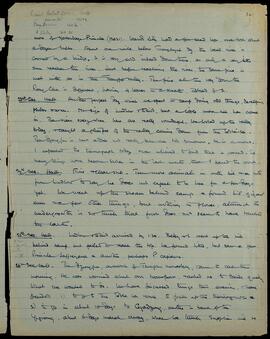
Pinus tabuliformis 12028
Armandii 12029
Tsuga dumosa 12030
P. whitei 12021

More of yesterday's Primula (12021). Ward's lily had a few seeds left and we took about a dozen bulbs. About one mile below Trongchu Dz, the local river is crossed by a bridge. It is very cold indeed down there, as only a very little sun reaches the river. Just before reaching the river, the same pine is met with as in the Tsangpo valley. The pine all the way down the Rong Chu is different, having 4 leaves in a sheath, instead of 2.

23rd Dec. Halt. Another perfect day, which we spent in camp doing odd things, developing photos and so on. No sign of Ludlow and Elliot, but a little more help has come in. The views everywhere here are really wonderful. We looked up the valley today, and caught a glimpse of the valley coming down from the Sobhe la. The Dzongpon is here and does not really take over till tomorrow. He is a monk. I unpacked the thermograph today, and was relieved to find that it worked. So many things have become broken in the last months, that I feared the worst.

24th Dec. Halt. Fine and clear still. Ten more animals in with kit and a note from Ludlow to say he does not expect to be here for a few days yet. We went up the

LSH/1/1/1/1/177 · Part · 1933-09-05
Part of The Ludlow & Sherriff Collection

SUMMARY:
On 7th September the party halted at Towa, met and lunched with the local jongpen, and confirmed plans to take the Lalung–Munda–Ling route. On 8th September they marched to Lalung, describing the good path, the Lhobrak valley, and a camp near the monastery, and discussed hopes for the Tashi Lama’s return to Tibet, a matter Williamson is expected to raise at Lhassa.

CONTENT:
getting pay. When a jongpen travels, he pays nothing on
the way, but has free transport wherever he goes.

7th September. Halt at Towa. We lazed in the morning waiting
for the summons to eat with the jongpen. He came himself
about 11:30, and after his visit we went up to the Dzong to
lunch. It was the usual pleasant meal of gyatu with
Chang - very excellent and satisfying. The jongpen is a nice
young man of 32, and was very obliging to us. I think
he would let us go by any route we wanted to. At any
rate the Lalung - Munda - Ling route is decided on.

8th September. To LALUNG 13,250' 8 miles. The path is good and
direct the whole way to Lalung. For the first 3 1/2 miles it
is through the Towa cultivation, then across stony waste land
to m 5 1/2 where the Lhobrak valley narrows to a gorge. At
m 7 the valley again broadens out and cultivation
is met. Lalung monastery lies on the left bank, and the
river is crossed by a bridge opposite the monastery. A very
good camping ground is in a willow garden in front of the
monastery. Water and fuel ample. Yesterday during
lunch we asked the jongpen whether he thought the
Tashi Lama would return to Tibet. This is one of the
things Williamson will certainly have to discuss at
Lhassa. The jongpen was full of hope, as a great
number of Tibetans are. One of the reasons he gave

LSH/1/1/2/1/163 · Part · 1933-08-30
Part of The Ludlow & Sherriff Collection

SUMMARY:
Camped at Tobrang in the Bashiyang Valley, the party plans a seven-day stay, dismisses the coolies, and notes leech problems and severely disorganized mail. Pimbo goes to T'gong to investigate the missing mail, while the diarist spends the day birding near camp and reports Ahmed Sheikh’s quick recovery. Heavy Bhutan–Tibet barter traffic is observed, and plant collections are listed.

CONTENT:
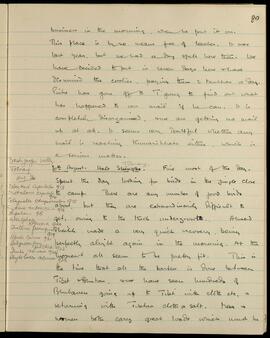
business in the morning, when he put it on.
This place is by no means free of leeches. It was last year, but we had a dry spell here then. We have decided to put in seven days here & have dismissed the coolies, paying them 2 tankhas a day. Pimbo has gone off to T'gong to find out what has happened to our mail if he can. It is completely disorganised, & we are getting no mail up at all. It seems very doubtful whether any mail is reaching Kumarikhata either, which is a serious matter.

Bashiyang Valley.
Tobrang
Aug. 30
Osbeckia capitata 913
Crotalaria capitata 914
Selaginella chrysocaulos 915
Erythrina arborescens 916
Impatiens 918
Adenophora khasiana 920
Shuteria ferruginea 919
Apios carnea 921
Didymocarpus pulchra 923
Inula nervosa 924
Phytolacca acinosa 926

30th August. Halt Tobrang. Fine most of the day.
Spent the day looking for birds in the jungle close to camp. There are any number of good birds about, but they are extraordinarily difficult to get, owing to the thick undergrowth. Ahmed Sheikh made a very quick recovery, being perfectly all right again in the morning. At the moment all seem to be pretty fit. This is the time that all the barter is done between Tibet & Bhutan, & we have seen hundreds of Bhutanese going up to Tibet with cloth etc, & returning with Tibetan cloth & salt. Men & women both carry great loads which must be

LSH/1/1/2/1/155 · Part · 1933-07-18
Part of The Ludlow & Sherriff Collection

SUMMARY:
The party halted at Shingbe in heavy rain, arranged outgoing mail via two men from Tiyangpi, and spent the morning collecting birds and noting flowering plants. Ludlow and the diarist obtained several birds including a young Heteroxenicus stellatus, while Dancong located Meconopsis sinuata and marked other plants; a family of Tibetans was also present. A short list of target plants with collection numbers is noted.

CONTENT:
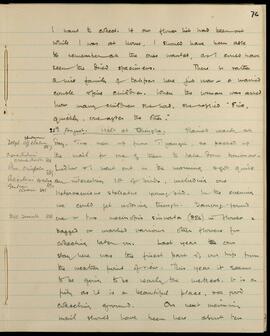
76

I want to collect. If our flower list had been out while I was at home, I should have been able to remember all the ones wanted, as I could have seen the dried specimens. There is rather a nice family of Tibetans here just now — a married couple & five children. When the woman was asked how many children she had, she replied "Five, quickly, one after the other."

25th August. Halt at Shingbe. Rained nearly all day. Two men up from Tiyangpi, so packed up the mail for one of them to take down tomorrow. Ludlow & I went out in the morning & got quite an interesting lot of birds, including one Heteroxenicus stellatus young bird. In the evening we could get nothing though. Dancong found one or two Meconopsis sinuata (886) in flower & bagged or marked various other flowers for collecting later on. Last year our stay here was the finest part of our trip from the weather point of view. This year it seems to be going to be nearly the wettest. It is a pity as it is a beautiful place, & a good collecting ground. Our next incoming mail should have been here about ten

Delph. bhutanicum afflatum 887.
Cremanthodium 888.
Prim. crispata 889.
Pedicularis excelsa 890.
Gentiana clivorum 891.
Mec. sinuata 886.