Showing 6828 results

Archival description
2091 results with digital objects Show results with digital objects
Hamburg Botanic Garden
GB 235 HBG · Item · 1820 - 1822

• 1 short handwritten narrative regarding the foundation of Hamburg Botanic Garden by Prof. C. Lehmann between 1820 and 1822. There is no author's name or date but it is an expert description of the contents of the Hamburg Botanic Garden.

Hamburg Botanic Garden
LSH/1/1/8/1/55 · Part · 1947-01-13
Part of The Ludlow & Sherriff Collection

SUMMARY:
Entries for early February describe halts near Laka, arrival of loads, and cordial interactions with locals who report oppression by soldiers and taxes to Kanam. The author notes bird observations and hunting attempts, mentions an iron mine near Chara, sends Lahu to search for game, asks the Tonse headman for Crossoptilon, and records geographic details around Makutang, Sibhe La, and Temo Channa.

CONTENT:
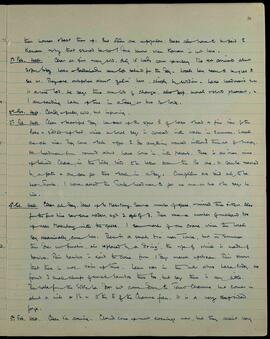
...their houses and beat them up. But others are unpopular: taxes also have to be paid to Kanam; why that should be so I don't know when Kanam is not here.

1st Feb. Halt. Clear at first and very cold. Only 15 loads came yesterday. The rest arrived about 3:00 pm today. Lahu and Balbahadur were left behind for the day. Locals here seem to be glad to see us. They are outspoken about 'zulm' here, chiefly by soldiers. Laka headman's son is a nice lad. He says there are lots of 'Chaugai', also 'kap', monal and blood pheasant. I am sending Lahu up there in a day or two to look.

2nd Feb. Halt. Cloudy and pretty cold, but improving.

3rd Feb. Halt. Clear and beautiful day. We went up the spur East of Laka and had a fine view of the lake and silted up bed, which a local says is covered with water in summer. Locals are all nice. They come and talk and offer to do anything wanted without thought of money. All headmen from round about have come in, with presents. There is an iron mine up behind Chara in the hills, said to be better than the Be one. It can be reached by a path and one can get there and back in a day. Crossoptilon are said only to be near Tonse. I have asked the Tonse headman to get me one or two and he says he will.

4th Feb. Halt. Clear all day. Went up to Makutang. Saw a number of geese, missed three sitters. Also for the first time saw some waders, got 2 out of 3. There were a number of mallard too up near Makutang with the geese. I saw marks of one crane, which the locals say occasionally come here. There is a small 'tru' near Tonse, but in summer this does not function, is replaced by a 'dring', the rope of which is made of bamboo. This bamboo is said to come from 1 day's march upstream. This shows that there is more rain up there. Lahu was in the hills above Laka today. He found 3 small clumps of small bamboo there too, but says there is very little. The nala from the Sibhe La does not come down to Temo Channa, but comes in about a mile or 1 1/2 miles to the East of the Channa fan. It is a very steep sided gorge.

5th Feb. Halt. Clear till evening. Clouds come up most evenings now, but they aren't very...

LSH/1/1/9/1/65 · Part · 1949-06-01
Part of The Ludlow & Sherriff Collection

SUMMARY:
The party halted for several days, searching in different directions but finding few plants, notably P. alpicola v. luna and Mec. sinuata just coming into flower. With the area yielding little, they plan to move to Gormotangha, whose lower elevation and cliffs may be more promising; Yumden brought in two young blood pheasants.

CONTENT:
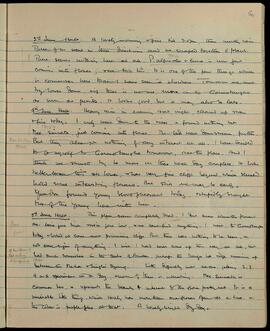
3rd June Halt. A lovely morning and fine till 3:00 pm, then mostly rain. Three of us went in three directions and we scraped together 6 plants. There seems nothing here at all. P. alpicola v. luna is now just coming into flower, river bank. It is one of the few things which is commoner here than I have seen it elsewhere. Tomorrow we must try lower down, and if that is no use, move on to Gormotangha as soon as possible. It looks good, but it may also be late.

4th June. Halt. Heavy rain in evening, last night, cleared up and was fine today. I only went down to the river, and found nothing but Mec. sinuata, just coming into flower. The lads went downstream, further. But they also saw nothing of any interest at all. I have decided to go myself to Gormotangha tomorrow, see the place. And I think we should try to move on there next day complete. It looks better than this and is lower, has very fine cliffs beyond, which should hold some interesting flowers. But still we may be early. Yumden found young blood pheasant today, stupidly brought two of the young here with him.

5th June Halt. This place seems completely dead. I don't know where the flowers are. We've gone high and we've gone low, and we can't find anything. I went to Gormotangha today and looked at some most promising cliffs. But there was nothing to

LSH/1/1/9/1/63 · Part · 1949-06-01
Part of The Ludlow & Sherriff Collection

SUMMARY:
High-altitude collecting around 14,000 ft yielded several small plants and a lake, with monal and burhel observed. The diarist notes mail delays, sends letters and parcels to H.H., Raja Dorji, and Betty during a halt, then crosses the Hubsing La to reach Kantanang in wet monsoon weather.

CONTENT:
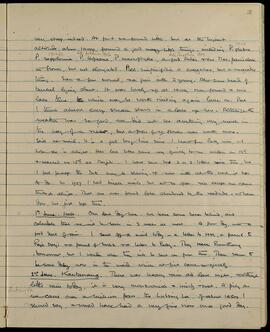
very steep indeed. At first we found little, but at the highest altitude, about 14000, found a good many little things, including P. glabra (19011), P. sapphirina (19025), P. hopeana (Lud. Sherriff 19030), P. macrophylla, a good Aster and one Mec. paniculata (Lud. Sherriff 19019) in flower, but not elongated. Plec. simplicifolia is everywhere, but a miserable thing. Saw a few monal, and a pair with 3 young. Also some heads of burhel lying about. It was lovely up at 14000, and we found a nice lake there, the which may be worth visiting again later on. But I think almost every stream starts in a lake up here. Although the weather was so good, we did not see anything very much in the way of a view, but a press of flowers was worth more.

Still no mail. It is a good long time since I heard from Betty now, and I hope she is alright. Her last letter came very quickly to me, written on 13th and reached me 15th at Menjisi. I have sent her 2 or 3 letters since then, but I feel perhaps the dak may be slowing up now with all the work it has to do. In 1937 I had bigger mails, but not so often, and all except one came through alright. That one was found later abandoned by the roadside - no harm done, but just left there.

1st June. Halt. Our last day here. We leave some boxes behind, and calculate that we will be back in 3 weeks at most. A poor day, with a good deal of rain. I sent off a mail today - a letter to H.H., a parcel to Raja Dorji and a parcel of books and a letter to Betty. They reach Bumthang tomorrow, but I wonder when they will be sent on from there. There seems to be some delay now in the mails, which at first came so quickly.

2nd June. Kantanang. There was heavy rain all last night, and although little rain today, it is very monsoonish and misty and wet. A pity as we came over a hellish pass, the Hubsing La, of about 14500 I should say, and would have had a very fine view on a good day.

LSH/1/1/3/3/13 · Part · 1936-02-09
Part of The Ludlow & Sherriff Collection

SUMMARY:
The diarist halts while Tobgye departs to meet Gould at Rangiya and then proceed to Shillong regarding Bhutan boundary matters, expressing concern over Gould’s treatment of Tobgye amid unsettled weather. Plans are made to go to Chungkar after hearing rhododendrons are out, a fishing trip is undertaken, and a wire from Mary reports the diarist’s mother has died; the Trashigong Dzongpon also departs.

CONTENT:
19th Feb. Halt. Tobgye stayed up till this afternoon, when he went off about 2.0 pm. He has to meet Gould at Rangiya & then go to Shillong to discuss Bhutan boundary questions. I don't much like what I hear about Gould, as he treats Tobgye rather like a 3rd grade clerk. We have queer kind of weather, thunder every day & night, some rain & some sun.

20th Feb. I hear that rhododendrons are out in Chungkar. We have decided to go on there on 22nd. I wonder if any other flowers will be out too. Here there is nothing. We went down this morning to the river NW of here & fished with the spoon, catching several fish which resemble mahseer, & which played quite well. It thundered & rained all night, & today has been more or less fine till 4.30 pm, when very heavy hail & rain with thunder came on. We returned at 2.0 pm & heard from Mary wire to say Mother had died. She must have been glad to get away from all her pain at last. Yesterday the Trashigong Dzongpon went off too. He wanted to meet us in his district, but we

LSH/1/1/5/1/105 · Part · 1937-06-07
Part of The Ludlow & Sherriff Collection

SUMMARY:
After heavy rain and hail, the writer explored near camp, noting Primula hopeana, saxifrages, and a Primula boothii believed to match last year’s variety from the Nyuhsangha in East Bhutan, with plans to collect it on the descent. On 7th June, a halt day brought a perfect morning followed by afternoon storms, and several Primula species were recorded, including elongata, hopeana, kingii, sapphirina, and tsariensis, along with the new variety of P. boothii.

CONTENT:
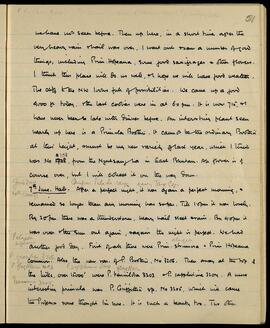
we have not seen before. Then up here, in a short time after the very heavy rain and hail was over, I went out and saw a number of good things, including Primula hopeana, some good saxifrages and other flowers. I think this place will do us well, and hope we will have good weather. The cliff to the NW looks full of possibilities. We came up a good 4000 ft today. The last coolies were in at 6.0 pm. It is now 7.15, and I have never been so late with dinner before. An interesting plant seen nearly up here is a Primula boothii. It cannot be the ordinary boothii at this height, and must be my new variety of last year, which I think was No. 1178, from the Nyuhsangha in East Bhutan. All flower is of course over, but I will collect it on the way down.

7th June. Halt. After a perfect night, it was again a perfect morning, and remained so longer than our morning has so far. Till 1.0 pm it was lovely. By 2.0 pm there was a thunderstorm, heavy hail, sleet and rain. By 4.0 pm it was over and the sun out again, and again the night is perfect. We had another good day. First of all there were Primula elongata and Primula hopeana common. Also the new variety of P. boothii, No. 3206. Then away at the top of the hills, over 15000' were P. kingii 3203 and P. sapphirina 3204. A more interesting primula was P. tsariensis No. 3205, which will cause the Professor some thought I'm sure. It is such a beauty too. Two other

LSH/1/1/3/3/223 · Part · 1936-07-01
Part of The Ludlow & Sherriff Collection

SUMMARY:
The diarist struggles to collect flowers due to a shortage of paper, sending Tenduk to seek supplies, and observes local dances with animal costumes while taking limited film and a color photo. On 1 July, departure is delayed by lack of transport amid movements of people from Lhasa and Dzongpens, so they explore up the valley south of Sangacholing, finding it dry and unpromising.

CONTENT:
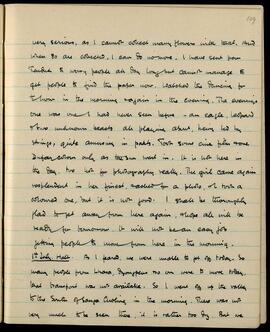
very serious, as I cannot collect many flowers with that. And when 80 are collected, I can do no more. I have sent poor Tenduk to worry people all day long but cannot manage to get people to find the paper now. Watched the dancing for half an hour in the morning and again in the evening. The evening's one was one I had never seen before - an eagle, leopard and two unknown beasts all prancing about, being led by strings, quite amusing in parts. Took some cine film and one Dufaycolour only as the sun went in. It is hot here in the day, too hot for photography really. The girl came again resplendent in her finest, and asked for a photo, so I took a coloured one, but it is not good. I shall be thoroughly glad to get away from here again, and hope all will be ready for tomorrow. It will not be an easy job getting people to move from here in the morning.

1st July. Halt. As I feared, we were unable to get off today. So many people from Lhasa, Dzongpens and so on were to move today, that transport was not available. So I went off up the valley to the South of Sangacholing in the morning. There was not very much to be seen there, it is rather too dry. But we

LSH/1/1/3/3/173 · Part · 1983-05-05
Part of The Ludlow & Sherriff Collection

SUMMARY:
The party halted near Migyitun, explored east up the valley to the Tsokar lake via the Nga La and Pang La, and collected game while noting Primula species abundant around 13,000 ft amid continuous rain. A mix-up over a horse with the headman occurred earlier, and on a subsequent rainy halt day they stayed in to pack and finally received a long-awaited mail.

CONTENT:
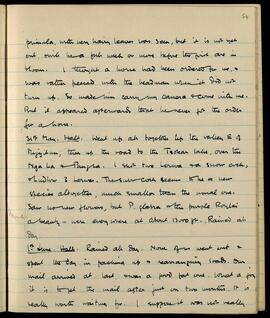
Primula, with very hairy leaves, was seen, but it is not yet out; it will be a full week or more before the first are in bloom. I thought a horse had been ordered for me, and was rather peeved with the headman when it did not turn up. So I made him carry my camera and come with me. But it appeared afterwards that he never got the order for a horse.

31st May. Halt. Went up all together up the valley E of Migyitun, then up the road to the Tsokar lake, over the Nga La and Pang La. I shot two Lerwa and a snow cock, Ludlow 3 Lerwas. The snow cock seems to be a new species altogether, much smaller than the usual one. Saw no new flowers, but P. glabra and the purple Roylei — a beauty — were everywhere at about 13,000 ft. Rained all day.

1st June. Halt. Rained all day. None of us went out and spent the day in packing up and rearranging loads. Our mail arrived at last, and was a good fat one. What a joy it is to get the mail after just on two months. It is really worth waiting for. I suppose it was not really

LSH/1/1/3/3/179 · Part · 1983-05-05
Part of The Ludlow & Sherriff Collection

SUMMARY:
Entries describe halt days with valley explorations near a waterfall, noting Meconopsis bella not yet open, an iris with a very long tube, and abundant primulas. A hypsometer reading was taken at Bimbi La amid snow and rain, followed by a fine day in camp.

CONTENT:
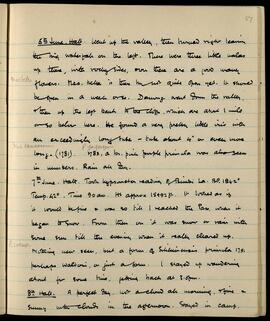
6th June. Halt. Went up the valley, then turned right leaving the big waterfall on the left. There were three little nalas up there, with rocky sides, over there are a good many flowers. Meconopsis bella is there but not quite open yet. It should be open in a week or so. Danuong went down the valley, then up the left bank to the cliffs, which are about 1 mile or so below here. He found a very pretty little iris with an exceedingly long tube - tube about 4" or even more long. (1781). Iris kemaonensis. 1783, a bright pink purple primula (P. yargongensis) was also seen in numbers. Rain all day.

7th June. Halt. Took hypsometer reading of Bimbi La. BP. 184.2° Temp. 42°. Time 9.0 am. Ht approx 15492 ft. It looked as if it would be fine & was so till I reached the Pass, when it began to snow. From then on it was snow or rain with some sun till the evening when it really cleared up. Nothing new seen, but a form of Sikkimensis primula (1791) perhaps waltonii, or just a form. (P. vicosa). I stayed up wandering about for some time, getting back at 3.0 pm.

8th Halt. A perfect day, not a cloud all morning, & fine & sunny with clouds in the afternoon. Stayed in camp,

LSH/1/1/8/1/83 · Part · 1947-03-20
Part of The Ludlow & Sherriff Collection

SUMMARY:
The party halts for several days in a valley on the right bank of the river, noting delayed flowering compared to Tongkyuk and recalling the 1933 flood from a lake on the Munkhu Phu Chu. They describe routes toward Munkhu La and Yigong, observe various birds, and report activities including Akong collecting specimens, Tsongpen traveling to Sobhe La to repair a thermograph, and Bill ascending above camp but finding little in flower.

CONTENT:
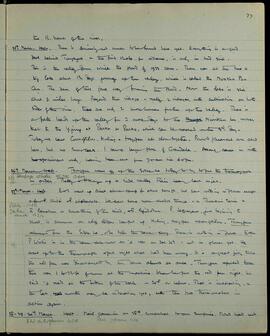
the R. bank of the river.

25th March. Halt. There is obviously not much to be found here yet. Everything is a good deal behind Tongkyuk — the pink rhodo, for instance, is only in bud still. This is the valley down which the flood of 1933 came. There was at the time a big lake about 1 1/2 days journey up this valley, which is called the Munkhu Phu Chu. The dam of this gave way forming the flood. Now the lake is still about 3 miles long. Beyond this village — really 2 villages, with cultivation on both sides of the river, there are only 2 more houses further up the valley. There is a path leads up the valley for 3 more days to the Munkhu la, over that to the Yigong at Parka or Parke, which can be reached on the 4th day. Today we saw Crossoptilon, kuling & tragopan all close together. Blood pheasant are also here, but no snowcock. I saw a large flock of Grandala. Akong came in with two specimens only, having been out from 7.0 am till 6.0 pm.

26th March Halt. Tsongpen went off up the Sobhe la today to try to put the thermograph in order. Betty & Akong up a side valley. Rain heavy last night.

27th March. Halt. Bill went up direct above camp for about 2000 ft, but saw nothing in flower except a few P. Winteri & rh. rhodentata. We saw some more rhodos though — a Thomsonii series & R. lanatum or something of the kind, rh. lepidotum. P. Jaffreyana, just beginning to shoot, is common on cliff ledges. We put up kuling, tragopan, crossoptilon. Tsongpen returned from the Sobhe la, she tells the same story. There is nothing in flower. Even P. Winteri is in the same state now as it was on Dec 31st — not in flower yet. He went up to the thermograph & put right what had been wrong. It is a great pity that the red pen was disarranged by the lama almost at once. Tsongpen reported that there was 1 to 1 1/2 ft of snow at the machine. When he put the red pen right, he said it read at the bottom of the scale — 20°F or below. That is interesting, & the last month may be interesting yet, with the two thermometers in action again.

28-29-30th March. Halt. Mail came in on 28th, somewhat to our surprise. Rhodo had not