Showing 6 results

Archival description
6 results with digital objects Show results with digital objects
LSH/1/1/2/1/178 · Part · 1933-09-13
Part of The Ludlow & Sherriff Collection

SUMMARY:
The diary notes that their camp east of the Dib La was set in a waterlogged morass, yet birding has been reasonably productive. Brief notes mention differences in Tragopan forms, comparing Cowan's 'Satyra' and 'molesworthi'.

CONTENT:
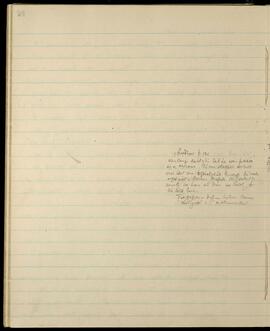
84

Ludlow p 121
our camp east of the Dib La was pitched
in a morass. If one stepped outside
one's tent one squelched through the water
and wet; However despite the unholy
weather we have not done so badly for
the birds here.
Tragopan - diffs between Cowan
'Satyra' + 'molesworthi'

LSH/1/1/8/1/83 · Part · 1947-03-20
Part of The Ludlow & Sherriff Collection

SUMMARY:
The party halts for several days in a valley on the right bank of the river, noting delayed flowering compared to Tongkyuk and recalling the 1933 flood from a lake on the Munkhu Phu Chu. They describe routes toward Munkhu La and Yigong, observe various birds, and report activities including Akong collecting specimens, Tsongpen traveling to Sobhe La to repair a thermograph, and Bill ascending above camp but finding little in flower.

CONTENT:
the R. bank of the river.

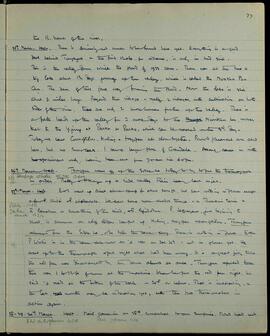
25th March. Halt. There is obviously not much to be found here yet. Everything is a good deal behind Tongkyuk — the pink rhodo, for instance, is only in bud still. This is the valley down which the flood of 1933 came. There was at the time a big lake about 1 1/2 days journey up this valley, which is called the Munkhu Phu Chu. The dam of this gave way forming the flood. Now the lake is still about 3 miles long. Beyond this village — really 2 villages, with cultivation on both sides of the river, there are only 2 more houses further up the valley. There is a path leads up the valley for 3 more days to the Munkhu la, over that to the Yigong at Parka or Parke, which can be reached on the 4th day. Today we saw Crossoptilon, kuling & tragopan all close together. Blood pheasant are also here, but no snowcock. I saw a large flock of Grandala. Akong came in with two specimens only, having been out from 7.0 am till 6.0 pm.

26th March Halt. Tsongpen went off up the Sobhe la today to try to put the thermograph in order. Betty & Akong up a side valley. Rain heavy last night.

27th March. Halt. Bill went up direct above camp for about 2000 ft, but saw nothing in flower except a few P. Winteri & rh. rhodentata. We saw some more rhodos though — a Thomsonii series & R. lanatum or something of the kind, rh. lepidotum. P. Jaffreyana, just beginning to shoot, is common on cliff ledges. We put up kuling, tragopan, crossoptilon. Tsongpen returned from the Sobhe la, she tells the same story. There is nothing in flower. Even P. Winteri is in the same state now as it was on Dec 31st — not in flower yet. He went up to the thermograph & put right what had been wrong. It is a great pity that the red pen was disarranged by the lama almost at once. Tsongpen reported that there was 1 to 1 1/2 ft of snow at the machine. When he put the red pen right, he said it read at the bottom of the scale — 20°F or below. That is interesting, & the last month may be interesting yet, with the two thermometers in action again.

28-29-30th March. Halt. Mail came in on 28th, somewhat to our surprise. Rhodo had not

LSH/1/1/6/1/49 · Part · 1933-05-03 - 1933-05-05
Part of The Ludlow & Sherriff Collection

SUMMARY:
Diary notes describe severe midges and rain while collecting Primula cortusoides and rhododendrons off the Nyug La ridge, followed by a weather-hampered attempt along the ridge. The party returns to Lalung where Tsongpen shoots a tragopan near camp and the diarist has a good day of bird shooting as weather improves; plant notes include R. edgeworthii, Pinus wallichiana, Cypripedium hookerae, and Monotropa uniflora.

CONTENT:
P. laciniata 3649
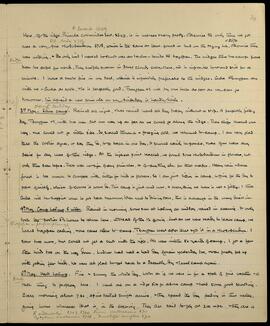
Here, off the ridge, Primula cortusoides No. 3649, is in masses and very pretty. Otherwise the only thing we got was a very fine Rhododendron 3708 (Rh. rude 3707), which is the same as that found in bud on the Nyug La (= 3670). Otherwise there was nothing, and the only bird I wanted to shoot was an Ixulus - beside the tragopan. The midges at these two camps have been too awful for words. They simply swarm in dense clouds everywhere, and it is impossible to stand still for a minute. I have a smoke fire in my tent, which is infinitely preferable to the midges. Gulla and Tsongpen are with me - Gulla as cook, he is perfectly good. Tsongpen and I will try our luck as far as we can go tomorrow. I'm afraid a new primula on my birthday is hardly likely. (Sherriff's birthday)

3rd May. Same camp. Rained all night, and has rained hard all day today without a stop. A perfectly filthy day. Tsongpen and I, with two men, cut our way up as far as we could go along the ridge. There cliffs blocked our way, and we could not go either side. So, soaked through and freezing cold, we returned to camp. I am very glad that the coolies agree, or say they do, to go back in one day. It seemed easily possible, none of us have any desire for any more of this ridge. At the highest point reached, we found some rhododendrons in flower, but only those seen before. There was no sign of any primulas, or of anything else for that matter. Heavy rain and dense forest is too much to compete with, either for birds or flowers. So I am just sitting in camp, hoping for the day to pass quickly, which of course it won't do. This camp is just mud now, and everything we have is wet and filthy. I think Gulla will be happiest when he gets back tomorrow. When used to driving cars, this is a change in the wrong direction.

4th May. Camp Lalung. 5 miles. Rained in morning, some sun at Lalung at midday, rained in evening. It only took the coolies 5 1/2 hours to return here, instead of the 12 going. Just as we were ready to leave camp, we heard tragopan calling, and one came close to camp (Tragopan in perfect plumage). Tsongpen went after it and got it in a rhododendron. I saw two more, but could not get a shot with the rifle. All were within 50 yards of camp. I got a few other birds too on the way down. Ludlow had had a bad day of rain yesterday too, and was pretty fed up with getting few birds. We were all glad to get back to a decent dry level camp again.

5th May. Halt Lalung. Fine and sunny the whole day. Looks as if we were in for a spell of fine weather - a rash thing to prophesy here. I went out on a ridge 500 ft above camp and had some good shooting. Every morning about 7.30, spine-tailed swifts arrive, and then spend the day feeding in this valley, going home wherever that is, in the evening. They are said to fly at 200 mph, and they are a...

R. edgeworthii 3709, 3720 Pinus wallichiana 3711
Cypripedium hookerae 3708, Monotropa uniflora 3710

LSH/1/1/8/1/183 · Part · 1947-04-27
Part of The Ludlow & Sherriff Collection

SUMMARY:
List of local names with language codes (P, T, Lep) for Monal, Tragopan, Crossoptilon, Kalij, partridges (Arborophila), and Tetraophasis.

CONTENT:
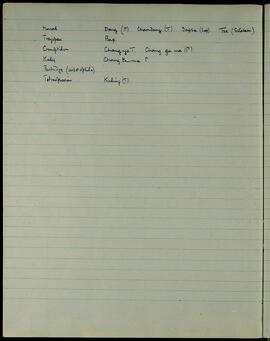
Monal Dong (P) Chamdang (T) Daphe (Lep) Tse (Sclateri)
Tragopan Bap.
Crossoptilon Changnga T. Chang ga ma (P)
Kalij Chang ka ma P.
Partridge (Arborophila)
Tetraophasis Kuling (T)

LSH/1/1/2/1/44 · Part · 1933-07-08
Part of The Ludlow & Sherriff Collection

SUMMARY:
The author disturbed a tragopan pheasant near Nyeng Sang La and fired hurried shots without success, noting the local birds are thought to be the rare 'molesworthi' race. At Sakden, half a dozen men searched over four days to capture a specimen, but the birds proved difficult to obtain during the breeding season due to their skulking in dense jungle.

CONTENT:
Ludlow 32 - near the top (Nyeng Sang La)
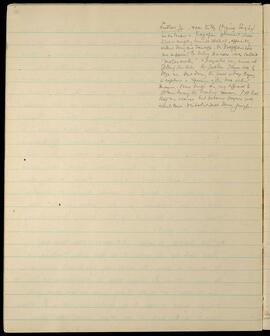
We disturbed a tragopan pheasant which I had a couple of hurried shots at, apparently without doing any damage. The tragopans here are supposed to belong to a rare race called 'molesworthi' and I regretted very much not getting this bird. At Sakden I have had half a dozen men out during the past 4 days trying to capture a specimen of this bird without success. These birds are very difficult to obtain during the breeding season. Not that they are scarce but because they are such skulkers in such dense jungle.

LSH/1/1/4/1/90 · Part · 1933-08-15
Part of The Ludlow & Sherriff Collection

SUMMARY:
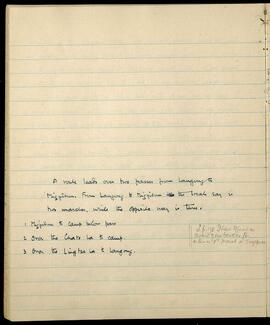
Notes a route between Langong and Migyitun over two passes, with locals stating it takes two marches one way and three the other. Lists stages via Chato La and Lingtsa La, and mentions an offered reward of 100 tankas for a male Monal or Tragopan.

CONTENT:
A route leads over two passes from Langong to
Migyitun. From Langong to Migyitun the locals say is
two marches, while the opposite way is three.

1 Migyitun to camp below pass L.p. 178 I have offered an
2 Over the Chato La to camp. award of 100 tankas for
3 Over the Lingtsa La to Langong. either a ♂ Monal or Tragopan.