
Showing 2 results

Archival description
2 results with digital objects Show results with digital objects
LSH/1/1/3/3/47 · Part · 1934-03-10
Part of The Ludlow & Sherriff Collection

SUMMARY:
The diarist describes finding an enormous Abies at Munde La, notes scarce birds with several sightings and a couple shot, and enjoys a cloudless view of the northern snows. Due to unreliable maps, he plans to ascend a high point on the ridge north of Mera, and mentions local information about the Mera chu.

CONTENT:
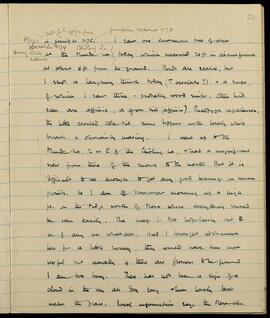
Abies and juniper 1175. I saw one enormous tree of Abies today at the Munde La, which measured 20 ft in circumference at about 5 ft from the ground. Birds are scarce, but I shot a laughing thrush today (T. ocellata?) - a snipe, of which I saw three - probably wood snipe. Other birds seen are affinis, a grosbeak (affinis), Pnoepyga nepalensis, the little crested coal tit, some dippers with lovely white breasts, and obviously mating.

I went up to the Munde La, 2 miles east of the Chöling La, and had a magnificent view from there of the snows to the north. But it is difficult to see enough to get any good bearings on known points. So I am off tomorrow morning up a high point on the ridge north of Mera where everything should be seen easily. The map is too hopelessly out to be of any use whatever. Had I brought instruments here for a little survey, they would have been most useful, but usually if there are flowers to be found I am too busy. There has not been a sign of a cloud in the sky all day long. How lovely that makes the place. Local information says the Mera chu
LSH/1/1/4/1/149 · Part · 1933-10-19
Part of The Ludlow & Sherriff Collection

SUMMARY:
The diarist reflects on missing the Slumpung La route earlier and suggests it would have yielded better collections than the Kashong La, noting rhododendron comparisons and that the pass he called Chang La is properly Kiang La. On 26 October at Natrampa, he and Tsongpen revisited a tragopan site, found fresh scratchings (likely T. ocellata), but saw no birds, noting others had been there first.

CONTENT:
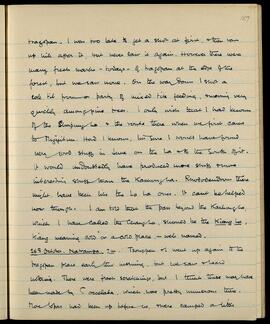
tragopan. I was too late to get a shot at first, and then ran uphill after it, but never saw it again. However there were many fresh marks - today's - of tragopan at the edge of the forest, but we saw none. On the way down I shot a coal tit from a party of mixed tits feeding, and moving very quickly among pine trees. I only wish that I had known of the Slumpung La and the route there when we first came to Mijitun. Had I known, I'm sure I would have found very good stuff in June on the La and to the south of it. It would undoubtedly have produced more stuff and more interesting stuff than the Kashong La. Rhododendrons there might have been like the Lo La ones. It can't be helped now though. I am told that the pass beyond the Kashong La, which I have called the Chang La, should be the Kiang La, Kiang meaning cold or a cold place, - well named.

26th October. Natrampa. 7 am. Tsongpen and I went up again to the tragopan place early this morning, but we saw and heard nothing. There were fresh scratchings, but I think these may have been made by T. ocellata, which was pretty numerous there. More Lopas had been up before us, and were camped a little