Showing 4 results

Archival description
4 results with digital objects Show results with digital objects
LSH/1/1/9/1/68 · Part · 1949-06-15
Part of The Ludlow & Sherriff Collection

SUMMARY:
The diarist sends the lads to Sharietang and notes target plants to collect, then observes blood pheasant chicks and attempts cine shots of the female. On 8 June, with Lhakpa and Ngudup, they make a rapid early trip to Hubsing La hoping to see Kula Kangri, viewing Kankarpunsum instead, with fine weather until evening.

CONTENT:
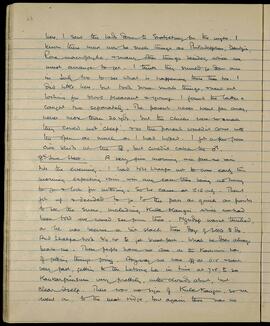
here, I sent the lads down to Sharietang for the night. I know there must now be such things as Philadelphus, Deutzia, Rosa macrophylla, and many other things besides, which we must arrange to get. I think they should go down once in July too to see what is happening there then too. I did little here, but took some small things, and went out looking for blood pheasant and young. I found the latter and caught two separately. The parents never went far away, never more than 20 yards, but the chicks were so small they could not 'cheep', and so the parents would not come into the open as much as I had hoped. I got a few poor cine shots at the ♀, but could not catch the ♂.

8th June Halt. A very fine morning, in fact no rain till the evening. I had told Lhakpa not to come early this morning, expecting rain, and in any case there being no hurry to go and look for nothing. So he came at 5.15 only. Then I got up and decided to go to the pass as quick as possible to see the snow, including Kula Kangri which we had been told we would see from there. Ngudup was not thrilled, as he has become a bit slack these days of little to do. And Lhakpa took 3/4 hour to get breakfast. What he does always beats me. These people have no idea, as the Kashmiri has, of getting things going. Anyway we were off at 6.15 and went very fast, getting to the Hubsing La in time at 7.15, to see Kankarpunsum very prettily, with clouds around, but clear itself. There was no sign of Kula Kangri, so we went on, to the next ridge, but again there was no
LSH/1/1/3/3/166 · Part · 1983-05-05
Part of The Ludlow & Sherriff Collection

SUMMARY:
Notes that bird life is very scarce at Migyitun, followed by an entry dated 28th May and a list of plant taxa with associated numbers. The page appears to record collections or observations made at Migyitun.

CONTENT:
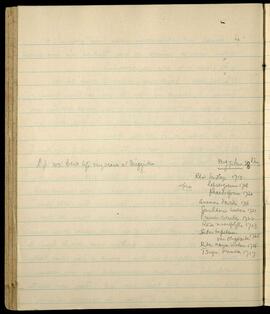
L. p. 103. Bird life very scarce at Migyitun

Migyitun 28th May
Rhod. linitage 1715.
sp. nov. lopsangianum 1718
phaedropum 1720
Anemone davidii 1716
Gaultheria hookeri 1721
Prunus cornuta 1722
Rosa macrophylla 1723
Sorbus hupehensis
var. oligodonta 1725
Ribes acuminatum 1726
Tsuga dumosa 1727

LSH/1/1/6/1/84 · Part · 1938-06-22
Part of The Ludlow & Sherriff Collection

SUMMARY:
The page lists plant specimens collected on June 24 and 25–26, with specimen numbers in the 5647–5679 range. It provides detailed route directions from Molo to Lilung along river banks and bridges through forest and pine, with distances and bearings. At Lilung, observations include temperature 68° at 3:00 pm and an approximate elevation of 10,119 feet.

CONTENT:
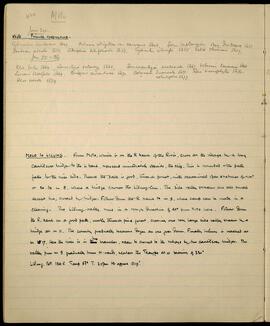
42a Molo

June 24.
5656 Primula jaffreyana.
Cypripedium himalaicum 5647, Androsace strigillosa var. canescens 5648, Sedum bupleuroides 5649, Iris decora 5651.
Sambucus adnata 5650 Adenophora liliifolia 5653, Cyananthus sherriffii 5655 Pedicularis oliveriana 5657.

June 25-26
Rhod. bulu 5664, Leucostegia delavayi 5665, Semiaquilegia ecalcarata 5667 Viburnum kansuense 5668
Lonicera trichopoda 5669. Briggsia aurantiaca 5670. Cotoneaster divaricata 5671. Rosa macrophylla 5676.
Rhod. wardii 5679 " rotundifolia 5677.

MOLO to LILUNG. From Molo, which is on the R bank of the River, cross at the village by a long cantilever bridge to the L bank, and ascend immediately opposite, the cliff. This is rounded and the path falls to the river side. Thence the path is good, through forest, with occasional open stretches of 100 yards or so to m 8, where a bridge crosses the Lilung Chu. The side valley streams are all small except two, crossed by bridges. Follow down the R bank to m 9, where camp can be made in a clearing. The Lilung valley runs in a rough direction of 40° from Molo here. Follow down the R. bank on a good path, mostly through pine forest, crossing one very large side valley stream by a bridge at m 11. The country gradually becomes dryer as one goes down. Finally Lilung is reached at m 17. Here the river is in two branches, and can be crossed to the village by two cantilever bridges. The valley from m 9 gradually turns N-wards, and enters the Tsangpo at a bearing of 330°.

Lilung. BP. 19.4.5 Temp 68° T. 3.0pm Ht approx 10119'.

LSH/1/1/10/1/127 · Part · 1949-04-16
Part of The Ludlow & Sherriff Collection

SUMMARY:
Page lists plant taxa with collection numbers and notes such as old seed and 2nd sending. Localities mentioned include Hsiu Lai La and Pampasung, with one entry noting an elevation of 15500 feet.

CONTENT:
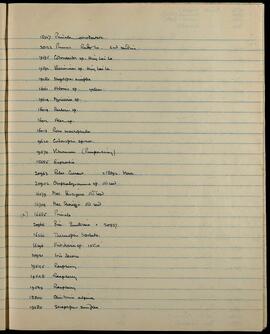
18957 Primula atrodentata.
20123 Prunus rufula. 2nd sending.
19595 Cotoneaster sp. Hsiu Lai La
19592 Vaccinium sp. Hsiu Lai La.
19280 Streptopus simplex
16161 Adonis sp. yellow.
19614 Myricaria sp.
16014 Berberis sp.
16012 Acer sp.
16013 Rosa macrophylla
19620 Codonopsis sp. nov.
19570 Viburnum (Pampasung)
18685 Euphorbia
20963 Ribes. Currant. = 18692. black.
20902 Omphalogramma sp. old seed.
16279 Meconopsis discigera old seed
16709 Meconopsis sherriffii old seed
(2) 16685 Primula
20964 Primula smithiana = 20937
16266 Thermopsis barbata.
16296 Fritillaria sp. 15500'
20921 Iris decora
19545 Raspberry.
19548 Raspberry
19549 Raspberry
18800 Clintonia alpina
19280 Streptopus simplex