
Showing 2 results

Archival description
2 results with digital objects Show results with digital objects
LSH/1/1/6/1/66 · Part · 1937-06-05
Part of The Ludlow & Sherriff Collection

SUMMARY:
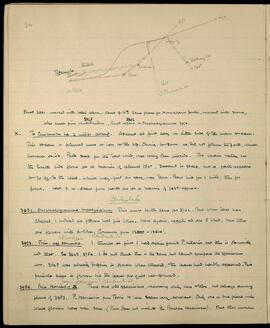
Field notes describe the ascent to Chubumbu La with bearings, terrain, and vegetation changes, and map labels for nearby locations. The page records locations and observations for several alpine plants, including Rhododendron, Omphalogramma, and Primula specimens, with altitudinal ranges and morphological notes.

CONTENT:
33a

[Map Labels]
Potsangla
Chianang
Pass
Peak
Lagyong
Sheltangla
Chubumbu La
46°
65°
145°
162°

Rhododendron 3941 marked with label above camp of 6th. Same place for Nomocharis souliei, marked with stone, also small pink Rhododendron 3925, Rhododendron repens 3942 and Omphalogramma 3970.

X - To Chubumbu La 2 miles ascent. Ascent at first easy on either side of the main stream. This stream is followed more or less to the top. Owing to snow, we did not follow the path, which however exists. Path steep for the last mile, over rocky open hillside. The main valley on the South side flows at a bearing of almost 180°. Descent is steep, but a path appears to go off to the West, which may find an easy way down. Bare hill for 1 mile, then fir forest. Last 2 miles ascent from North are at a bearing of 142° approx.
Chubumbu La

  1. Omphalogramma brachysiphon. This must be the same as 3762. But when that was collected, I noticed all flowers had five lobes. Here again, nearly all are 5 lobed, but there are flowers with 6 lobes. Common from 13,000 - 13,500'.
    Chubumbu La

  2. Primula aff. strumosa. (chionogenes? Chubumbu La) I thought at first I had again found P. hilaris, but this is obviously not that. See 3648, 3754. I do not think this is the same, but cannot compare the specimens now. 3648 was already dropping its flowers when collected, the leaves had hardly appeared. This primula keeps its flowers till the leaves are quite well formed.
    (tsariensis x chionogenes? Chubumbu La)

  3. Primula tsariensis X. These are odd specimens, occurring only here and there, but always among plants of 3983. P. tsariensis from Tsari to here seems very constant. Only one or two plants with white flowers have been seen. (This does not include the Bhutan specimens). But this number
LSH/1/1/7/1/1 · Part · 1940-05-24
Part of The Ludlow & Sherriff Collection

SUMMARY:
The expedition splits, with Ludlow and Taylor heading to passes east of Tsela Dzong while Sherriff works the Lanyong area and passes between Roro and Bela Dzong, departing Roro on 24 May. The page describes the Lanyong Chu valley, its isolated inhabitants and seasonal conditions, and notes early-season floral observations on high slopes, including Rhododendron repens and Primula species.

CONTENT:
1940.

Sherriff - May - July -

In order to cover as much ground as possible, we now decided that we should divide into two parties. Ludlow and Taylor were to visit as many passes East of Tsela Dzong as time allowed, while Sherriff worked the Lanyong area and other passes over the Himalayas between Roro and Bela Dzong. On 24th May therefore we all left Roro, and Sherriff went up the Lanyong Chu in easy stages to Lanyong.

The Lanyong Chu here is not unlike the Tsari Chu further to the West. It runs parallel to and about four miles North of the Himalayas. But whereas the Tsari Chu cuts through the axis, the Lanyong Chu turns North to the Tsangpo. Several side streams of considerable size, unfordable in summer, join the Lanyong from the South.

The valley, which is from 300-600 yards wide, flows gently through the valley bed. The inhabitants are very isolated. They grow no crops, but breed cattle and yaks. Here and there along the valley bed, one sees a few chalet-like huts, used by men and yaks alone in the winter months when snow lies deep. The rain of the summer turns to snow about the end of October or mid-November, and the inhabitants remain in their huts till March when they are able to get about again.

There was not much in flower in the valley bed, as it was still rather early for the passes over the Himalayas, which here vary between 13,500 - 15,000'.

The South sides of the passes were now almost free of snow, but North faces were still deeply covered. However on the open slopes about 14,000' a little North of the main axis, Rhododendron repens was just coming into flower, and with it (P. valentinianum and P. franchetii). On the same day as I first saw the latter in flower, I was also able to make a large collection of its seed. A north facing slope on which it grew P. vernicosa.