Showing 4 results

Archival description
4 results with digital objects Show results with digital objects
LSH/1/1/5/1/29 · Part · 1935-11-27
Part of The Ludlow & Sherriff Collection

SUMMARY:
Notes describe the ascent to camp m 5, including tall rhododendrons, abundant magnolias like those taken the day they reached Korshu, and a view of the Black Mountain before clouds set in. A cock escaped and, despite efforts, including Tungpen attempting to shoot it with a catapult, it flew away. Leeches and midges are noted as troublesome.

CONTENT:
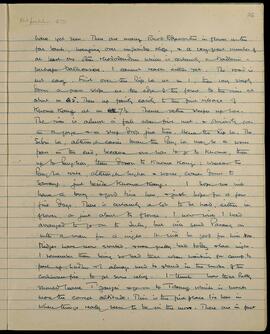
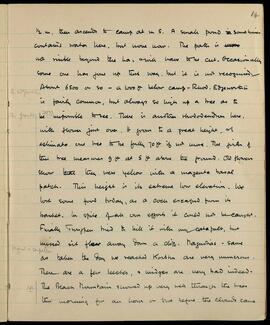
1/2 m, then ascends to camp at m 5. A small pond sometimes contains water here, but none now. The path is not visible beyond the ha, which have to be cut. Occasionally some one has gone up this way, but it is not recognized.

About 6500 or so - a 1000 ft below camp - Rhod. Edgeworthii is fairly common, but always so high up a tree as to be impossible to see. There is another rhododendron here, with flower just over. It grows to a great height, I estimate one tree to be fully 70 ft if not more. The girth of this tree measures 9 ft at 5 ft above the ground. Old flowers show that they were yellow with a magenta basal patch. This height is its extreme low elevation.

We lost some food today, as a cock escaped from its basket. In spite of all our efforts it could not be caught. Finally Tungpen tried to kill it with my catapult, but missed & it flew away down a cliff. Magnolias - same as taken the day we reached Korshu are very numerous. There are a few leeches, & midges are very bad indeed.

The Black Mountain showed up very well through the trees this morning for an hour or two before the clouds came.
LSH/1/1/9/1/32 · Part · 1949-05-06
Part of The Ludlow & Sherriff Collection

SUMMARY:
A wet halt day spent scrambling on a steep rock slope near Rip la to observe rhododendrons, notably Rhododendron edgeworthii, anthopogon, and lindleyi, with signs of bear and musk deer but no sightings. Men later brought in masses of R. edgeworthii, and the diarist began a letter to Betty before receiving mail from Kalimpong.

CONTENT:
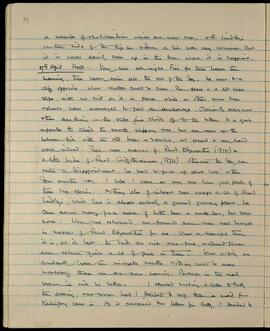
a number of rhododendrons which are now over, and R. lindleyi
on the side of the Rip la and down a bit was very common. But
it is never easily seen up in the trees where it is happiest.
27th April. Halt. Very wet all night. Fine for three hours this
morning, then heavy rain all the rest of the day. We went to a
cliff opposite, where Rhodos. could be seen. The place is a 45° rock
slope, with no soil on it in places, while in others some trees
and shrubs have managed to find an anchorage. Obviously every now
and then anything on the slope just shoots off to the bottom. It is quite
impossible to climb the smooth slippery rock, but we went up the
between bits with the odd trees and bamboo, and found it very hard
work indeed. There were masses of Rhod. edgeworthii (18777) and
a little higher of Rhod. anthopogon (18776). Otherwise the day was
rather a disappointment. We had to go on up above 2000' and then
down another way. I hope I have at any rate some good photos of
these two species. Nothing else of interest seen, except a lot of Rhod.
lindleyi, which here is almost entirely a ground growing plant. We
came across many fresh marks of both bear and musk deer, but saw
none. When we returned, we found some men had brought
in masses of Rhod. edgeworthii for me. What a beautiful thing
it is, at its best: the buds are rich rose pink, and opened flowers
even retain quite a lot of pink in them. What a pity we
constantly have this miserable weather. Nothing could be more
monsoony than we are now having. Perhaps in the real
season it will be better. I started writing a letter to Betty
this evening, and no sooner had I decided to stop than a mail from
Kalimpong came in. As it contained two letters for Betty, I decided to

LSH/1/1/9/1/26 · Part · 1949-04-29 - 1949-05-06
Part of The Ludlow & Sherriff Collection

SUMMARY:
Notes list Kodachrome and Dufay colour shots of Rhododendron species and Primula filipes, a view toward Tom Tom from Rip La, and a sun bird on Piptanthus. Locations include Denchung (river and camp) and Shambling, with mentions of items sent off. Dated entries include 29/04/1949 and 06/05/1949.

CONTENT:
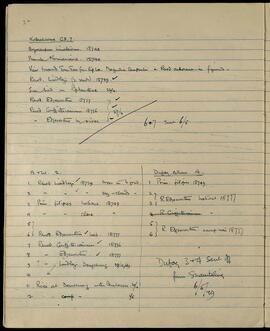
22

Kodachrome C.S. 7.
Bryocarpum himalaicum. 18744
Primula Normaniana. 18740
View toward Tom Tom from Rip La. Magnolia Campbellii & Rhododendron arboreum in foreground.
Rhododendron Lindleyi (2 shots) 18739.
Sun bird on Piptanthus. 23/4.
Rhododendron Edgeworthii 18777
Rhododendron Griffithianum 18776
Rhododendron Edgeworthii by river.
6+7 sent 6/5

B.W. 2. Dufay Colour 4.

  1. Rhododendron Lindleyi 18739 trees in background. 1 Primula filipes 18749
  2. Rhododendron Lindleyi 18739 sky + clouds - 2 }
  3. Primula filipes habitat 18749 3 } Rhododendron Edgeworthii habitat 18777
  4. Primula filipes close habitat 4 Rhododendron Griffithianum habitat
    5 } 5 }
    6 } Rhododendron Edgeworthii habitat 18777 6 } Rhododendron Edgeworthii camp river 18777)
    7 Rhododendron Griffithianum 18776
    8 Rhododendron Edgeworthii 18777
    9 ? Rhododendron Lindleyi. Denchung 29/4/49 Dufay 3+4 Sent off
    10 from Shambling
    11 River at Denchung with Bhutanese. 30/4 6/5/49
    12 River at Denchung camp - 1/5
LSH/1/1/9/1/31 · Part · 1949-05-06
Part of The Ludlow & Sherriff Collection

SUMMARY:
The diarist describes traversing Rip La down to a river and up to Khoma Kang, noting abundant rhododendrons including R. edgeworthii and a Maddenii-type on cliff faces. They compare the Sissi La and Pau La routes, plan to send Pasang to Sulu, complain of midges, recall standing in cookhouse smoke with Ludlow, and suggest Betty move from T'yangsi to Tobrang for better altitude.

CONTENT:
have yet seen. There are many Rhod. Edgeworthii in flower on the far bank, hanging over impossible cliffs, and a very great number of at least one other Rhododendron which is certainly a Maddenii - perhaps Dalhousiae. I cannot reach either yet. The road is not easy. First over the Rip La at m 1, then very steeply down a grass slope at the edge of the forest, to the river at about m 4.5. Then up fairly easily to the first village of Khoma Kang at m 7.5. Thence rather steeper up here. The river is almost a fall when first met, and boils over in a gorge and a steep drop just there. Hence the Rip La. The Sissi La, although easier than the Pau La, may be a worse pass in the end, because one has to go to Khoma, then up to Pangkar, then down to Khoma Kang: whereas the Pau La route, although higher and worse, comes down to Sawang, just beside Khoma Kang. I hope we will have a busy and good time here, and just hope for a few fine days. There is certainly a lot to be had, either in flower, or just about to flower. I now wish I had arranged to go on to Sulu, but will send Pasang on with a man for a night. It will be good for him too. Midges have now started, and were pretty bad today and last night. I remember them being so bad that when waiting for camp to pack up, Ludlow and I always used to stand in the smoke of the cookhouse fire, to get some relief. I think now that Betty should leave T'yangsi and go on to Tobrang which is much more the correct altitude. This is the first place I've been in where things really seem to be on the move. There are in fact