
Showing 2 results

Archival description
2 results with digital objects Show results with digital objects
LSH/1/1/5/1/31 · Part · 1937-05-03
Part of The Ludlow & Sherriff Collection

SUMMARY:
The diarist reports scarce, undrinkable water and a poor route. On 3rd May they camped on a ridge south of Jirgang Chu, with rain overnight, clear morning, and mist returning at noon; coolies traveled from 6:00 am to 1:00 pm. They glimpsed Dungshigou and noted abundant rhododendrons and magnolias (Nos. 2980, 2982, 2983) with color variation by elevation.

CONTENT:
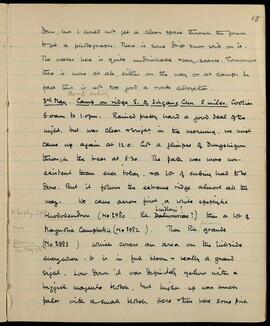
down, but I could not get a clear space through the forest to get a photograph. There is some drift snow still on it. The water here is quite undrinkable and very scarce. Tomorrow there is none at all, either on the way or at camp. In fact this is not too good a route altogether.

3rd May. Camp on ridge S. of Jirgang Chu 5 miles. Coolies 6:00 am to 1:00 pm. Rained pretty hard a good deal of the night, but was clear and bright in the morning, mist came up again at 12:00. Got a glimpse of Dungshigou through the trees at 6:30. The path was more non-existent than ever today, and a lot of cutting had to be done. But it follows the extreme ridge almost all the way. We came across first a white epiphytic Rhododendron (No 2980, Rh. Dalhousiae? Lindleyi?) then a lot of Magnolia Campbellii (No 2982). Then Rh. grande (falconeri) (No 2983) which covers an area on the hillside everywhere. It is in full bloom and really a grand sight. Low down it was definitely yellow with a biggish magenta blotch, but higher up was much paler with a small blotch. Here there were some pink
LSH/1/1/9/1/31 · Part · 1949-05-06
Part of The Ludlow & Sherriff Collection

SUMMARY:
The diarist describes traversing Rip La down to a river and up to Khoma Kang, noting abundant rhododendrons including R. edgeworthii and a Maddenii-type on cliff faces. They compare the Sissi La and Pau La routes, plan to send Pasang to Sulu, complain of midges, recall standing in cookhouse smoke with Ludlow, and suggest Betty move from T'yangsi to Tobrang for better altitude.

CONTENT:
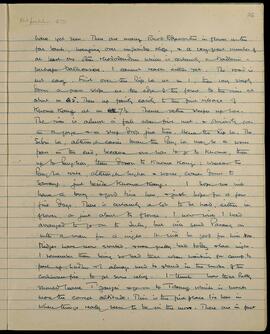
have yet seen. There are many Rhod. Edgeworthii in flower on the far bank, hanging over impossible cliffs, and a very great number of at least one other Rhododendron which is certainly a Maddenii - perhaps Dalhousiae. I cannot reach either yet. The road is not easy. First over the Rip La at m 1, then very steeply down a grass slope at the edge of the forest, to the river at about m 4.5. Then up fairly easily to the first village of Khoma Kang at m 7.5. Thence rather steeper up here. The river is almost a fall when first met, and boils over in a gorge and a steep drop just there. Hence the Rip La. The Sissi La, although easier than the Pau La, may be a worse pass in the end, because one has to go to Khoma, then up to Pangkar, then down to Khoma Kang: whereas the Pau La route, although higher and worse, comes down to Sawang, just beside Khoma Kang. I hope we will have a busy and good time here, and just hope for a few fine days. There is certainly a lot to be had, either in flower, or just about to flower. I now wish I had arranged to go on to Sulu, but will send Pasang on with a man for a night. It will be good for him too. Midges have now started, and were pretty bad today and last night. I remember them being so bad that when waiting for camp to pack up, Ludlow and I always used to stand in the smoke of the cookhouse fire, to get some relief. I think now that Betty should leave T'yangsi and go on to Tobrang which is much more the correct altitude. This is the first place I've been in where things really seem to be on the move. There are in fact