
Showing 3 results

Archival description
3 results with digital objects Show results with digital objects
LSH/1/1/1/1/77 · Part · 1933-07-01
Part of The Ludlow & Sherriff Collection

SUMMARY:
The party splits as W and Mrs W go to Punakha while the diarist and Ludlow, on Tobgye's advice, take a dense leech-infested jungle path from below Lomitsawa towards Wangdupotrang. They avoid shooting due to sensitivities in the late Shabdrung’s area near Thimbu, collect some birds, butterflies, and plants, and after a tiring nine-hour trek reach the Punakha Chu/Mo Chu; camp conditions are filthy with flies, mud, and fleas.

CONTENT:
36

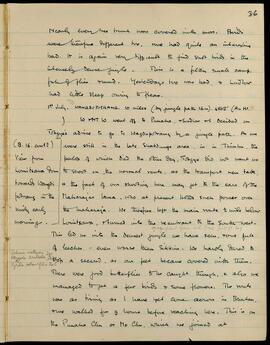
Nearly every tree trunk was covered with moss. Birds were therefore different too, and we had quite an interesting bag. It is again very difficult to find shot birds in the intensely dense jungle. This is a filthy small camp, full of flies and mud. Yesterday too was bad, and Ludlow had little sleep owing to fleas.

70
1st July. TO WANGDUPOTRANG. 10 miles (by jungle path 16 miles). 4508' (An Ht. ). W and Mrs W went off to Punakha, and Ludlow and I decided on Tobgye's advice to go to Wangdupotrang by a jungle path. As we

(B. 16. contd) View from Lomitsawa down towards Wangdi Potrang in the misty early morning.

were still in the late Shabdrung's area, in Thimbu, the Penlop of which died the other day, Tobgye did not want us to shoot on the normal route, as the transport men talk, and the fact of our shooting here may get to the ears of the Maharaja's lama, who at present holds such power over the Maharaja. We therefore left the main route ½ mile below Lomitsawa, and turned into the re-entrant to the South West.

magnificent fern with fronds 3-5 ft long
This led us into the densest jungle we have seen, and full of leeches - even worse than Sikkim. We hardly dared to stop a second, as our feet became covered with them.

Schima wallichii 201
Polygala arillata 202
Pyrola rotundifolia 203

There were good butterflies to be caught though, and also we managed to get a few birds and some flowers. The route was as tiring as I have yet come across in Bhutan, and we walked for 9 hours before reaching here. This is on the Punakha Chu or Mo Chu, which we joined at
LSH/1/1/1/1/75 · Part · 1933-06-30
Part of The Ludlow & Sherriff Collection

SUMMARY:
Notes on the death of the Thimbu penlop and Tobgye’s sending of English medicine, causing concern with the Maharaja. On 30th June Ludlow and the author travelled to Lomi-Tsa-wa via Do Kyong La in clearing weather, collecting flowers including Magnolia globosa and observing that vegetation in the Trashi-cho-dzong valley and at the pass resembled Sikkim.

CONTENT:
35

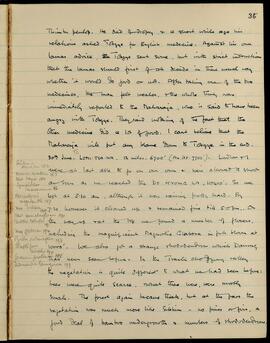
Thimbu penlop. He died of dropsy & a short while ago his
relations asked Tobgye for English medicine. Against his own
lamas advice, Tobgye sent some, but with strict instructions
that the lamas should first of all decide in their usual way
whether it would do good or not. After taking one of the two
medicines, the man felt weaker, & the whole thing was
immediately reported to the Maharaja, who is said to have been
angry with Tobgye. They said nothing of the fact that the
other medicine did a lot of good. I can't believe that the
Maharaja will put any blame down to Tobgye in the end.

30th June. TO LOMI-TSA-WA. 12 miles - 6700' (An. Ht. 7700'). Ludlow & I
Embelia oleracea 182
Anemone rivularis 183 were at last able to go on our own & were allowed to shoot
Rhod. Keysii 184
Symplocos ramosissima 186 as soon as we reached the DO KYONG LA, 10410'. So we
Pedicularis megalantha 187
left at 5.30 am, although it was raining pretty hard. By
Meconopsis villosa 189
Rhod. camelliaeflorum 190 7.30 however it cleared up & remained fine till 5.0 pm. On
Berberis celestina 191
the way up & at the top we found a number of flowers,
Mag. globosa 192
Pyrola rotundifolia 193 including the magnificent Magnolia Globosa in full bloom at
Streptopus simplex 194
10000'. We also got a strange rhododendron which Dawang
Geranium pratense 198
Didissandra lanuginosa 199 has never seen before. In the Trashi-cho-dzong valley
the vegetation is quite different to what we had seen before:
trees were quite scarce, & what there were, were mostly
small. The forest again became thick, but at the pass the
vegetation was much more like Sikkim - no pines or firs, a
good deal of bamboo undergrowth & numbers of rhododendrons.

LSH/1/1/4/1/23 · Part · 1936-07-02
Part of The Ludlow & Sherriff Collection

SUMMARY:
The diarist describes difficult stream crossings with washed-out bridges, a woman helping her brother, and a day in camp changing flowers and bathing. On 12 July they travel about 8 miles to Karutra via Drotang, encounter rain after 10 a.m., note relatively scarce rainfall in the valley, and await possible mail from Tsona via the dak runner.

CONTENT:
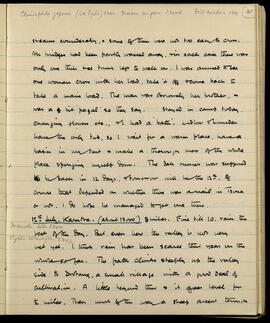
Chimaphila japonica (like Pyrola) 2340 Moneses uniflora 2340A Frit. cirrhosa 2341 121

streams considerably, and some of them were not too easy to cross.
All bridges had been partly washed away, and in each case there was
only one thin tree trunk left to walk on. I was amused to see
one woman cross with her load, take it off and come back to
take a man's load. The man was obviously her brother, and
was a bit 'pagal' so they say. Stayed in camp today,
changing flowers etc., and had a 'bath'. Ludlow and Lumsden
have the only tub, so I wait for a warm place, have a
basin in my tent and make a thorough mess of the whole
place sponging myself down. The dak runner was supposed
to be back in 12 days, and tomorrow will be the 12th. Of
course that depended on whether there was a mail in Tsona
or not. I do hope he managed to get one there.

12th July. Karutra. (about 13,000') 8 miles. Fine till 10, rain the
Incarvillea lutea 2342
rest of the day. But even here the valley is not very
Pyrola rotundifolia 2343
wet yet. I think rain has been scarce this year on the
whole so far. The path climbs steeply up the valley
side to Drotang, a small village with a good deal of
cultivation. A little beyond this and it goes level for
1/2 mile. Then most of the way a steep ascent through