SUMMARY:
The diarist describes a difficult crossing of the Chubumbu La in mist, rain, and snow, followed by notable finds of Primula species and hybrids on the southern slopes. They also note a later visit to the Chimi La, where melting snow revealed several bodies of Lhopas from the previous autumn.
CONTENT:
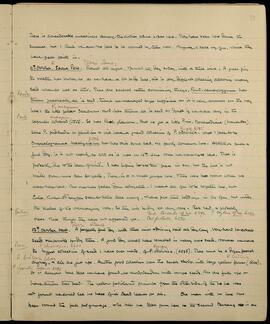
In profusion had just been uncovered by melting snow, and seed capsules were still full of good seed. On the edge of the Abies forest, Omphalogramma minus was seen, while on very damp swampy slopes, O. brachysiphon was again found. As before, the flowers of this were mostly 5-partite, though a small percentage had six segments. On June 7th, I crossed the Chubumbu La (13,900'), the last 1,000 ft of which was deep in snow on the North side. The South face, however, was clear except for piles of avalanche snow 1,000' down the very steep slopes. It was a beastly day of driving mist and rain, over cold conditions which we had on every single Himalayan Pass this year, with the solitary exception of one fine morning on the Ka La in April. However, I was soon compensated for this. We took a last breather behind a rock on the summit before plunging down the southern slopes, and a compass bearing to keep us right as there was no path visible. Almost at once, we saw a mass of golden yellow Primulas. This proved to be the same as found south of the Do La in Ap at 11,500'; but here it was with proper habitat. This has now been named P. chionogenes. With it was also another Petiolarid Primula - P. tsariensis, and occasionally these two had hybridized and produced a queer but pretty Primula, the colour of which was about halfway between golden yellow and blue-violet. These covered the steep, slippery slopes for 500 ft, where their place was taken by equally large numbers of P. elizabethae, one of the most magnificent of Primulas. Among other Primulas found here were P. pudibunda, P. firma, P. normandiana, P. aff. clutterbuckii (3937), P. dickieana var. pantlingii, and P. barbatula.
The next Pass visited was only a few miles further East - the Chimi La, of 15,000'. Here again, snow lay deep on the North face, the last 1,000' of the N face, but it was melting fast, and we came across several bodies of Lhopas who had been overcome by bad weather the previous Autumn. I was surprised to find that