Showing 3 results

Archival description
3 results with digital objects Show results with digital objects
LSH/1/1/4/1/70 · Part · 1933-08-15
Part of The Ludlow & Sherriff Collection

SUMMARY:
Page lists plant collections with specimen numbers from Takar La on 15 Aug and additional Gentiana records from Sur La in the Phari-Kyirong-da area in 1933. Mentions Ludlow and Sherriff.

CONTENT:
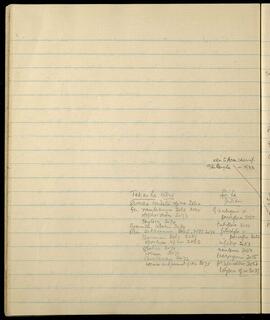
aka to Ludlow & Sherriff.
Phari-Kyirong-da in 1933

Takar La 15 Aug
Swertia handelii sp. nov. 2062
Gen. namlaensis 2063, 2064
otophoroides 2073
taylori 2074
Cyananthus lobatus 2084
Prim. sikkimensis 2065, 2077, 2078
tsariensis 2067, 2081
odontica sp. nov. 2068
glabra 2070
ioessa 2071
cawdoriana 2072
ioessa subpinnatifida 2075

Sur La
Gentiana
G. rubicunda v.
parviflora 2050
tubiflora 2051
filistyla v.
parviflora 2052
infelix 2053
namlaensis 2054
tsarongensis 2055
przewalskii 2056
taylori sp. nov. 2057

LSH/1/1/6/1/72 · Part · 1938-06-09
Part of The Ludlow & Sherriff Collection

SUMMARY:
The page describes the route from the Upper Bridge over the Lanjung to Sinjo Samba, including bridge crossings and path conditions through fir forest. At Tsari Sama (13 June), the author records Primula collections (Nos. 5537–5541), discussing color variation among P. sikkimensis forms and considering P. ioessa and P. Hopeana as true species. Additional route notes describe a path from the lower bridge up the right bank to Trashijing, a small gompa site used by yakherds, with reference to Tolo and the Lanjung Chu.

CONTENT:
36a

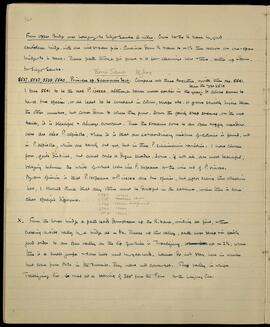
From Upper Bridge over Lanjung to Sinjo Samba 6 miles. Cross to the R bank by good cantilever bridge, with one mid stream pier. Continue down R bank to m 1 1/2 then recross on one-span bridge to L bank. Thence path through fir forest & a few clearings here & there, rather up & down, to Sinjo Samba.

Tsari Sama 13 June

5537, 5538, 5539, 5540. Primulae sp. sikkimensis Sect. Compare all these together, & with them No. 5541.
I take 5541 to be the real P. ioessa, although taken much earlier in the year than the type 2514. It alone seems to be a true species, or at least to be constant in colour, shape etc. It grows slightly higher than the other numbers, but comes down to where they grow. Down the fairly steep streams, on the wet banks, it is plentiful & always constant. Then the streams come to an open boggy meadow. Here are also P. alpicola, & here it is that an extraordinary mixture of colours is found, not in P. alpicola, which are barely out yet, but in these P. sikkimensis varieties. I have chosen four, quite distinct, but could take a dozen shades. Some, if not all, are most beautiful, varying between the white of what looks like P. Hopeana to the wine red of P. vinosa. My own opinion is that P. Hopeana & P. ioessa are true species, but after seeing this collection here, I should think that any others must be doubtful in the extreme, unless there is some clear specific difference.
5537 cocoa
5538 reddish cocoa
5539 cocoa incipient
5540 cocoa
5541 cocoa

X. From the lower bridge a path leads downstream up the R. bank, winding at first, then crossing a side valley by a bridge at m 3/4. Thence up this valley, path never steep & in fairly good order to an open valley on the lip of which is Trashijing, at m 2 1/2, where there is a small gompa & some huts used by yakherds. Lamas do not stay here in winter but come from Tolo in the summer. They have not come yet. The valley in which Trashijing lies, runs at a bearing of 340° from the Pass to the Lanjung Chu.

LSH/1/1/6/1/56 · Part · 1936-06-26
Part of The Ludlow & Sherriff Collection

SUMMARY:
The page lists Primula, Rhododendron, and Lilium/Nomocharis records from Lo La, Lo La Chu, Sengo Sambu, and near Molo, with a note referencing Ludlow specimen 1868 dated 26/06/1936. It records that on May 24 G. Taylor left for Lilung in the Tsangpo Valley after discovering a new race of Yunnan Greenfinch, and the party then split between the Molo area and routes toward Lilung and the Dashong La.

CONTENT:
Loda Lo La Chu
98a

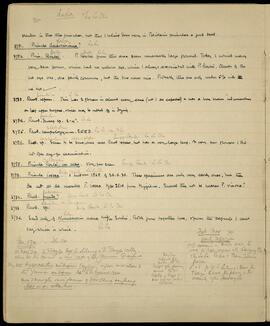
slender in these three primulas, but this I believe does vary in Petiolaris primulas a good deal.

  1. Primula glabra (Genestieriana?) Lo La

  2. Primula lactea (Roylei). P. lactea from this area seem remarkably large flowered. Today I noticed many very dark forms, which had no yellow eye, which I always associated with P. Roylei. Clumps of the no eye one, are fairly common, but the two never mix. Probably there are only under 5% with no eye.

  3. Rhododendron forrestii var. (repens). This has 2 flowers in almost every case (not 1 as expected) & has a loose brown indumentum on leaf upper surface, which may be rubbed off in drying. Lo La

  4. Rhododendron pumilum (Dwarf sp. 2-4"). Lo La

  5. Rhododendron calostrotum (campylogynum). SEED. Lo La near Molo

  6. Rhododendron chaetomallum var. chamaephytum (sp.). Seems to be somewhere near Rhododendron chamaephytum (repens), but has a very large leaf. As very few flowers I did not open any for examination. Sengo Sambu Lo La Chu

  7. Primula Calderiana (Roylei) var. alba. Very few seen. Sengo Sambu Lo La Chu

  8. Primula ioessa. = Ludlow 1868 of 26.6.36. These specimens are only very early ones, but they do not at all resemble P. ioessa type 2514 from Migyitun. Should they not be nearer P. vinosa? Sengo Sambu Lo La Chu

  9. Rhododendron pumilum (fraude?) Sengo Sambu Lo La Chu

  10. Rhododendron lanatum var. luciferum (sp.). Sengo Sambu, Lo La Chu

  11. Seed only of Lilium (Nomocharis) nana and/or Souliei. Both grow together here, from the capsule I can't say which is which. Lo La

No. 17a - Skin set
On May 24. G. Taylor left for Lilung in the Tsangpo Valley where he discovered a new race of the Yunnan Greenfinch.
No. 355 Hypacanthis ambiguus taylori, a form much closer to the Yunnan ambiguus than to the typical race. More & more of the avifauna of S.W. China was forcing itself on our attention.

24th May * Party separates
G.S. remains in Molo area to work the upper reaches of the Langong Chu, Thide La, Lo La, Tsari Sarma passes.
L & T go off to Lilung & down the Tsangpo work the passes in the vicinity of the Dashong La.

They thus separate for the whole of the season & the result is a bigger & more representative collection.